 Add to Chrome
 Add to Firefox
 Add to Edge
Spec-o3: A Tool-Augmented Vision-Language Agent for Rare Celestial Object Candidate Vetting via Automated Spectral Inspection
Jan 10, 2026
Due to the limited generalization and interpretability of deep learning classifiers, The final vetting of rare celestial object candidates still relies on expert visual inspection--a manually intensive process. In this process, astronomers leverage specialized tools to analyze spectra and construct reliable catalogs. However, this practice has become the primary bottleneck, as it is fundamentally incapable of scaling with the data deluge from modern spectroscopic surveys. To bridge this gap, we propose Spec-o3, a tool-augmented vision-language agent that performs astronomer-aligned spectral inspection via interleaved multimodal chain-of-thought reasoning. Spec-o3 is trained with a two-stage post-training recipe: cold-start supervised fine-tuning on expert inspection trajectories followed by outcome-based reinforcement learning on rare-type verification tasks. Evaluated on five rare-object identification tasks from LAMOST, Spec-o3 establishes a new State-of-the-Art, boosting the macro-F1 score from 28.3 to 76.5 with a 7B parameter base model and outperforming both proprietary VLMs and specialized deep models. Crucially, the agent demonstrates strong generalization to unseen inspection tasks across survey shifts (from LAMOST to SDSS/DESI). Expert evaluations confirm that its reasoning traces are coherent and physically consistent, supporting transparent and trustworthy decision-making. Code, data, and models are available at \href{https://github.com/Maxwell-Jia/spec-o3}{Project HomePage}.

FLARE: A Framework for Stellar Flare Forecasting using Stellar Physical Properties and Historical Records
Feb 25, 2025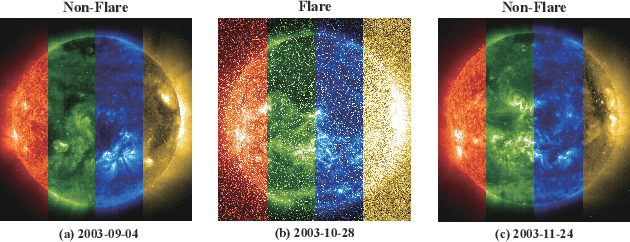
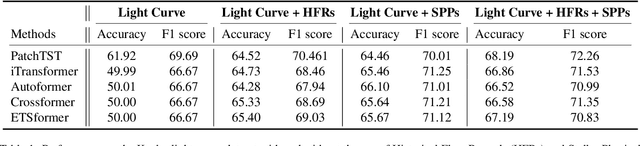
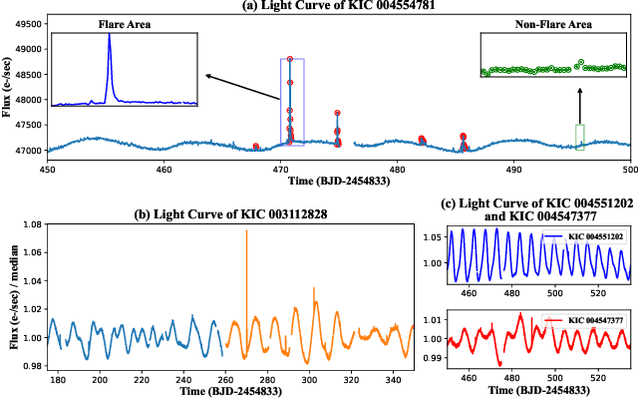
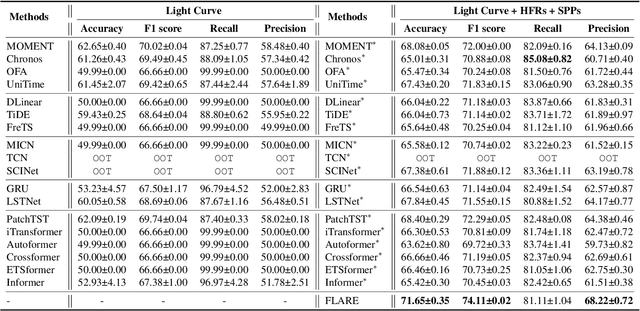
Stellar flare events are critical observational samples for astronomical research; however, recorded flare events remain limited. Stellar flare forecasting can provide additional flare event samples to support research efforts. Despite this potential, no specialized models for stellar flare forecasting have been proposed to date. In this paper, we present extensive experimental evidence demonstrating that both stellar physical properties and historical flare records are valuable inputs for flare forecasting tasks. We then introduce FLARE (Forecasting Light-curve-based Astronomical Records via features Ensemble), the first-of-its-kind large model specifically designed for stellar flare forecasting. FLARE integrates stellar physical properties and historical flare records through a novel Soft Prompt Module and Residual Record Fusion Module. Our experiments on the publicly available Kepler light curve dataset demonstrate that FLARE achieves superior performance compared to other methods across all evaluation metrics. Finally, we validate the forecast capability of our model through a comprehensive case study.