 Add to Chrome
 Add to Firefox
 Add to Edge
High-Fidelity 3D Geometric Reconstruction of Pelvic Organs from MRI: A Hybrid Deep Learning and Iterative Optimization Approach
Jun 16, 2026
Patient-specific 3D reconstruction of pelvic organ geometry from MRI is important for pelvic floor modeling and downstream patient-specific analysis. However, while previous studies have focused primarily on either image segmentation or downstream use of 3D models, the reconstruction of high-fidelity, high-quality geometries remains labor-intensive and poorly standardized. The study introduced a hybrid deformable shape modeling framework that integrates deep learning prediction with iterative optimization for the reconstruction of the bladder, uterus, and rectum. The framework consists of three core components: a geometry-aware multi-level deep learning architecture that preserves topological consistency of pelvic organs; a two-stage amortized optimization training strategy that balances global shape capture and local surface refinement; and a holistic synergy mechanism--where iterative optimization provides supervision for deep learning during the training phase, and during inference, deep learning rapidly predicts the global organ morphology, followed by iterative optimization to refine local surfaces and mesh quality. This framework demonstrated marked superiority in geometric fidelity than current mainstream deep learning-based organ reconstruction models. For individual anatomical structures, the reconstructed 3D geometries for the bladder, rectum, and uterus achieved significantly lower Chamfer Distance values and higher Dice Similarity Coefficient scores. In addition, while maintaining high computational efficiency, the proposed architecture yielded superior overall volumetric mesh quality. At the patient level, the framework achieved higher mean values for the 10 worst elements for both minSICN and minSIGE compared to traditional geometric post-processing algorithms.

PGCD: a position-guied contributive distribution unit for aspect based sentiment analysis
Aug 11, 2021
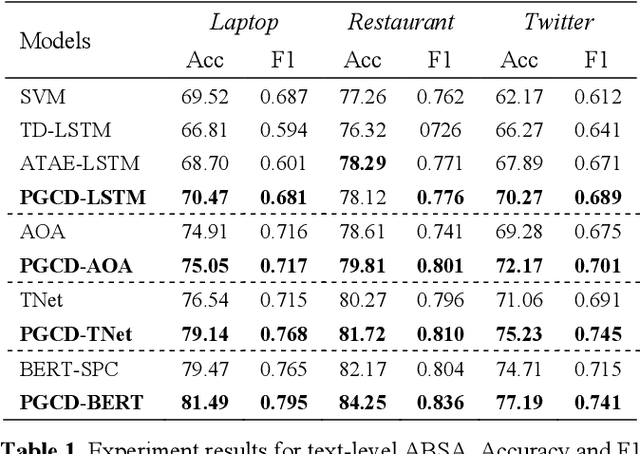
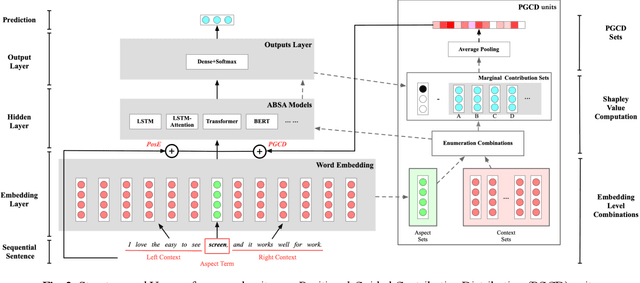
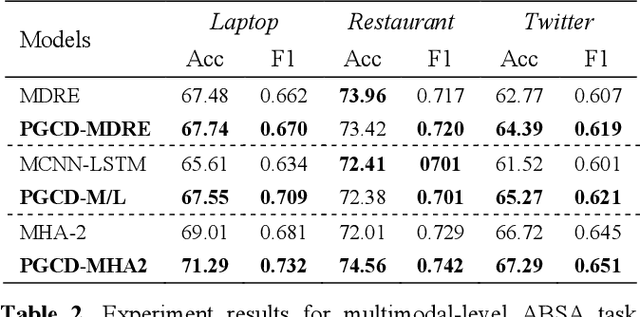
Aspect based sentiment analysis (ABSA), exploring sentim- ent polarity of aspect-given sentence, has drawn widespread applications in social media and public opinion. Previously researches typically derive aspect-independent representation by sentence feature generation only depending on text data. In this paper, we propose a Position-Guided Contributive Distribution (PGCD) unit. It achieves a position-dependent contributive pattern and generates aspect-related statement feature for ABSA task. Quoted from Shapley Value, PGCD can gain position-guided contextual contribution and enhance the aspect-based representation. Furthermore, the unit can be used for improving effects on multimodal ABSA task, whose datasets restructured by ourselves. Extensive experiments on both text and text-audio level using dataset (SemEval) show that by applying the proposed unit, the mainstream models advance performance in accuracy and F1 score.