 Add to Chrome
 Add to Firefox
 Add to Edge
Harvesting AI Computation at the Edge via Generic Approximation
Jun 28, 2026
With the widespread adoption of AI in various IoT scenarios such as smart sensing and processing, AI chips have become a common component at the edge. These chips are typically specialized for structured neural network (NN) processing and are designed to meet peak workload demands. However, they are often underutilized and suffer from considerable computational waste due to temporal or spatial redundancy in processing. Conversely, general-purpose processing engines at the edge may struggle with compute-intensive tasks such as signal processing and complex numerical operations because of stringent resource constraints. To address this imbalance, we propose a framework that harvests unused AI computation resources using general-purpose approximation techniques. The core idea is to automatically convert traditional computing tasks into neural network models via a representative neural architecture search (NAS) method. These approximate versions of general-purpose tasks are then deployed on AI engines during their idle periods. Specifically, we introduce a runtime scheduler that offloads these tasks to AI chips without compromising the performance of primary AI workloads, thereby alleviating the burden on general-purpose processors. Experiments on a representative AIoT processor show that our proposed AI computation harvesting strategy delivers substantial performance improvements across a set of edge processing tasks.

VeriPilot: An LLM-Powered Verilog Debugging Framework
Jun 22, 2026Verilog debugging remains one of the most time-consuming stages in digital circuit design. Recent advances in Large Language Models (LLMs) have enabled automated debugging; however, most existing approaches rely solely on test outputs and compiler feedback in an end-to-end manner, limiting their effectiveness on complex bugs. A key challenge is that the root cause of an error may be far removed from its observable outputs, making it difficult for LLMs to trace long dependency chains in code. This challenge is further exacerbated in large codebases, where long context lengths hinder efficient reasoning. To address these limitations, we propose VeriPilot, an LLM-powered debugging framework that leverages golden reference models to enable fine-grained bug localization and repair. VeriPilot goes beyond output-level comparison by aligning internal variable semantics between the Verilog design and its corresponding golden model through LLM-based analysis. It then performs step-by-step signal tracing using Control-Data-Flow Graphs (CDFGs) derived from static analysis, identifying a minimal set of suspicious code regions along with their correct counterparts from the golden model. These structured insights are subsequently provided to the LLM to guide reasoning and automated code repair. Experimental results on the Comprehensive Verilog Design Problems (CVDP) benchmark from NVIDIA demonstrate that VeriPilot improves the repair success rate of GPT-4o from 54.3\% to 85.71\%, significantly enhancing both bug localization accuracy and repair effectiveness for complex Verilog designs. The source code and benchmark are publicly available at Github https://github.com/YihanWn/VeriPilot.git.
Realtime-VLA FLASH: Speculative Inference Framework for Diffusion-based VLAs
May 13, 2026Diffusion-based vision-language-action models (dVLAs) are promising for embodied intelligence but are fundamentally limited in real-time deployment by the high latency of full inference. We propose Realtime-VLA FLASH, a speculative inference framework that eliminates most full inference calls during replanning by introducing a lightweight draft model with parallel verification via the main model's Action Expert and a phase-aware fallback mechanism that reverts to the full inference pipeline when needed. This design enables low-latency, high-frequency replanning without sacrificing reliability. Experiments show that on LIBERO, FLASH largely preserves task performance by replacing many 58.0 ms full-inference rounds with speculative rounds as fast as 7.8 ms, lowering task-level average inference latency to 19.1 ms (3.04x speedup). We additionally demonstrate effectiveness on real-world conveyor-belt sorting, highlighting its practical impact for latency-critical embodied tasks.
Arcane: An Assertion Reduction Framework through Semantic Clustering and MCTS-Guided Rule Exploring
May 11, 2026Assertion-based Verification (ABV) is essential for ensuring that hardware designs conform to their intended specifications. However, existing automated assertion-generation approaches, such as LLM-based frameworks, often generate large numbers of redundant assertions, which significantly degrade simulation efficiency. To mitigate the simulation overhead caused by redundant assertions, this paper proposes Arcane, an efficient assertion reduction framework. It integrates a two-tier assertion clustering approach for accurate semantic classification of large assertion sets, and employs Monte Carlo Tree Search (MCTS) to explore optimal rule-application sequences for efficient assertion reduction. The experimental results on Assertionbench [20] show that Arcane achieves a reduction of up to 76.2% in the assertion count while fully preserving formal coverage and mutation-detection ability. Further simulation studies demonstrate a speedup of 2.6x to 6.1x speedup in simulation time. The proposed framework is released at https://anonymous.4open.science/r/Arcane1-0A6F/.
RTLSeek: Boosting the LLM-Based RTL Generation with Multi-Stage Diversity-Oriented Reinforcement Learning
Mar 29, 2026Register Transfer Level (RTL) design translates high-level specifications into hardware using HDLs such as Verilog. Although LLM-based RTL generation is promising, the scarcity of functionally verifiable high-quality data limits both accuracy and diversity. Existing post-training typically produces a single HDL implementation per specification, lacking awareness of RTL variations needed for different design goals. We propose RTLSeek, a post-training paradigm that applies rule-based Diversity-Oriented Reinforcement Learning to improve RTL correctness and diversity. Our Diversity-Centric Multi-Objective Reward Scheduling integrates expert knowledge with EDA feedback, and a three-stage framework maximizes the utility of limited data. Experiments on the RTLLM benchmark show that RTLSeek surpasses prior methods, with ablation results confirming that encouraging broader design-space exploration improves RTL quality and achieves the principle of "the more generated, the better results." Implementation framework, including the dataset, source code, and model weights, is shown at https://anonymous.4open.science/r/DAC2026ID71-ACB4/.
From Buffers to Registers: Unlocking Fine-Grained FlashAttention with Hybrid-Bonded 3D NPU Co-Design
Feb 11, 2026Transformer-based models dominate modern AI workloads but exacerbate memory bottlenecks due to their quadratic attention complexity and ever-growing model sizes. Existing accelerators, such as Groq and Cerebras, mitigate off-chip traffic with large on-chip caches, while algorithmic innovations such as FlashAttention fuse operators to avoid materializing large attention matrices. However, as off-chip traffic decreases, our measurements show that on-chip SRAM accesses account for over 60% of energy in long-sequence workloads, making cache access the new bottleneck. We propose 3D-Flow, a hybrid-bonded, 3D-stacked spatial accelerator that enables register-to-register communication across vertically partitioned PE tiers. Unlike 2D multi-array architectures limited by NoC-based router-to-router transfers, 3D-Flow leverages sub-10 um vertical TSVs to sustain cycle-level operator pipelining with minimal overhead. On top of this architecture, we design 3D-FlashAttention, a fine-grained scheduling method that balances latency across tiers, forming a bubble-free vertical dataflow without on-chip SRAM roundtrips. Evaluations on Transformer workloads (OPT and QWEN models) show that our 3D spatial accelerator reduces 46-93% energy consumption and achieves 1.4x-7.6x speedups compared to state-of-the-art 2D and 3D designs.
Understanding and Mitigating Errors of LLM-Generated RTL Code
Aug 07, 2025Despite the promising potential of large language model (LLM) based register-transfer-level (RTL) code generation, the overall success rate remains unsatisfactory. Errors arise from various factors, with limited understanding of specific failure causes hindering improvement. To address this, we conduct a comprehensive error analysis and manual categorization. Our findings reveal that most errors stem not from LLM reasoning limitations, but from insufficient RTL programming knowledge, poor understanding of circuit concepts, ambiguous design descriptions, or misinterpretation of complex multimodal inputs. Leveraging in-context learning, we propose targeted error correction techniques. Specifically, we construct a domain-specific knowledge base and employ retrieval-augmented generation (RAG) to supply necessary RTL knowledge. To mitigate ambiguity errors, we introduce design description rules and implement a rule-checking mechanism. For multimodal misinterpretation, we integrate external tools to convert inputs into LLM-compatible meta-formats. For remaining errors, we adopt an iterative debugging loop (simulation-error localization-correction). Integrating these techniques into an LLM-based framework significantly improves performance. We incorporate these error correction techniques into a foundational LLM-based RTL code generation framework, resulting in significantly improved performance. Experimental results show that our enhanced framework achieves 91.0\% accuracy on the VerilogEval benchmark, surpassing the baseline code generation approach by 32.7\%, demonstrating the effectiveness of our methods.
PAPI: Exploiting Dynamic Parallelism in Large Language Model Decoding with a Processing-In-Memory-Enabled Computing System
Feb 21, 2025Large language models (LLMs) are widely used for natural language understanding and text generation. An LLM model relies on a time-consuming step called LLM decoding to generate output tokens. Several prior works focus on improving the performance of LLM decoding using parallelism techniques, such as batching and speculative decoding. State-of-the-art LLM decoding has both compute-bound and memory-bound kernels. Some prior works statically identify and map these different kernels to a heterogeneous architecture consisting of both processing-in-memory (PIM) units and computation-centric accelerators. We observe that characteristics of LLM decoding kernels (e.g., whether or not a kernel is memory-bound) can change dynamically due to parameter changes to meet user and/or system demands, making (1) static kernel mapping to PIM units and computation-centric accelerators suboptimal, and (2) one-size-fits-all approach of designing PIM units inefficient due to a large degree of heterogeneity even in memory-bound kernels. In this paper, we aim to accelerate LLM decoding while considering the dynamically changing characteristics of the kernels involved. We propose PAPI (PArallel Decoding with PIM), a PIM-enabled heterogeneous architecture that exploits dynamic scheduling of compute-bound or memory-bound kernels to suitable hardware units. PAPI has two key mechanisms: (1) online kernel characterization to dynamically schedule kernels to the most suitable hardware units at runtime and (2) a PIM-enabled heterogeneous computing system that harmoniously orchestrates both computation-centric processing units and hybrid PIM units with different computing capabilities. Our experimental results on three broadly-used LLMs show that PAPI achieves 1.8$\times$ and 11.1$\times$ speedups over a state-of-the-art heterogeneous LLM accelerator and a state-of-the-art PIM-only LLM accelerator, respectively.
A Fully Hardware Implemented Accelerator Design in ReRAM Analog Computing without ADCs
Dec 27, 2024Emerging ReRAM-based accelerators process neural networks via analog Computing-in-Memory (CiM) for ultra-high energy efficiency. However, significant overhead in peripheral circuits and complex nonlinear activation modes constrain system energy efficiency improvements. This work explores the hardware implementation of the Sigmoid and SoftMax activation functions of neural networks with stochastically binarized neurons by utilizing sampled noise signals from ReRAM devices to achieve a stochastic effect. We propose a complete ReRAM-based Analog Computing Accelerator (RACA) that accelerates neural network computation by leveraging stochastically binarized neurons in combination with ReRAM crossbars. The novel circuit design removes significant sources of energy/area efficiency degradation, i.e., the Digital-to-Analog and Analog-to-Digital Converters (DACs and ADCs) as well as the components to explicitly calculate the activation functions. Experimental results show that our proposed design outperforms traditional architectures across all overall performance metrics without compromising inference accuracy.
OpenLS-DGF: An Adaptive Open-Source Dataset Generation Framework for Machine Learning Tasks in Logic Synthesis
Nov 16, 2024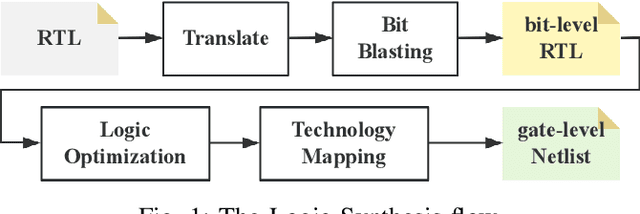
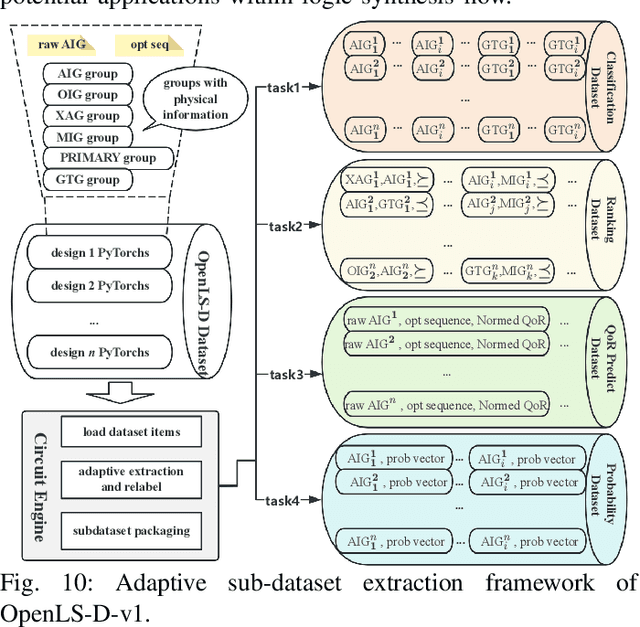
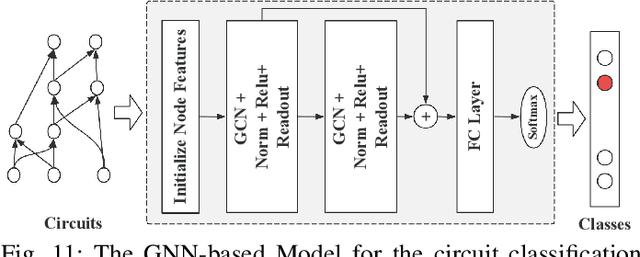
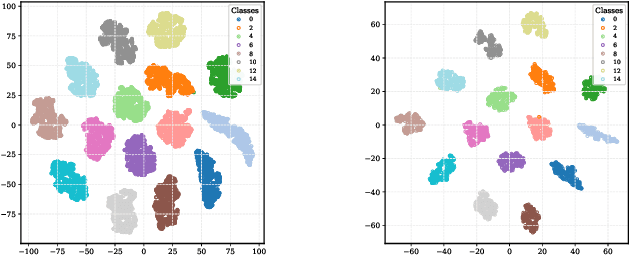
This paper introduces OpenLS-DGF, an adaptive logic synthesis dataset generation framework, to enhance machine learning~(ML) applications within the logic synthesis process. Previous dataset generation flows were tailored for specific tasks or lacked integrated machine learning capabilities. While OpenLS-DGF supports various machine learning tasks by encapsulating the three fundamental steps of logic synthesis: Boolean representation, logic optimization, and technology mapping. It preserves the original information in both Verilog and machine-learning-friendly GraphML formats. The verilog files offer semi-customizable capabilities, enabling researchers to insert additional steps and incrementally refine the generated dataset. Furthermore, OpenLS-DGF includes an adaptive circuit engine that facilitates the final dataset management and downstream tasks. The generated OpenLS-D-v1 dataset comprises 46 combinational designs from established benchmarks, totaling over 966,000 Boolean circuits. OpenLS-D-v1 supports integrating new data features, making it more versatile for new challenges. This paper demonstrates the versatility of OpenLS-D-v1 through four distinct downstream tasks: circuit classification, circuit ranking, quality of results (QoR) prediction, and probability prediction. Each task is chosen to represent essential steps of logic synthesis, and the experimental results show the generated dataset from OpenLS-DGF achieves prominent diversity and applicability. The source code and datasets are available at https://github.com/Logic-Factory/ACE/blob/master/OpenLS-DGF/readme.md.