 Add to Chrome
 Add to Firefox
 Add to Edge
A Tilt-Rotor UAV with a Gripper for Stable Contact-Based Tasks via Environmental Anchoring
Aug 03, 2026
Maintaining a stable pose during physical interaction is a significant challenge for aerial robots, often limiting their use in contact-based tasks. This paper presents a novel uncrewed aerial vehicle (UAV) platform designed to transition from unconstrained flight to a stable, constrained work platform via environmental anchoring. Our system comprises: 1) a multirotor with a tilt-rotor mechanism that decouples pitch from forward motion, enabling stable hover at non-zero pitch angles, and 2) a novel underactuated, cable-driven, prismatic gripper featuring compliance to adapt to irregular geometries, designed to stabilize the UAV by anchoring it to its environment. We present the design and prototyping of the complete system and validate its performance through a series of real-robot flight tests. Results demonstrate that anchoring significantly improves stability for interaction tasks, reducing positional drift RMSE by over 95% compared to a free-flight baseline, even under windy conditions. The anchored system can withstand longitudinal reaction forces up to 75N while maintaining a stable pose. Furthermore, across a range of target geometries and orientations, the system demonstrated consistent stability with a positional drift RMSE that never exceeded 3mm. These results establish the viability of our approach for complex physical interaction tasks, such as sampling tree health by drilling or sensor installation in hard-to-reach locations. Watch our UAV at: https://youtu.be/HDQ8S4ZW3Ls

VistaVLA: Geometry- and Semantic-Aware 3D Gaussian-Grounded VLA for Robotic Manipulation
Jul 14, 2026Vision-Language-Action (VLA) models have emerged as a powerful end-to-end paradigm for robotic manipulation by mapping language instructions and 2D visual inputs directly to actions. However, these models lack an explicit, scene-level 3D representation, limiting their ability to reason over spatial layouts and geometric constraints. While recent efforts incorporate explicit 3D cues, such as depth maps or point clouds, to improve geometric awareness, they primarily capture low-level structures and lack high-level semantic grounding in 3D space. In human cognition, interaction with the physical world relies on a 3D semantic cognitive map - an internal mental model that integrates spatial layouts with semantic context to enable persistent, viewpoint-invariant reasoning. In light of this, we present VistaVLA, a novel two-stage framework that constructs a geometry- and semantics-aware 3D cognitive representation from 3D Gaussian primitives and grounds it as compact context tokens for VLA policy learning. Specifically, VistaVLA lifts multi-view vision-language features into 3D Gaussian primitives, forming geometry-anchored semantic tokens that align view-consistent spatial grounding with 2D visual feature spaces. To make this 3D representation computationally tractable for effective VLA control, we introduce Merge-then-Query (MtQ), a token summarization mechanism. MtQ compresses dense Gaussian primitives into a highly compact set of spatially informative tokens, achieving a 99% token reduction while preserving action-relevant 3D layouts and semantic context. Extensive evaluations in both simulated and real-world environments demonstrate the effectiveness of VistaVLA. Notably, in real-world scenarios, VistaVLA improves success rates by 22.8% across seven real-world tasks and by 30.0% over the VLA-Adapter baseline on challenging out-of-distribution tasks.
EAGOR: Embodied Reasoning in Omni-direction
Jul 07, 2026Omni-directional (360°) cameras provide embodied agents with a holistic view of their surroundings, making them suited for directional reasoning in tasks such as navigation and object search. Existing Vision Language Models (VLMs) project 360° observations to 2D equirectangular projection (ERP) images and process them using architectures designed for perspective images. However, they ignore the spherical nature of 360° observations, where each pixel represents a viewing direction relative to the agent. Consequently, their direction estimates often become inconsistent under camera view transformations caused by agent motion. This limitation is particularly critical for map-free navigation, where the agent must continuously estimate the target direction in its egocentric frame. We propose EAGOR, a training-free, geometry-aware framework for embodied 360° directional reasoning. Instead of predicting target directions as ERP image coordinates, EAGOR formulates directional reasoning as recursive Bayesian estimation directly on the sphere. It maintains a continuous belief over target directions and propagates it equivariantly under agent motion without training the backbone VLMs. To achieve this, we introduce the Spherical Harmonic Belief Field (SH-BF), whose spherical harmonic representation provides a globally defined, rotation-aware basis for directional estimation on the spherical manifold. This formulation eliminates ERP seam discontinuities, latitude distortions, and interpolation errors. We evaluate EAGOR on two benchmark datasets and real-world experiments with a legged robot across directional reasoning tasks. EAGOR consistently outperforms existing methods, achieving average relative gains of +34.4% and +45.6% on HOS and OSR-Bench, respectively, while improving navigation success by +14.6%, reducing step count by 17.7%, and lowering mean angular error by 24.5%.
Robots as Tokens: Unified Diffusion Transformer for Coordinated Multi-Robot Trajectory Generation
Jun 14, 2026The success of generative models in language and visual generation has inspired extensive applications to generative robot planning. However, most existing works either focus on single-robot planning, or generate multi-robot trajectories in a sequential manner with iterative post-processing to resolve inter-robot conflicts. In this work, we investigate whether coordinated multi-robot trajectories, as a special spatiotemporal distribution, can be learned and generated with a generative model in a feed-forward manner. We propose Robots as Tokens (Roken), a unified diffusion transformer that directly generates multi-robot trajectories that satisfy both (individual) safety and (global) connectivity constraints. The core design of Roken is to represent each robot as a discrete token, allowing them to naturally interact with each other through self-attention, and cross-attend to map tokens for environment layouts. We further introduce several auxiliary tasks based on Bayes' theorem to provide multi-scale spatial-temporal supervision for efficient learning of the conditional distribution. In training, Roken absorbs diverse expert trajectories from different team sizes. During inference, Roken behaves as a versatile multi-robot planner that can handle single-robot planning, coordinated multi-robot trajectory generation, and conditional trajectory generation by fixing some robot tokens as conditions. Experiments in diverse cluttered environments show that Roken can generate coordinated multi-robot trajectories to perform connectivity-constrained goal navigation tasks with high success rates, outperforming the baseline method used to generate the training dataset. Roken also demonstrates good scalability after training with mixed team sizes, and shows generalization to unseen or partially observed environments, verifying its potential to learn from diverse data and perform versatile tasks.
IntentNav: Learning Spatial-Visual Object Navigation from Human Demonstrations
Jun 06, 2026Object navigation requires a robot to search for an unobserved target in an unknown environment by deciding where to explore next under partial observability. Effective search resembles human-like exploration: selectively probing visually promising frontiers while relying on spatial memory to avoid redundant revisits. We propose IntentNav, a spatial-visual imitation framework that learns human-like ObjectNav policies from human demonstrations. To infer high-level search intent from low-level human actions, we introduce Frontier-based Human-Intent Labeling, which looks ahead in human demonstrations and labels the frontier that best explains the demonstrator's future search direction. We construct a spatial-visual candidate space, where BEV memory tracks explored regions, unexplored frontiers, and trajectory history, while egocentric visual memory provides semantic cues for each candidate. A VLM policy is trained to select among these grounded candidates, using Intent-Aligned Objective to encourage consistent and human-like exploration. IntentNav achieves state-of-the-art performance on the MP3D, HM3D-v1 and HM3D-v2 ObjectNav benchmarks. The proposed candidate-level navigation interface transfers zero-shot to wheeled, quadruped, and humanoid robots without further VLM fine-tuning. \href{https://anonymous.4open.science/w/IntentNav/}{Project page}.
Line-of-Sight-Constrained Multi-Robot Mapless Navigation via Polygonal Visible Regions
Mar 27, 2026Multi-robot systems rely on underlying connectivity to ensure reliable communication and timely coordination. This paper studies the line-of-sight (LoS) connectivity maintenance problem in multi-robot navigation with unknown obstacles. Prior works typically assume known environment maps to formulate LoS constraints between robots, which hinders their practical deployment. To overcome this limitation, we propose an inherently distributed approach where each robot only constructs an egocentric visible region based on its real-time LiDAR scans, instead of endeavoring to build a global map online. The individual visible regions are shared through distributed communication to establish inter-robot LoS constraints, which are then incorporated into a multi-robot navigation framework to ensure LoS-connectivity. Moreover, we enhance the robustness of connectivity maintenance by proposing a more accurate LoS-distance metric, which further enables flexible topology optimization that eliminates redundant and effort-demanding connections. The proposed framework is evaluated through extensive multi-robot navigation and exploration tasks in both simulation and real-world experiments. Results show that it reliably maintains LoS-connectivity between robots in challenging environments cluttered with obstacles, even under large visible ranges and fragile minimal topologies, where existing methods consistently fail. Ablation studies also reveal that topology optimization boosts navigation efficiency by around $20\%$, demonstrating the framework's potential for efficient navigation under connectivity constraints.
Beyond Imitation: Reinforcement Learning Fine-Tuning for Adaptive Diffusion Navigation Policies
Mar 13, 2026Diffusion-based robot navigation policies trained on large-scale imitation learning datasets, can generate multi-modal trajectories directly from the robot's visual observations, bypassing the traditional localization-mapping-planning pipeline and achieving strong zero-shot generalization. However, their performance remains constrained by the coverage of offline datasets, and when deployed in unseen settings, distribution shift often leads to accumulated trajectory errors and safety-critical failures. Adapting diffusion policies with reinforcement learning is challenging because their iterative denoising structure hinders effective gradient backpropagation, while also making the training of an additional value network computationally expensive and less stable. To address these issues, we propose a reinforcement learning fine-tuning framework tailored for diffusion-based navigation. The method leverages the inherent multi-trajectory sampling mechanism of diffusion models and adopts Group Relative Policy Optimization (GRPO), which estimates relative advantages across sampled trajectories without requiring a separate value network. To preserve pretrained representations while enabling adaptation, we freeze the visual encoder and selectively update the higher decoder layers and action head, enhancing safety-aware behaviors through online environmental feedback. On the PointGoal task in Isaac Sim, our approach improves the Success Rate from 52.0% to 58.7% and SPL from 0.49 to 0.54 on unseen scenes, while reducing collision frequency. Additional experiments show that the fine-tuned policy transfers zero-shot to a real quadruped platform and maintains stable performance in geometrically out-of-distribution environments, suggesting improved adaptability and safe generalization to new domains.
CL-CoTNav: Closed-Loop Hierarchical Chain-of-Thought for Zero-Shot Object-Goal Navigation with Vision-Language Models
Apr 11, 2025Visual Object Goal Navigation (ObjectNav) requires a robot to locate a target object in an unseen environment using egocentric observations. However, decision-making policies often struggle to transfer to unseen environments and novel target objects, which is the core generalization problem. Traditional end-to-end learning methods exacerbate this issue, as they rely on memorizing spatial patterns rather than employing structured reasoning, limiting their ability to generalize effectively. In this letter, we introduce Closed-Loop Hierarchical Chain-of-Thought Navigation (CL-CoTNav), a vision-language model (VLM)-driven ObjectNav framework that integrates structured reasoning and closed-loop feedback into navigation decision-making. To enhance generalization, we fine-tune a VLM using multi-turn question-answering (QA) data derived from human demonstration trajectories. This structured dataset enables hierarchical Chain-of-Thought (H-CoT) prompting, systematically extracting compositional knowledge to refine perception and decision-making, inspired by the human cognitive process of locating a target object through iterative reasoning steps. Additionally, we propose a Closed-Loop H-CoT mechanism that incorporates detection and reasoning confidence scores into training. This adaptive weighting strategy guides the model to prioritize high-confidence data pairs, mitigating the impact of noisy inputs and enhancing robustness against hallucinated or incorrect reasoning. Extensive experiments in the AI Habitat environment demonstrate CL-CoTNav's superior generalization to unseen scenes and novel object categories. Our method consistently outperforms state-of-the-art approaches in navigation success rate (SR) and success weighted by path length (SPL) by 22.4\%. We release our datasets, models, and supplementary videos on our project page.
Realm: Real-Time Line-of-Sight Maintenance in Multi-Robot Navigation with Unknown Obstacles
Feb 21, 2025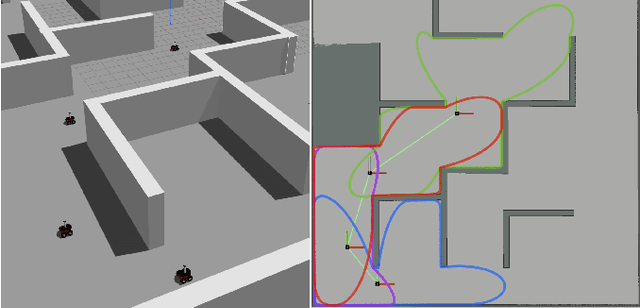
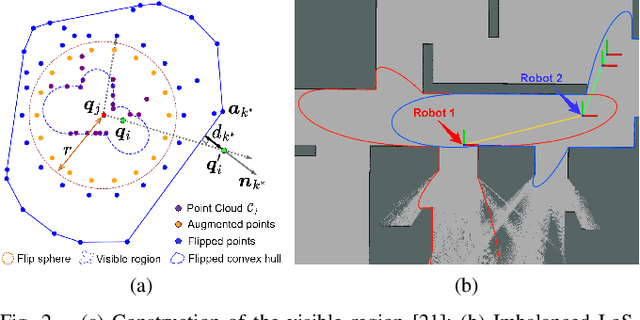
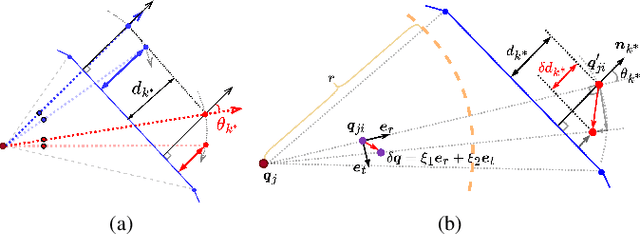
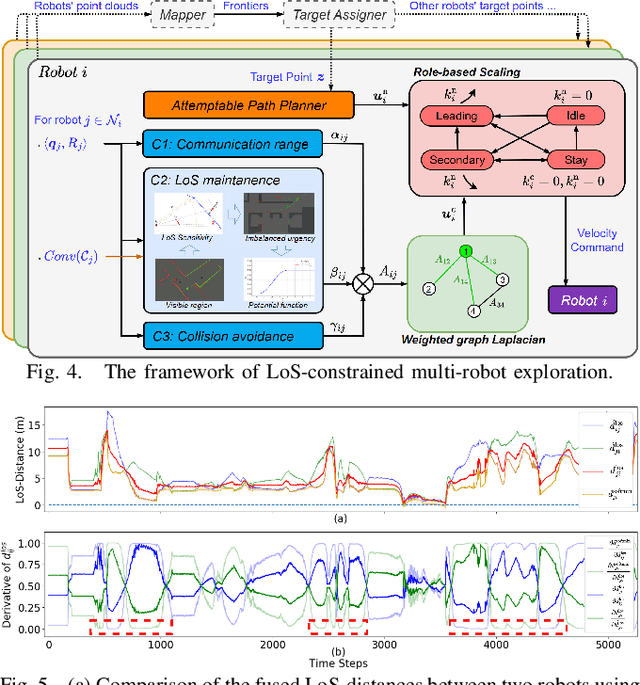
Multi-robot navigation in complex environments relies on inter-robot communication and mutual observations for coordination and situational awareness. This paper studies the multi-robot navigation problem in unknown environments with line-of-sight (LoS) connectivity constraints. While previous works are limited to known environment models to derive the LoS constraints, this paper eliminates such requirements by directly formulating the LoS constraints between robots from their real-time point cloud measurements, leveraging point cloud visibility analysis techniques. We propose a novel LoS-distance metric to quantify both the urgency and sensitivity of losing LoS between robots considering potential robot movements. Moreover, to address the imbalanced urgency of losing LoS between two robots, we design a fusion function to capture the overall urgency while generating gradients that facilitate robots' collaborative movement to maintain LoS. The LoS constraints are encoded into a potential function that preserves the positivity of the Fiedler eigenvalue of the robots' network graph to ensure connectivity. Finally, we establish a LoS-constrained exploration framework that integrates the proposed connectivity controller. We showcase its applications in multi-robot exploration in complex unknown environments, where robots can always maintain the LoS connectivity through distributed sensing and communication, while collaboratively mapping the unknown environment. The implementations are open-sourced at https://github.com/bairuofei/LoS_constrained_navigation.
Multi-Robot Reliable Navigation in Uncertain Topological Environments with Graph Attention Networks
Nov 25, 2024


This paper studies the multi-robot reliable navigation problem in uncertain topological networks, which aims at maximizing the robot team's on-time arrival probabilities in the face of road network uncertainties. The uncertainty in these networks stems from the unknown edge traversability, which is only revealed to the robot upon its arrival at the edge's starting node. Existing approaches often struggle to adapt to real-time network topology changes, making them unsuitable for varying topological environments. To address the challenge, we reformulate the problem into a Partially Observable Markov Decision Process (POMDP) framework and introduce the Dynamic Adaptive Graph Embedding method to capture the evolving nature of the navigation task. We further enhance each robot's policy learning process by integrating deep reinforcement learning with Graph Attention Networks (GATs), leveraging self-attention to focus on critical graph features. The proposed approach, namely Multi-Agent Routing in Variable Environments with Learning (MARVEL) employs the generalized policy gradient algorithm to optimize the robots' real-time decision-making process iteratively. We compare the performance of MARVEL with state-of-the-art reliable navigation algorithms as well as Canadian traveller problem solutions in a range of canonical transportation networks, demonstrating improved adaptability and performance in uncertain topological networks. Additionally, real-world experiments with two robots navigating within a self-constructed indoor environment with uncertain topological structures demonstrate MARVEL's practicality.