 Add to Chrome
 Add to Firefox
 Add to Edge
A Virtual Machine for Arbitrary Low-Precision GPGPU Computation in LLM Serving
Apr 17, 2025
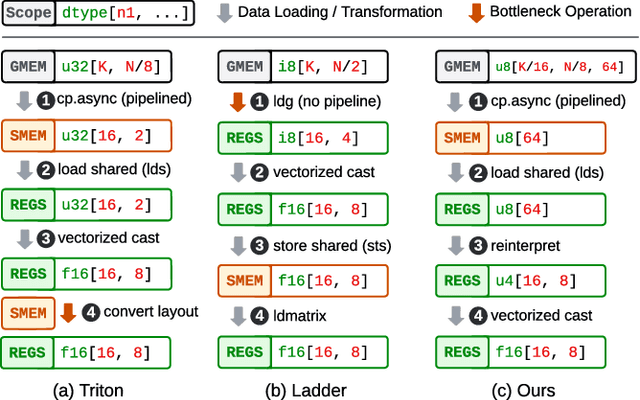
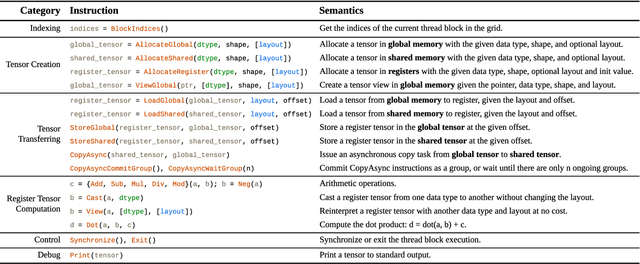
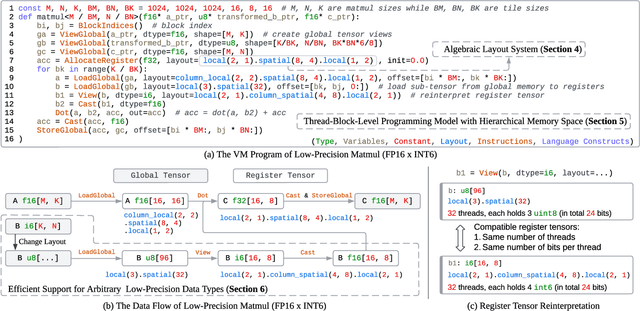
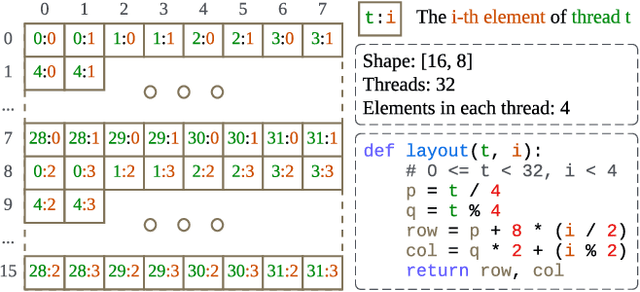
Serving Large Language Models (LLMs) is critical for AI-powered applications but demands substantial computational resources, particularly in memory bandwidth and computational throughput. Low-precision computation has emerged as a key technique to improve efficiency while reducing resource consumption. Existing approaches for generating low-precision kernels are limited to weight bit widths that are powers of two and suffer from suboptimal performance due to high-level GPU programming abstractions. These abstractions restrict critical optimizations, such as fine-grained register management and optimized memory access patterns, which are essential for efficient low-precision computations. In this paper, we introduce a virtual machine (VM) designed for General-Purpose GPU (GPGPU) computing, enabling support for low-precision data types with arbitrary bit widths while maintaining GPU programmability. The proposed VM features a thread-block-level programming model, a hierarchical memory space, a novel algebraic layout system, and extensive support for diverse low-precision data types. VM programs are compiled into highly efficient GPU programs with automatic vectorization and instruction selection. Extensive experiments demonstrate that our VM efficiently supports a full spectrum of low-precision data types, and outperforms state-of-the-art low-precision kernels on their supported types. Compared to existing compilers like Triton and Ladder, as well as hand-optimized kernels such as QuantLLM and Marlin, our VM achieves performance improvements of 1.75x, 2.61x, 1.29x and 1.03x, respectively.

From Gaze to Insight: Bridging Human Visual Attention and Vision Language Model Explanation for Weakly-Supervised Medical Image Segmentation
Apr 15, 2025Medical image segmentation remains challenging due to the high cost of pixel-level annotations for training. In the context of weak supervision, clinician gaze data captures regions of diagnostic interest; however, its sparsity limits its use for segmentation. In contrast, vision-language models (VLMs) provide semantic context through textual descriptions but lack the explanation precision required. Recognizing that neither source alone suffices, we propose a teacher-student framework that integrates both gaze and language supervision, leveraging their complementary strengths. Our key insight is that gaze data indicates where clinicians focus during diagnosis, while VLMs explain why those regions are significant. To implement this, the teacher model first learns from gaze points enhanced by VLM-generated descriptions of lesion morphology, establishing a foundation for guiding the student model. The teacher then directs the student through three strategies: (1) Multi-scale feature alignment to fuse visual cues with textual semantics; (2) Confidence-weighted consistency constraints to focus on reliable predictions; (3) Adaptive masking to limit error propagation in uncertain areas. Experiments on the Kvasir-SEG, NCI-ISBI, and ISIC datasets show that our method achieves Dice scores of 80.78%, 80.53%, and 84.22%, respectively-improving 3-5% over gaze baselines without increasing the annotation burden. By preserving correlations among predictions, gaze data, and lesion descriptions, our framework also maintains clinical interpretability. This work illustrates how integrating human visual attention with AI-generated semantic context can effectively overcome the limitations of individual weak supervision signals, thereby advancing the development of deployable, annotation-efficient medical AI systems. Code is available at: https://github.com/jingkunchen/FGI.git.
Unified Generative Search and Recommendation
Apr 10, 2025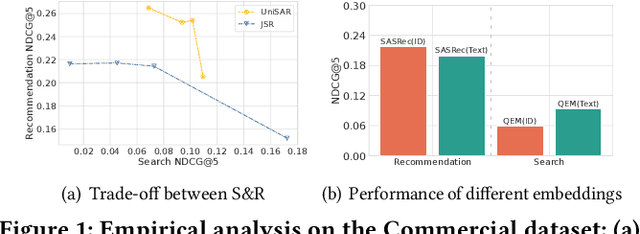
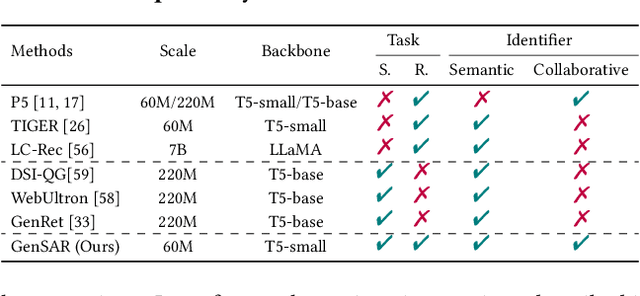
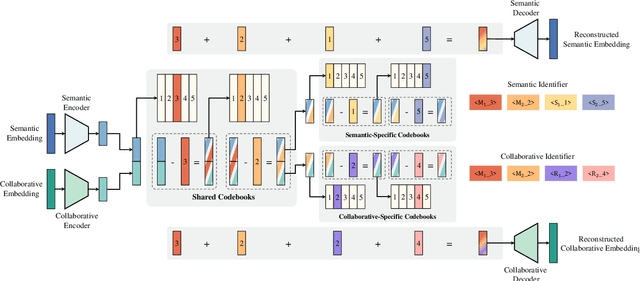

Modern commercial platforms typically offer both search and recommendation functionalities to serve diverse user needs, making joint modeling of these tasks an appealing direction. While prior work has shown that integrating search and recommendation can be mutually beneficial, it also reveals a performance trade-off: enhancements in one task often come at the expense of the other. This challenge arises from their distinct information requirements: search emphasizes semantic relevance between queries and items, whereas recommendation depends more on collaborative signals among users and items. Effectively addressing this trade-off requires tackling two key problems: (1) integrating both semantic and collaborative signals into item representations, and (2) guiding the model to distinguish and adapt to the unique demands of search and recommendation. The emergence of generative retrieval with Large Language Models (LLMs) presents new possibilities. This paradigm encodes items as identifiers and frames both search and recommendation as sequential generation tasks, offering the flexibility to leverage multiple identifiers and task-specific prompts. In light of this, we introduce GenSAR, a unified generative framework for balanced search and recommendation. Our approach designs dual-purpose identifiers and tailored training strategies to incorporate complementary signals and align with task-specific objectives. Experiments on both public and commercial datasets demonstrate that GenSAR effectively reduces the trade-off and achieves state-of-the-art performance on both tasks.
Falcon: Fractional Alternating Cut with Overcoming Minima in Unsupervised Segmentation
Apr 08, 2025Today's unsupervised image segmentation algorithms often segment suboptimally. Modern graph-cut based approaches rely on high-dimensional attention maps from Transformer-based foundation models, typically employing a relaxed Normalized Cut solved recursively via the Fiedler vector (the eigenvector of the second smallest eigenvalue). Consequently, they still lag behind supervised methods in both mask generation speed and segmentation accuracy. We present a regularized fractional alternating cut (Falcon), an optimization-based K-way Normalized Cut without relying on recursive eigenvector computations, achieving substantially improved speed and accuracy. Falcon operates in two stages: (1) a fast K-way Normalized Cut solved by extending into a fractional quadratic transformation, with an alternating iterative procedure and regularization to avoid local minima; and (2) refinement of the resulting masks using complementary low-level information, producing high-quality pixel-level segmentations. Experiments show that Falcon not only surpasses existing state-of-the-art methods by an average of 2.5% across six widely recognized benchmarks (reaching up to 4.3\% improvement on Cityscapes), but also reduces runtime by around 30% compared to prior graph-based approaches. These findings demonstrate that the semantic information within foundation-model attention can be effectively harnessed by a highly parallelizable graph cut framework. Consequently, Falcon can narrow the gap between unsupervised and supervised segmentation, enhancing scalability in real-world applications and paving the way for dense prediction-based vision pre-training in various downstream tasks. The code is released in https://github.com/KordingLab/Falcon.
PipeDec: Low-Latency Pipeline-based Inference with Dynamic Speculative Decoding towards Large-scale Models
Apr 05, 2025Autoregressive large language model inference primarily consists of two stages: pre-filling and decoding. Decoding involves sequential computation for each token, which leads to significant latency. Speculative decoding is a technique that leverages the draft model combined with large model verification to enhance parallelism without sacrificing accuracy. However, existing external prediction methods face challenges in adapting to multi-node serial deployments. While they can maintain speedup under such conditions, the high latency of multi-node deployments ultimately results in low overall efficiency. We propose a speculative decoding framework named PipeDec to address the low global resource utilization of single tasks in pipeline deployments thereby reducing decoding latency. We integrate a draft model into the pipeline of the large model and immediately forward each prediction from the draft model to subsequent pipeline stages. A dynamic prediction tree manages prediction sequences across nodes, enabling efficient updating and pruning. This approach leverages the draft model's predictions to utilize all pipeline nodes for parallel decoding of a single task. Experiments were conducted using LLama3.2 1B as the draft model in conjunction with a 14-stage parallel pipeline to accelerate LLama3.1 70B by six different types of datasets. During the decoding phase of a single task, PipeDec achieved a 4.46x-7.79x speedup compared to traditional pipeline parallelism and a 2.2x-2.69x speedup compared to baseline tree-based speculative decoding methods. The code will be released after the review process.
LightPROF: A Lightweight Reasoning Framework for Large Language Model on Knowledge Graph
Apr 04, 2025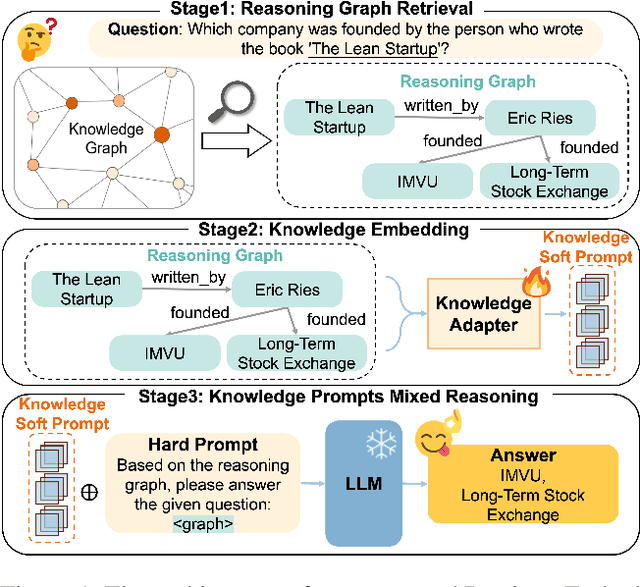
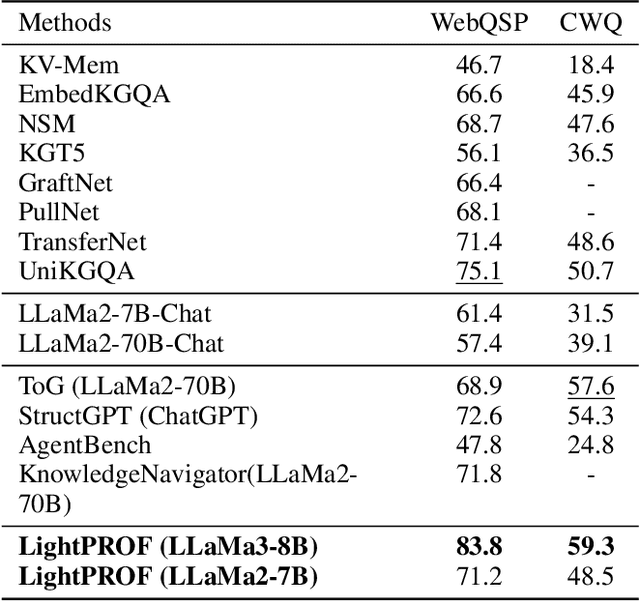
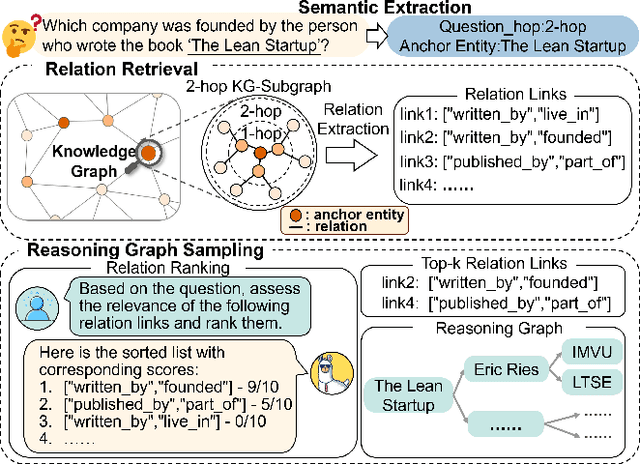
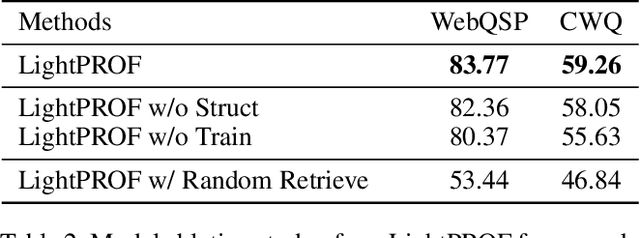
Large Language Models (LLMs) have impressive capabilities in text understanding and zero-shot reasoning. However, delays in knowledge updates may cause them to reason incorrectly or produce harmful results. Knowledge Graphs (KGs) provide rich and reliable contextual information for the reasoning process of LLMs by structurally organizing and connecting a wide range of entities and relations. Existing KG-based LLM reasoning methods only inject KGs' knowledge into prompts in a textual form, ignoring its structural information. Moreover, they mostly rely on close-source models or open-source models with large parameters, which poses challenges to high resource consumption. To address this, we propose a novel Lightweight and efficient Prompt learning-ReasOning Framework for KGQA (LightPROF), which leverages the full potential of LLMs to tackle complex reasoning tasks in a parameter-efficient manner. Specifically, LightPROF follows a "Retrieve-Embed-Reason process", first accurately, and stably retrieving the corresponding reasoning graph from the KG through retrieval module. Next, through a Transformer-based Knowledge Adapter, it finely extracts and integrates factual and structural information from the KG, then maps this information to the LLM's token embedding space, creating an LLM-friendly prompt to be used by the LLM for the final reasoning. Additionally, LightPROF only requires training Knowledge Adapter and can be compatible with any open-source LLM. Extensive experiments on two public KGQA benchmarks demonstrate that LightPROF achieves superior performance with small-scale LLMs. Furthermore, LightPROF shows significant advantages in terms of input token count and reasoning time.
PIONM: A Generalized Approach to Solving Density-Constrained Mean-Field Games Equilibrium under Modified Boundary Conditions
Apr 04, 2025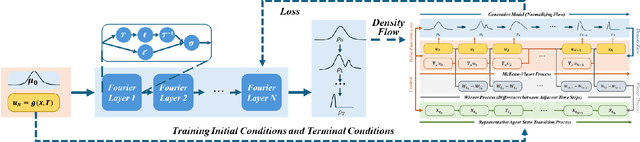
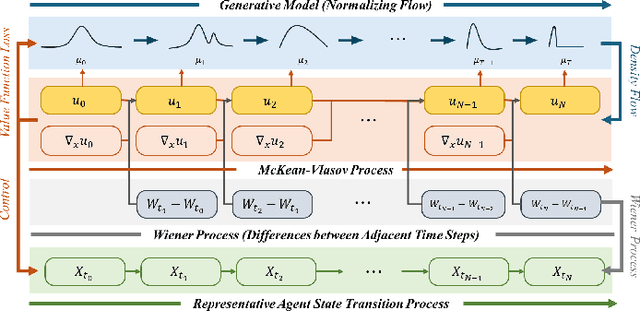
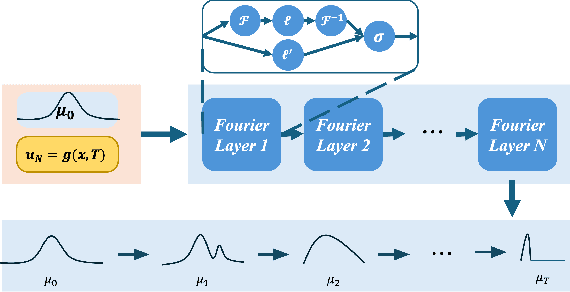
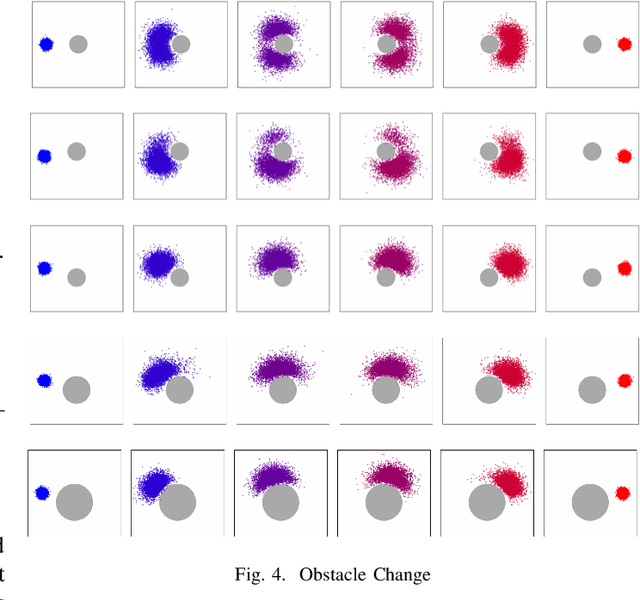
Neural network-based methods are effective for solving equilibria in Mean-Field Games (MFGs), particularly in high-dimensional settings. However, solving the coupled partial differential equations (PDEs) in MFGs limits their applicability since solving coupled PDEs is computationally expensive. Additionally, modifying boundary conditions, such as the initial state distribution or terminal value function, necessitates extensive retraining, reducing scalability. To address these challenges, we propose a generalized framework, PIONM (Physics-Informed Neural Operator NF-MKV Net), which leverages physics-informed neural operators to solve MFGs equations. PIONM utilizes neural operators to compute MFGs equilibria for arbitrary boundary conditions. The method encodes boundary conditions as input features and trains the model to align them with density evolution, modeled using discrete-time normalizing flows. Once trained, the algorithm efficiently computes the density distribution at any time step for modified boundary condition, ensuring efficient adaptation to different boundary conditions in MFGs equilibria. Unlike traditional MFGs methods constrained by fixed coefficients, PIONM efficiently computes equilibria under varying boundary conditions, including obstacles, diffusion coefficients, initial densities, and terminal functions. PIONM can adapt to modified conditions while preserving density distribution constraints, demonstrating superior scalability and generalization capabilities compared to existing methods.
GPG: A Simple and Strong Reinforcement Learning Baseline for Model Reasoning
Apr 03, 2025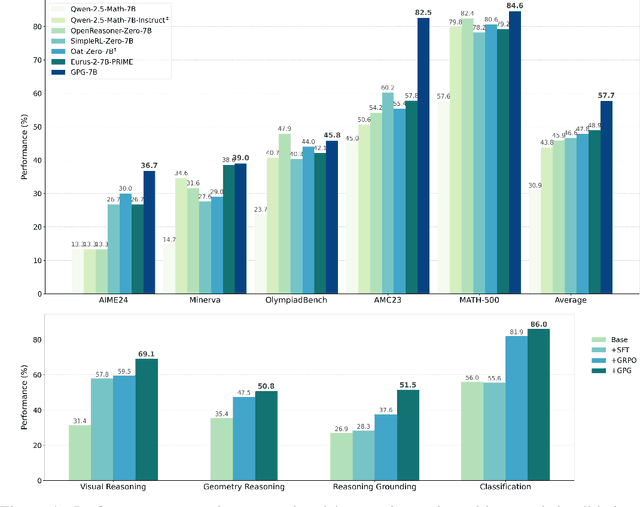
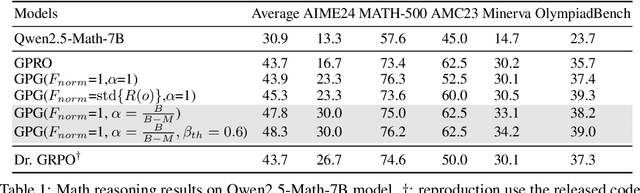
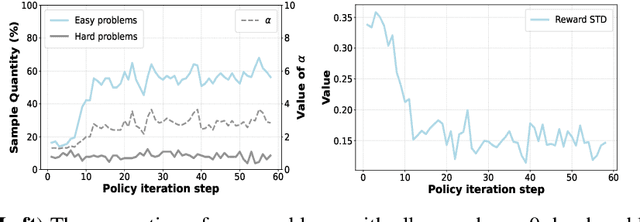
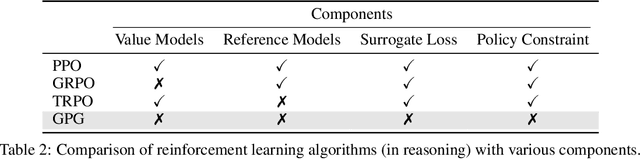
Reinforcement Learning (RL) can directly enhance the reasoning capabilities of large language models without extensive reliance on Supervised Fine-Tuning (SFT). In this work, we revisit the traditional Policy Gradient (PG) mechanism and propose a minimalist RL approach termed Group Policy Gradient (GPG). Unlike conventional methods, GPG directly optimize the original RL objective, thus obviating the need for surrogate loss functions. As illustrated in our paper, by eliminating both the critic and reference models, and avoiding KL divergence constraints, our approach significantly simplifies the training process when compared to Group Relative Policy Optimization (GRPO). Our approach achieves superior performance without relying on auxiliary techniques or adjustments. Extensive experiments demonstrate that our method not only reduces computational costs but also consistently outperforms GRPO across various unimodal and multimodal tasks. Our code is available at https://github.com/AMAP-ML/GPG.
Test-Time Alignment for Tracking User Interest Shifts in Sequential Recommendation
Apr 02, 2025Sequential recommendation is essential in modern recommender systems, aiming to predict the next item a user may interact with based on their historical behaviors. However, real-world scenarios are often dynamic and subject to shifts in user interests. Conventional sequential recommendation models are typically trained on static historical data, limiting their ability to adapt to such shifts and resulting in significant performance degradation during testing. Recently, Test-Time Training (TTT) has emerged as a promising paradigm, enabling pre-trained models to dynamically adapt to test data by leveraging unlabeled examples during testing. However, applying TTT to effectively track and address user interest shifts in recommender systems remains an open and challenging problem. Key challenges include how to capture temporal information effectively and explicitly identifying shifts in user interests during the testing phase. To address these issues, we propose T$^2$ARec, a novel model leveraging state space model for TTT by introducing two Test-Time Alignment modules tailored for sequential recommendation, effectively capturing the distribution shifts in user interest patterns over time. Specifically, T$^2$ARec aligns absolute time intervals with model-adaptive learning intervals to capture temporal dynamics and introduce an interest state alignment mechanism to effectively and explicitly identify the user interest shifts with theoretical guarantees. These two alignment modules enable efficient and incremental updates to model parameters in a self-supervised manner during testing, enhancing predictions for online recommendation. Extensive evaluations on three benchmark datasets demonstrate that T$^2$ARec achieves state-of-the-art performance and robustly mitigates the challenges posed by user interest shifts.
NullSwap: Proactive Identity Cloaking Against Deepfake Face Swapping
Mar 24, 2025Suffering from performance bottlenecks in passively detecting high-quality Deepfake images due to the advancement of generative models, proactive perturbations offer a promising approach to disabling Deepfake manipulations by inserting signals into benign images. However, existing proactive perturbation approaches remain unsatisfactory in several aspects: 1) visual degradation due to direct element-wise addition; 2) limited effectiveness against face swapping manipulation; 3) unavoidable reliance on white- and grey-box settings to involve generative models during training. In this study, we analyze the essence of Deepfake face swapping and argue the necessity of protecting source identities rather than target images, and we propose NullSwap, a novel proactive defense approach that cloaks source image identities and nullifies face swapping under a pure black-box scenario. We design an Identity Extraction module to obtain facial identity features from the source image, while a Perturbation Block is then devised to generate identity-guided perturbations accordingly. Meanwhile, a Feature Block extracts shallow-level image features, which are then fused with the perturbation in the Cloaking Block for image reconstruction. Furthermore, to ensure adaptability across different identity extractors in face swapping algorithms, we propose Dynamic Loss Weighting to adaptively balance identity losses. Experiments demonstrate the outstanding ability of our approach to fool various identity recognition models, outperforming state-of-the-art proactive perturbations in preventing face swapping models from generating images with correct source identities.