 Add to Chrome
 Add to Firefox
 Add to Edge
EAFormer: Scene Text Segmentation with Edge-Aware Transformers
Jul 24, 2024
Scene text segmentation aims at cropping texts from scene images, which is usually used to help generative models edit or remove texts. The existing text segmentation methods tend to involve various text-related supervisions for better performance. However, most of them ignore the importance of text edges, which are significant for downstream applications. In this paper, we propose Edge-Aware Transformers, termed EAFormer, to segment texts more accurately, especially at the edge of texts. Specifically, we first design a text edge extractor to detect edges and filter out edges of non-text areas. Then, we propose an edge-guided encoder to make the model focus more on text edges. Finally, an MLP-based decoder is employed to predict text masks. We have conducted extensive experiments on commonly-used benchmarks to verify the effectiveness of EAFormer. The experimental results demonstrate that the proposed method can perform better than previous methods, especially on the segmentation of text edges. Considering that the annotations of several benchmarks (e.g., COCO_TS and MLT_S) are not accurate enough to fairly evaluate our methods, we have relabeled these datasets. Through experiments, we observe that our method can achieve a higher performance improvement when more accurate annotations are used for training.

Make a Strong Teacher with Label Assistance: A Novel Knowledge Distillation Approach for Semantic Segmentation
Jul 18, 2024

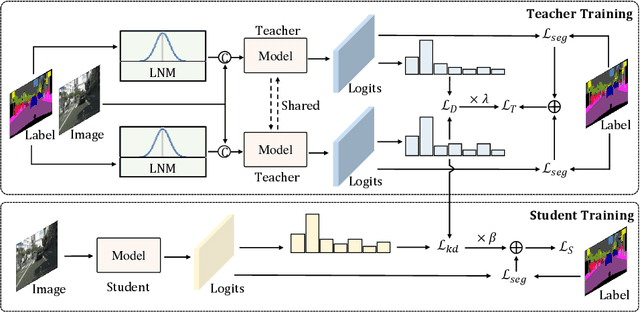

In this paper, we introduce a novel knowledge distillation approach for the semantic segmentation task. Unlike previous methods that rely on power-trained teachers or other modalities to provide additional knowledge, our approach does not require complex teacher models or information from extra sensors. Specifically, for the teacher model training, we propose to noise the label and then incorporate it into input to effectively boost the lightweight teacher performance. To ensure the robustness of the teacher model against the introduced noise, we propose a dual-path consistency training strategy featuring a distance loss between the outputs of two paths. For the student model training, we keep it consistent with the standard distillation for simplicity. Our approach not only boosts the efficacy of knowledge distillation but also increases the flexibility in selecting teacher and student models. To demonstrate the advantages of our Label Assisted Distillation (LAD) method, we conduct extensive experiments on five challenging datasets including Cityscapes, ADE20K, PASCAL-VOC, COCO-Stuff 10K, and COCO-Stuff 164K, five popular models: FCN, PSPNet, DeepLabV3, STDC, and OCRNet, and results show the effectiveness and generalization of our approach. We posit that incorporating labels into the input, as demonstrated in our work, will provide valuable insights into related fields. Code is available at https://github.com/skyshoumeng/Label_Assisted_Distillation.
Automated Label Unification for Multi-Dataset Semantic Segmentation with GNNs
Jul 15, 2024Deep supervised models possess significant capability to assimilate extensive training data, thereby presenting an opportunity to enhance model performance through training on multiple datasets. However, conflicts arising from different label spaces among datasets may adversely affect model performance. In this paper, we propose a novel approach to automatically construct a unified label space across multiple datasets using graph neural networks. This enables semantic segmentation models to be trained simultaneously on multiple datasets, resulting in performance improvements. Unlike existing methods, our approach facilitates seamless training without the need for additional manual reannotation or taxonomy reconciliation. This significantly enhances the efficiency and effectiveness of multi-dataset segmentation model training. The results demonstrate that our method significantly outperforms other multi-dataset training methods when trained on seven datasets simultaneously, and achieves state-of-the-art performance on the WildDash 2 benchmark.
Towards Open-set Camera 3D Object Detection
Jun 25, 2024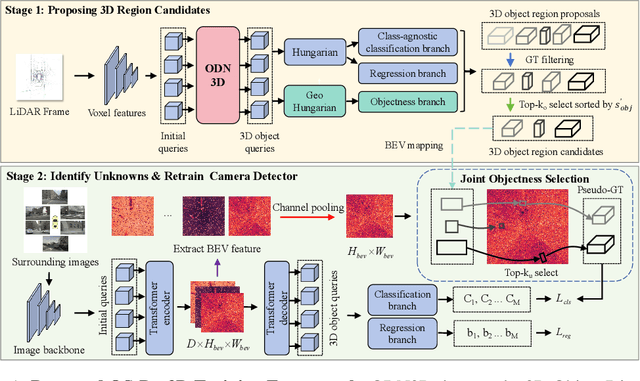
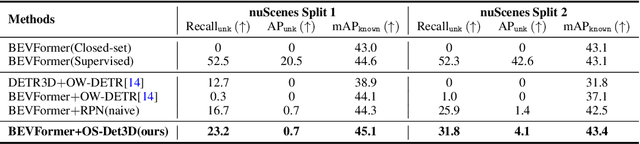
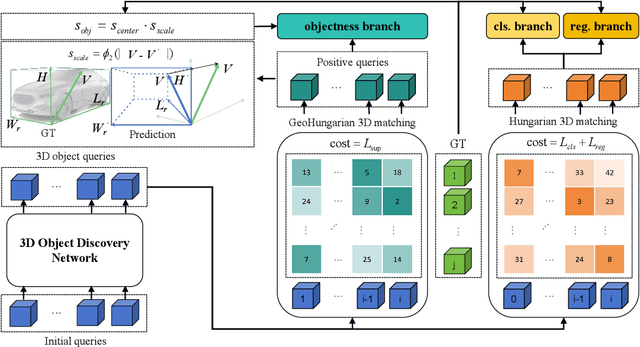
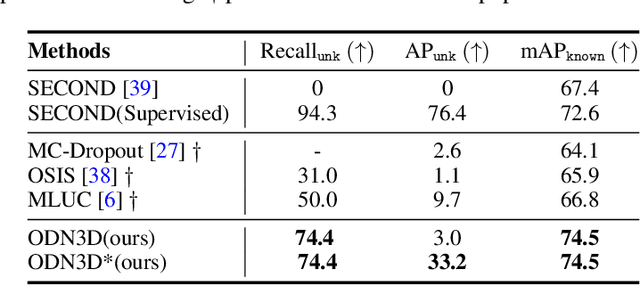
Traditional camera 3D object detectors are typically trained to recognize a predefined set of known object classes. In real-world scenarios, these detectors may encounter unknown objects outside the training categories and fail to identify them correctly. To address this gap, we present OS-Det3D (Open-set Camera 3D Object Detection), a two-stage training framework enhancing the ability of camera 3D detectors to identify both known and unknown objects. The framework involves our proposed 3D Object Discovery Network (ODN3D), which is specifically trained using geometric cues such as the location and scale of 3D boxes to discover general 3D objects. ODN3D is trained in a class-agnostic manner, and the provided 3D object region proposals inherently come with data noise. To boost accuracy in identifying unknown objects, we introduce a Joint Objectness Selection (JOS) module. JOS selects the pseudo ground truth for unknown objects from the 3D object region proposals of ODN3D by combining the ODN3D objectness and camera feature attention objectness. Experiments on the nuScenes and KITTI datasets demonstrate the effectiveness of our framework in enabling camera 3D detectors to successfully identify unknown objects while also improving their performance on known objects.
Unleashing the Potential of Tracklets for Unsupervised Video Person Re-Identification
Jun 20, 2024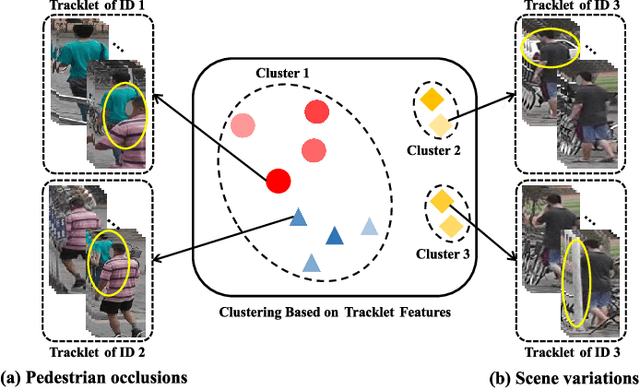
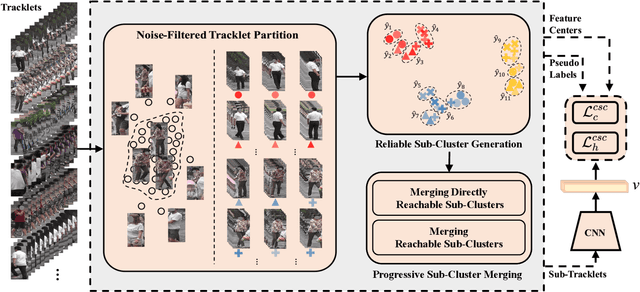
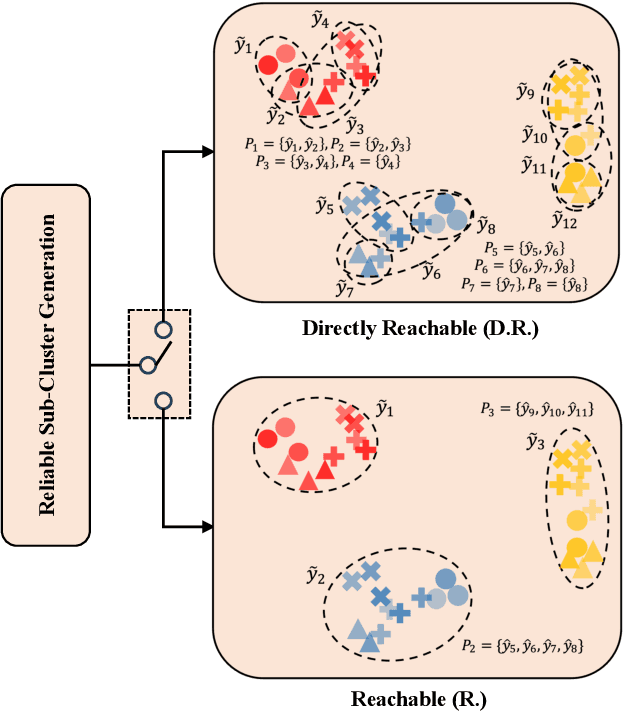
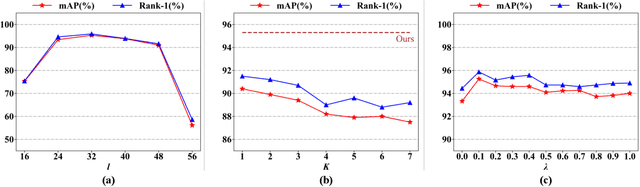
With rich temporal-spatial information, video-based person re-identification methods have shown broad prospects. Although tracklets can be easily obtained with ready-made tracking models, annotating identities is still expensive and impractical. Therefore, some video-based methods propose using only a few identity annotations or camera labels to facilitate feature learning. They also simply average the frame features of each tracklet, overlooking unexpected variations and inherent identity consistency within tracklets. In this paper, we propose the Self-Supervised Refined Clustering (SSR-C) framework without relying on any annotation or auxiliary information to promote unsupervised video person re-identification. Specifically, we first propose the Noise-Filtered Tracklet Partition (NFTP) module to reduce the feature bias of tracklets caused by noisy tracking results, and sequentially partition the noise-filtered tracklets into "sub-tracklets". Then, we cluster and further merge sub-tracklets using the self-supervised signal from tracklet partition, which is enhanced through a progressive strategy to generate reliable pseudo labels, facilitating intra-class cross-tracklet aggregation. Moreover, we propose the Class Smoothing Classification (CSC) loss to efficiently promote model learning. Extensive experiments on the MARS and DukeMTMC-VideoReID datasets demonstrate that our proposed SSR-C for unsupervised video person re-identification achieves state-of-the-art results and is comparable to advanced supervised methods.
LOP-Field: Brain-inspired Layout-Object-Position Fields for Robotic Scene Understanding
Jun 11, 2024Spatial cognition empowers animals with remarkably efficient navigation abilities, largely depending on the scene-level understanding of spatial environments. Recently, it has been found that a neural population in the postrhinal cortex of rat brains is more strongly tuned to the spatial layout rather than objects in a scene. Inspired by the representations of spatial layout in local scenes to encode different regions separately, we proposed LOP-Field that realizes the Layout-Object-Position(LOP) association to model the hierarchical representations for robotic scene understanding. Powered by foundation models and implicit scene representation, a neural field is implemented as a scene memory for robots, storing a queryable representation of scenes with position-wise, object-wise, and layout-wise information. To validate the built LOP association, the model is tested to infer region information from 3D positions with quantitative metrics, achieving an average accuracy of more than 88\%. It is also shown that the proposed method using region information can achieve improved object and view localization results with text and RGB input compared to state-of-the-art localization methods.
Synthesizing Efficient Data with Diffusion Models for Person Re-Identification Pre-Training
Jun 10, 2024
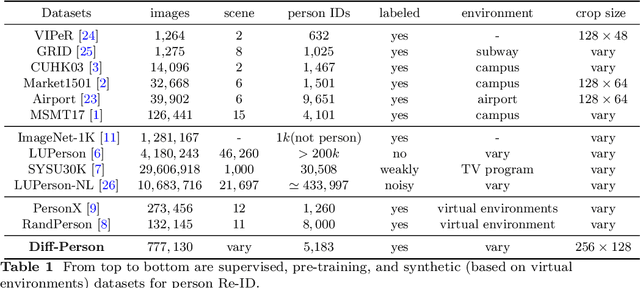
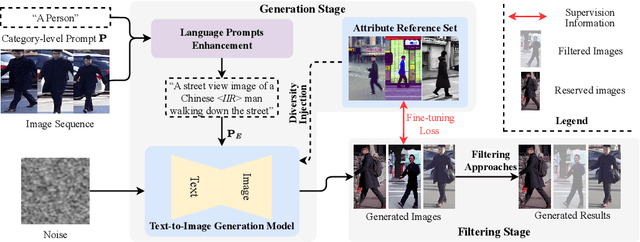
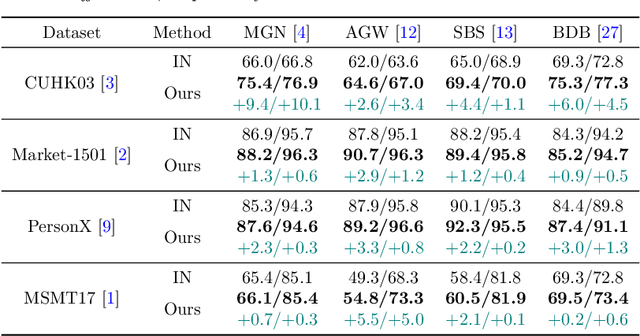
Existing person re-identification (Re-ID) methods principally deploy the ImageNet-1K dataset for model initialization, which inevitably results in sub-optimal situations due to the large domain gap. One of the key challenges is that building large-scale person Re-ID datasets is time-consuming. Some previous efforts address this problem by collecting person images from the internet e.g., LUPerson, but it struggles to learn from unlabeled, uncontrollable, and noisy data. In this paper, we present a novel paradigm Diffusion-ReID to efficiently augment and generate diverse images based on known identities without requiring any cost of data collection and annotation. Technically, this paradigm unfolds in two stages: generation and filtering. During the generation stage, we propose Language Prompts Enhancement (LPE) to ensure the ID consistency between the input image sequence and the generated images. In the diffusion process, we propose a Diversity Injection (DI) module to increase attribute diversity. In order to make the generated data have higher quality, we apply a Re-ID confidence threshold filter to further remove the low-quality images. Benefiting from our proposed paradigm, we first create a new large-scale person Re-ID dataset Diff-Person, which consists of over 777K images from 5,183 identities. Next, we build a stronger person Re-ID backbone pre-trained on our Diff-Person. Extensive experiments are conducted on four person Re-ID benchmarks in six widely used settings. Compared with other pre-training and self-supervised competitors, our approach shows significant superiority.
Distribution Aligned Semantics Adaption for Lifelong Person Re-Identification
May 30, 2024
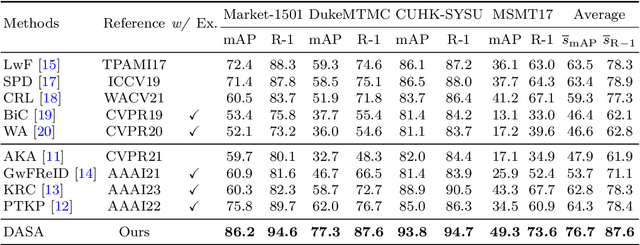

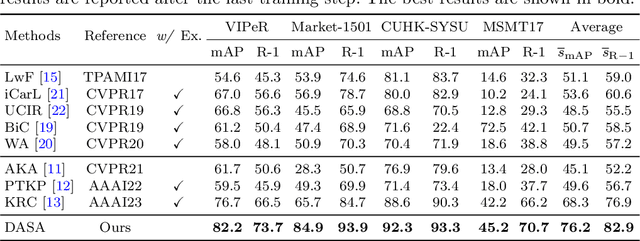
In real-world scenarios, person Re-IDentification (Re-ID) systems need to be adaptable to changes in space and time. Therefore, the adaptation of Re-ID models to new domains while preserving previously acquired knowledge is crucial, known as Lifelong person Re-IDentification (LReID). Advanced LReID methods rely on replaying exemplars from old domains and applying knowledge distillation in logits with old models. However, due to privacy concerns, retaining previous data is inappropriate. Additionally, the fine-grained and open-set characteristics of Re-ID limit the effectiveness of the distillation paradigm for accumulating knowledge. We argue that a Re-ID model trained on diverse and challenging pedestrian images at a large scale can acquire robust and general human semantic knowledge. These semantics can be readily utilized as shared knowledge for lifelong applications. In this paper, we identify the challenges and discrepancies associated with adapting a pre-trained model to each application domain, and introduce the Distribution Aligned Semantics Adaption (DASA) framework. It efficiently adjusts Batch Normalization (BN) to mitigate interference from data distribution discrepancy and freezes the pre-trained convolutional layers to preserve shared knowledge. Additionally, we propose the lightweight Semantics Adaption (SA) module, which effectively adapts learned semantics to enhance pedestrian representations. Extensive experiments demonstrate the remarkable superiority of our proposed framework over advanced LReID methods, and it exhibits significantly reduced storage consumption. DASA presents a novel and cost-effective perspective on effectively adapting pre-trained models for LReID.
Image-Text-Image Knowledge Transferring for Lifelong Person Re-Identification with Hybrid Clothing States
May 26, 2024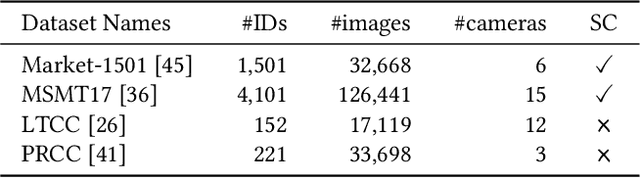
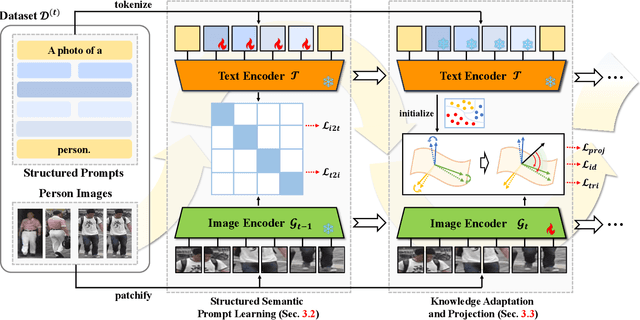
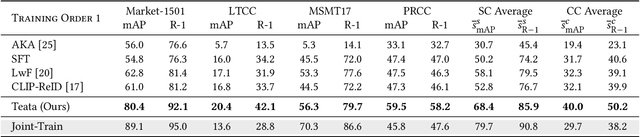
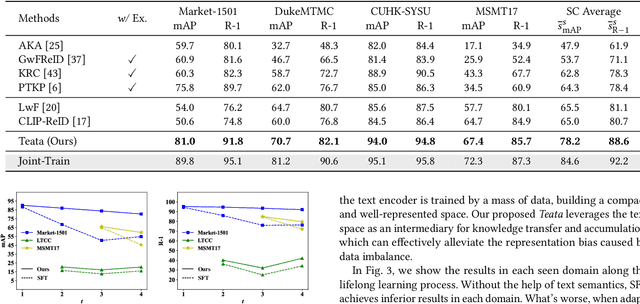
With the continuous expansion of intelligent surveillance networks, lifelong person re-identification (LReID) has received widespread attention, pursuing the need of self-evolution across different domains. However, existing LReID studies accumulate knowledge with the assumption that people would not change their clothes. In this paper, we propose a more practical task, namely lifelong person re-identification with hybrid clothing states (LReID-Hybrid), which takes a series of cloth-changing and cloth-consistent domains into account during lifelong learning. To tackle the challenges of knowledge granularity mismatch and knowledge presentation mismatch that occurred in LReID-Hybrid, we take advantage of the consistency and generalization of the text space, and propose a novel framework, dubbed $Teata$, to effectively align, transfer and accumulate knowledge in an "image-text-image" closed loop. Concretely, to achieve effective knowledge transfer, we design a Structured Semantic Prompt (SSP) learning to decompose the text prompt into several structured pairs to distill knowledge from the image space with a unified granularity of text description. Then, we introduce a Knowledge Adaptation and Projection strategy (KAP), which tunes text knowledge via a slow-paced learner to adapt to different tasks without catastrophic forgetting. Extensive experiments demonstrate the superiority of our proposed $Teata$ for LReID-Hybrid as well as on conventional LReID benchmarks over advanced methods.
Content and Salient Semantics Collaboration for Cloth-Changing Person Re-Identification
May 26, 2024
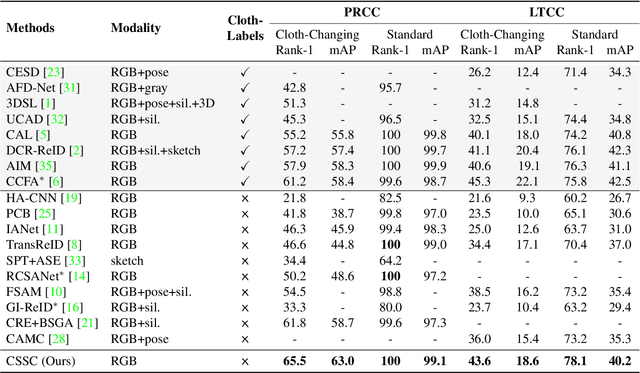

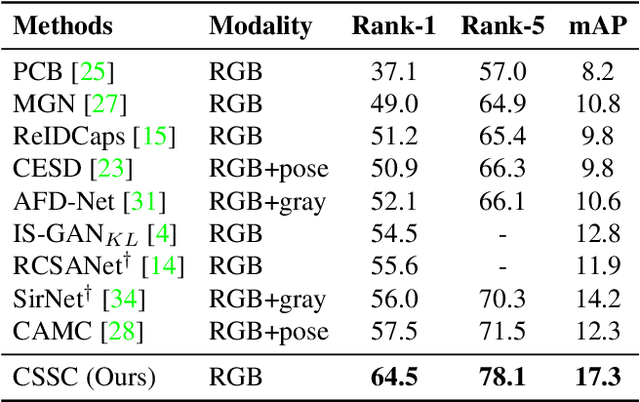
Cloth-changing person Re-IDentification (Re-ID) aims at recognizing the same person with clothing changes across non-overlapping cameras. Conventional person Re-ID methods usually bias the model's focus on cloth-related appearance features rather than identity-sensitive features associated with biological traits. Recently, advanced cloth-changing person Re-ID methods either resort to identity-related auxiliary modalities (e.g., sketches, silhouettes, keypoints and 3D shapes) or clothing labels to mitigate the impact of clothes. However, relying on unpractical and inflexible auxiliary modalities or annotations limits their real-world applicability. In this paper, we promote cloth-changing person Re-ID by effectively leveraging abundant semantics present within pedestrian images without the need for any auxiliaries. Specifically, we propose the Content and Salient Semantics Collaboration (CSSC) framework, facilitating cross-parallel semantics interaction and refinement. Our framework is simple yet effective, and the vital design is the Semantics Mining and Refinement (SMR) module. It extracts robust identity features about content and salient semantics, while mitigating interference from clothing appearances effectively. By capitalizing on the mined abundant semantic features, our proposed approach achieves state-of-the-art performance on three cloth-changing benchmarks as well as conventional benchmarks, demonstrating its superiority over advanced competitors.