 Add to Chrome
 Add to Firefox
 Add to Edge
Deconstructing Multimodal Mathematical Reasoning: Towards a Unified Perception-Alignment-Reasoning Paradigm
Mar 09, 2026
Multimodal Mathematical Reasoning (MMR) has recently attracted increasing attention for its capability to solve mathematical problems that involve both textual and visual modalities. However, current models still face significant challenges in real-world visual math tasks. They often misinterpret diagrams, fail to align mathematical symbols with visual evidence, and produce inconsistent reasoning steps. Moreover, existing evaluations mainly focus on checking final answers rather than verifying the correctness or executability of each intermediate step. To address these limitations, a growing body of recent research addresses these issues by integrating structured perception, explicit alignment, and verifiable reasoning within unified frameworks. To establish a clear roadmap for understanding and comparing different MMR approaches, we systematically study them around four fundamental questions: (1) What to extract from multimodal inputs, (2) How to represent and align textual and visual information, (3) How to perform the reasoning, and (4) How to evaluate the correctness of the overall reasoning process. Finally, we discuss open challenges and offer perspectives on promising directions for future research.

SaSR-Net: Source-Aware Semantic Representation Network for Enhancing Audio-Visual Question Answering
Nov 07, 2024
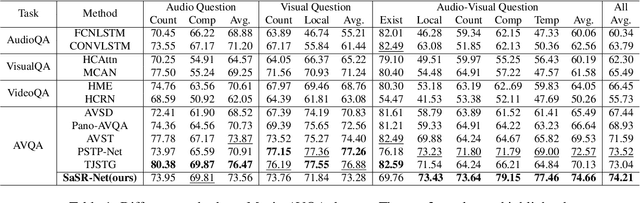

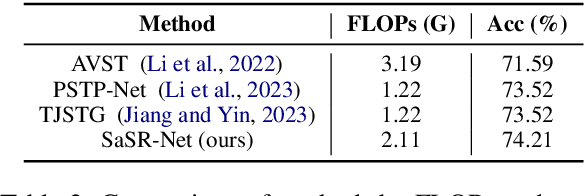
Audio-Visual Question Answering (AVQA) is a challenging task that involves answering questions based on both auditory and visual information in videos. A significant challenge is interpreting complex multi-modal scenes, which include both visual objects and sound sources, and connecting them to the given question. In this paper, we introduce the Source-aware Semantic Representation Network (SaSR-Net), a novel model designed for AVQA. SaSR-Net utilizes source-wise learnable tokens to efficiently capture and align audio-visual elements with the corresponding question. It streamlines the fusion of audio and visual information using spatial and temporal attention mechanisms to identify answers in multi-modal scenes. Extensive experiments on the Music-AVQA and AVQA-Yang datasets show that SaSR-Net outperforms state-of-the-art AVQA methods.
CLIPErase: Efficient Unlearning of Visual-Textual Associations in CLIP
Oct 30, 2024


Machine unlearning (MU) has gained significant attention as a means to remove specific data from trained models without requiring a full retraining process. While progress has been made in unimodal domains like text and image classification, unlearning in multimodal models remains relatively underexplored. In this work, we address the unique challenges of unlearning in CLIP, a prominent multimodal model that aligns visual and textual representations. We introduce CLIPErase, a novel approach that disentangles and selectively forgets both visual and textual associations, ensuring that unlearning does not compromise model performance. CLIPErase consists of three key modules: a Forgetting Module that disrupts the associations in the forget set, a Retention Module that preserves performance on the retain set, and a Consistency Module that maintains consistency with the original model. Extensive experiments on the CIFAR-100 and Flickr30K datasets across four CLIP downstream tasks demonstrate that CLIPErase effectively forgets designated associations in zero-shot tasks for multimodal samples, while preserving the model's performance on the retain set after unlearning.