 Add to Chrome
 Add to Firefox
 Add to Edge
PolicyLLM: Towards Excellent Comprehension of Public Policy for Large Language Models
Apr 14, 2026
Large Language Models (LLMs) are increasingly integrated into real-world decision-making, including in the domain of public policy. Yet, their ability to comprehend and reason about policy-related content remains underexplored. To fill this gap, we present \textbf{\textit{PolicyBench}}, the first large-scale cross-system benchmark (US-China) evaluating policy comprehension, comprising 21K cases across a broad spectrum of policy areas, capturing the diversity and complexity of real-world governance. Following Bloom's taxonomy, the benchmark assesses three core capabilities: (1) \textbf{Memorization}: factual recall of policy knowledge, (2) \textbf{Understanding}: conceptual and contextual reasoning, and (3) \textbf{Application}: problem-solving in real-life policy scenarios. Building on this benchmark, we further propose \textbf{\textit{PolicyMoE}}, a domain-specialized Mixture-of-Experts (MoE) model with expert modules aligned to each cognitive level. The proposed models demonstrate stronger performance on application-oriented policy tasks than on memorization or conceptual understanding, and yields the highest accuracy on structured reasoning tasks. Our results reveal key limitations of current LLMs in policy understanding and suggest paths toward more reliable, policy-focused models.

Patho-R1: A Multimodal Reinforcement Learning-Based Pathology Expert Reasoner
May 16, 2025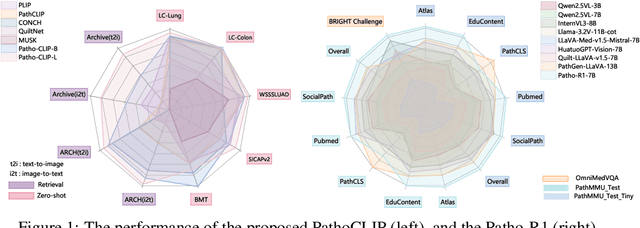
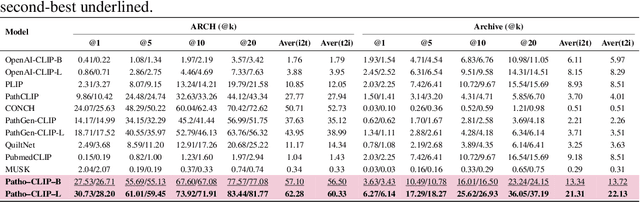
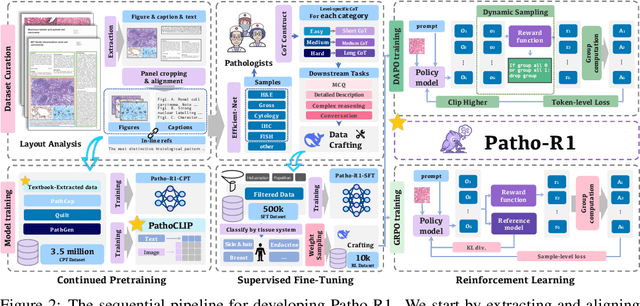
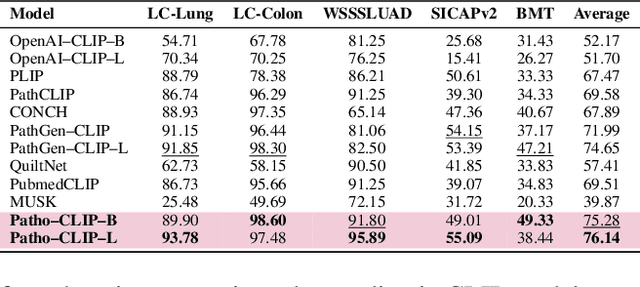
Recent advances in vision language models (VLMs) have enabled broad progress in the general medical field. However, pathology still remains a more challenging subdomain, with current pathology specific VLMs exhibiting limitations in both diagnostic accuracy and reasoning plausibility. Such shortcomings are largely attributable to the nature of current pathology datasets, which are primarily composed of image description pairs that lack the depth and structured diagnostic paradigms employed by real world pathologists. In this study, we leverage pathology textbooks and real world pathology experts to construct high-quality, reasoning-oriented datasets. Building on this, we introduce Patho-R1, a multimodal RL-based pathology Reasoner, trained through a three-stage pipeline: (1) continued pretraining on 3.5 million image-text pairs for knowledge infusion; (2) supervised fine-tuning on 500k high-quality Chain-of-Thought samples for reasoning incentivizing; (3) reinforcement learning using Group Relative Policy Optimization and Decoupled Clip and Dynamic sAmpling Policy Optimization strategies for multimodal reasoning quality refinement. To further assess the alignment quality of our dataset, we propose PathoCLIP, trained on the same figure-caption corpus used for continued pretraining. Comprehensive experimental results demonstrate that both PathoCLIP and Patho-R1 achieve robust performance across a wide range of pathology-related tasks, including zero-shot classification, cross-modal retrieval, Visual Question Answering, and Multiple Choice Question. Our project is available at the Patho-R1 repository: https://github.com/Wenchuan-Zhang/Patho-R1.