 Add to Chrome
 Add to Firefox
 Add to Edge
PolicyLLM: Towards Excellent Comprehension of Public Policy for Large Language Models
Apr 14, 2026
Large Language Models (LLMs) are increasingly integrated into real-world decision-making, including in the domain of public policy. Yet, their ability to comprehend and reason about policy-related content remains underexplored. To fill this gap, we present \textbf{\textit{PolicyBench}}, the first large-scale cross-system benchmark (US-China) evaluating policy comprehension, comprising 21K cases across a broad spectrum of policy areas, capturing the diversity and complexity of real-world governance. Following Bloom's taxonomy, the benchmark assesses three core capabilities: (1) \textbf{Memorization}: factual recall of policy knowledge, (2) \textbf{Understanding}: conceptual and contextual reasoning, and (3) \textbf{Application}: problem-solving in real-life policy scenarios. Building on this benchmark, we further propose \textbf{\textit{PolicyMoE}}, a domain-specialized Mixture-of-Experts (MoE) model with expert modules aligned to each cognitive level. The proposed models demonstrate stronger performance on application-oriented policy tasks than on memorization or conceptual understanding, and yields the highest accuracy on structured reasoning tasks. Our results reveal key limitations of current LLMs in policy understanding and suggest paths toward more reliable, policy-focused models.

Emergent Social Intelligence Risks in Generative Multi-Agent Systems
Mar 29, 2026Multi-agent systems composed of large generative models are rapidly moving from laboratory prototypes to real-world deployments, where they jointly plan, negotiate, and allocate shared resources to solve complex tasks. While such systems promise unprecedented scalability and autonomy, their collective interaction also gives rise to failure modes that cannot be reduced to individual agents. Understanding these emergent risks is therefore critical. Here, we present a pioneer study of such emergent multi-agent risk in workflows that involve competition over shared resources (e.g., computing resources or market share), sequential handoff collaboration (where downstream agents see only predecessor outputs), collective decision aggregation, and others. Across these settings, we observe that such group behaviors arise frequently across repeated trials and a wide range of interaction conditions, rather than as rare or pathological cases. In particular, phenomena such as collusion-like coordination and conformity emerge with non-trivial frequency under realistic resource constraints, communication protocols, and role assignments, mirroring well-known pathologies in human societies despite no explicit instruction. Moreover, these risks cannot be prevented by existing agent-level safeguards alone. These findings expose the dark side of intelligent multi-agent systems: a social intelligence risk where agent collectives, despite no instruction to do so, spontaneously reproduce familiar failure patterns from human societies.
Capability-Oriented Training Induced Alignment Risk
Feb 12, 2026While most AI alignment research focuses on preventing models from generating explicitly harmful content, a more subtle risk is emerging: capability-oriented training induced exploitation. We investigate whether language models, when trained with reinforcement learning (RL) in environments with implicit loopholes, will spontaneously learn to exploit these flaws to maximize their reward, even without any malicious intent in their training. To test this, we design a suite of four diverse "vulnerability games", each presenting a unique, exploitable flaw related to context-conditional compliance, proxy metrics, reward tampering, and self-evaluation. Our experiments show that models consistently learn to exploit these vulnerabilities, discovering opportunistic strategies that significantly increase their reward at the expense of task correctness or safety. More critically, we find that these exploitative strategies are not narrow "tricks" but generalizable skills; they can be transferred to new tasks and even "distilled" from a capable teacher model to other student models through data alone. Our findings reveal that capability-oriented training induced risks pose a fundamental challenge to current alignment approaches, suggesting that future AI safety work must extend beyond content moderation to rigorously auditing and securing the training environments and reward mechanisms themselves. Code is available at https://github.com/YujunZhou/Capability_Oriented_Alignment_Risk.
pFedDSH: Enabling Knowledge Transfer in Personalized Federated Learning through Data-free Sub-Hypernetwork
Aug 07, 2025Federated Learning (FL) enables collaborative model training across distributed clients without sharing raw data, offering a significant privacy benefit. However, most existing Personalized Federated Learning (pFL) methods assume a static client participation, which does not reflect real-world scenarios where new clients may continuously join the federated system (i.e., dynamic client onboarding). In this paper, we explore a practical scenario in which a new batch of clients is introduced incrementally while the learning task remains unchanged. This dynamic environment poses various challenges, including preserving performance for existing clients without retraining and enabling efficient knowledge transfer between client batches. To address these issues, we propose Personalized Federated Data-Free Sub-Hypernetwork (pFedDSH), a novel framework based on a central hypernetwork that generates personalized models for each client via embedding vectors. To maintain knowledge stability for existing clients, pFedDSH incorporates batch-specific masks, which activate subsets of neurons to preserve knowledge. Furthermore, we introduce a data-free replay strategy motivated by DeepInversion to facilitate backward transfer, enhancing existing clients' performance without compromising privacy. Extensive experiments conducted on CIFAR-10, CIFAR-100, and Tiny-ImageNet demonstrate that pFedDSH outperforms the state-of-the-art pFL and Federated Continual Learning baselines in our investigation scenario. Our approach achieves robust performance stability for existing clients, as well as adaptation for new clients and efficient utilization of neural resources.
Neural Graph Pattern Machine
Jan 30, 2025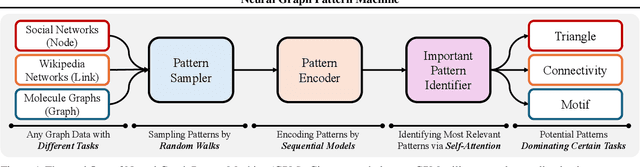
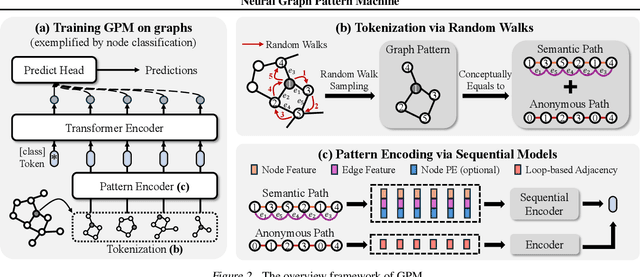

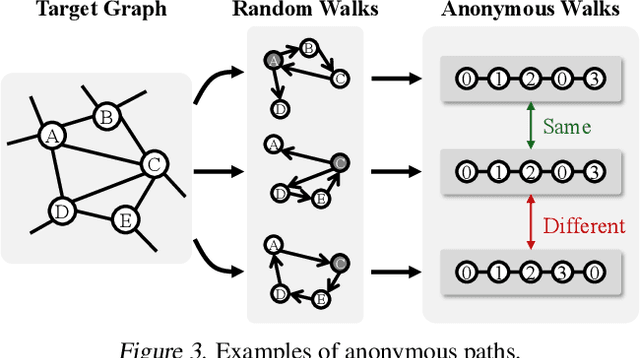
Graph learning tasks require models to comprehend essential substructure patterns relevant to downstream tasks, such as triadic closures in social networks and benzene rings in molecular graphs. Due to the non-Euclidean nature of graphs, existing graph neural networks (GNNs) rely on message passing to iteratively aggregate information from local neighborhoods. Despite their empirical success, message passing struggles to identify fundamental substructures, such as triangles, limiting its expressiveness. To overcome this limitation, we propose the Neural Graph Pattern Machine (GPM), a framework designed to learn directly from graph patterns. GPM efficiently extracts and encodes substructures while identifying the most relevant ones for downstream tasks. We also demonstrate that GPM offers superior expressivity and improved long-range information modeling compared to message passing. Empirical evaluations on node classification, link prediction, graph classification, and regression show the superiority of GPM over state-of-the-art baselines. Further analysis reveals its desirable out-of-distribution robustness, scalability, and interpretability. We consider GPM to be a step toward going beyond message passing.
Learning Cross-Task Generalities Across Graphs via Task-trees
Dec 21, 2024Foundation models aim to create general, cross-task, and cross-domain machine learning models by pretraining on large-scale datasets to capture shared patterns or concepts (generalities), such as contours, colors, textures, and edges in images, or tokens, words, and sentences in text. However, discovering generalities across graphs remains challenging, which has hindered the development of graph foundation models. To tackle this challenge, in this paper, we propose a novel approach to learn generalities across graphs via task-trees. Specifically, we first define the basic learning instances in graphs as task-trees and assume that the generalities shared across graphs are, at least partially, preserved in the task-trees of the given graphs. To validate the assumption, we first perform a theoretical analysis of task-trees in terms of stability, transferability, and generalization. We find that if a graph neural network (GNN) model is pretrained on diverse task-trees through a reconstruction task, it can learn sufficient transferable knowledge for downstream tasks using an appropriate set of fine-tuning samples. To empirically validate the assumption, we further instantiate the theorems by developing a cross-task, cross-domain graph foundation model named Graph generality Identifier on task-Trees (GIT). The extensive experiments over 30 graphs from five domains demonstrate the effectiveness of GIT in fine-tuning, in-context learning, and zero-shot learning scenarios. Particularly, the general GIT model pretrained on large-scale datasets can be quickly adapted to specific domains, matching or even surpassing expert models designed for those domains. Our data and code are available at https://github.com/Zehong-Wang/GIT.
NGQA: A Nutritional Graph Question Answering Benchmark for Personalized Health-aware Nutritional Reasoning
Dec 20, 2024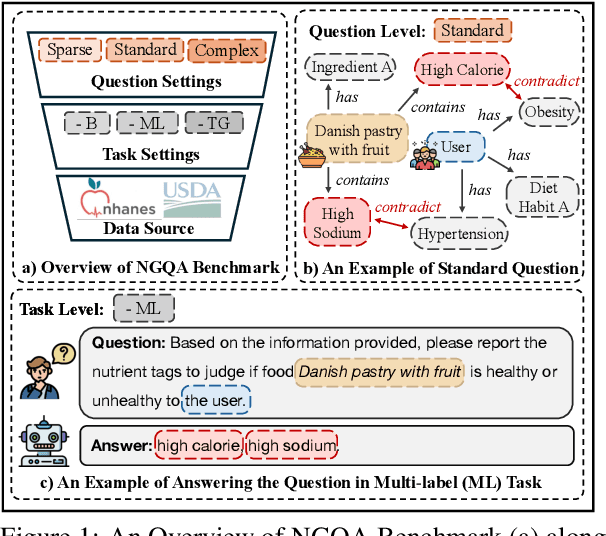
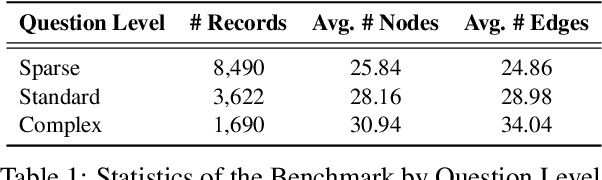
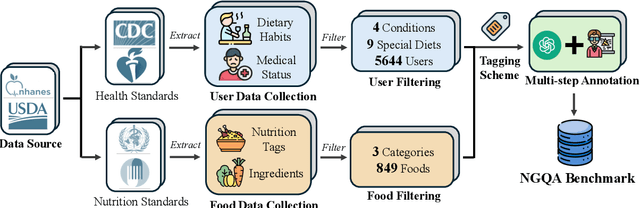
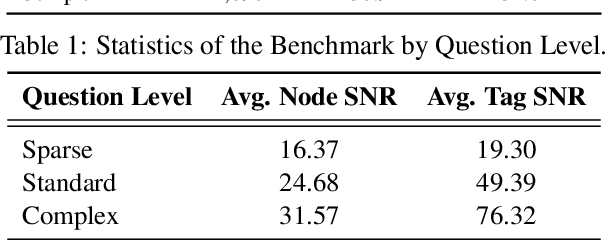
Diet plays a critical role in human health, yet tailoring dietary reasoning to individual health conditions remains a major challenge. Nutrition Question Answering (QA) has emerged as a popular method for addressing this problem. However, current research faces two critical limitations. On one hand, the absence of datasets involving user-specific medical information severely limits \textit{personalization}. This challenge is further compounded by the wide variability in individual health needs. On the other hand, while large language models (LLMs), a popular solution for this task, demonstrate strong reasoning abilities, they struggle with the domain-specific complexities of personalized healthy dietary reasoning, and existing benchmarks fail to capture these challenges. To address these gaps, we introduce the Nutritional Graph Question Answering (NGQA) benchmark, the first graph question answering dataset designed for personalized nutritional health reasoning. NGQA leverages data from the National Health and Nutrition Examination Survey (NHANES) and the Food and Nutrient Database for Dietary Studies (FNDDS) to evaluate whether a food is healthy for a specific user, supported by explanations of the key contributing nutrients. The benchmark incorporates three question complexity settings and evaluates reasoning across three downstream tasks. Extensive experiments with LLM backbones and baseline models demonstrate that the NGQA benchmark effectively challenges existing models. In sum, NGQA addresses a critical real-world problem while advancing GraphQA research with a novel domain-specific benchmark.
MOPI-HFRS: A Multi-objective Personalized Health-aware Food Recommendation System with LLM-enhanced Interpretation
Dec 12, 2024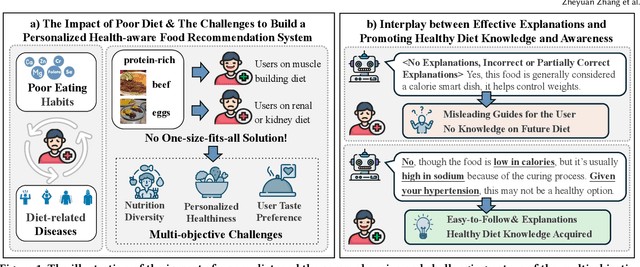
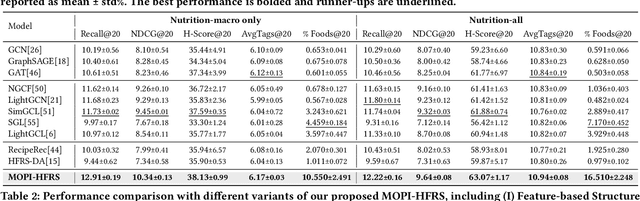

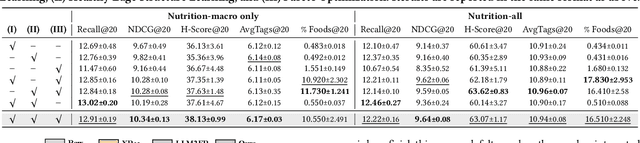
The prevalence of unhealthy eating habits has become an increasingly concerning issue in the United States. However, major food recommendation platforms (e.g., Yelp) continue to prioritize users' dietary preferences over the healthiness of their choices. Although efforts have been made to develop health-aware food recommendation systems, the personalization of such systems based on users' specific health conditions remains under-explored. In addition, few research focus on the interpretability of these systems, which hinders users from assessing the reliability of recommendations and impedes the practical deployment of these systems. In response to this gap, we first establish two large-scale personalized health-aware food recommendation benchmarks at the first attempt. We then develop a novel framework, Multi-Objective Personalized Interpretable Health-aware Food Recommendation System (MOPI-HFRS), which provides food recommendations by jointly optimizing the three objectives: user preference, personalized healthiness and nutritional diversity, along with an large language model (LLM)-enhanced reasoning module to promote healthy dietary knowledge through the interpretation of recommended results. Specifically, this holistic graph learning framework first utilizes two structure learning and a structure pooling modules to leverage both descriptive features and health data. Then it employs Pareto optimization to achieve designed multi-facet objectives. Finally, to further promote the healthy dietary knowledge and awareness, we exploit an LLM by utilizing knowledge-infusion, prompting the LLMs with knowledge obtained from the recommendation model for interpretation.
GFT: Graph Foundation Model with Transferable Tree Vocabulary
Nov 09, 2024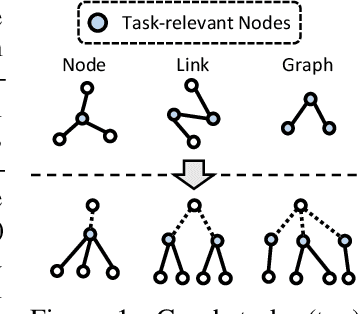
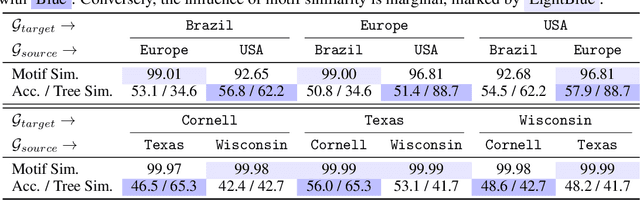
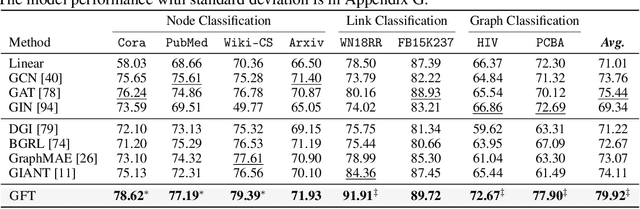

Inspired by the success of foundation models in applications such as ChatGPT, as graph data has been ubiquitous, one can envision the far-reaching impacts that can be brought by Graph Foundation Models (GFMs) with broader applications in the areas such as scientific research, social network analysis, drug discovery, and e-commerce. Despite the significant progress of pre-trained graph neural networks, there haven't been GFMs that can achieve desired performance on various graph-learning-related tasks. Building GFMs may rely on a vocabulary that encodes transferable patterns shared among different tasks and domains. Unlike image and text, defining such transferable patterns for graphs remains an open question. In this paper, we aim to bridge this gap by rethinking the transferable patterns on graphs as computation trees -- i.e., tree structures derived from the message-passing process. Based on this insight, we propose a cross-task, cross-domain graph foundation model named GFT, short for Graph Foundation model with transferable Tree vocabulary. By treating computation trees as tokens within the transferable vocabulary, GFT improves model generalization and reduces the risk of negative transfer. The theoretical analyses and extensive experimental studies have demonstrated the transferability of computation trees and shown the effectiveness of GFT across diverse tasks and domains in graph learning. The open source code and data are available at https://github.com/Zehong-Wang/GFT.
Class-Aware Contrastive Optimization for Imbalanced Text Classification
Oct 29, 2024The unique characteristics of text data make classification tasks a complex problem. Advances in unsupervised and semi-supervised learning and autoencoder architectures addressed several challenges. However, they still struggle with imbalanced text classification tasks, a common scenario in real-world applications, demonstrating a tendency to produce embeddings with unfavorable properties, such as class overlap. In this paper, we show that leveraging class-aware contrastive optimization combined with denoising autoencoders can successfully tackle imbalanced text classification tasks, achieving better performance than the current state-of-the-art. Concretely, our proposal combines reconstruction loss with contrastive class separation in the embedding space, allowing a better balance between the truthfulness of the generated embeddings and the model's ability to separate different classes. Compared with an extensive set of traditional and state-of-the-art competing methods, our proposal demonstrates a notable increase in performance across a wide variety of text datasets.