 Add to Chrome
 Add to Firefox
 Add to Edge
BuddyBench: A Privacy-Constrained Multi-Task Benchmark for Pediatric Social-Communication Personalization
May 27, 2026
BuddyBench introduces a privacy-constrained multi-task benchmark for pediatric social-communication personalization. Unlike existing neurodevelopmental repositories that primarily emphasize imaging, genetics, or cross-sectional clinical phenotyping, BuddyBench links drill-level learning trajectories, standardized clinical assessments, BuddyPlan self-report, and randomized-treatment endpoints within a unified benchmark schema. BuddyBench combines two cohorts: ND-03 is an observational cohort with dense drill coverage for Tasks1-2 (n = 189), and ND-02 is a randomized controlled trial cohort for Tasks3-4 (n = 86 ITT). Together, they support knowledge tracing, next-drill recommendation, clinical prediction, and causal inference, linking behavioral personalization to clinical evaluation. We additionally introduce BuddyBench-Sim, a synthetic companion dataset for reproducible evaluation. Baselines show signal across tasks while keeping pediatric clinical records protected.

Open-H-Embodiment: A Large-Scale Dataset for Enabling Foundation Models in Medical Robotics
Apr 22, 2026Autonomous medical robots hold promise to improve patient outcomes, reduce provider workload, democratize access to care, and enable superhuman precision. However, autonomous medical robotics has been limited by a fundamental data problem: existing medical robotic datasets are small, single-embodiment, and rarely shared openly, restricting the development of foundation models that the field needs to advance. We introduce Open-H-Embodiment, the largest open dataset of medical robotic video with synchronized kinematics to date, spanning more than 49 institutions and multiple robotic platforms including the CMR Versius, Intuitive Surgical's da Vinci, da Vinci Research Kit (dVRK), Rob Surgical BiTrack, Virtual Incision's MIRA, Moon Surgical Maestro, and a variety of custom systems, spanning surgical manipulation, robotic ultrasound, and endoscopy procedures. We demonstrate the research enabled by this dataset through two foundation models. GR00T-H is the first open foundation vision-language-action model for medical robotics, which is the only evaluated model to achieve full end-to-end task completion on a structured suturing benchmark (25% of trials vs. 0% for all others) and achieves 64% average success across a 29-step ex vivo suturing sequence. We also train Cosmos-H-Surgical-Simulator, the first action-conditioned world model to enable multi-embodiment surgical simulation from a single checkpoint, spanning nine robotic platforms and supporting in silico policy evaluation and synthetic data generation for the medical domain. These results suggest that open, large-scale medical robot data collection can serve as critical infrastructure for the research community, enabling advances in robot learning, world modeling, and beyond.
A Training-Free Large Reasoning Model-based Knowledge Tracing Framework for Unified Prediction and Prescription
Jan 05, 2026Knowledge Tracing (KT) aims to estimate a learner's evolving mastery based on interaction histories. Recent studies have explored Large Language Models (LLMs) for KT via autoregressive nature, but such approaches typically require fine-tuning and exhibit unstable or near-random performance. Moreover, prior KT systems primarily focus on prediction and rely on multi-stage pipelines for feedback and recommendation, resulting in increased system complexity and resources. To address this gap, we propose Thinking-KT, a training-free KT framework that incorporates Test-Time Scaling (TTS), enabling even small LLMs to achieve competitive KT performance. Moreover, in this framework, a small LLM can jointly perform KT prediction, personalized feedback generation, and learning recommendation in a unified output without degrading prediction accuracy. Beyond performance, we present the systematic analysis of reasoning traces in KT. Our results demonstrate that TTS is a critical yet underexplored factor in LLM-based KT, and that small LLMs can serve as unified ITS engines.
DEFormer: DCT-driven Enhancement Transformer for Low-light Image and Dark Vision
Sep 13, 2023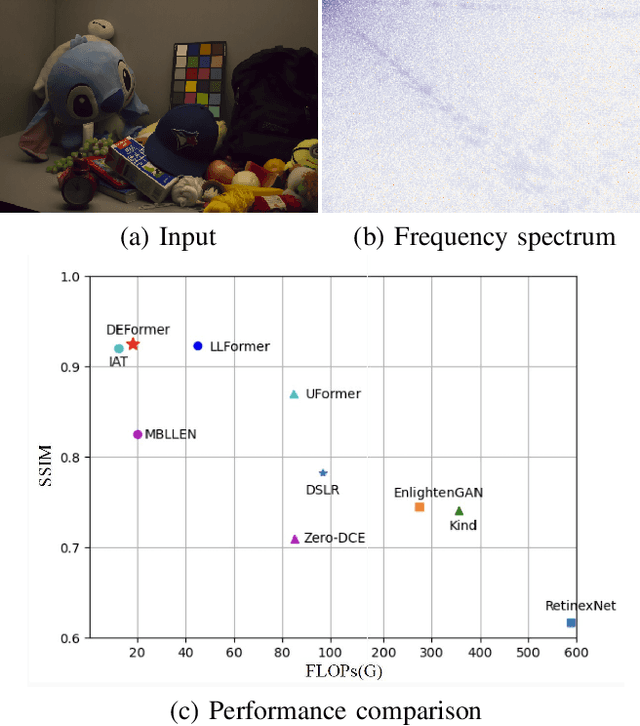
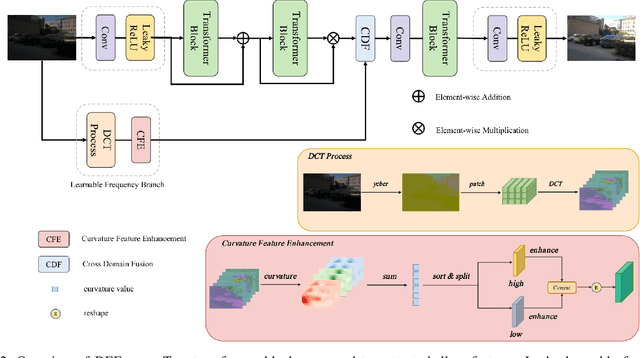
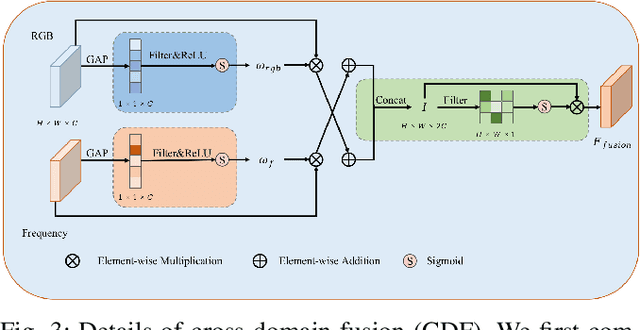
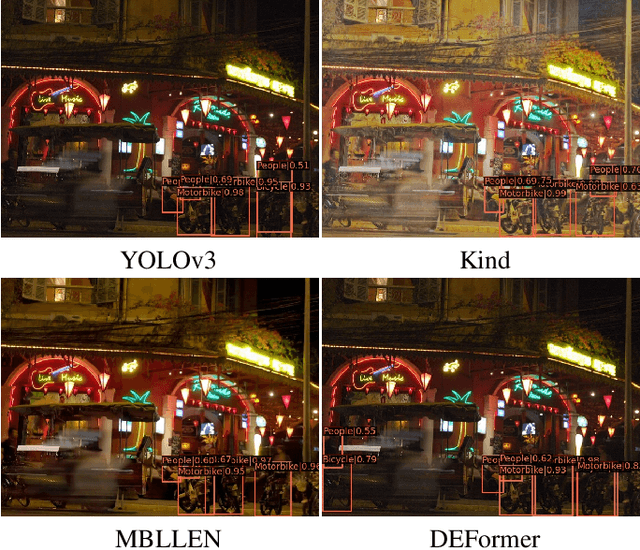
The goal of low-light image enhancement is to restore the color and details of the image and is of great significance for high-level visual tasks in autonomous driving. However, it is difficult to restore the lost details in the dark area by relying only on the RGB domain. In this paper we introduce frequency as a new clue into the network and propose a novel DCT-driven enhancement transformer (DEFormer). First, we propose a learnable frequency branch (LFB) for frequency enhancement contains DCT processing and curvature-based frequency enhancement (CFE). CFE calculates the curvature of each channel to represent the detail richness of different frequency bands, then we divides the frequency features, which focuses on frequency bands with richer textures. In addition, we propose a cross domain fusion (CDF) for reducing the differences between the RGB domain and the frequency domain. We also adopt DEFormer as a preprocessing in dark detection, DEFormer effectively improves the performance of the detector, bringing 2.1% and 3.4% improvement in ExDark and DARK FACE datasets on mAP respectively.