 Add to Chrome
 Add to Firefox
 Add to Edge
Ego3DT: Tracking Every 3D Object in Ego-centric Videos
Oct 11, 2024

The growing interest in embodied intelligence has brought ego-centric perspectives to contemporary research. One significant challenge within this realm is the accurate localization and tracking of objects in ego-centric videos, primarily due to the substantial variability in viewing angles. Addressing this issue, this paper introduces a novel zero-shot approach for the 3D reconstruction and tracking of all objects from the ego-centric video. We present Ego3DT, a novel framework that initially identifies and extracts detection and segmentation information of objects within the ego environment. Utilizing information from adjacent video frames, Ego3DT dynamically constructs a 3D scene of the ego view using a pre-trained 3D scene reconstruction model. Additionally, we have innovated a dynamic hierarchical association mechanism for creating stable 3D tracking trajectories of objects in ego-centric videos. Moreover, the efficacy of our approach is corroborated by extensive experiments on two newly compiled datasets, with 1.04x - 2.90x in HOTA, showcasing the robustness and accuracy of our method in diverse ego-centric scenarios.

Smart Audit System Empowered by LLM
Oct 10, 2024


Manufacturing quality audits are pivotal for ensuring high product standards in mass production environments. Traditional auditing processes, however, are labor-intensive and reliant on human expertise, posing challenges in maintaining transparency, accountability, and continuous improvement across complex global supply chains. To address these challenges, we propose a smart audit system empowered by large language models (LLMs). Our approach introduces three innovations: a dynamic risk assessment model that streamlines audit procedures and optimizes resource allocation; a manufacturing compliance copilot that enhances data processing, retrieval, and evaluation for a self-evolving manufacturing knowledge base; and a Re-act framework commonality analysis agent that provides real-time, customized analysis to empower engineers with insights for supplier improvement. These enhancements elevate audit efficiency and effectiveness, with testing scenarios demonstrating an improvement of over 24%.
Associate Everything Detected: Facilitating Tracking-by-Detection to the Unknown
Sep 14, 2024


Multi-object tracking (MOT) emerges as a pivotal and highly promising branch in the field of computer vision. Classical closed-vocabulary MOT (CV-MOT) methods aim to track objects of predefined categories. Recently, some open-vocabulary MOT (OV-MOT) methods have successfully addressed the problem of tracking unknown categories. However, we found that the CV-MOT and OV-MOT methods each struggle to excel in the tasks of the other. In this paper, we present a unified framework, Associate Everything Detected (AED), that simultaneously tackles CV-MOT and OV-MOT by integrating with any off-the-shelf detector and supports unknown categories. Different from existing tracking-by-detection MOT methods, AED gets rid of prior knowledge (e.g. motion cues) and relies solely on highly robust feature learning to handle complex trajectories in OV-MOT tasks while keeping excellent performance in CV-MOT tasks. Specifically, we model the association task as a similarity decoding problem and propose a sim-decoder with an association-centric learning mechanism. The sim-decoder calculates similarities in three aspects: spatial, temporal, and cross-clip. Subsequently, association-centric learning leverages these threefold similarities to ensure that the extracted features are appropriate for continuous tracking and robust enough to generalize to unknown categories. Compared with existing powerful OV-MOT and CV-MOT methods, AED achieves superior performance on TAO, SportsMOT, and DanceTrack without any prior knowledge. Our code is available at https://github.com/balabooooo/AED.
Improving Multimodal Emotion Recognition by Leveraging Acoustic Adaptation and Visual Alignment
Sep 10, 2024
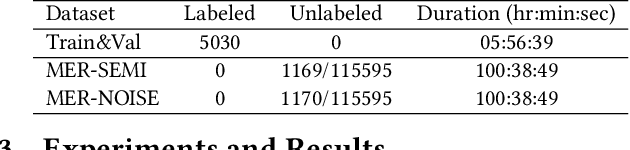

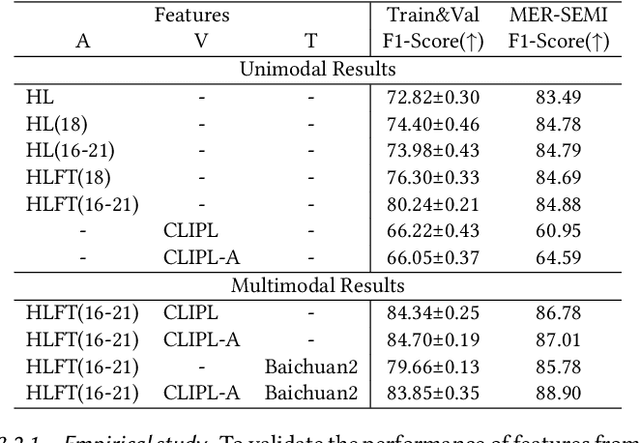
Multimodal Emotion Recognition (MER) aims to automatically identify and understand human emotional states by integrating information from various modalities. However, the scarcity of annotated multimodal data significantly hinders the advancement of this research field. This paper presents our solution for the MER-SEMI sub-challenge of MER 2024. First, to better adapt acoustic modality features for the MER task, we experimentally evaluate the contributions of different layers of the pre-trained speech model HuBERT in emotion recognition. Based on these observations, we perform Parameter-Efficient Fine-Tuning (PEFT) on the layers identified as most effective for emotion recognition tasks, thereby achieving optimal adaptation for emotion recognition with a minimal number of learnable parameters. Second, leveraging the strengths of the acoustic modality, we propose a feature alignment pre-training method. This approach uses large-scale unlabeled data to train a visual encoder, thereby promoting the semantic alignment of visual features within the acoustic feature space. Finally, using the adapted acoustic features, aligned visual features, and lexical features, we employ an attention mechanism for feature fusion. On the MER2024-SEMI test set, the proposed method achieves a weighted F1 score of 88.90%, ranking fourth among all participating teams, validating the effectiveness of our approach.
Hybrid Mask Generation for Infrared Small Target Detection with Single-Point Supervision
Sep 06, 2024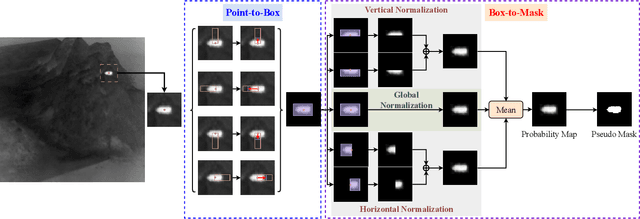


Single-frame infrared small target (SIRST) detection poses a significant challenge due to the requirement to discern minute targets amidst complex infrared background clutter. Recently, deep learning approaches have shown promising results in this domain. However, these methods heavily rely on extensive manual annotations, which are particularly cumbersome and resource-intensive for infrared small targets owing to their minute sizes. To address this limitation, we introduce a Hybrid Mask Generation (HMG) approach that recovers high-quality masks for each target from only a single-point label for network training. Specifically, our HMG approach consists of a handcrafted Points-to-Mask Generation strategy coupled with a pseudo mask updating strategy to recover and refine pseudo masks from point labels. The Points-to-Mask Generation strategy divides two distinct stages: Points-to-Box conversion, where individual point labels are transformed into bounding boxes, and subsequently, Box-to-Mask prediction, where these bounding boxes are elaborated into precise masks. The mask updating strategy integrates the complementary strengths of handcrafted and deep-learning algorithms to iteratively refine the initial pseudo masks. Experimental results across three datasets demonstrate that our method outperforms the existing methods for infrared small target detection with single-point supervision.
CustomCrafter: Customized Video Generation with Preserving Motion and Concept Composition Abilities
Aug 23, 2024


Customized video generation aims to generate high-quality videos guided by text prompts and subject's reference images. However, since it is only trained on static images, the fine-tuning process of subject learning disrupts abilities of video diffusion models (VDMs) to combine concepts and generate motions. To restore these abilities, some methods use additional video similar to the prompt to fine-tune or guide the model. This requires frequent changes of guiding videos and even re-tuning of the model when generating different motions, which is very inconvenient for users. In this paper, we propose CustomCrafter, a novel framework that preserves the model's motion generation and conceptual combination abilities without additional video and fine-tuning to recovery. For preserving conceptual combination ability, we design a plug-and-play module to update few parameters in VDMs, enhancing the model's ability to capture the appearance details and the ability of concept combinations for new subjects. For motion generation, we observed that VDMs tend to restore the motion of video in the early stage of denoising, while focusing on the recovery of subject details in the later stage. Therefore, we propose Dynamic Weighted Video Sampling Strategy. Using the pluggability of our subject learning modules, we reduce the impact of this module on motion generation in the early stage of denoising, preserving the ability to generate motion of VDMs. In the later stage of denoising, we restore this module to repair the appearance details of the specified subject, thereby ensuring the fidelity of the subject's appearance. Experimental results show that our method has a significant improvement compared to previous methods.
Envisioning Class Entity Reasoning by Large Language Models for Few-shot Learning
Aug 22, 2024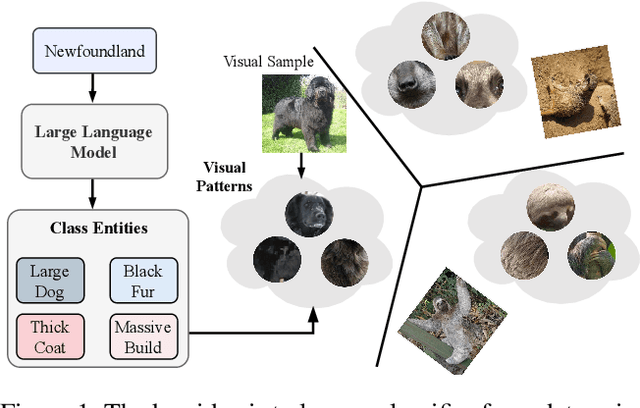
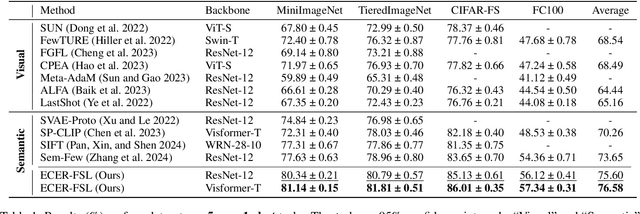
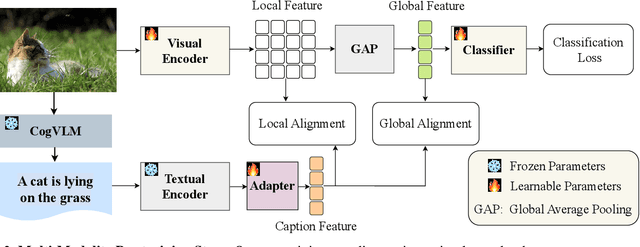
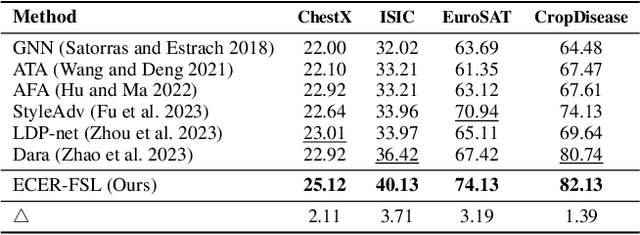
Few-shot learning (FSL) aims to recognize new concepts using a limited number of visual samples. Existing approaches attempt to incorporate semantic information into the limited visual data for category understanding. However, these methods often enrich class-level feature representations with abstract category names, failing to capture the nuanced features essential for effective generalization. To address this issue, we propose a novel framework for FSL, which incorporates both the abstract class semantics and the concrete class entities extracted from Large Language Models (LLMs), to enhance the representation of the class prototypes. Specifically, our framework composes a Semantic-guided Visual Pattern Extraction (SVPE) module and a Prototype-Calibration (PC) module, where the SVPE meticulously extracts semantic-aware visual patterns across diverse scales, while the PC module seamlessly integrates these patterns to refine the visual prototype, enhancing its representativeness. Extensive experiments on four few-shot classification benchmarks and the BSCD-FSL cross-domain benchmarks showcase remarkable advancements over the current state-of-the-art methods. Notably, for the challenging one-shot setting, our approach, utilizing the ResNet-12 backbone, achieves an impressive average improvement of 1.95% over the second-best competitor.
TXL-PBC: a freely accessible labeled peripheral blood cell dataset
Jul 18, 2024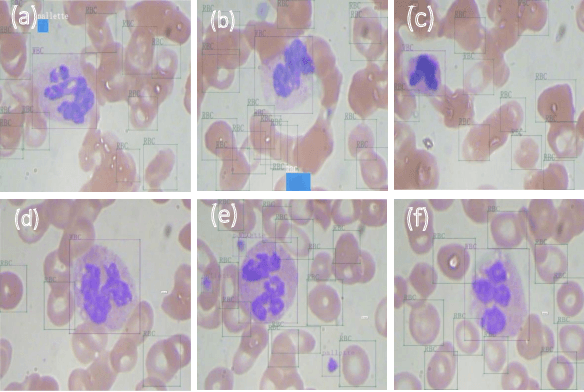
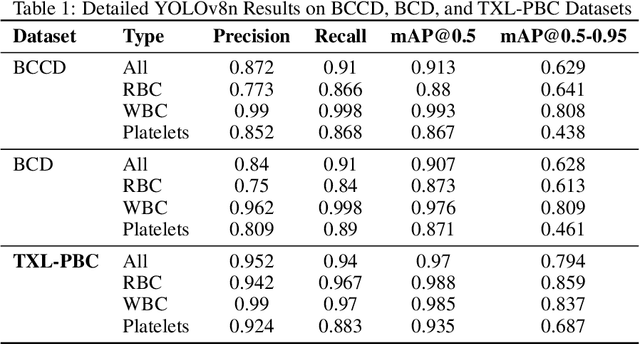
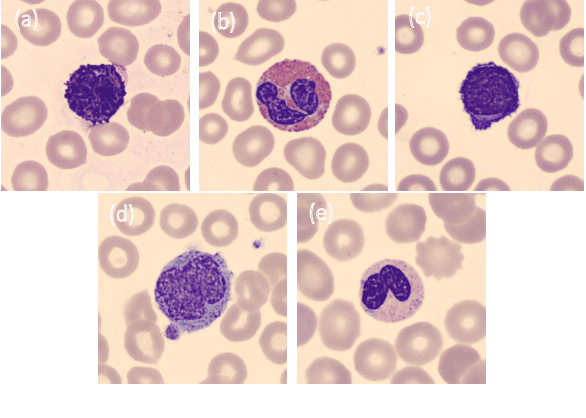
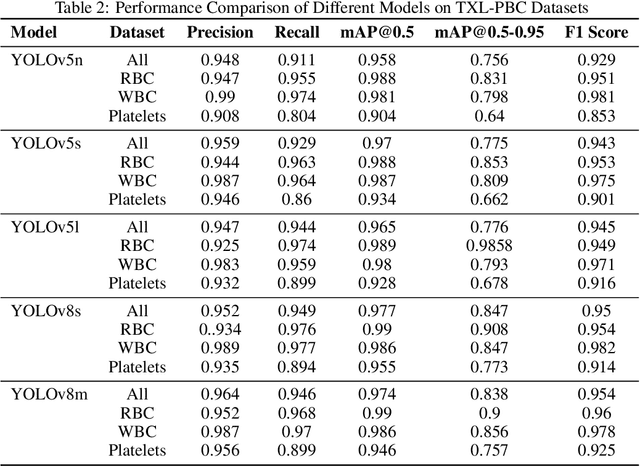
In a recent study, we found that publicly BCCD and BCD datasets have significant issues such as labeling errors, insufficient sample size, and poor data quality. To address these problems, we performed sample deletion, re-labeling, and integration of these two datasets. Additionally, we introduced the PBC and Raabin-WBC datasets, and ultimately created a high-quality, sample-balanced new dataset, which we named TXL-PBC. The dataset contains 1008 training sets, 288 validation sets, and 144 test sets. Firstly, The dataset underwent strict manual annotation, automatic annotation with YOLOv8n model, and manual audit steps to ensure the accuracy and consistency of annotations. Secondly, we addresses the blood cell mislabeling problem of the original datasets. The distribution of label boundary box areas and the number of labels are better than the BCCD and BCD datasets. Moreover, we used the YOLOv8n model to train these three datasets, the performance of the TXL-PBC dataset surpass the original two datasets. Finally, we employed YOLOv5n, YOLOv5s, YOLOv5l, YOLOv8s, YOLOv8m detection models as the baseline models for TXL-PBC. This study not only enhances the quality of the blood cell dataset but also supports researchers in improving models for blood cell target detection. We published our freely accessible TXL-PBC dataset at https://github.com/lugan113/TXL-PBC\_Dataset.
CLASH: Complementary Learning with Neural Architecture Search for Gait Recognition
Jul 04, 2024


Gait recognition, which aims at identifying individuals by their walking patterns, has achieved great success based on silhouette. The binary silhouette sequence encodes the walking pattern within the sparse boundary representation. Therefore, most pixels in the silhouette are under-sensitive to the walking pattern since the sparse boundary lacks dense spatial-temporal information, which is suitable to be represented with dense texture. To enhance the sensitivity to the walking pattern while maintaining the robustness of recognition, we present a Complementary Learning with neural Architecture Search (CLASH) framework, consisting of walking pattern sensitive gait descriptor named dense spatial-temporal field (DSTF) and neural architecture search based complementary learning (NCL). Specifically, DSTF transforms the representation from the sparse binary boundary into the dense distance-based texture, which is sensitive to the walking pattern at the pixel level. Further, NCL presents a task-specific search space for complementary learning, which mutually complements the sensitivity of DSTF and the robustness of the silhouette to represent the walking pattern effectively. Extensive experiments demonstrate the effectiveness of the proposed methods under both in-the-lab and in-the-wild scenarios. On CASIA-B, we achieve rank-1 accuracy of 98.8%, 96.5%, and 89.3% under three conditions. On OU-MVLP, we achieve rank-1 accuracy of 91.9%. Under the latest in-the-wild datasets, we outperform the latest silhouette-based methods by 16.3% and 19.7% on Gait3D and GREW, respectively.
GVDIFF: Grounded Text-to-Video Generation with Diffusion Models
Jul 02, 2024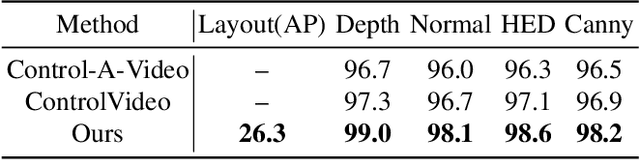

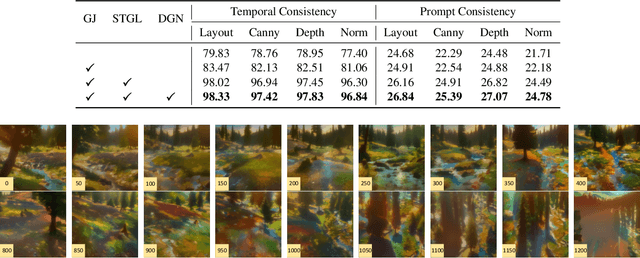

In text-to-video (T2V) generation, significant attention has been directed toward its development, yet unifying discrete and continuous grounding conditions in T2V generation remains under-explored. This paper proposes a Grounded text-to-Video generation framework, termed GVDIFF. First, we inject the grounding condition into the self-attention through an uncertainty-based representation to explicitly guide the focus of the network. Second, we introduce a spatial-temporal grounding layer that connects the grounding condition with target objects and enables the model with the grounded generation capacity in the spatial-temporal domain. Third, our dynamic gate network adaptively skips the redundant grounding process to selectively extract grounding information and semantics while improving efficiency. We extensively evaluate the grounded generation capacity of GVDIFF and demonstrate its versatility in applications, including long-range video generation, sequential prompts, and object-specific editing.