 Add to Chrome
 Add to Firefox
 Add to Edge
FeatUp: A Model-Agnostic Framework for Features at Any Resolution
Mar 15, 2024
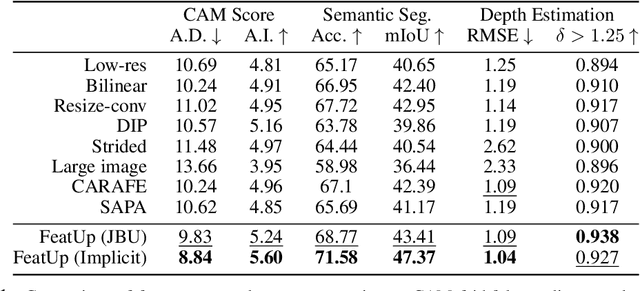

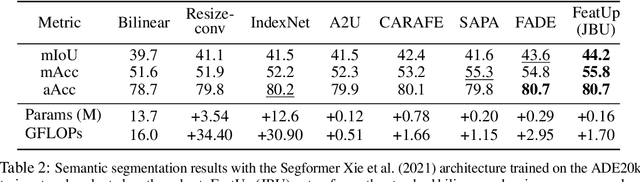

Deep features are a cornerstone of computer vision research, capturing image semantics and enabling the community to solve downstream tasks even in the zero- or few-shot regime. However, these features often lack the spatial resolution to directly perform dense prediction tasks like segmentation and depth prediction because models aggressively pool information over large areas. In this work, we introduce FeatUp, a task- and model-agnostic framework to restore lost spatial information in deep features. We introduce two variants of FeatUp: one that guides features with high-resolution signal in a single forward pass, and one that fits an implicit model to a single image to reconstruct features at any resolution. Both approaches use a multi-view consistency loss with deep analogies to NeRFs. Our features retain their original semantics and can be swapped into existing applications to yield resolution and performance gains even without re-training. We show that FeatUp significantly outperforms other feature upsampling and image super-resolution approaches in class activation map generation, transfer learning for segmentation and depth prediction, and end-to-end training for semantic segmentation.

Bayes3D: fast learning and inference in structured generative models of 3D objects and scenes
Dec 14, 2023
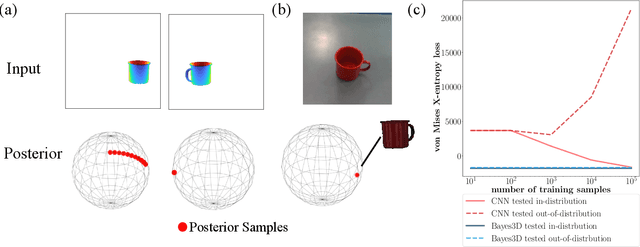
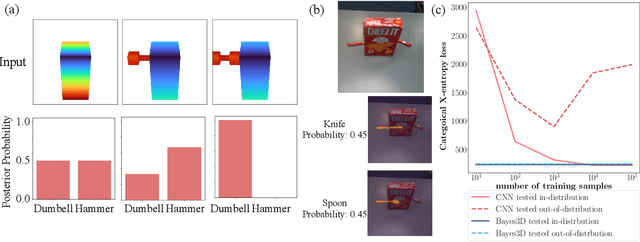
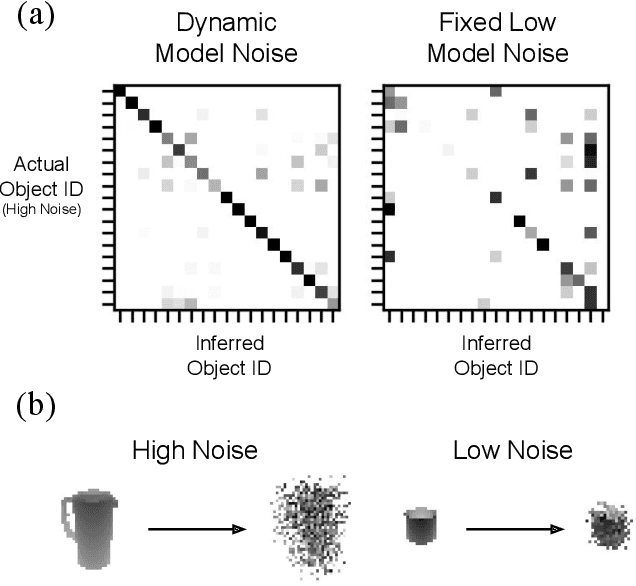
Robots cannot yet match humans' ability to rapidly learn the shapes of novel 3D objects and recognize them robustly despite clutter and occlusion. We present Bayes3D, an uncertainty-aware perception system for structured 3D scenes, that reports accurate posterior uncertainty over 3D object shape, pose, and scene composition in the presence of clutter and occlusion. Bayes3D delivers these capabilities via a novel hierarchical Bayesian model for 3D scenes and a GPU-accelerated coarse-to-fine sequential Monte Carlo algorithm. Quantitative experiments show that Bayes3D can learn 3D models of novel objects from just a handful of views, recognizing them more robustly and with orders of magnitude less training data than neural baselines, and tracking 3D objects faster than real time on a single GPU. We also demonstrate that Bayes3D learns complex 3D object models and accurately infers 3D scene composition when used on a Panda robot in a tabletop scenario.
WonderJourney: Going from Anywhere to Everywhere
Dec 06, 2023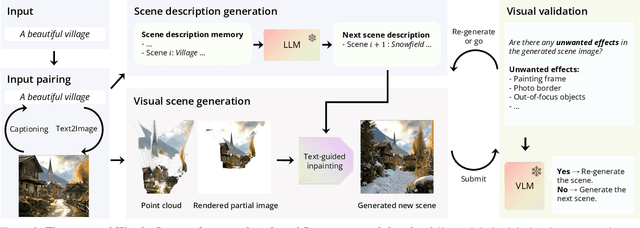
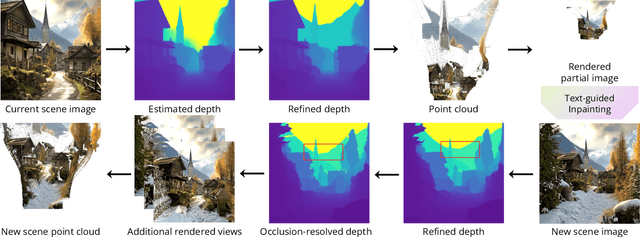


We introduce WonderJourney, a modularized framework for perpetual 3D scene generation. Unlike prior work on view generation that focuses on a single type of scenes, we start at any user-provided location (by a text description or an image) and generate a journey through a long sequence of diverse yet coherently connected 3D scenes. We leverage an LLM to generate textual descriptions of the scenes in this journey, a text-driven point cloud generation pipeline to make a compelling and coherent sequence of 3D scenes, and a large VLM to verify the generated scenes. We show compelling, diverse visual results across various scene types and styles, forming imaginary "wonderjourneys". Project website: https://kovenyu.com/WonderJourney/
One-step Diffusion with Distribution Matching Distillation
Dec 05, 2023
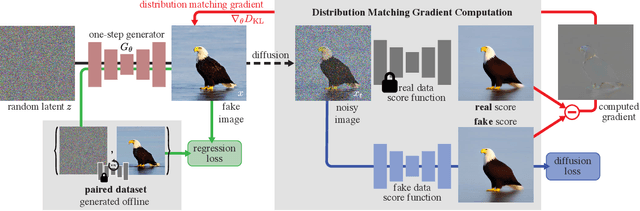

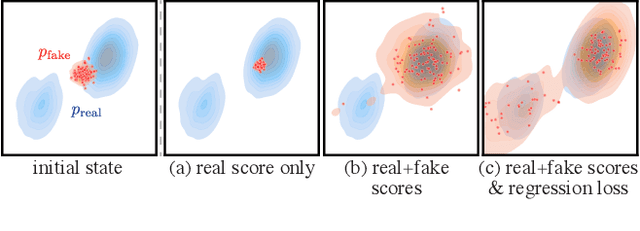
Diffusion models generate high-quality images but require dozens of forward passes. We introduce Distribution Matching Distillation (DMD), a procedure to transform a diffusion model into a one-step image generator with minimal impact on image quality. We enforce the one-step image generator match the diffusion model at distribution level, by minimizing an approximate KL divergence whose gradient can be expressed as the difference between 2 score functions, one of the target distribution and the other of the synthetic distribution being produced by our one-step generator. The score functions are parameterized as two diffusion models trained separately on each distribution. Combined with a simple regression loss matching the large-scale structure of the multi-step diffusion outputs, our method outperforms all published few-step diffusion approaches, reaching 2.62 FID on ImageNet 64x64 and 11.49 FID on zero-shot COCO-30k, comparable to Stable Diffusion but orders of magnitude faster. Utilizing FP16 inference, our model generates images at 20 FPS on modern hardware.
Alchemist: Parametric Control of Material Properties with Diffusion Models
Dec 05, 2023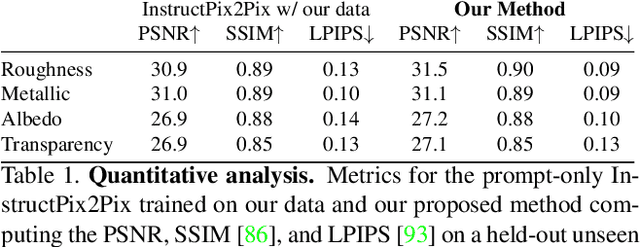
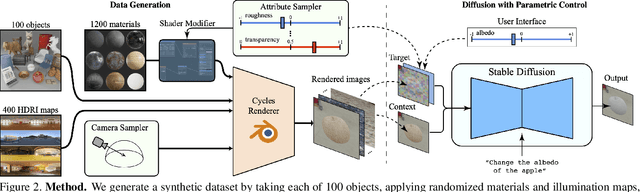
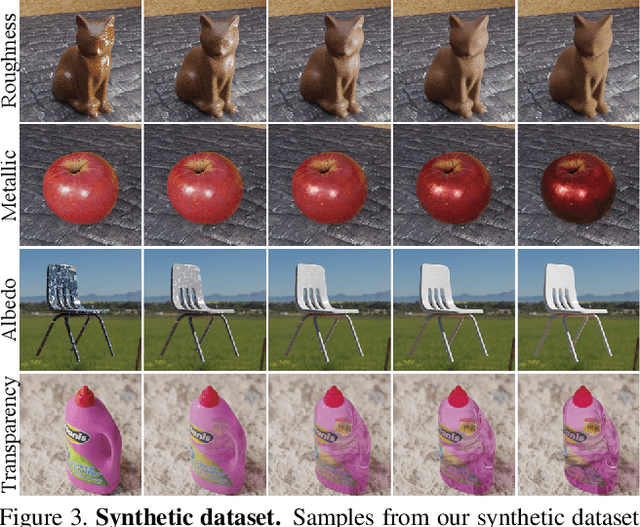
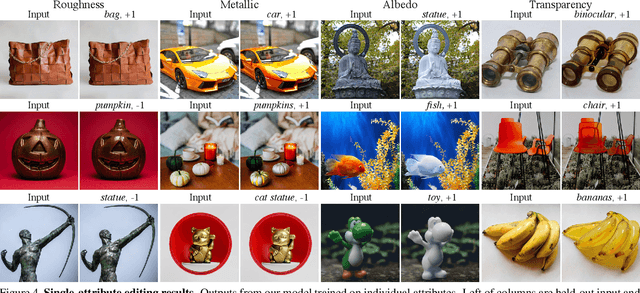
We propose a method to control material attributes of objects like roughness, metallic, albedo, and transparency in real images. Our method capitalizes on the generative prior of text-to-image models known for photorealism, employing a scalar value and instructions to alter low-level material properties. Addressing the lack of datasets with controlled material attributes, we generated an object-centric synthetic dataset with physically-based materials. Fine-tuning a modified pre-trained text-to-image model on this synthetic dataset enables us to edit material properties in real-world images while preserving all other attributes. We show the potential application of our model to material edited NeRFs.
Large-Scale Automatic Audiobook Creation
Sep 07, 2023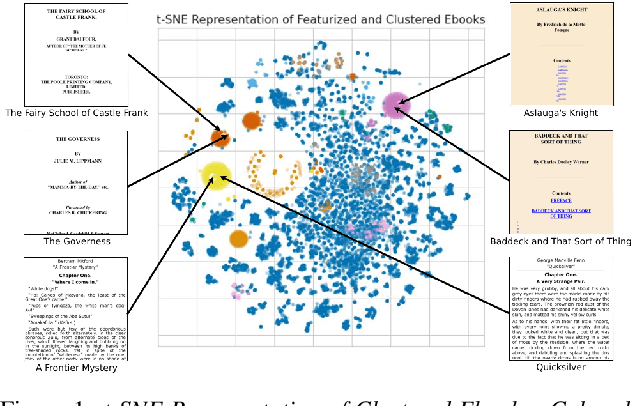
An audiobook can dramatically improve a work of literature's accessibility and improve reader engagement. However, audiobooks can take hundreds of hours of human effort to create, edit, and publish. In this work, we present a system that can automatically generate high-quality audiobooks from online e-books. In particular, we leverage recent advances in neural text-to-speech to create and release thousands of human-quality, open-license audiobooks from the Project Gutenberg e-book collection. Our method can identify the proper subset of e-book content to read for a wide collection of diversely structured books and can operate on hundreds of books in parallel. Our system allows users to customize an audiobook's speaking speed and style, emotional intonation, and can even match a desired voice using a small amount of sample audio. This work contributed over five thousand open-license audiobooks and an interactive demo that allows users to quickly create their own customized audiobooks. To listen to the audiobook collection visit \url{https://aka.ms/audiobook}.
3D Motion Magnification: Visualizing Subtle Motions with Time Varying Radiance Fields
Aug 07, 2023Motion magnification helps us visualize subtle, imperceptible motion. However, prior methods only work for 2D videos captured with a fixed camera. We present a 3D motion magnification method that can magnify subtle motions from scenes captured by a moving camera, while supporting novel view rendering. We represent the scene with time-varying radiance fields and leverage the Eulerian principle for motion magnification to extract and amplify the variation of the embedding of a fixed point over time. We study and validate our proposed principle for 3D motion magnification using both implicit and tri-plane-based radiance fields as our underlying 3D scene representation. We evaluate the effectiveness of our method on both synthetic and real-world scenes captured under various camera setups.
Diffusion with Forward Models: Solving Stochastic Inverse Problems Without Direct Supervision
Jun 20, 2023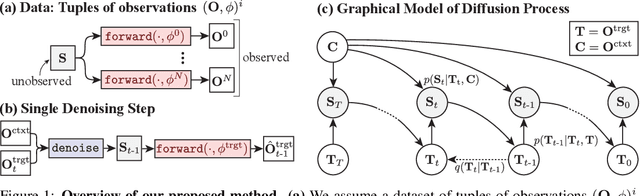


Denoising diffusion models are a powerful type of generative models used to capture complex distributions of real-world signals. However, their applicability is limited to scenarios where training samples are readily available, which is not always the case in real-world applications. For example, in inverse graphics, the goal is to generate samples from a distribution of 3D scenes that align with a given image, but ground-truth 3D scenes are unavailable and only 2D images are accessible. To address this limitation, we propose a novel class of denoising diffusion probabilistic models that learn to sample from distributions of signals that are never directly observed. Instead, these signals are measured indirectly through a known differentiable forward model, which produces partial observations of the unknown signal. Our approach involves integrating the forward model directly into the denoising process. This integration effectively connects the generative modeling of observations with the generative modeling of the underlying signals, allowing for end-to-end training of a conditional generative model over signals. During inference, our approach enables sampling from the distribution of underlying signals that are consistent with a given partial observation. We demonstrate the effectiveness of our method on three challenging computer vision tasks. For instance, in the context of inverse graphics, our model enables direct sampling from the distribution of 3D scenes that align with a single 2D input image.
Background Prompting for Improved Object Depth
Jun 08, 2023Estimating the depth of objects from a single image is a valuable task for many vision, robotics, and graphics applications. However, current methods often fail to produce accurate depth for objects in diverse scenes. In this work, we propose a simple yet effective Background Prompting strategy that adapts the input object image with a learned background. We learn the background prompts only using small-scale synthetic object datasets. To infer object depth on a real image, we place the segmented object into the learned background prompt and run off-the-shelf depth networks. Background Prompting helps the depth networks focus on the foreground object, as they are made invariant to background variations. Moreover, Background Prompting minimizes the domain gap between synthetic and real object images, leading to better sim2real generalization than simple finetuning. Results on multiple synthetic and real datasets demonstrate consistent improvements in real object depths for a variety of existing depth networks. Code and optimized background prompts can be found at: https://mbaradad.github.io/depth_prompt.
Materialistic: Selecting Similar Materials in Images
May 22, 2023Separating an image into meaningful underlying components is a crucial first step for both editing and understanding images. We present a method capable of selecting the regions of a photograph exhibiting the same material as an artist-chosen area. Our proposed approach is robust to shading, specular highlights, and cast shadows, enabling selection in real images. As we do not rely on semantic segmentation (different woods or metal should not be selected together), we formulate the problem as a similarity-based grouping problem based on a user-provided image location. In particular, we propose to leverage the unsupervised DINO features coupled with a proposed Cross-Similarity module and an MLP head to extract material similarities in an image. We train our model on a new synthetic image dataset, that we release. We show that our method generalizes well to real-world images. We carefully analyze our model's behavior on varying material properties and lighting. Additionally, we evaluate it against a hand-annotated benchmark of 50 real photographs. We further demonstrate our model on a set of applications, including material editing, in-video selection, and retrieval of object photographs with similar materials.