 Add to Chrome
 Add to Firefox
 Add to Edge
Lighting-Consistent Object Transfer Across Radiance Fields
Jun 21, 2026
3D Gaussian Splatting (3DGS) is widely used to capture and render real scenes. Compositing objects from one capture into another has applications in many domains, such as VFX, architecture and interior design, or marketing. However, extracting an object from a source scene and naively pasting it into a target scene will fail to produce realistic results due to the different lighting conditions between the two scenes. To address this problem, we introduce a diffusion model that harmonizes naively composited images with inconsistent lighting. The model is trained with a heterogeneous dataset of image pairs (inconsistent composite input, consistent output), combining synthetic, generated, and real data. Our complete 3D solution allows a user to extract an object from the source scene and composite it into the target scene. From this, the (inconsistent) views of the target scene with the composite object are rendered. Our diffusion model harmonizes each one of these views, which are finally consolidated in a 3DGS representation with a post-optimization step. Our method provides visually compelling results, making object transfer between 3DGS easy to use and significantly improving quality compared to previous methods.
* Project page: https://repo-sam.inria.fr/nerphys/dot3d

Go-with-the-Track: Video Compositing and Motion Control with Point Tracking
Jun 18, 2026Filmmaking demands precise motion control and reference image compositing -- capabilities that existing methods treat separately. Point-track-conditioned image-to-video models restrict content insertion to the first frame, while reference-to-video models lack fine-grained spatial-temporal control over how reference content integrates across frames. We present Go-with-the-Track, which unifies both capabilities by jointly conditioning on multiple reference images and reference-anchored point-tracks -- extending conventional point-tracks to explicitly establish correspondences between generated frames and reference images, thus enabling precise compositing and motion control throughout the video. To achieve this, we introduce spatially-aware point-track embeddings that encode the full sequence of point-track coordinates using a coordinate-wise MLP followed by temporal pooling. This representation captures the spatial characteristics of each point-track (serving as a unique identifier), while the embedding similarity correlates directly with spatial proximity, enhancing the model's ability to distinguish and associate point-tracks. We inject these point-track embeddings into a video diffusion transformer via a lightweight adapter, resolving the pixel-to-patch resolution mismatch while avoiding the substantial motion detail loss inherent in naive point-track subsampling. We use a hybrid training strategy to train jointly on dynamic, static, and synthetic scene video datasets to boost motion controllability. Experiments demonstrate that Go-with-the-Track achieves superior motion and reference control in a single model and enables new capabilities: multi-reference conditioned video generation with point-track driven compositing, as well as camera control for both static and dynamic scenes. Project Page: https://eyeline-labs.github.io/Go-with-the-Track/
BodyReLux: Temporally Consistent Full-Body Video Relighting
May 20, 2026Being able to relight human performance is a fundamental task for post production and content creation. We present BodyReLux, a subject-specific video diffusion-based framework for relighting full-body human performances in a temporally consistent way. Our model is trained on a hybrid dataset of pixel-aligned video relighting pairs, covering a diverse combination of lighting conditions, performances and viewpoints. To acquire such dataset, we combine traditional static One-Light-at-a-Time (OLAT) capture and a novel dynamic performance capture in which two smoothly varying lighting sequences are rapidly interleaved. Because the lighting operates above the human flicker-fusion threshold, the interleaving does not appear to strobe. We train our video relighting model from a pretrained text-to-video model to fully leverage the generative priors for producing high quality videos. To achieve accurate lighting control, we introduce a new lighting conditioning method that represents each light source as a token. We further condition on sequences of lighting using masked attention to support dynamic lighting control. Together with a carefully designed data augmentation pipeline, we achieve photorealistic, robust, and temporally consistent video relighting of subject-specific human performances.
DiffHDR: Re-Exposing LDR Videos with Video Diffusion Models
Apr 07, 2026Most digital videos are stored in 8-bit low dynamic range (LDR) formats, where much of the original high dynamic range (HDR) scene radiance is lost due to saturation and quantization. This loss of highlight and shadow detail precludes mapping accurate luminance to HDR displays and limits meaningful re-exposure in post-production workflows. Although techniques have been proposed to convert LDR images to HDR through dynamic range expansion, they struggle to restore realistic detail in the over- and underexposed regions. To address this, we present DiffHDR, a framework that formulates LDR-to-HDR conversion as a generative radiance inpainting task within the latent space of a video diffusion model. By operating in Log-Gamma color space, DiffHDR leverages spatio-temporal generative priors from a pretrained video diffusion model to synthesize plausible HDR radiance in over- and underexposed regions while recovering the continuous scene radiance of the quantized pixels. Our framework further enables controllable LDR-to-HDR video conversion guided by text prompts or reference images. To address the scarcity of paired HDR video data, we develop a pipeline that synthesizes high-quality HDR video training data from static HDRI maps. Extensive experiments demonstrate that DiffHDR significantly outperforms state-of-the-art approaches in radiance fidelity and temporal stability, producing realistic HDR videos with considerable latitude for re-exposure.
Lighting in Motion: Spatiotemporal HDR Lighting Estimation
Dec 15, 2025We present Lighting in Motion (LiMo), a diffusion-based approach to spatiotemporal lighting estimation. LiMo targets both realistic high-frequency detail prediction and accurate illuminance estimation. To account for both, we propose generating a set of mirrored and diffuse spheres at different exposures, based on their 3D positions in the input. Making use of diffusion priors, we fine-tune powerful existing diffusion models on a large-scale customized dataset of indoor and outdoor scenes, paired with spatiotemporal light probes. For accurate spatial conditioning, we demonstrate that depth alone is insufficient and we introduce a new geometric condition to provide the relative position of the scene to the target 3D position. Finally, we combine diffuse and mirror predictions at different exposures into a single HDRI map leveraging differentiable rendering. We thoroughly evaluate our method and design choices to establish LiMo as state-of-the-art for both spatial control and prediction accuracy.
Virtually Being: Customizing Camera-Controllable Video Diffusion Models with Multi-View Performance Captures
Oct 16, 2025We introduce a framework that enables both multi-view character consistency and 3D camera control in video diffusion models through a novel customization data pipeline. We train the character consistency component with recorded volumetric capture performances re-rendered with diverse camera trajectories via 4D Gaussian Splatting (4DGS), lighting variability obtained with a video relighting model. We fine-tune state-of-the-art open-source video diffusion models on this data to provide strong multi-view identity preservation, precise camera control, and lighting adaptability. Our framework also supports core capabilities for virtual production, including multi-subject generation using two approaches: joint training and noise blending, the latter enabling efficient composition of independently customized models at inference time; it also achieves scene and real-life video customization as well as control over motion and spatial layout during customization. Extensive experiments show improved video quality, higher personalization accuracy, and enhanced camera control and lighting adaptability, advancing the integration of video generation into virtual production. Our project page is available at: https://eyeline-labs.github.io/Virtually-Being.
Lux Post Facto: Learning Portrait Performance Relighting with Conditional Video Diffusion and a Hybrid Dataset
Mar 18, 2025Video portrait relighting remains challenging because the results need to be both photorealistic and temporally stable. This typically requires a strong model design that can capture complex facial reflections as well as intensive training on a high-quality paired video dataset, such as dynamic one-light-at-a-time (OLAT). In this work, we introduce Lux Post Facto, a novel portrait video relighting method that produces both photorealistic and temporally consistent lighting effects. From the model side, we design a new conditional video diffusion model built upon state-of-the-art pre-trained video diffusion model, alongside a new lighting injection mechanism to enable precise control. This way we leverage strong spatial and temporal generative capability to generate plausible solutions to the ill-posed relighting problem. Our technique uses a hybrid dataset consisting of static expression OLAT data and in-the-wild portrait performance videos to jointly learn relighting and temporal modeling. This avoids the need to acquire paired video data in different lighting conditions. Our extensive experiments show that our model produces state-of-the-art results both in terms of photorealism and temporal consistency.
A Diffusion Approach to Radiance Field Relighting using Multi-Illumination Synthesis
Sep 17, 2024Relighting radiance fields is severely underconstrained for multi-view data, which is most often captured under a single illumination condition; It is especially hard for full scenes containing multiple objects. We introduce a method to create relightable radiance fields using such single-illumination data by exploiting priors extracted from 2D image diffusion models. We first fine-tune a 2D diffusion model on a multi-illumination dataset conditioned by light direction, allowing us to augment a single-illumination capture into a realistic -- but possibly inconsistent -- multi-illumination dataset from directly defined light directions. We use this augmented data to create a relightable radiance field represented by 3D Gaussian splats. To allow direct control of light direction for low-frequency lighting, we represent appearance with a multi-layer perceptron parameterized on light direction. To enforce multi-view consistency and overcome inaccuracies we optimize a per-image auxiliary feature vector. We show results on synthetic and real multi-view data under single illumination, demonstrating that our method successfully exploits 2D diffusion model priors to allow realistic 3D relighting for complete scenes. Project site https://repo-sam.inria.fr/fungraph/generative-radiance-field-relighting/
* Project site https://repo-sam.inria.fr/fungraph/generative-radiance-field-relighting/
RRM: Relightable assets using Radiance guided Material extraction
Jul 08, 2024Synthesizing NeRFs under arbitrary lighting has become a seminal problem in the last few years. Recent efforts tackle the problem via the extraction of physically-based parameters that can then be rendered under arbitrary lighting, but they are limited in the range of scenes they can handle, usually mishandling glossy scenes. We propose RRM, a method that can extract the materials, geometry, and environment lighting of a scene even in the presence of highly reflective objects. Our method consists of a physically-aware radiance field representation that informs physically-based parameters, and an expressive environment light structure based on a Laplacian Pyramid. We demonstrate that our contributions outperform the state-of-the-art on parameter retrieval tasks, leading to high-fidelity relighting and novel view synthesis on surfacic scenes.
Fast and Uncertainty-Aware SVBRDF Recovery from Multi-View Capture using Frequency Domain Analysis
Jun 25, 2024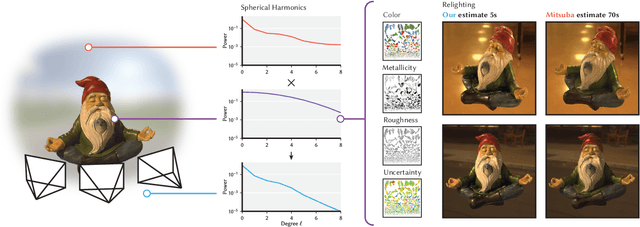
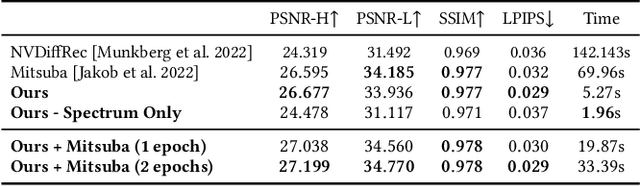
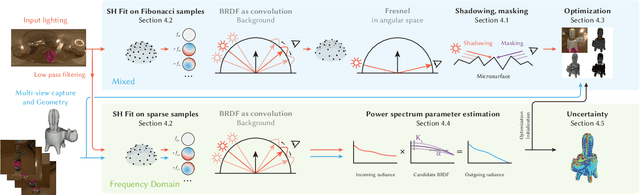

Relightable object acquisition is a key challenge in simplifying digital asset creation. Complete reconstruction of an object typically requires capturing hundreds to thousands of photographs under controlled illumination, with specialized equipment. The recent progress in differentiable rendering improved the quality and accessibility of inverse rendering optimization. Nevertheless, under uncontrolled illumination and unstructured viewpoints, there is no guarantee that the observations contain enough information to reconstruct the appearance properties of the captured object. We thus propose to consider the acquisition process from a signal-processing perspective. Given an object's geometry and a lighting environment, we estimate the properties of the materials on the object's surface in seconds. We do so by leveraging frequency domain analysis, considering the recovery of material properties as a deconvolution, enabling fast error estimation. We then quantify the uncertainty of the estimation, based on the available data, highlighting the areas for which priors or additional samples would be required for improved acquisition quality. We compare our approach to previous work and quantitatively evaluate our results, showing similar quality as previous work in a fraction of the time, and providing key information about the certainty of the results.