 Add to Chrome
 Add to Firefox
 Add to Edge
SF-GNN: Self Filter for Message Lossless Propagation in Deep Graph Neural Network
Jul 03, 2024

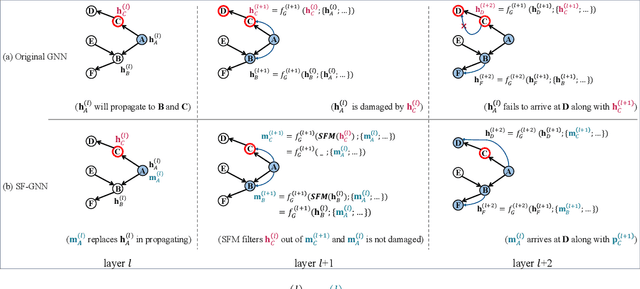
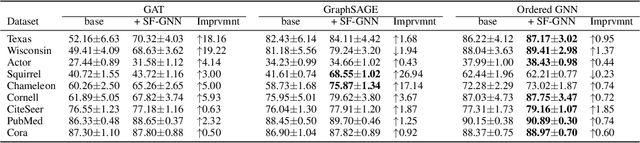
Graph Neural Network (GNN), with the main idea of encoding graph structure information of graphs by propagation and aggregation, has developed rapidly. It achieved excellent performance in representation learning of multiple types of graphs such as homogeneous graphs, heterogeneous graphs, and more complex graphs like knowledge graphs. However, merely stacking GNN layers may not improve the model's performance and can even be detrimental. For the phenomenon of performance degradation in deep GNNs, we propose a new perspective. Unlike the popular explanations of over-smoothing or over-squashing, we think the issue arises from the interference of low-quality node representations during message propagation. We introduce a simple and general method, SF-GNN, to address this problem. In SF-GNN, we define two representations for each node, one is the node representation that represents the feature of the node itself, and the other is the message representation specifically for propagating messages to neighbor nodes. A self-filter module evaluates the quality of the node representation and decides whether to integrate it into the message propagation based on this quality assessment. Experiments on node classification tasks for both homogeneous and heterogeneous graphs, as well as link prediction tasks on knowledge graphs, demonstrate that our method can be applied to various GNN models and outperforms state-of-the-art baseline methods in addressing deep GNN degradation.

ZeroDDI: A Zero-Shot Drug-Drug Interaction Event Prediction Method with Semantic Enhanced Learning and Dual-Modal Uniform Alignment
Jul 01, 2024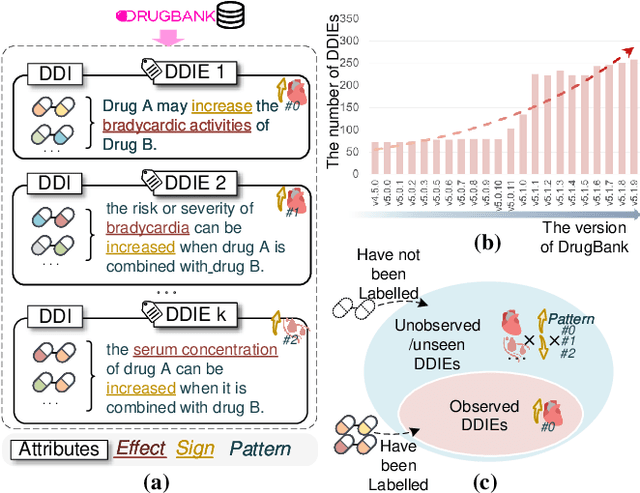
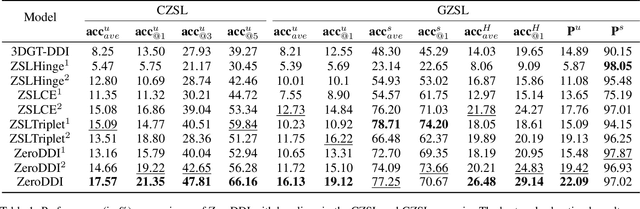
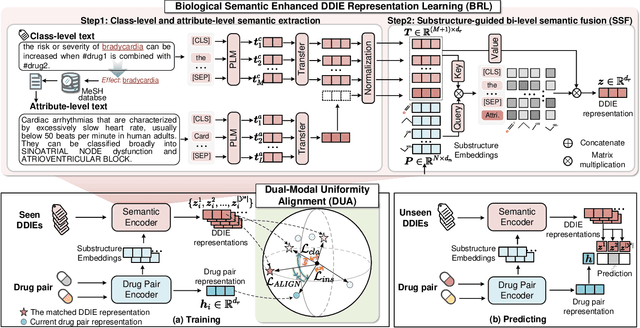
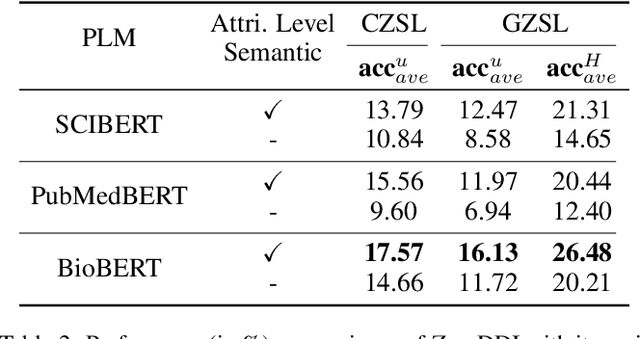
Drug-drug interactions (DDIs) can result in various pharmacological changes, which can be categorized into different classes known as DDI events (DDIEs). In recent years, previously unobserved/unseen DDIEs have been emerging, posing a new classification task when unseen classes have no labelled instances in the training stage, which is formulated as a zero-shot DDIE prediction (ZS-DDIE) task. However, existing computational methods are not directly applicable to ZS-DDIE, which has two primary challenges: obtaining suitable DDIE representations and handling the class imbalance issue. To overcome these challenges, we propose a novel method named ZeroDDI for the ZS-DDIE task. Specifically, we design a biological semantic enhanced DDIE representation learning module, which emphasizes the key biological semantics and distills discriminative molecular substructure-related semantics for DDIE representation learning. Furthermore, we propose a dual-modal uniform alignment strategy to distribute drug pair representations and DDIE semantic representations uniformly in a unit sphere and align the matched ones, which can mitigate the issue of class imbalance. Extensive experiments showed that ZeroDDI surpasses the baselines and indicate that it is a promising tool for detecting unseen DDIEs. Our code has been released in https://github.com/wzy-Sarah/ZeroDDI.
TrustUQA: A Trustful Framework for Unified Structured Data Question Answering
Jun 27, 2024


Natural language question answering (QA) over structured data sources such as tables and knowledge graphs (KGs) have been widely investigated, for example with Large Language Models (LLMs). The main solutions include question to formal query parsing and retrieval-based answer generation. However, current methods of the former often suffer from weak generalization, failing to dealing with multiple sources simultaneously, while the later is limited in trustfulness. In this paper, we propose UnifiedTQA, a trustful QA framework that can simultaneously support multiple types of structured data in a unified way. To this end, it adopts an LLM-friendly and unified knowledge representation method called Condition Graph (CG), and uses an LLM and demonstration-based two-level method for CG querying. For enhancement, it is also equipped with dynamic demonstration retrieval. We have evaluated UnifiedTQA with 5 benchmarks covering 3 types of structured data. It outperforms 2 existing unified structured data QA methods and in comparison with the baselines that are specific to a data type, it achieves state-of-the-art on 2 of them. Further more, we demonstrates potential of our method for more general QA tasks, QA over mixed structured data and QA across structured data.
Heterogeneous Causal Metapath Graph Neural Network for Gene-Microbe-Disease Association Prediction
Jun 27, 2024The recent focus on microbes in human medicine highlights their potential role in the genetic framework of diseases. To decode the complex interactions among genes, microbes, and diseases, computational predictions of gene-microbe-disease (GMD) associations are crucial. Existing methods primarily address gene-disease and microbe-disease associations, but the more intricate triple-wise GMD associations remain less explored. In this paper, we propose a Heterogeneous Causal Metapath Graph Neural Network (HCMGNN) to predict GMD associations. HCMGNN constructs a heterogeneous graph linking genes, microbes, and diseases through their pairwise associations, and utilizes six predefined causal metapaths to extract directed causal subgraphs, which facilitate the multi-view analysis of causal relations among three entity types. Within each subgraph, we employ a causal semantic sharing message passing network for node representation learning, coupled with an attentive fusion method to integrate these representations for predicting GMD associations. Our extensive experiments show that HCMGNN effectively predicts GMD associations and addresses association sparsity issue by enhancing the graph's semantics and structure.
Start from Zero: Triple Set Prediction for Automatic Knowledge Graph Completion
Jun 26, 2024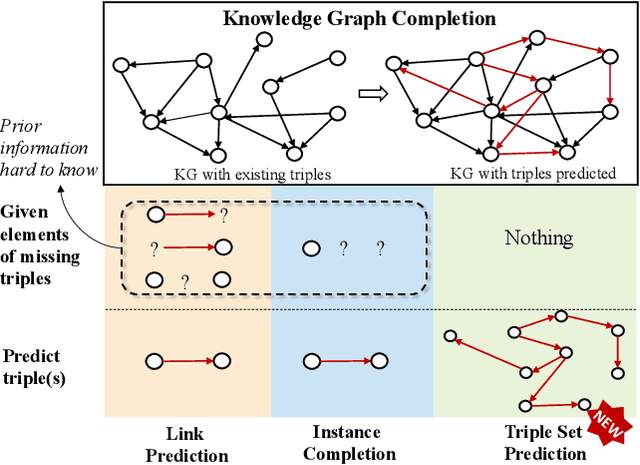



Knowledge graph (KG) completion aims to find out missing triples in a KG. Some tasks, such as link prediction and instance completion, have been proposed for KG completion. They are triple-level tasks with some elements in a missing triple given to predict the missing element of the triple. However, knowing some elements of the missing triple in advance is not always a realistic setting. In this paper, we propose a novel graph-level automatic KG completion task called Triple Set Prediction (TSP) which assumes none of the elements in the missing triples is given. TSP is to predict a set of missing triples given a set of known triples. To properly and accurately evaluate this new task, we propose 4 evaluation metrics including 3 classification metrics and 1 ranking metric, considering both the partial-open-world and the closed-world assumptions. Furthermore, to tackle the huge candidate triples for prediction, we propose a novel and efficient subgraph-based method GPHT that can predict the triple set fast. To fairly compare the TSP results, we also propose two types of methods RuleTensor-TSP and KGE-TSP applying the existing rule- and embedding-based methods for TSP as baselines. During experiments, we evaluate the proposed methods on two datasets extracted from Wikidata following the relation-similarity partial-open-world assumption proposed by us, and also create a complete family data set to evaluate TSP results following the closed-world assumption. Results prove that the methods can successfully generate a set of missing triples and achieve reasonable scores on the new task, and GPHT performs better than the baselines with significantly shorter prediction time. The datasets and code for experiments are available at https://github.com/zjukg/GPHT-for-TSP.
Learning to Plan for Retrieval-Augmented Large Language Models from Knowledge Graphs
Jun 20, 2024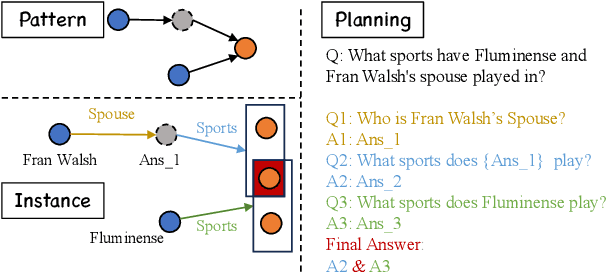


Improving the performance of large language models (LLMs) in complex question-answering (QA) scenarios has always been a research focal point. Recent studies have attempted to enhance LLMs' performance by combining step-wise planning with external retrieval. While effective for advanced models like GPT-3.5, smaller LLMs face challenges in decomposing complex questions, necessitating supervised fine-tuning. Previous work has relied on manual annotation and knowledge distillation from teacher LLMs, which are time-consuming and not accurate enough. In this paper, we introduce a novel framework for enhancing LLMs' planning capabilities by using planning data derived from knowledge graphs (KGs). LLMs fine-tuned with this data have improved planning capabilities, better equipping them to handle complex QA tasks that involve retrieval. Evaluations on multiple datasets, including our newly proposed benchmark, highlight the effectiveness of our framework and the benefits of KG-derived planning data.
Liberal Entity Matching as a Compound AI Toolchain
Jun 17, 2024Entity matching (EM), the task of identifying whether two descriptions refer to the same entity, is essential in data management. Traditional methods have evolved from rule-based to AI-driven approaches, yet current techniques using large language models (LLMs) often fall short due to their reliance on static knowledge and rigid, predefined prompts. In this paper, we introduce Libem, a compound AI system designed to address these limitations by incorporating a flexible, tool-oriented approach. Libem supports entity matching through dynamic tool use, self-refinement, and optimization, allowing it to adapt and refine its process based on the dataset and performance metrics. Unlike traditional solo-AI EM systems, which often suffer from a lack of modularity that hinders iterative design improvements and system optimization, Libem offers a composable and reusable toolchain. This approach aims to contribute to ongoing discussions and developments in AI-driven data management.
Improving Paratope and Epitope Prediction by Multi-Modal Contrastive Learning and Interaction Informativeness Estimation
May 31, 2024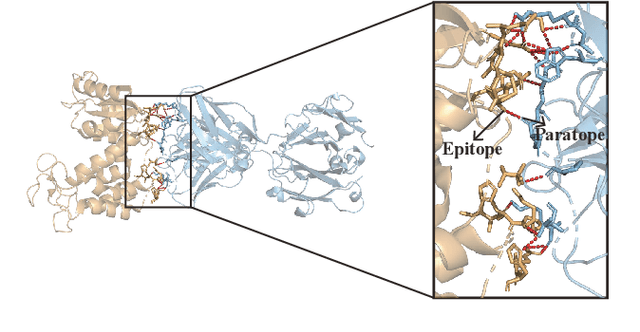
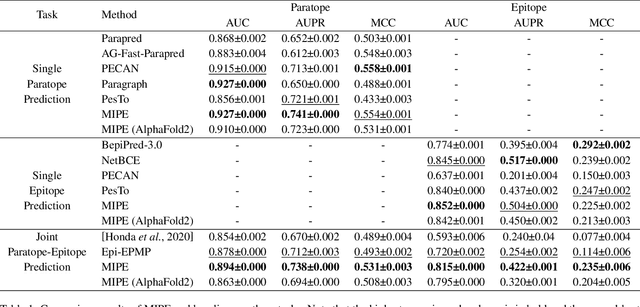
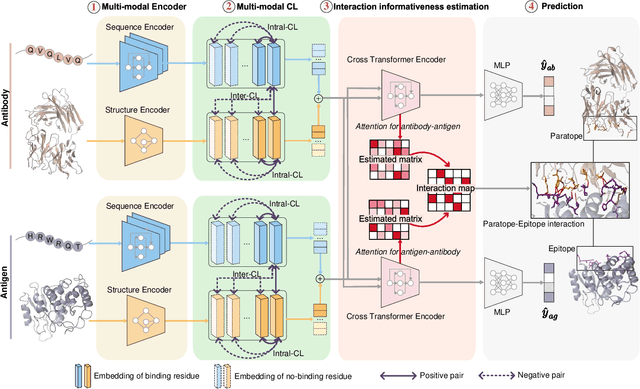
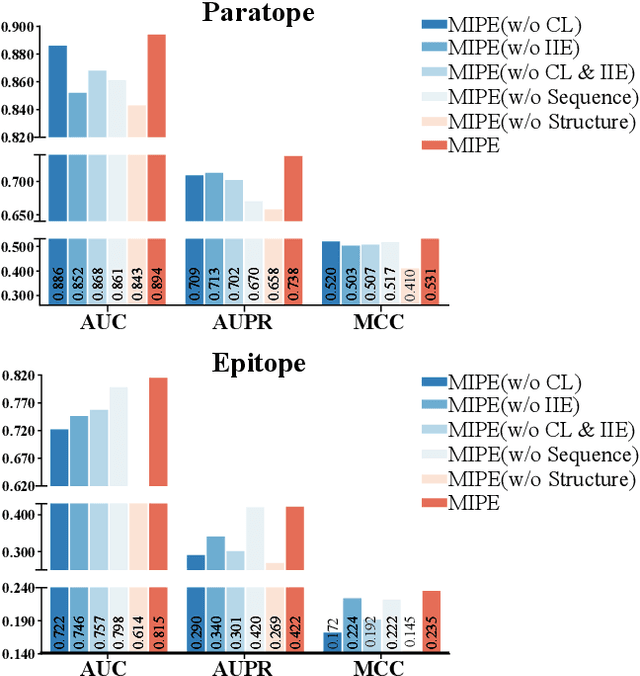
Accurately predicting antibody-antigen binding residues, i.e., paratopes and epitopes, is crucial in antibody design. However, existing methods solely focus on uni-modal data (either sequence or structure), disregarding the complementary information present in multi-modal data, and most methods predict paratopes and epitopes separately, overlooking their specific spatial interactions. In this paper, we propose a novel Multi-modal contrastive learning and Interaction informativeness estimation-based method for Paratope and Epitope prediction, named MIPE, by using both sequence and structure data of antibodies and antigens. MIPE implements a multi-modal contrastive learning strategy, which maximizes representations of binding and non-binding residues within each modality and meanwhile aligns uni-modal representations towards effective modal representations. To exploit the spatial interaction information, MIPE also incorporates an interaction informativeness estimation that computes the estimated interaction matrices between antibodies and antigens, thereby approximating them to the actual ones. Extensive experiments demonstrate the superiority of our method compared to baselines. Additionally, the ablation studies and visualizations demonstrate the superiority of MIPE owing to the better representations acquired through multi-modal contrastive learning and the interaction patterns comprehended by the interaction informativeness estimation.
Adapting Differential Molecular Representation with Hierarchical Prompts for Multi-label Property Prediction
May 29, 2024

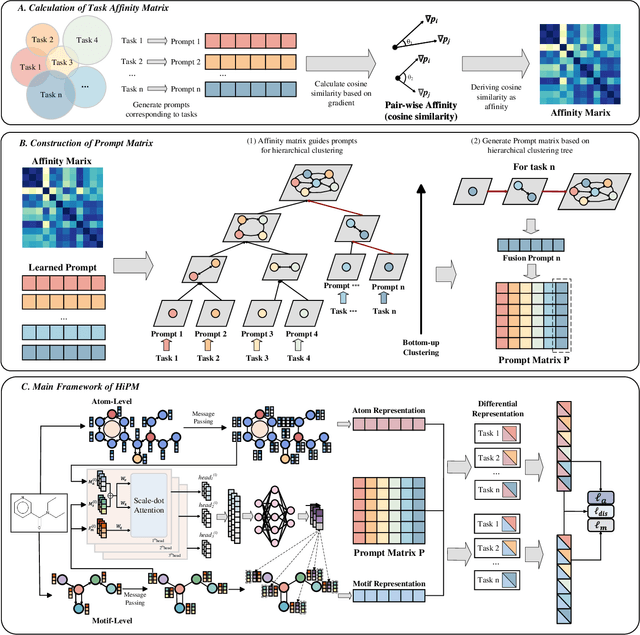
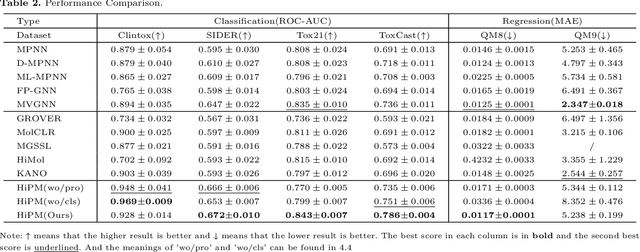
Accurate prediction of molecular properties is critical in the field of drug discovery. However, existing methods do not fully consider the fact that molecules in the real world usually possess multiple property labels, and complex high-order relationships may exist among these labels. Therefore, molecular representation learning models should generate differential molecular representations that consider multi-granularity correlation information among tasks. To this end, our research introduces a Hierarchical Prompted Molecular Representation Learning Framework (HiPM), which enhances the differential expression of tasks in molecular representations through task-aware prompts, and utilizes shared information among labels to mitigate negative transfer between different tasks. HiPM primarily consists of two core components: the Molecular Representation Encoder (MRE) and the Task-Aware Prompter (TAP). The MRE employs a hierarchical message-passing network architecture to capture molecular features at both the atomic and motif levels, while the TAP uses agglomerative hierarchical clustering to build a prompt tree that reflects the affinity and distinctiveness of tasks, enabling the model to effectively handle the complexity of multi-label property predictions. Extensive experiments demonstrate that HiPM achieves state-of-the-art performance across various multi-label datasets, offering a new perspective on multi-label molecular representation learning.
Mixture of Modality Knowledge Experts for Robust Multi-modal Knowledge Graph Completion
May 27, 2024Multi-modal knowledge graph completion (MMKGC) aims to automatically discover new knowledge triples in the given multi-modal knowledge graphs (MMKGs), which is achieved by collaborative modeling the structural information concealed in massive triples and the multi-modal features of the entities. Existing methods tend to focus on crafting elegant entity-wise multi-modal fusion strategies, yet they overlook the utilization of multi-perspective features concealed within the modalities under diverse relational contexts. To address this issue, we introduce a novel MMKGC framework with Mixture of Modality Knowledge experts (MoMoK for short) to learn adaptive multi-modal embedding under intricate relational contexts. We design relation-guided modality knowledge experts to acquire relation-aware modality embeddings and integrate the predictions from multi-modalities to achieve comprehensive decisions. Additionally, we disentangle the experts by minimizing their mutual information. Experiments on four public MMKG benchmarks demonstrate the outstanding performance of MoMoK under complex scenarios.