 Add to Chrome
 Add to Firefox
 Add to Edge
Long-Horizon Rollout via Dynamics Diffusion for Offline Reinforcement Learning
Jun 09, 2024

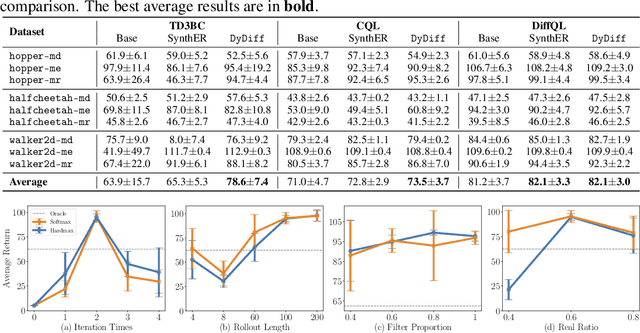
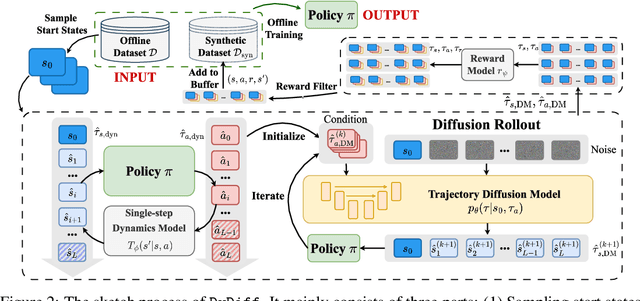
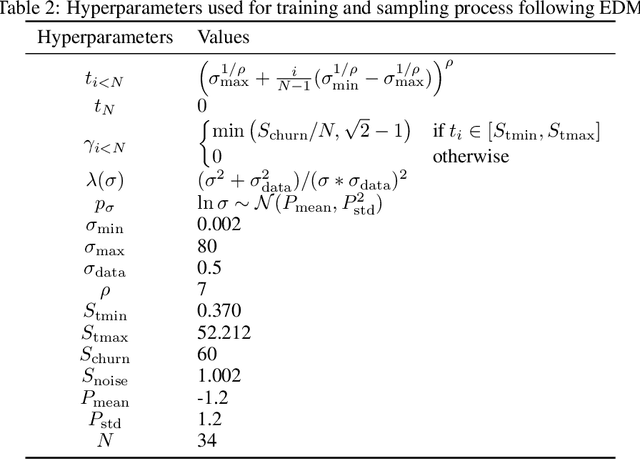
With the great success of diffusion models (DMs) in generating realistic synthetic vision data, many researchers have investigated their potential in decision-making and control. Most of these works utilized DMs to sample directly from the trajectory space, where DMs can be viewed as a combination of dynamics models and policies. In this work, we explore how to decouple DMs' ability as dynamics models in fully offline settings, allowing the learning policy to roll out trajectories. As DMs learn the data distribution from the dataset, their intrinsic policy is actually the behavior policy induced from the dataset, which results in a mismatch between the behavior policy and the learning policy. We propose Dynamics Diffusion, short as DyDiff, which can inject information from the learning policy to DMs iteratively. DyDiff ensures long-horizon rollout accuracy while maintaining policy consistency and can be easily deployed on model-free algorithms. We provide theoretical analysis to show the advantage of DMs on long-horizon rollout over models and demonstrate the effectiveness of DyDiff in the context of offline reinforcement learning, where the rollout dataset is provided but no online environment for interaction. Our code is at https://github.com/FineArtz/DyDiff.

Unraveling and Mitigating Retriever Inconsistencies in Retrieval-Augmented Large Language Models
Jun 04, 2024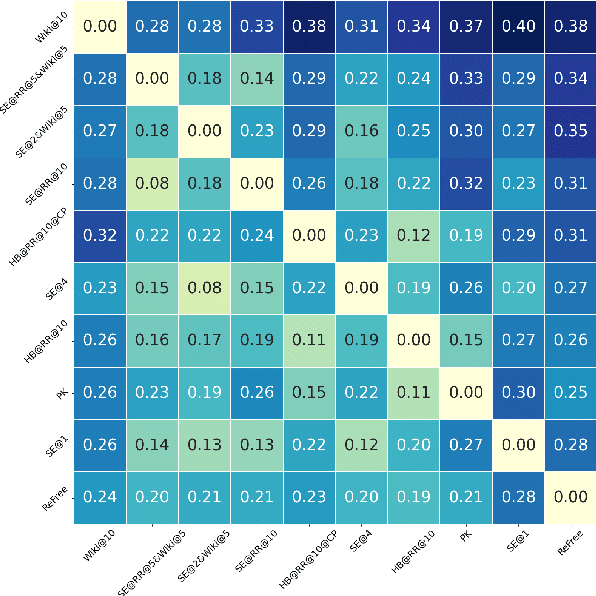
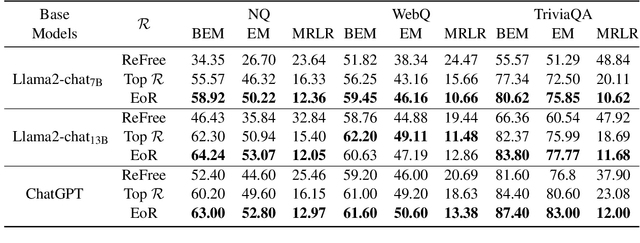
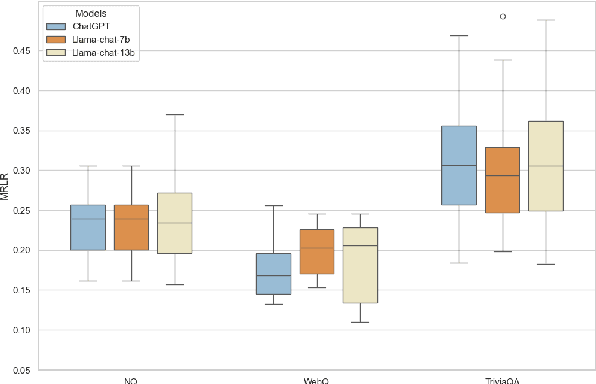

Although Retrieval-Augmented Large Language Models (RALMs) demonstrate their superiority in terms of factuality, they do not consistently outperform the original retrieval-free Language Models (LMs). Our experiments reveal that this example-level performance inconsistency exists not only between retrieval-augmented and retrieval-free LM but also among different retrievers. To understand this phenomenon, we investigate the degeneration behavior of RALMs and theoretically decompose it into four categories. Further analysis based on our decomposition reveals that the innate difference in knowledge sources and the unpredictable degeneration of the reader model contribute most to the inconsistency. Drawing from our analysis, we introduce Ensemble of Retrievers (EoR), a trainable framework that can adaptively retrieve from different knowledge sources and effectively decrease unpredictable reader errors. Our experiments on Open Domain Question Answering show that EoR substantially improves performance over the RALM with a single retriever by considerably reducing inconsistent behaviors.
Large Language Models Make Sample-Efficient Recommender Systems
Jun 04, 2024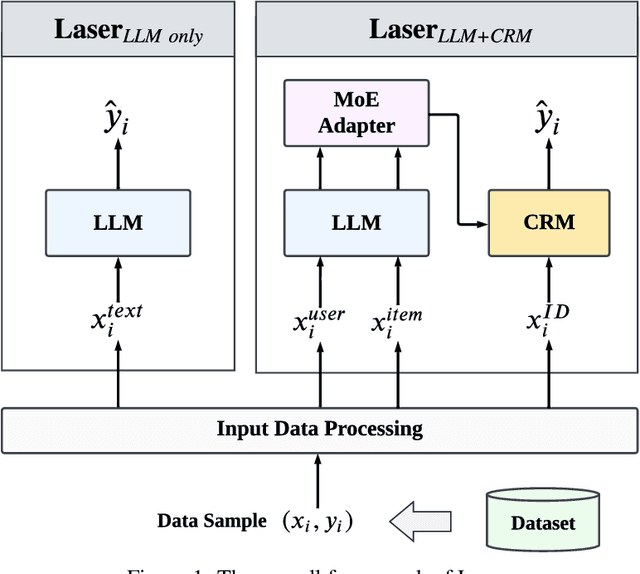
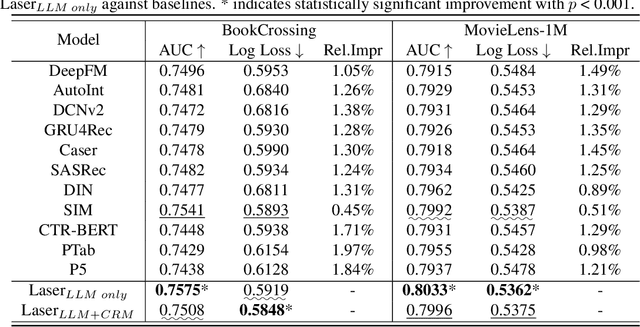

Large language models (LLMs) have achieved remarkable progress in the field of natural language processing (NLP), demonstrating remarkable abilities in producing text that resembles human language for various tasks. This opens up new opportunities for employing them in recommender systems (RSs). In this paper, we specifically examine the sample efficiency of LLM-enhanced recommender systems, which pertains to the model's capacity to attain superior performance with a limited quantity of training data. Conventional recommendation models (CRMs) often need a large amount of training data because of the sparsity of features and interactions. Hence, we propose and verify our core viewpoint: Large Language Models Make Sample-Efficient Recommender Systems. We propose a simple yet effective framework (i.e., Laser) to validate the viewpoint from two aspects: (1) LLMs themselves are sample-efficient recommenders; and (2) LLMs, as feature generators and encoders, make CRMs more sample-efficient. Extensive experiments on two public datasets show that Laser requires only a small fraction of training samples to match or even surpass CRMs that are trained on the entire training set, demonstrating superior sample efficiency.
Diffusion-based Dynamics Models for Long-Horizon Rollout in Offline Reinforcement Learning
May 29, 2024With the great success of diffusion models (DMs) in generating realistic synthetic vision data, many researchers have investigated their potential in decision-making and control. Most of these works utilized DMs to sample directly from the trajectory space, where DMs can be viewed as a combination of dynamics models and policies. In this work, we explore how to decouple DMs' ability as dynamics models in fully offline settings, allowing the learning policy to roll out trajectories. As DMs learn the data distribution from the dataset, their intrinsic policy is actually the behavior policy induced from the dataset, which results in a mismatch between the behavior policy and the learning policy. We propose Dynamics Diffusion, short as DyDiff, which can inject information from the learning policy to DMs iteratively. DyDiff ensures long-horizon rollout accuracy while maintaining policy consistency and can be easily deployed on model-free algorithms. We provide theoretical analysis to show the advantage of DMs on long-horizon rollout over models and demonstrate the effectiveness of DyDiff in the context of offline reinforcement learning, where the rollout dataset is provided but no online environment for interaction. Our code is at https://github.com/FineArtz/DyDiff.
Diffusion-based Reinforcement Learning via Q-weighted Variational Policy Optimization
May 25, 2024
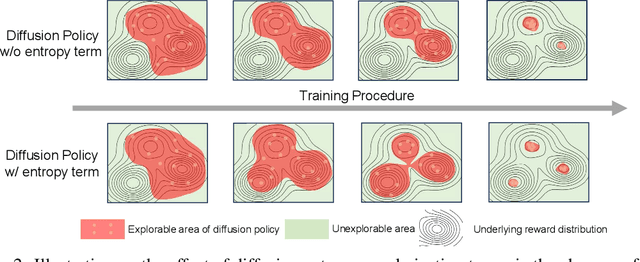


Diffusion models have garnered widespread attention in Reinforcement Learning (RL) for their powerful expressiveness and multimodality. It has been verified that utilizing diffusion policies can significantly improve the performance of RL algorithms in continuous control tasks by overcoming the limitations of unimodal policies, such as Gaussian policies, and providing the agent with enhanced exploration capabilities. However, existing works mainly focus on the application of diffusion policies in offline RL, while their incorporation into online RL is less investigated. The training objective of the diffusion model, known as the variational lower bound, cannot be optimized directly in online RL due to the unavailability of 'good' actions. This leads to difficulties in conducting diffusion policy improvement. To overcome this, we propose a novel model-free diffusion-based online RL algorithm, Q-weighted Variational Policy Optimization (QVPO). Specifically, we introduce the Q-weighted variational loss, which can be proved to be a tight lower bound of the policy objective in online RL under certain conditions. To fulfill these conditions, the Q-weight transformation functions are introduced for general scenarios. Additionally, to further enhance the exploration capability of the diffusion policy, we design a special entropy regularization term. We also develop an efficient behavior policy to enhance sample efficiency by reducing the variance of the diffusion policy during online interactions. Consequently, the QVPO algorithm leverages the exploration capabilities and multimodality of diffusion policies, preventing the RL agent from converging to a sub-optimal policy. To verify the effectiveness of QVPO, we conduct comprehensive experiments on MuJoCo benchmarks. The final results demonstrate that QVPO achieves state-of-the-art performance on both cumulative reward and sample efficiency.
Reinforcing Language Agents via Policy Optimization with Action Decomposition
May 23, 2024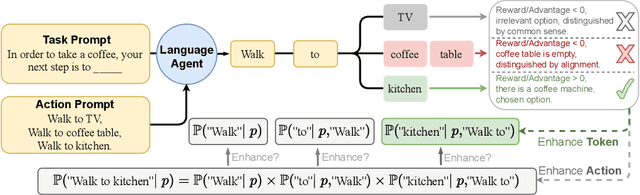
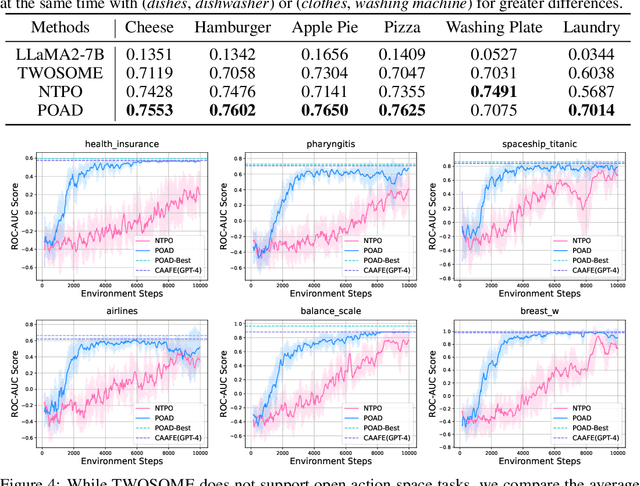
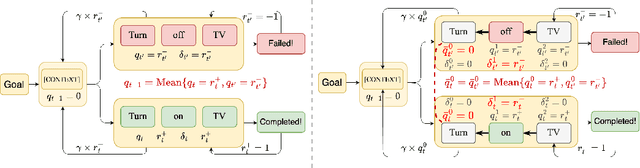
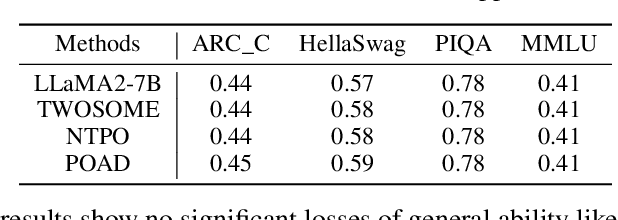
Language models as intelligent agents push the boundaries of sequential decision-making agents but struggle with limited knowledge of environmental dynamics and exponentially huge action space. Recent efforts like GLAM and TWOSOME manually constrain the action space to a restricted subset and employ reinforcement learning to align agents' knowledge with specific environments. However, they overlook fine-grained credit assignments for intra-action tokens, which is essential for efficient language agent optimization, and rely on human's prior knowledge to restrict action space. This paper proposes decomposing language agent optimization from the action level to the token level, offering finer supervision for each intra-action token and manageable optimization complexity in environments with unrestricted action spaces. Beginning with the simplification of flattening all actions, we theoretically explore the discrepancies between action-level optimization and this naive token-level optimization. We then derive the Bellman backup with Action Decomposition (BAD) to integrate credit assignments for both intra-action and inter-action tokens, effectively eliminating the discrepancies. Implementing BAD within the PPO algorithm, we introduce Policy Optimization with Action Decomposition (POAD). POAD benefits from a finer-grained credit assignment process and lower optimization complexity, leading to enhanced learning efficiency and generalization abilities in aligning language agents with interactive environments. We validate POAD across diverse testbeds, with results affirming the advantages of our approach and the correctness of our theoretical analysis.
Look into the Future: Deep Contextualized Sequential Recommendation
May 23, 2024
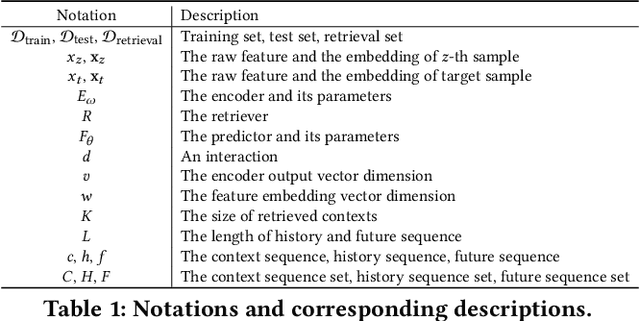
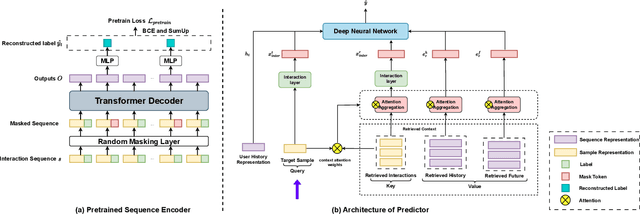
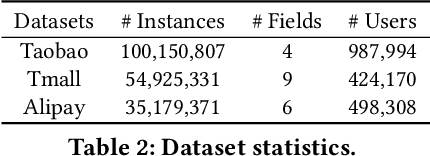
Sequential recommendation focuses on mining useful patterns from the user behavior history to better estimate his preference on the candidate items. Previous solutions adopt recurrent networks or retrieval methods to obtain the user's profile representation so as to perform the preference estimation. In this paper, we propose a novel framework of sequential recommendation called Look into the Future (LIFT), which builds and leverages the contexts of sequential recommendation. The context in LIFT refers to a user's current profile that can be represented based on both past and future behaviors. As such, the learned context will be more effective in predicting the user's behaviors in sequential recommendation. Apparently, it is impossible to use real future information to predict the current behavior, we thus propose a novel retrieval-based framework to use the most similar interaction's future information as the future context of the target interaction without data leakage. Furthermore, in order to exploit the intrinsic information embedded within the context itself, we introduce an innovative pretraining methodology incorporating behavior masking. This approach is designed to facilitate the efficient acquisition of context representations. We demonstrate that finding relevant contexts from the global user pool via retrieval methods will greatly improve preference estimation performance. In our extensive experiments over real-world datasets, LIFT demonstrates significant performance improvement on click-through rate prediction tasks in sequential recommendation over strong baselines.
Learning Structure and Knowledge Aware Representation with Large Language Models for Concept Recommendation
May 21, 2024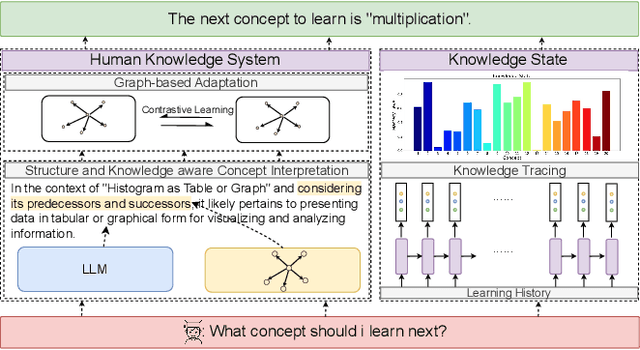
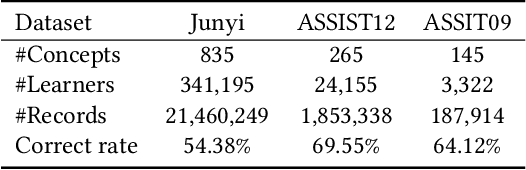

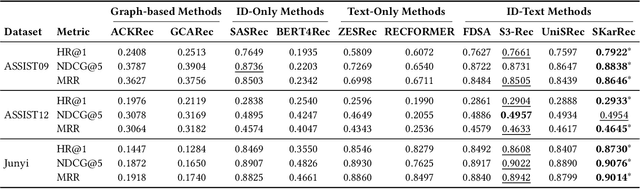
Concept recommendation aims to suggest the next concept for learners to study based on their knowledge states and the human knowledge system. While knowledge states can be predicted using knowledge tracing models, previous approaches have not effectively integrated the human knowledge system into the process of designing these educational models. In the era of rapidly evolving Large Language Models (LLMs), many fields have begun using LLMs to generate and encode text, introducing external knowledge. However, integrating LLMs into concept recommendation presents two urgent challenges: 1) How to construct text for concepts that effectively incorporate the human knowledge system? 2) How to adapt non-smooth, anisotropic text encodings effectively for concept recommendation? In this paper, we propose a novel Structure and Knowledge Aware Representation learning framework for concept Recommendation (SKarREC). We leverage factual knowledge from LLMs as well as the precedence and succession relationships between concepts obtained from the knowledge graph to construct textual representations of concepts. Furthermore, we propose a graph-based adapter to adapt anisotropic text embeddings to the concept recommendation task. This adapter is pre-trained through contrastive learning on the knowledge graph to get a smooth and structure-aware concept representation. Then, it's fine-tuned through the recommendation task, forming a text-to-knowledge-to-recommendation adaptation pipeline, which effectively constructs a structure and knowledge-aware concept representation. Our method does a better job than previous adapters in transforming text encodings for application in concept recommendation. Extensive experiments on real-world datasets demonstrate the effectiveness of the proposed approach.
CodeGRAG: Extracting Composed Syntax Graphs for Retrieval Augmented Cross-Lingual Code Generation
May 03, 2024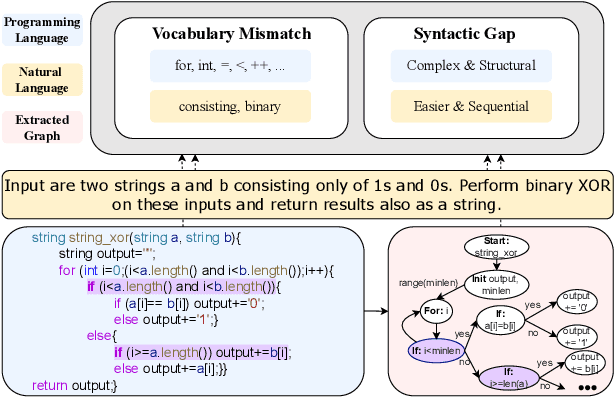
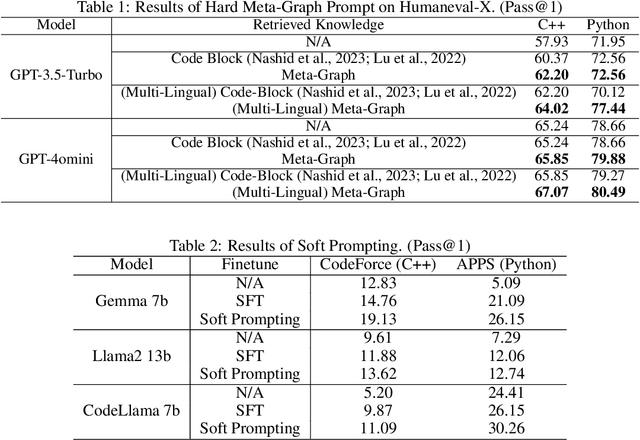
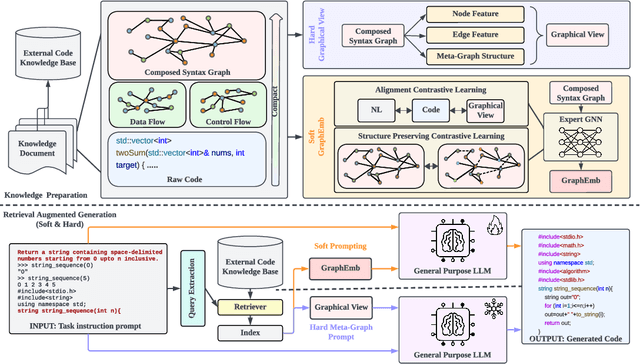
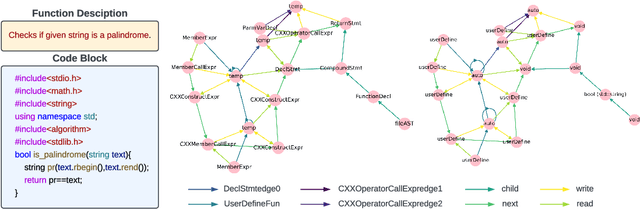
Utilizing large language models to generate codes has shown promising meaning in software development revolution. Despite the intelligence shown by the general large language models, their specificity in code generation can still be improved due to the syntactic gap and mismatched vocabulary existing among natural language and different programming languages. In addition, programming languages are inherently logical and complex, making them hard to be correctly generated. Existing methods rely on multiple prompts to the large language model to explore better solutions, which is expensive. In this paper, we propose Syntax Graph Retrieval Augmented Code Generation (CodeGRAG) to enhance the performance of LLMs in single-round code generation tasks. CodeGRAG extracts and summarizes the control flow and data flow of code blocks to fill the gap between programming languages and natural language. The extracted external structural knowledge models the inherent flows of code blocks, which can facilitate LLMs for better understanding of code syntax and serve as a bridge among different programming languages. CodeGRAG significantly improves the code generation ability of LLMs and can even offer performance gain for cross-lingual code generation, e.g., C++ for Python.
4DBInfer: A 4D Benchmarking Toolbox for Graph-Centric Predictive Modeling on Relational DBs
Apr 28, 2024


Although RDBs store vast amounts of rich, informative data spread across interconnected tables, the progress of predictive machine learning models as applied to such tasks arguably falls well behind advances in other domains such as computer vision or natural language processing. This deficit stems, at least in part, from the lack of established/public RDB benchmarks as needed for training and evaluation purposes. As a result, related model development thus far often defaults to tabular approaches trained on ubiquitous single-table benchmarks, or on the relational side, graph-based alternatives such as GNNs applied to a completely different set of graph datasets devoid of tabular characteristics. To more precisely target RDBs lying at the nexus of these two complementary regimes, we explore a broad class of baseline models predicated on: (i) converting multi-table datasets into graphs using various strategies equipped with efficient subsampling, while preserving tabular characteristics; and (ii) trainable models with well-matched inductive biases that output predictions based on these input subgraphs. Then, to address the dearth of suitable public benchmarks and reduce siloed comparisons, we assemble a diverse collection of (i) large-scale RDB datasets and (ii) coincident predictive tasks. From a delivery standpoint, we operationalize the above four dimensions (4D) of exploration within a unified, scalable open-source toolbox called 4DBInfer. We conclude by presenting evaluations using 4DBInfer, the results of which highlight the importance of considering each such dimension in the design of RDB predictive models, as well as the limitations of more naive approaches such as simply joining adjacent tables. Our source code is released at https://github.com/awslabs/multi-table-benchmark .