 Add to Chrome
 Add to Firefox
 Add to Edge
PhageBench: Can LLMs Understand Raw Bacteriophage Genomes?
Apr 07, 2026
Bacteriophages, often referred to as the dark matter of the biosphere, play a critical role in regulating microbial ecosystems and in antibiotic alternatives. Thus, accurate interpretation of their genomes holds significant scientific and practical value. While general-purpose Large Language Models (LLMs) excel at understanding biological texts, their ability to directly interpret raw nucleotide sequences and perform biological reasoning remains underexplored. To address this, we introduce PhageBench, the first benchmark designed to evaluate phage genome understanding by mirroring the workflow of bioinformatics experts. The dataset contains 5,600 high-quality samples covering five core tasks across three stages: Screening, Quality Control, and Phenotype Annotation. Our evaluation of eight LLMs reveals that general-purpose reasoning models significantly outperform random baselines in phage contig identification and host prediction, demonstrating promising potential for genomic understanding. However, they exhibit significant limitations in complex reasoning tasks involving long-range dependencies and fine-grained functional localization. These findings highlight the necessity of developing next-generation models with enhanced reasoning capabilities for biological sequences.

GenomeQA: Benchmarking General Large Language Models for Genome Sequence Understanding
Apr 07, 2026Large Language Models (LLMs) are increasingly adopted as conversational assistants in genomics, where they are mainly used to reason over biological knowledge, annotations, and analysis outputs through natural language interfaces. However, existing benchmarks either focus on specialized DNA models trained for sequence prediction or evaluate biological knowledge using text-only questions, leaving the behavior of general-purpose LLMs when directly exposed to raw genome sequences underexplored. We introduce GenomeQA, a benchmark designed to provide a controlled evaluation setting for general-purpose LLMs on sequence-based genome inference tasks. GenomeQA comprises 5,200 samples drawn from multiple biological databases, with sequence lengths ranging from 6 to 1,000 base pairs (bp), spanning six task families: Enhancer and Promoter Identification, Splice Site Identification, Taxonomic Classification, Histone Mark Prediction, Transcription Factor Binding Site Prediction, and TF Motif Prediction. Across six frontier LLMs, we find that models consistently outperform random baselines and can exploit local sequence signals such as GC content and short motifs, while performance degrades on tasks that require more indirect or multi-step inference over sequence patterns. GenomeQA establishes a diagnostic benchmark for studying and improving the use of general-purpose LLMs on raw genomic sequences.
Data is All You Need: Markov Chain Car-Following (MC-CF) Model
Mar 29, 2026Car-following behavior is fundamental to traffic flow theory, yet traditional models often fail to capture the stochasticity of naturalistic driving. This paper introduces a new car-following modeling category called the empirical probabilistic paradigm, which bypasses conventional parametric assumptions. Within this paradigm, we propose the Markov Chain Car-Following (MC-CF) model, which represents state transitions as a Markov process and predicts behavior by randomly sampling accelerations from empirical distributions within discretized state bins. Evaluation of the MC-CF model trained on the Waymo Open Motion Dataset (WOMD) demonstrates that its variants significantly outperform physics-based models including IDM, Gipps, FVDM, and SIDM in both one-step and open-loop trajectory prediction accuracy. Statistical analysis of transition probabilities confirms that the model-generated trajectories are indistinguishable from real-world behavior, successfully reproducing the probabilistic structure of naturalistic driving across all interaction types. Zero-shot generalization on the Naturalistic Phoenix (PHX) dataset further confirms the model's robustness. Finally, microscopic ring road simulations validate the framework's scalability. By incrementally integrating unconstrained free-flow trajectories and high-speed freeway data (TGSIM) alongside a conservative inference strategy, the model drastically reduces collisions, achieving zero crashes in multiple equilibrium and shockwave scenarios, while successfully reproducing naturalistic and stochastic shockwave propagation. Overall, the proposed MC-CF model provides a robust, scalable, and calibration-free foundation for high-fidelity stochastic traffic modeling, uniquely suited for the data-rich future of intelligent transportation.
No Need to Train Your RDB Foundation Model
Feb 14, 2026Relational databases (RDBs) contain vast amounts of heterogeneous tabular information that can be exploited for predictive modeling purposes. But since the space of potential targets is vast across enterprise settings, how can we \textit{avoid retraining} a new model each time we wish to predict a new quantity of interest? Foundation models based on in-context learning (ICL) offer a convenient option, but so far are largely restricted to single-table operability. In generalizing to multiple interrelated tables, it is essential to compress variably-sized RDB neighborhoods into fixed-length ICL samples for consumption by the decoder. However, the details here are critical: unlike existing supervised learning RDB pipelines, we provide theoretical and empirical evidence that ICL-specific compression should be constrained \emph{within} high-dimensional RDB columns where all entities share units and roles, not \textit{across} columns where the relevance of heterogeneous data types cannot possibly be determined without label information. Conditioned on this restriction, we then demonstrate that encoder expressiveness is actually not compromised by excluding trainable parameters. Hence we arrive at a principled family of RDB encoders that can be seamlessly paired with already-existing single-table ICL foundation models, whereby no training or fine-tuning is required. From a practical standpoint, we develop scalable SQL primitives to implement the encoder stage, resulting in an easy-to-use open-source RDB foundation model\footnote{\label{foot: RDBLearn_learn} https://github.com/HKUSHXLab/rdblearn} capable of robust performance on unseen datasets out of the box.
Can the Waymo Open Motion Dataset Support Realistic Behavioral Modeling? A Validation Study with Naturalistic Trajectories
Sep 03, 2025The Waymo Open Motion Dataset (WOMD) has become a popular resource for data-driven modeling of autonomous vehicles (AVs) behavior. However, its validity for behavioral analysis remains uncertain due to proprietary post-processing, the absence of error quantification, and the segmentation of trajectories into 20-second clips. This study examines whether WOMD accurately captures the dynamics and interactions observed in real-world AV operations. Leveraging an independently collected naturalistic dataset from Level 4 AV operations in Phoenix, Arizona (PHX), we perform comparative analyses across three representative urban driving scenarios: discharging at signalized intersections, car-following, and lane-changing behaviors. For the discharging analysis, headways are manually extracted from aerial video to ensure negligible measurement error. For the car-following and lane-changing cases, we apply the Simulation-Extrapolation (SIMEX) method to account for empirically estimated error in the PHX data and use Dynamic Time Warping (DTW) distances to quantify behavioral differences. Results across all scenarios consistently show that behavior in PHX falls outside the behavioral envelope of WOMD. Notably, WOMD underrepresents short headways and abrupt decelerations. These findings suggest that behavioral models calibrated solely on WOMD may systematically underestimate the variability, risk, and complexity of naturalistic driving. Caution is therefore warranted when using WOMD for behavior modeling without proper validation against independently collected data.
CHARM: Calibrating Reward Models With Chatbot Arena Scores
Apr 14, 2025Reward models (RMs) play a crucial role in Reinforcement Learning from Human Feedback by serving as proxies for human preferences in aligning large language models. In this paper, we identify a model preference bias in RMs, where they systematically assign disproportionately high scores to responses from certain policy models. This bias distorts ranking evaluations and leads to unfair judgments. To address this issue, we propose a calibration method named CHatbot Arena calibrated Reward Modeling (CHARM) that leverages Elo scores from the Chatbot Arena leaderboard to mitigate RM overvaluation. We also introduce a Mismatch Degree metric to measure this preference bias. Our approach is computationally efficient, requiring only a small preference dataset for continued training of the RM. We conduct extensive experiments on reward model benchmarks and human preference alignment. Results demonstrate that our calibrated RMs (1) achieve improved evaluation accuracy on RM-Bench and the Chat-Hard domain of RewardBench, and (2) exhibit a stronger correlation with human preferences by producing scores more closely aligned with Elo rankings. By mitigating model preference bias, our method provides a generalizable and efficient solution for building fairer and more reliable reward models.
ELF-Gym: Evaluating Large Language Models Generated Features for Tabular Prediction
Oct 13, 2024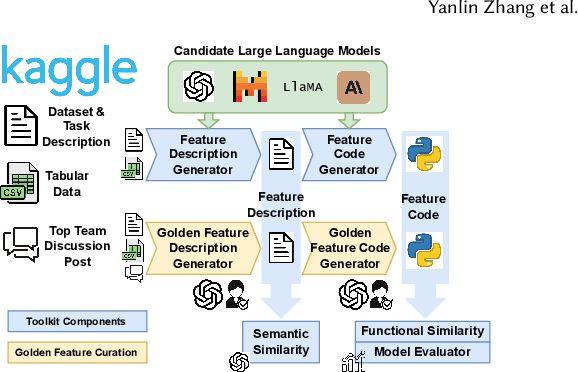
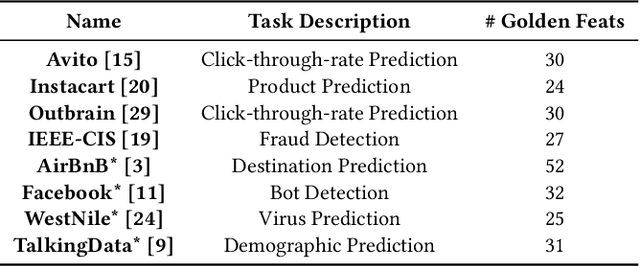
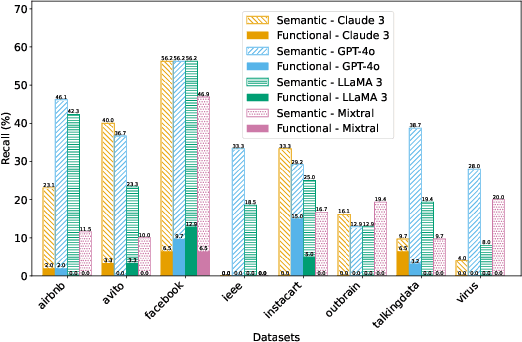
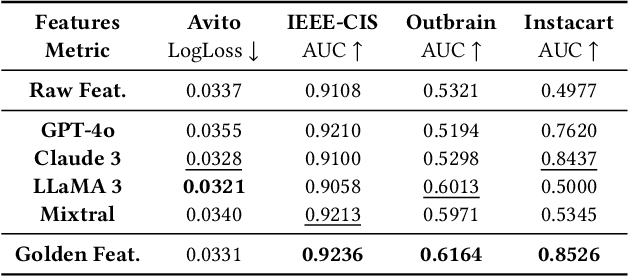
Crafting effective features is a crucial yet labor-intensive and domain-specific task within machine learning pipelines. Fortunately, recent advancements in Large Language Models (LLMs) have shown promise in automating various data science tasks, including feature engineering. But despite this potential, evaluations thus far are primarily based on the end performance of a complete ML pipeline, providing limited insight into precisely how LLMs behave relative to human experts in feature engineering. To address this gap, we propose ELF-Gym, a framework for Evaluating LLM-generated Features. We curated a new dataset from historical Kaggle competitions, including 251 "golden" features used by top-performing teams. ELF-Gym then quantitatively evaluates LLM-generated features by measuring their impact on downstream model performance as well as their alignment with expert-crafted features through semantic and functional similarity assessments. This approach provides a more comprehensive evaluation of disparities between LLMs and human experts, while offering valuable insights into specific areas where LLMs may have room for improvement. For example, using ELF-Gym we empirically demonstrate that, in the best-case scenario, LLMs can semantically capture approximately 56% of the golden features, but at the more demanding implementation level this overlap drops to 13%. Moreover, in other cases LLMs may fail completely, particularly on datasets that require complex features, indicating broad potential pathways for improvement.
4DBInfer: A 4D Benchmarking Toolbox for Graph-Centric Predictive Modeling on Relational DBs
Apr 28, 2024


Although RDBs store vast amounts of rich, informative data spread across interconnected tables, the progress of predictive machine learning models as applied to such tasks arguably falls well behind advances in other domains such as computer vision or natural language processing. This deficit stems, at least in part, from the lack of established/public RDB benchmarks as needed for training and evaluation purposes. As a result, related model development thus far often defaults to tabular approaches trained on ubiquitous single-table benchmarks, or on the relational side, graph-based alternatives such as GNNs applied to a completely different set of graph datasets devoid of tabular characteristics. To more precisely target RDBs lying at the nexus of these two complementary regimes, we explore a broad class of baseline models predicated on: (i) converting multi-table datasets into graphs using various strategies equipped with efficient subsampling, while preserving tabular characteristics; and (ii) trainable models with well-matched inductive biases that output predictions based on these input subgraphs. Then, to address the dearth of suitable public benchmarks and reduce siloed comparisons, we assemble a diverse collection of (i) large-scale RDB datasets and (ii) coincident predictive tasks. From a delivery standpoint, we operationalize the above four dimensions (4D) of exploration within a unified, scalable open-source toolbox called 4DBInfer. We conclude by presenting evaluations using 4DBInfer, the results of which highlight the importance of considering each such dimension in the design of RDB predictive models, as well as the limitations of more naive approaches such as simply joining adjacent tables. Our source code is released at https://github.com/awslabs/multi-table-benchmark .