 Add to Chrome
 Add to Firefox
 Add to Edge
RxBrain: Embodied Cognition Foundation Model with Joint Language-Visual Reasoning and Imagination
Jul 15, 2026
Embodied cognition requires agents to connect high-level task reasoning with the physical states to be achieved. We introduce Hy-Embodied-RxBrain, an embodied cognition foundation model with joint language-visual reasoning and imagination. Unlike vision-language models that emphasize scene understanding and textual decision making, or generative world models that mainly predict future visual states, RxBrain represents embodied plans in a single planning sequence where language and visual imagination play complementary roles. Language provides the abstract structure of a plan, including task decomposition, planning primitives, constraints, temporal order, and decision logic, while visual imagination grounds this structure through world state prediction and joint subgoal planning, associating each planning step with intermediate and final physical states. RxBrain adopts a unified multimodal Mixture-of-Transformers architecture that supports language, image, and video understanding and generation within one model. To train this capability, we build an automatic pipeline that converts embodied videos into joint text-visual planning supervision by decomposing videos into planning steps and aligning them with visual state transitions. We further introduce RxBrain-Bench to evaluate whether models can represent embodied plans through joint textual and visual components rather than separate understanding or generation. Experiments show that RxBrain maintains embodied understanding and generation abilities, and produces plans with coupled textual reasoning, world state prediction, and joint subgoal planning. We also extend RxBrain to continuous robot action generation, where it shows promising real-robot performance without large-scale action-data pretraining. These results provide an initial step toward foundation models for embodied cognition.

Diffusion Inpainting MIMO-OFDM Channels with Limited Noisy Observations
Apr 10, 2026Acquiring the channel state information from limited and noisy observations at pilot positions is critical for wireless multiple-input multiple-output (MIMO)-orthogonal frequency division multiplexing (OFDM) systems. In this paper, we view this process as a conditional generative task in which the partial noisy channel estimates at the pilots are utilized as a ``prompt'' to guide the diffusion ``inpainting'' of the underlying channel. To this end, we resort to a general Conditional Diffusion Transformer (CDiT) framework with a well-designed network architecture and update rule. In particular, we design a dedicated embedding strategy to encode and adapt to different pilot patterns and noise levels, and utilize a special cross-attention mechanism to align the partial raw channel observations with the denoised channel at each time step of the generation process. This architecture effectively anchors the diffusion process, enabling the model to accurately recover full channel details from limited noisy observations. Comprehensive experimental results show that, the proposed approach achieves a performance gain of over 5 dB compared to the baselines under varying noise conditions, and provides robust channel acquisition even under a sparse pilot density of 1/32 without significant performance loss compared to the denser pilot cases. Moreover, it is capable of generating high-quality channel matrices within just 10 inference steps, effectively balancing estimation accuracy with computational efficiency and inference speed. Ablation studies demonstrate the rationality of the model design and the necessity of its modules.
Listening with the Eyes: Benchmarking Egocentric Co-Speech Grounding across Space and Time
Mar 09, 2026In situated collaboration, speakers often use intentionally underspecified deictic commands (e.g., ``pass me \textit{that}''), whose referent becomes identifiable only by aligning speech with a brief co-speech pointing \emph{stroke}. However, many embodied benchmarks admit language-only shortcuts, allowing MLLMs to perform well without learning the \emph{audio--visual alignment} required by deictic interaction. To bridge this gap, we introduce \textbf{Egocentric Co-Speech Grounding (EcoG)}, where grounding is executable only if an agent jointly predicts \textit{What}, \textit{Where}, and \textit{When}. To operationalize this, we present \textbf{EcoG-Bench}, an evaluation-only bilingual (EN/ZH) diagnostic benchmark of \textbf{811} egocentric clips with dense spatial annotations and millisecond-level stroke supervision. It is organized under a \textbf{Progressive Cognitive Evaluation} protocol. Benchmarking state-of-the-art MLLMs reveals a severe executability gap: while human subjects achieve near-ceiling performance on EcoG-Bench (\textbf{96.9\%} strict Eco-Accuracy), the best native video-audio setting remains low (Gemini-3-Pro: \textbf{17.0\%}). Moreover, in a diagnostic ablation, replacing the native video--audio interface with timestamped frame samples and externally verified ASR (with word-level timing) substantially improves the same model (\textbf{17.0\%}$\to$\textbf{42.9\%}). Overall, EcoG-Bench provides a strict, executable testbed for event-level speech--gesture binding, and suggests that multimodal interfaces may bottleneck the observability of temporal alignment cues, independently of model reasoning.
ProAct: A Benchmark and Multimodal Framework for Structure-Aware Proactive Response
Feb 03, 2026While passive agents merely follow instructions, proactive agents align with higher-level objectives, such as assistance and safety by continuously monitoring the environment to determine when and how to act. However, developing proactive agents is hindered by the lack of specialized resources. To address this, we introduce ProAct-75, a benchmark designed to train and evaluate proactive agents across diverse domains, including assistance, maintenance, and safety monitoring. Spanning 75 tasks, our dataset features 91,581 step-level annotations enriched with explicit task graphs. These graphs encode step dependencies and parallel execution possibilities, providing the structural grounding necessary for complex decision-making. Building on this benchmark, we propose ProAct-Helper, a reference baseline powered by a Multimodal Large Language Model (MLLM) that grounds decision-making in state detection, and leveraging task graphs to enable entropy-driven heuristic search for action selection, allowing agents to execute parallel threads independently rather than mirroring the human's next step. Extensive experiments demonstrate that ProAct-Helper outperforms strong closed-source models, improving trigger detection mF1 by 6.21%, saving 0.25 more steps in online one-step decision, and increasing the rate of parallel actions by 15.58%.
SteerEval: A Framework for Evaluating Steerability with Natural Language Profiles for Recommendation
Jan 28, 2026Natural-language user profiles have recently attracted attention not only for improved interpretability, but also for their potential to make recommender systems more steerable. By enabling direct editing, natural-language profiles allow users to explicitly articulate preferences that may be difficult to infer from past behavior. However, it remains unclear whether current natural-language-based recommendation methods can follow such steering commands. While existing steerability evaluations have shown some success for well-recognized item attributes (e.g., movie genres), we argue that these benchmarks fail to capture the richer forms of user control that motivate steerable recommendations. To address this gap, we introduce SteerEval, an evaluation framework designed to measure more nuanced and diverse forms of steerability by using interventions that range from genres to content-warning for movies. We assess the steerability of a family of pretrained natural-language recommenders, examine the potential and limitations of steering on relatively niche topics, and compare how different profile and recommendation interventions impact steering effectiveness. Finally, we offer practical design suggestions informed by our findings and discuss future steps in steerable recommender design.
ESearch-R1: Learning Cost-Aware MLLM Agents for Interactive Embodied Search via Reinforcement Learning
Dec 21, 2025Multimodal Large Language Models (MLLMs) have empowered embodied agents with remarkable capabilities in planning and reasoning. However, when facing ambiguous natural language instructions (e.g., "fetch the tool" in a cluttered room), current agents often fail to balance the high cost of physical exploration against the cognitive cost of human interaction. They typically treat disambiguation as a passive perception problem, lacking the strategic reasoning to minimize total task execution costs. To bridge this gap, we propose ESearch-R1, a cost-aware embodied reasoning framework that unifies interactive dialogue (Ask), episodic memory retrieval (GetMemory), and physical navigation (Navigate) into a single decision process. We introduce HC-GRPO (Heterogeneous Cost-Aware Group Relative Policy Optimization). Unlike traditional PPO which relies on a separate value critic, HC-GRPO optimizes the MLLM by sampling groups of reasoning trajectories and reinforcing those that achieve the optimal trade-off between information gain and heterogeneous costs (e.g., navigate time, and human attention). Extensive experiments in AI2-THOR demonstrate that ESearch-R1 significantly outperforms standard ReAct-based agents. It improves task success rates while reducing total operational costs by approximately 50\%, validating the effectiveness of GRPO in aligning MLLM agents with physical world constraints.
UniBYD: A Unified Framework for Learning Robotic Manipulation Across Embodiments Beyond Imitation of Human Demonstrations
Dec 12, 2025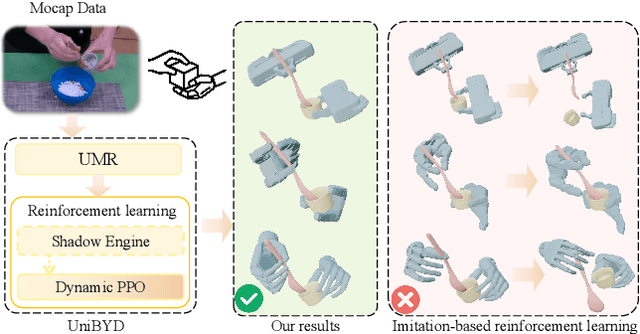
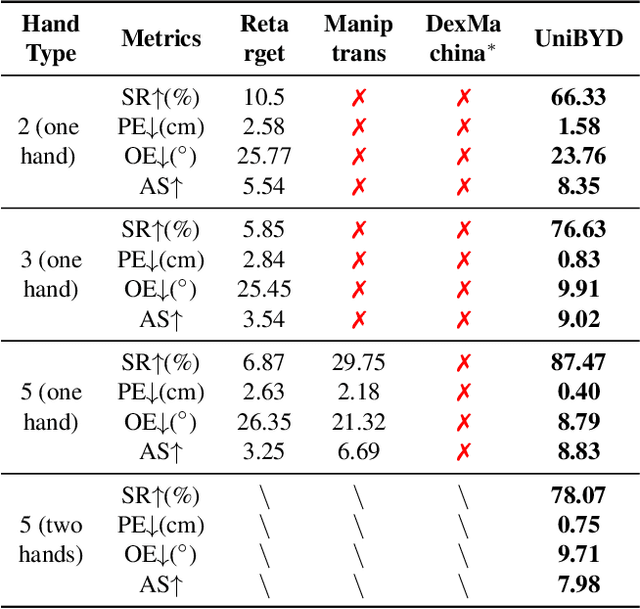
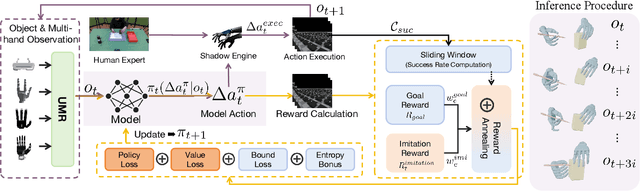
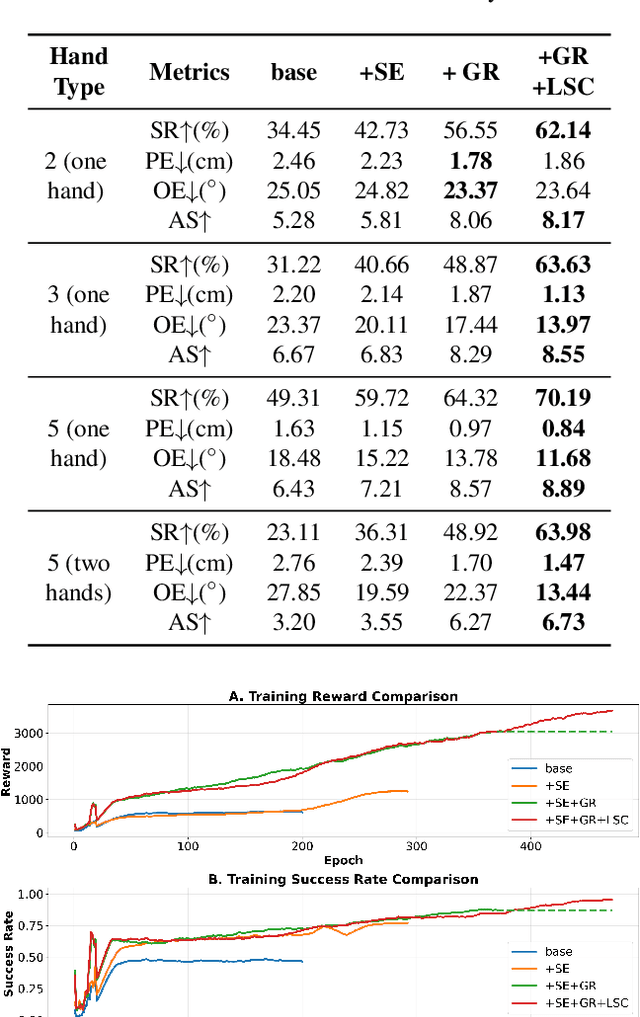
In embodied intelligence, the embodiment gap between robotic and human hands brings significant challenges for learning from human demonstrations. Although some studies have attempted to bridge this gap using reinforcement learning, they remain confined to merely reproducing human manipulation, resulting in limited task performance. In this paper, we propose UniBYD, a unified framework that uses a dynamic reinforcement learning algorithm to discover manipulation policies aligned with the robot's physical characteristics. To enable consistent modeling across diverse robotic hand morphologies, UniBYD incorporates a unified morphological representation (UMR). Building on UMR, we design a dynamic PPO with an annealed reward schedule, enabling reinforcement learning to transition from imitation of human demonstrations to explore policies adapted to diverse robotic morphologies better, thereby going beyond mere imitation of human hands. To address the frequent failures of learning human priors in the early training stage, we design a hybrid Markov-based shadow engine that enables reinforcement learning to imitate human manipulations in a fine-grained manner. To evaluate UniBYD comprehensively, we propose UniManip, the first benchmark encompassing robotic manipulation tasks spanning multiple hand morphologies. Experiments demonstrate a 67.90% improvement in success rate over the current state-of-the-art. Upon acceptance of the paper, we will release our code and benchmark at https://github.com/zhanheng-creator/UniBYD.
PhysVLM: Enabling Visual Language Models to Understand Robotic Physical Reachability
Mar 13, 2025Understanding the environment and a robot's physical reachability is crucial for task execution. While state-of-the-art vision-language models (VLMs) excel in environmental perception, they often generate inaccurate or impractical responses in embodied visual reasoning tasks due to a lack of understanding of robotic physical reachability. To address this issue, we propose a unified representation of physical reachability across diverse robots, i.e., Space-Physical Reachability Map (S-P Map), and PhysVLM, a vision-language model that integrates this reachability information into visual reasoning. Specifically, the S-P Map abstracts a robot's physical reachability into a generalized spatial representation, independent of specific robot configurations, allowing the model to focus on reachability features rather than robot-specific parameters. Subsequently, PhysVLM extends traditional VLM architectures by incorporating an additional feature encoder to process the S-P Map, enabling the model to reason about physical reachability without compromising its general vision-language capabilities. To train and evaluate PhysVLM, we constructed a large-scale multi-robot dataset, Phys100K, and a challenging benchmark, EQA-phys, which includes tasks for six different robots in both simulated and real-world environments. Experimental results demonstrate that PhysVLM outperforms existing models, achieving a 14\% improvement over GPT-4o on EQA-phys and surpassing advanced embodied VLMs such as RoboMamba and SpatialVLM on the RoboVQA-val and OpenEQA benchmarks. Additionally, the S-P Map shows strong compatibility with various VLMs, and its integration into GPT-4o-mini yields a 7.1\% performance improvement.
LightPlanner: Unleashing the Reasoning Capabilities of Lightweight Large Language Models in Task Planning
Mar 11, 2025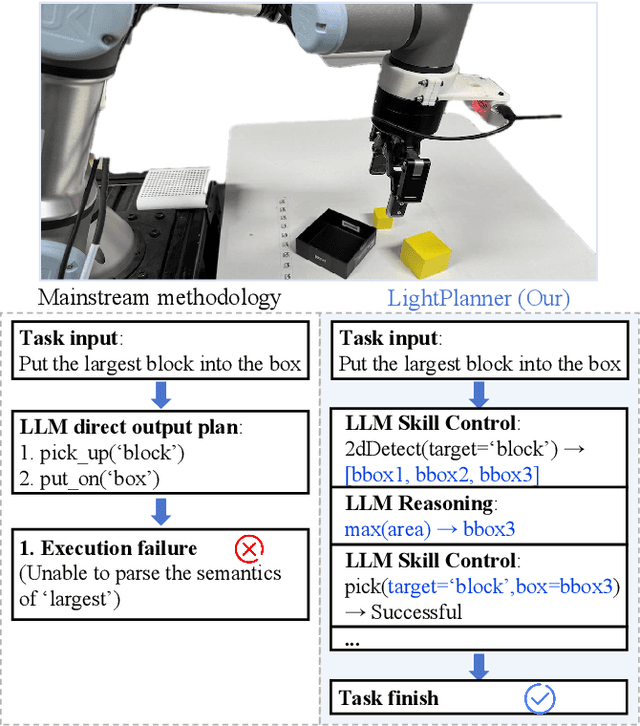
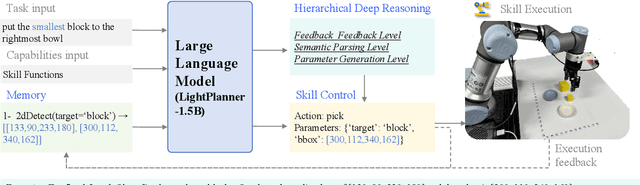
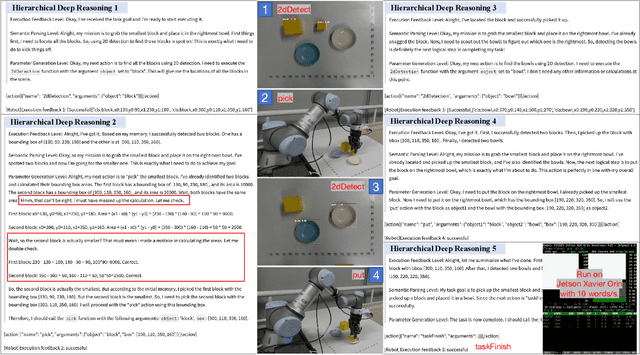
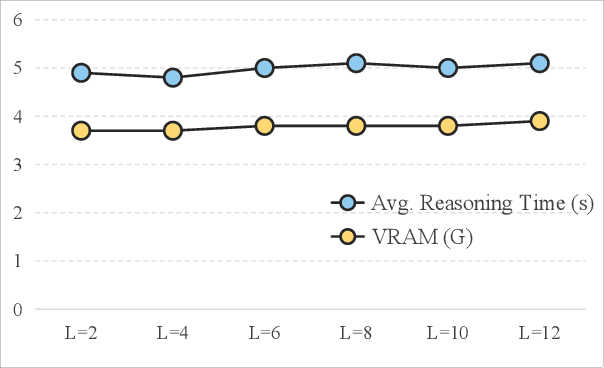
In recent years, lightweight large language models (LLMs) have garnered significant attention in the robotics field due to their low computational resource requirements and suitability for edge deployment. However, in task planning -- particularly for complex tasks that involve dynamic semantic logic reasoning -- lightweight LLMs have underperformed. To address this limitation, we propose a novel task planner, LightPlanner, which enhances the performance of lightweight LLMs in complex task planning by fully leveraging their reasoning capabilities. Unlike conventional planners that use fixed skill templates, LightPlanner controls robot actions via parameterized function calls, dynamically generating parameter values. This approach allows for fine-grained skill control and improves task planning success rates in complex scenarios. Furthermore, we introduce hierarchical deep reasoning. Before generating each action decision step, LightPlanner thoroughly considers three levels: action execution (feedback verification), semantic parsing (goal consistency verification), and parameter generation (parameter validity verification). This ensures the correctness of subsequent action controls. Additionally, we incorporate a memory module to store historical actions, thereby reducing context length and enhancing planning efficiency for long-term tasks. We train the LightPlanner-1.5B model on our LightPlan-40k dataset, which comprises 40,000 action controls across tasks with 2 to 13 action steps. Experiments demonstrate that our model achieves the highest task success rate despite having the smallest number of parameters. In tasks involving spatial semantic reasoning, the success rate exceeds that of ReAct by 14.9 percent. Moreover, we demonstrate LightPlanner's potential to operate on edge devices.
Capture Artifacts via Progressive Disentangling and Purifying Blended Identities for Deepfake Detection
Oct 15, 2024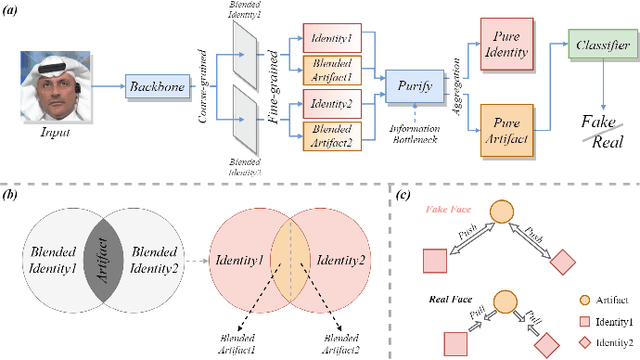
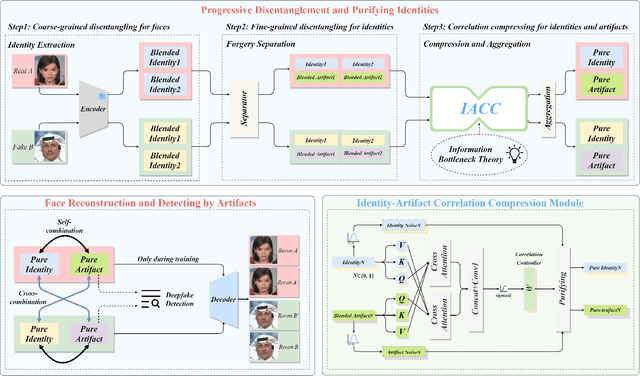


The Deepfake technology has raised serious concerns regarding privacy breaches and trust issues. To tackle these challenges, Deepfake detection technology has emerged. Current methods over-rely on the global feature space, which contains redundant information independent of the artifacts. As a result, existing Deepfake detection techniques suffer performance degradation when encountering unknown datasets. To reduce information redundancy, the current methods use disentanglement techniques to roughly separate the fake faces into artifacts and content information. However, these methods lack a solid disentanglement foundation and cannot guarantee the reliability of their disentangling process. To address these issues, a Deepfake detection method based on progressive disentangling and purifying blended identities is innovatively proposed in this paper. Based on the artifact generation mechanism, the coarse- and fine-grained strategies are combined to ensure the reliability of the disentanglement method. Our method aims to more accurately capture and separate artifact features in fake faces. Specifically, we first perform the coarse-grained disentangling on fake faces to obtain a pair of blended identities that require no additional annotation to distinguish between source face and target face. Then, the artifact features from each identity are separated to achieve fine-grained disentanglement. To obtain pure identity information and artifacts, an Identity-Artifact Correlation Compression module (IACC) is designed based on the information bottleneck theory, effectively reducing the potential correlation between identity information and artifacts. Additionally, an Identity-Artifact Separation Contrast Loss is designed to enhance the independence of artifact features post-disentangling. Finally, the classifier only focuses on pure artifact features to achieve a generalized Deepfake detector.