 Add to Chrome
 Add to Firefox
 Add to Edge
Listening with the Eyes: Benchmarking Egocentric Co-Speech Grounding across Space and Time
Mar 09, 2026
In situated collaboration, speakers often use intentionally underspecified deictic commands (e.g., ``pass me \textit{that}''), whose referent becomes identifiable only by aligning speech with a brief co-speech pointing \emph{stroke}. However, many embodied benchmarks admit language-only shortcuts, allowing MLLMs to perform well without learning the \emph{audio--visual alignment} required by deictic interaction. To bridge this gap, we introduce \textbf{Egocentric Co-Speech Grounding (EcoG)}, where grounding is executable only if an agent jointly predicts \textit{What}, \textit{Where}, and \textit{When}. To operationalize this, we present \textbf{EcoG-Bench}, an evaluation-only bilingual (EN/ZH) diagnostic benchmark of \textbf{811} egocentric clips with dense spatial annotations and millisecond-level stroke supervision. It is organized under a \textbf{Progressive Cognitive Evaluation} protocol. Benchmarking state-of-the-art MLLMs reveals a severe executability gap: while human subjects achieve near-ceiling performance on EcoG-Bench (\textbf{96.9\%} strict Eco-Accuracy), the best native video-audio setting remains low (Gemini-3-Pro: \textbf{17.0\%}). Moreover, in a diagnostic ablation, replacing the native video--audio interface with timestamped frame samples and externally verified ASR (with word-level timing) substantially improves the same model (\textbf{17.0\%}$\to$\textbf{42.9\%}). Overall, EcoG-Bench provides a strict, executable testbed for event-level speech--gesture binding, and suggests that multimodal interfaces may bottleneck the observability of temporal alignment cues, independently of model reasoning.

ESearch-R1: Learning Cost-Aware MLLM Agents for Interactive Embodied Search via Reinforcement Learning
Dec 21, 2025Multimodal Large Language Models (MLLMs) have empowered embodied agents with remarkable capabilities in planning and reasoning. However, when facing ambiguous natural language instructions (e.g., "fetch the tool" in a cluttered room), current agents often fail to balance the high cost of physical exploration against the cognitive cost of human interaction. They typically treat disambiguation as a passive perception problem, lacking the strategic reasoning to minimize total task execution costs. To bridge this gap, we propose ESearch-R1, a cost-aware embodied reasoning framework that unifies interactive dialogue (Ask), episodic memory retrieval (GetMemory), and physical navigation (Navigate) into a single decision process. We introduce HC-GRPO (Heterogeneous Cost-Aware Group Relative Policy Optimization). Unlike traditional PPO which relies on a separate value critic, HC-GRPO optimizes the MLLM by sampling groups of reasoning trajectories and reinforcing those that achieve the optimal trade-off between information gain and heterogeneous costs (e.g., navigate time, and human attention). Extensive experiments in AI2-THOR demonstrate that ESearch-R1 significantly outperforms standard ReAct-based agents. It improves task success rates while reducing total operational costs by approximately 50\%, validating the effectiveness of GRPO in aligning MLLM agents with physical world constraints.
PhysVLM: Enabling Visual Language Models to Understand Robotic Physical Reachability
Mar 13, 2025Understanding the environment and a robot's physical reachability is crucial for task execution. While state-of-the-art vision-language models (VLMs) excel in environmental perception, they often generate inaccurate or impractical responses in embodied visual reasoning tasks due to a lack of understanding of robotic physical reachability. To address this issue, we propose a unified representation of physical reachability across diverse robots, i.e., Space-Physical Reachability Map (S-P Map), and PhysVLM, a vision-language model that integrates this reachability information into visual reasoning. Specifically, the S-P Map abstracts a robot's physical reachability into a generalized spatial representation, independent of specific robot configurations, allowing the model to focus on reachability features rather than robot-specific parameters. Subsequently, PhysVLM extends traditional VLM architectures by incorporating an additional feature encoder to process the S-P Map, enabling the model to reason about physical reachability without compromising its general vision-language capabilities. To train and evaluate PhysVLM, we constructed a large-scale multi-robot dataset, Phys100K, and a challenging benchmark, EQA-phys, which includes tasks for six different robots in both simulated and real-world environments. Experimental results demonstrate that PhysVLM outperforms existing models, achieving a 14\% improvement over GPT-4o on EQA-phys and surpassing advanced embodied VLMs such as RoboMamba and SpatialVLM on the RoboVQA-val and OpenEQA benchmarks. Additionally, the S-P Map shows strong compatibility with various VLMs, and its integration into GPT-4o-mini yields a 7.1\% performance improvement.
LightPlanner: Unleashing the Reasoning Capabilities of Lightweight Large Language Models in Task Planning
Mar 11, 2025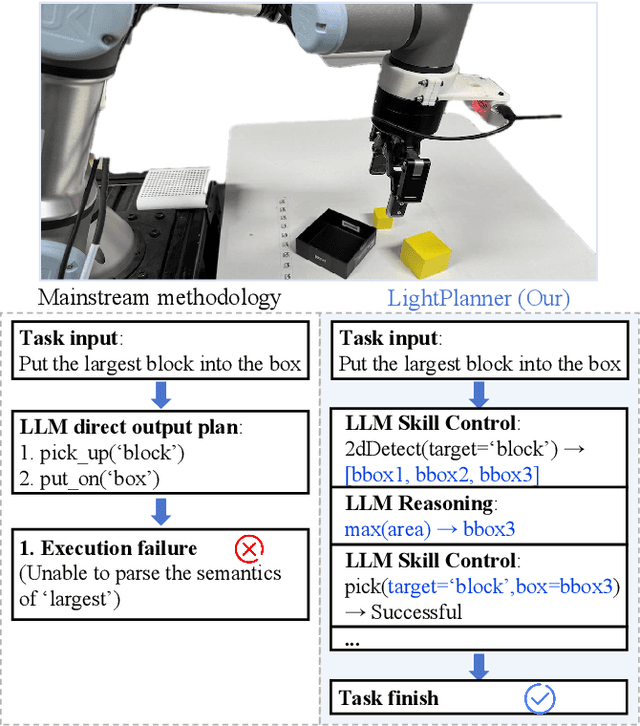
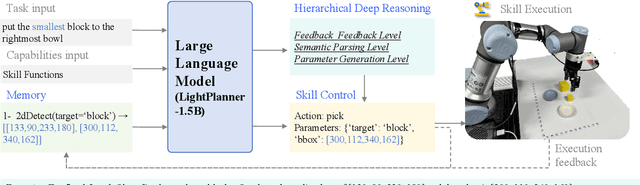
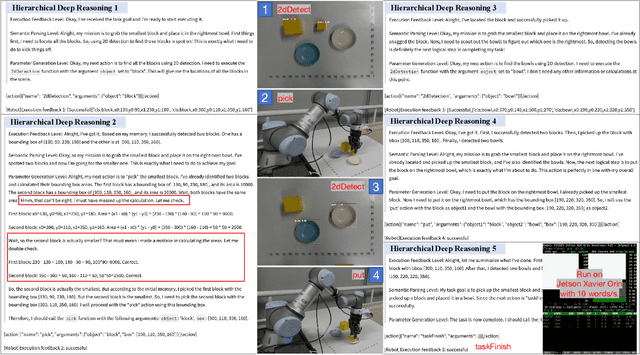
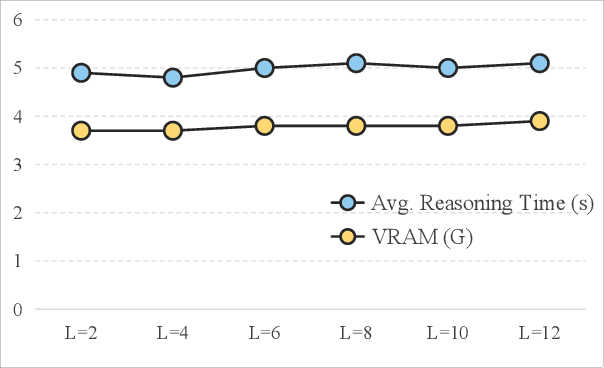
In recent years, lightweight large language models (LLMs) have garnered significant attention in the robotics field due to their low computational resource requirements and suitability for edge deployment. However, in task planning -- particularly for complex tasks that involve dynamic semantic logic reasoning -- lightweight LLMs have underperformed. To address this limitation, we propose a novel task planner, LightPlanner, which enhances the performance of lightweight LLMs in complex task planning by fully leveraging their reasoning capabilities. Unlike conventional planners that use fixed skill templates, LightPlanner controls robot actions via parameterized function calls, dynamically generating parameter values. This approach allows for fine-grained skill control and improves task planning success rates in complex scenarios. Furthermore, we introduce hierarchical deep reasoning. Before generating each action decision step, LightPlanner thoroughly considers three levels: action execution (feedback verification), semantic parsing (goal consistency verification), and parameter generation (parameter validity verification). This ensures the correctness of subsequent action controls. Additionally, we incorporate a memory module to store historical actions, thereby reducing context length and enhancing planning efficiency for long-term tasks. We train the LightPlanner-1.5B model on our LightPlan-40k dataset, which comprises 40,000 action controls across tasks with 2 to 13 action steps. Experiments demonstrate that our model achieves the highest task success rate despite having the smallest number of parameters. In tasks involving spatial semantic reasoning, the success rate exceeds that of ReAct by 14.9 percent. Moreover, we demonstrate LightPlanner's potential to operate on edge devices.