 Add to Chrome
 Add to Firefox
 Add to Edge
RxBrain: Embodied Cognition Foundation Model with Joint Language-Visual Reasoning and Imagination
Jul 15, 2026
Embodied cognition requires agents to connect high-level task reasoning with the physical states to be achieved. We introduce Hy-Embodied-RxBrain, an embodied cognition foundation model with joint language-visual reasoning and imagination. Unlike vision-language models that emphasize scene understanding and textual decision making, or generative world models that mainly predict future visual states, RxBrain represents embodied plans in a single planning sequence where language and visual imagination play complementary roles. Language provides the abstract structure of a plan, including task decomposition, planning primitives, constraints, temporal order, and decision logic, while visual imagination grounds this structure through world state prediction and joint subgoal planning, associating each planning step with intermediate and final physical states. RxBrain adopts a unified multimodal Mixture-of-Transformers architecture that supports language, image, and video understanding and generation within one model. To train this capability, we build an automatic pipeline that converts embodied videos into joint text-visual planning supervision by decomposing videos into planning steps and aligning them with visual state transitions. We further introduce RxBrain-Bench to evaluate whether models can represent embodied plans through joint textual and visual components rather than separate understanding or generation. Experiments show that RxBrain maintains embodied understanding and generation abilities, and produces plans with coupled textual reasoning, world state prediction, and joint subgoal planning. We also extend RxBrain to continuous robot action generation, where it shows promising real-robot performance without large-scale action-data pretraining. These results provide an initial step toward foundation models for embodied cognition.

Plan Right, Then Plan Tight: Symbolic RL for Efficient Embodied Reasoning
Jun 30, 2026Embodied task planning asks an agent to turn a natural-language instruction into an executable sequence of actions in a physical scene, and is a building block for household, assistive, and service robots. Recent prompting-based and reinforcement-learning planners generate fluent action text but lack a cheap deterministic check that the produced plan is valid in the target world, while high-fidelity simulation is too slow to serve as an inner-loop training signal. The general problem is therefore how to obtain verifiable supervision and rewards for embodied planners without relying on string-level matching or full simulation. Here we show that a single BDDL specification, automatically constructed from open-world video evidence or curated tasks, can serve as a shared interface for data construction, plan verification, and reward design. A video-to-BDDL parser, an LLM verifier, and a lightweight symbolic engine together supply dense feedback at millisecond latency. We further introduce GroupAdapt, a difficulty-aware length schedule that uses the in-batch group pass rate as a zero-cost signal so that hard prompts get wider length tolerance and automatically tighten as their pass rate improves. Under the guidance of the proposed verifier and GroupAdapt schedule, the 8B planner attains a Strict-Pass score of 97.3 on BEHAVIOR-1000, yielding a 25.9 percent relative improvement over the Qwen3-8B baseline. This result exceeds the strongest large-model baseline by 3.5 percent, while simultaneously compressing the response length by 79 percent to 207 tokens, demonstrating both effectiveness and efficiency.
Hy-Embodied-0.5-VLA: From Vision-Language-Action Models to a Real-World Robot Learning Stack
Jun 12, 2026In this report, we present Hy-Embodied-0.5-VLA, abbreviated as HyVLA-0.5, an end-to-end system that spans the full robot learning stack: data collection, model design, continued pre-training and supervised fine-tuning, RL post-training, and real-world deployment. Each component serves a distinct role in this stack.
ProAct: A Benchmark and Multimodal Framework for Structure-Aware Proactive Response
Feb 03, 2026While passive agents merely follow instructions, proactive agents align with higher-level objectives, such as assistance and safety by continuously monitoring the environment to determine when and how to act. However, developing proactive agents is hindered by the lack of specialized resources. To address this, we introduce ProAct-75, a benchmark designed to train and evaluate proactive agents across diverse domains, including assistance, maintenance, and safety monitoring. Spanning 75 tasks, our dataset features 91,581 step-level annotations enriched with explicit task graphs. These graphs encode step dependencies and parallel execution possibilities, providing the structural grounding necessary for complex decision-making. Building on this benchmark, we propose ProAct-Helper, a reference baseline powered by a Multimodal Large Language Model (MLLM) that grounds decision-making in state detection, and leveraging task graphs to enable entropy-driven heuristic search for action selection, allowing agents to execute parallel threads independently rather than mirroring the human's next step. Extensive experiments demonstrate that ProAct-Helper outperforms strong closed-source models, improving trigger detection mF1 by 6.21%, saving 0.25 more steps in online one-step decision, and increasing the rate of parallel actions by 15.58%.
Autonomous Quilt Spreading for Caregiving Robots
May 24, 2024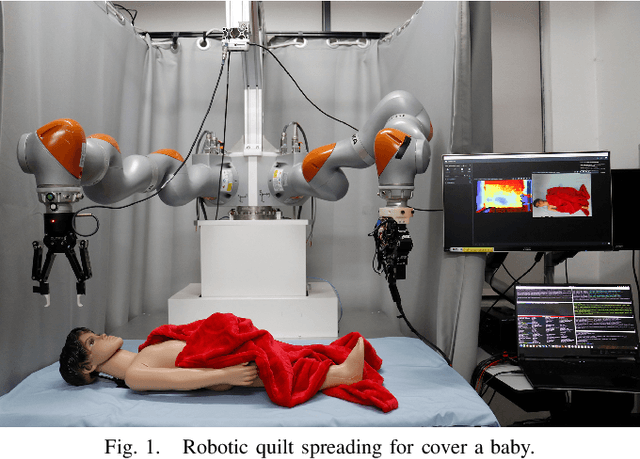
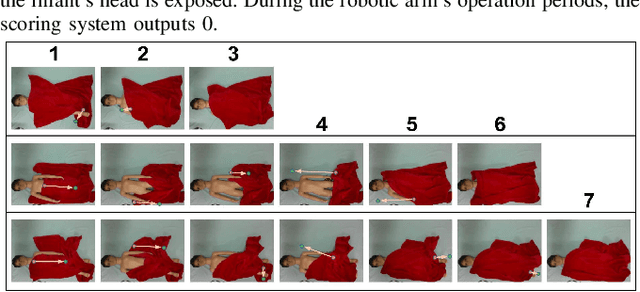
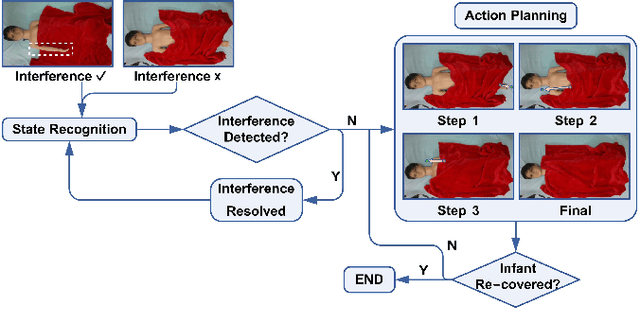
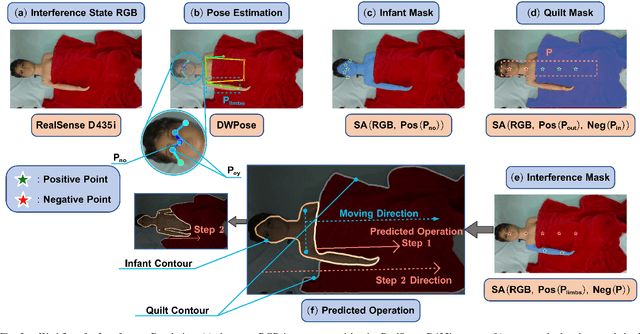
In this work, we propose a novel strategy to ensure infants, who inadvertently displace their quilts during sleep, are promptly and accurately re-covered. Our approach is formulated into two subsequent steps: interference resolution and quilt spreading. By leveraging the DWPose human skeletal detection and the Segment Anything instance segmentation models, the proposed method can accurately recognize the states of the infant and the quilt over her, which involves addressing the interferences resulted from an infant's limbs laid on part of the quilt. Building upon prior research, the EM*D deep learning model is employed to forecast quilt state transitions before and after quilt spreading actions. To improve the sensitivity of the network in distinguishing state variation of the handled quilt, we introduce an enhanced loss function that translates the voxelized quilt state into a more representative one. Both simulation and real-world experiments validate the efficacy of our method, in spreading and recover a quilt over an infant.