 Add to Chrome
 Add to Firefox
 Add to Edge
Credit-assigned Policy Gradient for Early Stage Retrieval in Two-stage Ranking
May 25, 2026
Large-scale search, recommendation, and retrieval-augmented generation (RAG) systems typically employ a two-stage architecture: an early-stage ranker (ESR) generates a candidate set, which is subsequently re-ranked by a late-stage ranker (LSR). While there are many reinforcement learning (RL) methods for training the LSR, end-to-end training of the ESR has proven challenging. In particular, naive application of "vanilla" policy gradient (V-PG) is not scalable for candidate-set sizes relevant for practical use due to exploding variance. This issue arises because V-PG propagates the gradient to the joint probability of the candidate sets, ignoring the contribution of each specific item in the candidate set to the reward. To mitigate this issue, we propose a novel "credit-assigned" policy gradient (CA-PG), which computes gradients with respect to the probability that the target item is chosen in any candidate set, i.e. marginalizing over all candidate sets that contain it. Our theoretical analysis reveals that CA-PG significantly reduces the variance of V-PG by marginalizing over the specific composition of the candidate set, while preserving the ability to learn the correct ranking of items under a reasonably aligned LSR policy. Experiments on both synthetic and real-world data demonstrate that CA-PG improves the convergence speed and training stability for ESRs utilizing the canonical Plackett-Luce model, especially when the candidate-set size is large.

$p1$: Better Prompt Optimization with Fewer Prompts
Apr 09, 2026Prompt optimization improves language models without updating their weights by searching for a better system prompt, but its effectiveness varies widely across tasks. We study what makes a task amenable to prompt optimization. We show that the reward variance across different system prompts can be decomposed into two components: variance among responses, which captures generation stochasticity, and variance among system prompts, which captures differences in system prompt quality. Prompt optimization succeeds when variance among system prompts is sufficiently large, but fails when variance among responses dominates the variance of the system prompts. Surprisingly, we further show that scaling to more user prompts can hurt optimization by reducing variance among system prompts, especially on heterogeneous datasets where different user prompts favor different system prompts. Motivated by this insight, we propose $p1$, a simple user prompt filtering method that selects a small subset of user prompts with high variance across candidate system prompts. This subset of user prompts allows one to distinguish a good system prompt from a bad one, making system optimization easier. Experiments on reasoning benchmarks show that $p1$ substantially improves prompt optimization over training on the full dataset and outperforms strong baselines such as GEPA. Notably, training on only two prompts from AIME 24 yields a system prompt that generalizes well to other reasoning benchmarks.
SteerEval: A Framework for Evaluating Steerability with Natural Language Profiles for Recommendation
Jan 28, 2026Natural-language user profiles have recently attracted attention not only for improved interpretability, but also for their potential to make recommender systems more steerable. By enabling direct editing, natural-language profiles allow users to explicitly articulate preferences that may be difficult to infer from past behavior. However, it remains unclear whether current natural-language-based recommendation methods can follow such steering commands. While existing steerability evaluations have shown some success for well-recognized item attributes (e.g., movie genres), we argue that these benchmarks fail to capture the richer forms of user control that motivate steerable recommendations. To address this gap, we introduce SteerEval, an evaluation framework designed to measure more nuanced and diverse forms of steerability by using interventions that range from genres to content-warning for movies. We assess the steerability of a family of pretrained natural-language recommenders, examine the potential and limitations of steering on relatively niche topics, and compare how different profile and recommendation interventions impact steering effectiveness. Finally, we offer practical design suggestions informed by our findings and discuss future steps in steerable recommender design.
Do LLMs Favor LLMs? Quantifying Interaction Effects in Peer Review
Jan 28, 2026There are increasing indications that LLMs are not only used for producing scientific papers, but also as part of the peer review process. In this work, we provide the first comprehensive analysis of LLM use across the peer review pipeline, with particular attention to interaction effects: not just whether LLM-assisted papers or LLM-assisted reviews are different in isolation, but whether LLM-assisted reviews evaluate LLM-assisted papers differently. In particular, we analyze over 125,000 paper-review pairs from ICLR, NeurIPS, and ICML. We initially observe what appears to be a systematic interaction effect: LLM-assisted reviews seem especially kind to LLM-assisted papers compared to papers with minimal LLM use. However, controlling for paper quality reveals a different story: LLM-assisted reviews are simply more lenient toward lower quality papers in general, and the over-representation of LLM-assisted papers among weaker submissions creates a spurious interaction effect rather than genuine preferential treatment of LLM-generated content. By augmenting our observational findings with reviews that are fully LLM-generated, we find that fully LLM-generated reviews exhibit severe rating compression that fails to discriminate paper quality, while human reviewers using LLMs substantially reduce this leniency. Finally, examining metareviews, we find that LLM-assisted metareviews are more likely to render accept decisions than human metareviews given equivalent reviewer scores, though fully LLM-generated metareviews tend to be harsher. This suggests that meta-reviewers do not merely outsource the decision-making to the LLM. These findings provide important input for developing policies that govern the use of LLMs during peer review, and they more generally indicate how LLMs interact with existing decision-making processes.
Prompt Optimization with Logged Bandit Data
Apr 03, 2025We study how to use naturally available user feedback, such as clicks, to optimize large language model (LLM) pipelines for generating personalized sentences using prompts. Naive approaches, which estimate the policy gradient in the prompt space, suffer either from variance caused by the large action space of prompts or bias caused by inaccurate reward predictions. To circumvent these challenges, we propose a novel kernel-based off-policy gradient method, which estimates the policy gradient by leveraging similarity among generated sentences, substantially reducing variance while suppressing the bias. Empirical results on our newly established suite of benchmarks demonstrate the effectiveness of the proposed approach in generating personalized descriptions for movie recommendations, particularly when the number of candidate prompts is large.
Poor Alignment and Steerability of Large Language Models: Evidence from College Admission Essays
Mar 25, 2025People are increasingly using technologies equipped with large language models (LLM) to write texts for formal communication, which raises two important questions at the intersection of technology and society: Who do LLMs write like (model alignment); and can LLMs be prompted to change who they write like (model steerability). We investigate these questions in the high-stakes context of undergraduate admissions at a selective university by comparing lexical and sentence variation between essays written by 30,000 applicants to two types of LLM-generated essays: one prompted with only the essay question used by the human applicants; and another with additional demographic information about each applicant. We consistently find that both types of LLM-generated essays are linguistically distinct from human-authored essays, regardless of the specific model and analytical approach. Further, prompting a specific sociodemographic identity is remarkably ineffective in aligning the model with the linguistic patterns observed in human writing from this identity group. This holds along the key dimensions of sex, race, first-generation status, and geographic location. The demographically prompted and unprompted synthetic texts were also more similar to each other than to the human text, meaning that prompting did not alleviate homogenization. These issues of model alignment and steerability in current LLMs raise concerns about the use of LLMs in high-stakes contexts.
End-to-end Training for Recommendation with Language-based User Profiles
Oct 24, 2024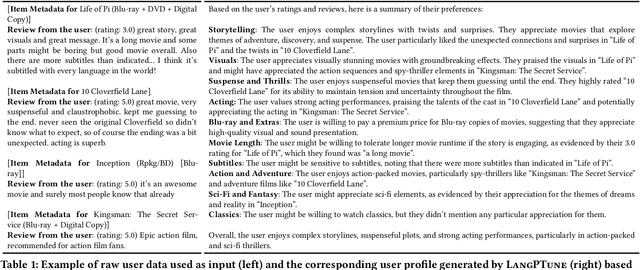
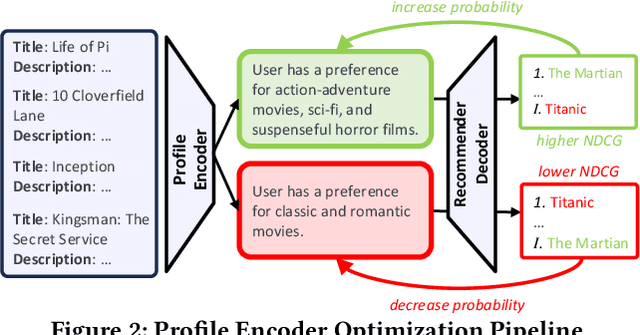
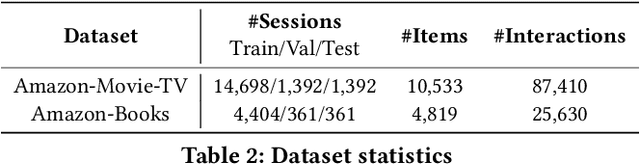
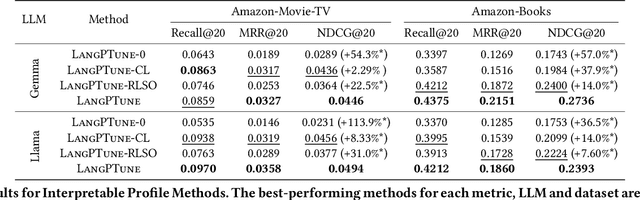
Many online platforms maintain user profiles for personalization. Unfortunately, these profiles are typically not interpretable or easily modifiable by the user. To remedy this shortcoming, we explore natural language-based user profiles, as they promise enhanced transparency and scrutability of recommender systems. While existing work has shown that language-based profiles from standard LLMs can be effective, such generalist LLMs are unlikely to be optimal for this task. In this paper, we introduce LangPTune, the first end-to-end learning method for training LLMs to produce language-based user profiles that optimize recommendation effectiveness. Through comprehensive evaluations of LangPTune across various training configurations and benchmarks, we demonstrate that our approach significantly outperforms existing profile-based methods. In addition, it approaches performance levels comparable to state-of-the-art, less transparent recommender systems, providing a robust and interpretable alternative to conventional systems. Finally, we validate the relative interpretability of these language-based user profiles through user studies involving crowdworkers and GPT-4-based evaluations. Implementation of LangPTune can be found at https://github.com/ZhaolinGao/LangPTune.
REBEL: Reinforcement Learning via Regressing Relative Rewards
Apr 25, 2024While originally developed for continuous control problems, Proximal Policy Optimization (PPO) has emerged as the work-horse of a variety of reinforcement learning (RL) applications including the fine-tuning of generative models. Unfortunately, PPO requires multiple heuristics to enable stable convergence (e.g. value networks, clipping) and is notorious for its sensitivity to the precise implementation of these components. In response, we take a step back and ask what a minimalist RL algorithm for the era of generative models would look like. We propose REBEL, an algorithm that cleanly reduces the problem of policy optimization to regressing the relative rewards via a direct policy parameterization between two completions to a prompt, enabling strikingly lightweight implementation. In theory, we prove that fundamental RL algorithms like Natural Policy Gradient can be seen as variants of REBEL, which allows us to match the strongest known theoretical guarantees in terms of convergence and sample complexity in the RL literature. REBEL can also cleanly incorporate offline data and handle the intransitive preferences we frequently see in practice. Empirically, we find that REBEL provides a unified approach to language modeling and image generation with stronger or similar performance as PPO and DPO, all while being simpler to implement and more computationally tractable than PPO.
Language-Based User Profiles for Recommendation
Feb 23, 2024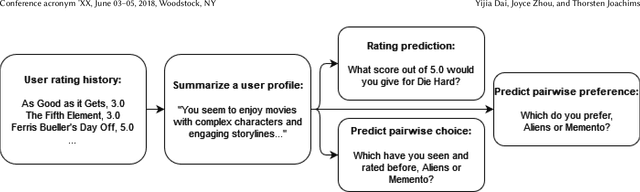
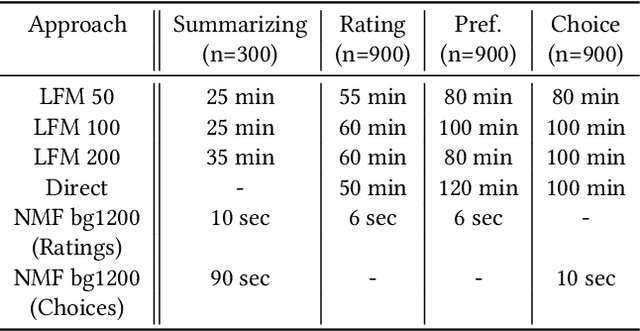
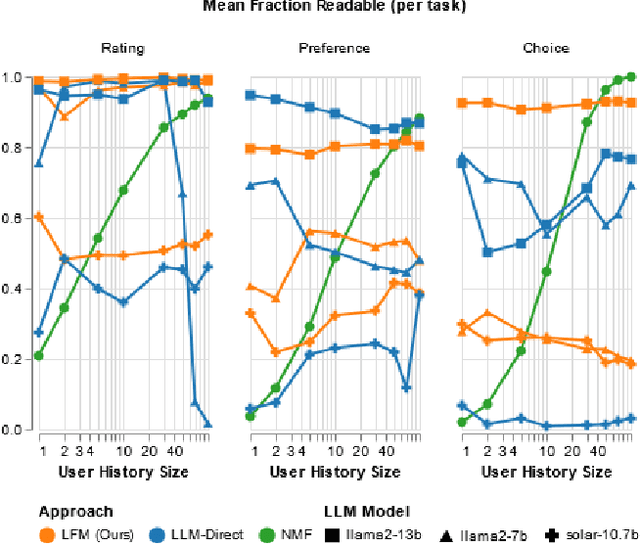
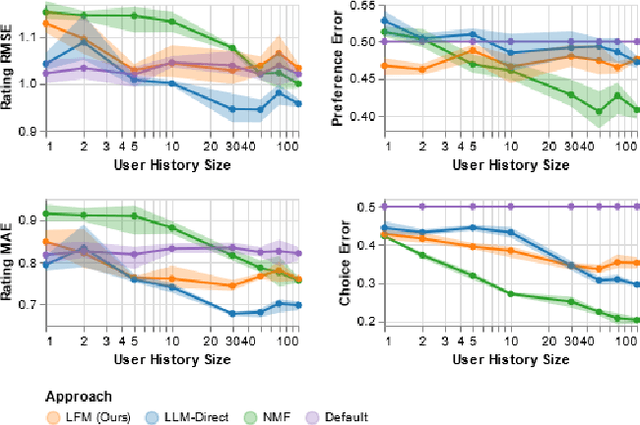
Most conventional recommendation methods (e.g., matrix factorization) represent user profiles as high-dimensional vectors. Unfortunately, these vectors lack interpretability and steerability, and often perform poorly in cold-start settings. To address these shortcomings, we explore the use of user profiles that are represented as human-readable text. We propose the Language-based Factorization Model (LFM), which is essentially an encoder/decoder model where both the encoder and the decoder are large language models (LLMs). The encoder LLM generates a compact natural-language profile of the user's interests from the user's rating history. The decoder LLM uses this summary profile to complete predictive downstream tasks. We evaluate our LFM approach on the MovieLens dataset, comparing it against matrix factorization and an LLM model that directly predicts from the user's rating history. In cold-start settings, we find that our method can have higher accuracy than matrix factorization. Furthermore, we find that generating a compact and human-readable summary often performs comparably with or better than direct LLM prediction, while enjoying better interpretability and shorter model input length. Our results motivate a number of future research directions and potential improvements.
Reviewer2: Optimizing Review Generation Through Prompt Generation
Feb 16, 2024Recent developments in LLMs offer new opportunities for assisting authors in improving their work. In this paper, we envision a use case where authors can receive LLM-generated reviews that uncover weak points in the current draft. While initial methods for automated review generation already exist, these methods tend to produce reviews that lack detail, and they do not cover the range of opinions that human reviewers produce. To address this shortcoming, we propose an efficient two-stage review generation framework called Reviewer2. Unlike prior work, this approach explicitly models the distribution of possible aspects that the review may address. We show that this leads to more detailed reviews that better cover the range of aspects that human reviewers identify in the draft. As part of the research, we generate a large-scale review dataset of 27k papers and 99k reviews that we annotate with aspect prompts, which we make available as a resource for future research.