 Add to Chrome
 Add to Firefox
 Add to Edge
ST-$π$: Structured SpatioTemporal VLA for Robotic Manipulation
Apr 20, 2026
Vision-language-action (VLA) models have achieved great success on general robotic tasks, but still face challenges in fine-grained spatiotemporal manipulation. Typically, existing methods mainly embed spatiotemporal knowledge into visual and action representations, and directly perform a cross-modal mapping for step-level action prediction. However, such spatiotemporal reasoning remains largely implicit, making it difficult to handle multiple sequential behaviors with explicit spatiotemporal boundaries. In this work, we propose ST-$π$, a structured spatiotemporal VLA model for robotic manipulation. Our model is guided by two key designs: 1) Spatiotemporal VLM. We encode 4D observations and task instructions into latent spaces, and feed them into the LLM to generate a sequence of causally ordered chunk-level action prompts consisting of sub-tasks, spatial grounding and temporal grounding. 2) Spatiotemporal action expert. Conditioned on chunk-level action prompts, we design a structured dual-generator guidance to jointly model spatial dependencies and temporal causality, thus predicting step-level action parameters. Within this structured framework, the VLM explicitly plans global spatiotemporal behavior, and the action expert further refines local spatiotemporal control. In addition, we propose a real-world robotic dataset with structured spatiotemporal annotations for fine-tuning. Extensive experiments have been conducted to demonstrate the effectiveness of our model. Our code link: https://github.com/chuanhaoma/ST-pi.

Traceable Latent Variable Discovery Based on Multi-Agent Collaboration
Feb 16, 2026Revealing the underlying causal mechanisms in the real world is crucial for scientific and technological progress. Despite notable advances in recent decades, the lack of high-quality data and the reliance of traditional causal discovery algorithms (TCDA) on the assumption of no latent confounders, as well as their tendency to overlook the precise semantics of latent variables, have long been major obstacles to the broader application of causal discovery. To address this issue, we propose a novel causal modeling framework, TLVD, which integrates the metadata-based reasoning capabilities of large language models (LLMs) with the data-driven modeling capabilities of TCDA for inferring latent variables and their semantics. Specifically, we first employ a data-driven approach to construct a causal graph that incorporates latent variables. Then, we employ multi-LLM collaboration for latent variable inference, modeling this process as a game with incomplete information and seeking its Bayesian Nash Equilibrium (BNE) to infer the possible specific latent variables. Finally, to validate the inferred latent variables across multiple real-world web-based data sources, we leverage LLMs for evidence exploration to ensure traceability. We comprehensively evaluate TLVD on three de-identified real patient datasets provided by a hospital and two benchmark datasets. Extensive experimental results confirm the effectiveness and reliability of TLVD, with average improvements of 32.67% in Acc, 62.21% in CAcc, and 26.72% in ECit across the five datasets.
LQA: A Lightweight Quantized-Adaptive Framework for Vision-Language Models on the Edge
Feb 08, 2026Deploying Vision-Language Models (VLMs) on edge devices is challenged by resource constraints and performance degradation under distribution shifts. While test-time adaptation (TTA) can counteract such shifts, existing methods are too resource-intensive for on-device deployment. To address this challenge, we propose LQA, a lightweight, quantized-adaptive framework for VLMs that combines a modality-aware quantization strategy with gradient-free test-time adaptation. We introduce Selective Hybrid Quantization (SHQ) and a quantized, gradient-free adaptation mechanism to enable robust and efficient VLM deployment on resource-constrained hardware. Experiments across both synthetic and real-world distribution shifts show that LQA improves overall adaptation performance by 4.5\%, uses less memory than full-precision models, and significantly outperforms gradient-based TTA methods, achieving up to 19.9$\times$ lower memory usage across seven open-source datasets. These results demonstrate that LQA offers a practical pathway for robust, privacy-preserving, and efficient VLM deployment on edge devices.
HoRD: Robust Humanoid Control via History-Conditioned Reinforcement Learning and Online Distillation
Feb 05, 2026Humanoid robots can suffer significant performance drops under small changes in dynamics, task specifications, or environment setup. We propose HoRD, a two-stage learning framework for robust humanoid control under domain shift. First, we train a high-performance teacher policy via history-conditioned reinforcement learning, where the policy infers latent dynamics context from recent state--action trajectories to adapt online to diverse randomized dynamics. Second, we perform online distillation to transfer the teacher's robust control capabilities into a transformer-based student policy that operates on sparse root-relative 3D joint keypoint trajectories. By combining history-conditioned adaptation with online distillation, HoRD enables a single policy to adapt zero-shot to unseen domains without per-domain retraining. Extensive experiments show HoRD outperforms strong baselines in robustness and transfer, especially under unseen domains and external perturbations. Code and project page are available at https://tonywang-0517.github.io/hord/.
Energy and Memory-Efficient Federated Learning With Ordered Layer Freezing
Dec 29, 2025Federated Learning (FL) has emerged as a privacy-preserving paradigm for training machine learning models across distributed edge devices in the Internet of Things (IoT). By keeping data local and coordinating model training through a central server, FL effectively addresses privacy concerns and reduces communication overhead. However, the limited computational power, memory, and bandwidth of IoT edge devices pose significant challenges to the efficiency and scalability of FL, especially when training deep neural networks. Various FL frameworks have been proposed to reduce computation and communication overheads through dropout or layer freezing. However, these approaches often sacrifice accuracy or neglect memory constraints. To this end, in this work, we introduce Federated Learning with Ordered Layer Freezing (FedOLF). FedOLF consistently freezes layers in a predefined order before training, significantly mitigating computation and memory requirements. To further reduce communication and energy costs, we incorporate Tensor Operation Approximation (TOA), a lightweight alternative to conventional quantization that better preserves model accuracy. Experimental results demonstrate that over non-iid data, FedOLF achieves at least 0.3%, 6.4%, 5.81%, 4.4%, 6.27% and 1.29% higher accuracy than existing works respectively on EMNIST (with CNN), CIFAR-10 (with AlexNet), CIFAR-100 (with ResNet20 and ResNet44), and CINIC-10 (with ResNet20 and ResNet44), along with higher energy efficiency and lower memory footprint.
Subspace-Based Super-Resolution Sensing for Bi-Static ISAC with Clock Asynchronism
May 15, 2025Bi-static sensing is an attractive configuration for integrated sensing and communications (ISAC) systems; however, clock asynchronism between widely separated transmitters and receivers introduces time-varying time offsets (TO) and phase offsets (PO), posing significant challenges. This paper introduces a signal-subspace-based framework that estimates decoupled angles, delays, and complex gain sequences (CGS)-- the target-reflected signals -- for multiple dynamic target paths. The proposed framework begins with a novel TO alignment algorithm, leveraging signal subspace or covariance, to mitigate TO variations across temporal snapshots, enabling coherent delay-domain analysis. Subsequently, subspace-based methods are developed to compensate for TO residuals and to perform joint angle-delay estimation. Finally, leveraging the high resolution in the joint angle-delay domain, the framework compensates for the PO and estimates the CGS for each target. The framework can be applied to both single-antenna and multi-antenna systems. Extensive simulations and experiments using commercial Wi-Fi devices demonstrate that the proposed framework significantly surpasses existing solutions in parameter estimation accuracy and delay resolution. Notably, it uniquely achieves a super-resolution in the delay domain, with a probability-of-resolution curve tightly approaching that in synchronized systems.
Magic Clothing: Controllable Garment-Driven Image Synthesis
Apr 15, 2024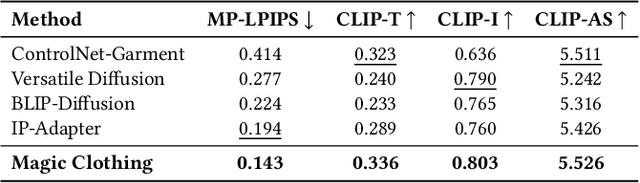



We propose Magic Clothing, a latent diffusion model (LDM)-based network architecture for an unexplored garment-driven image synthesis task. Aiming at generating customized characters wearing the target garments with diverse text prompts, the image controllability is the most critical issue, i.e., to preserve the garment details and maintain faithfulness to the text prompts. To this end, we introduce a garment extractor to capture the detailed garment features, and employ self-attention fusion to incorporate them into the pretrained LDMs, ensuring that the garment details remain unchanged on the target character. Then, we leverage the joint classifier-free guidance to balance the control of garment features and text prompts over the generated results. Meanwhile, the proposed garment extractor is a plug-in module applicable to various finetuned LDMs, and it can be combined with other extensions like ControlNet and IP-Adapter to enhance the diversity and controllability of the generated characters. Furthermore, we design Matched-Points-LPIPS (MP-LPIPS), a robust metric for evaluating the consistency of the target image to the source garment. Extensive experiments demonstrate that our Magic Clothing achieves state-of-the-art results under various conditional controls for garment-driven image synthesis. Our source code is available at https://github.com/ShineChen1024/MagicClothing.
Performance Bounds for Passive Sensing in Asynchronous ISAC Systems -- Appendices
Mar 09, 2024This document contains the appendices for our paper titled ``Performance Bounds for Passive Sensing in Asynchronous ISAC Systems." The appendices include rigorous derivations of key formulas, detailed proofs of the theorems and propositions introduced in the paper, and details of the algorithm tested in the numerical simulation for validation. These appendices aim to support and elaborate on the findings and methodologies presented in the main text. All external references to equations, theorems, and so forth, are directed towards the corresponding elements within the main paper.
OOTDiffusion: Outfitting Fusion based Latent Diffusion for Controllable Virtual Try-on
Mar 07, 2024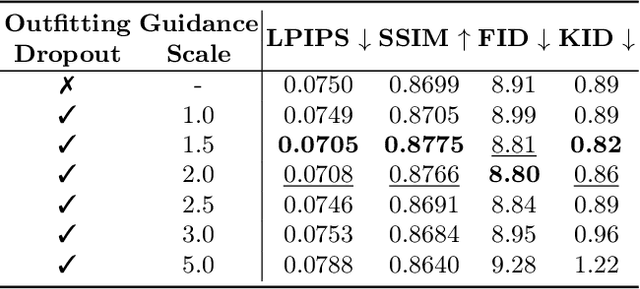

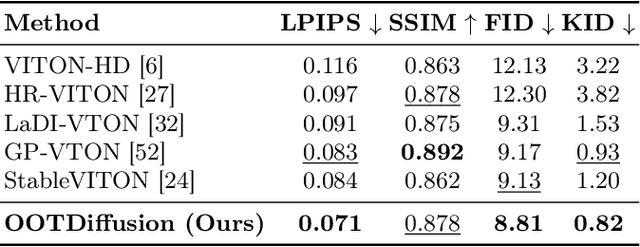

We present OOTDiffusion, a novel network architecture for realistic and controllable image-based virtual try-on (VTON). We leverage the power of pretrained latent diffusion models, designing an outfitting UNet to learn the garment detail features. Without a redundant warping process, the garment features are precisely aligned with the target human body via the proposed outfitting fusion in the self-attention layers of the denoising UNet. In order to further enhance the controllability, we introduce outfitting dropout to the training process, which enables us to adjust the strength of the garment features through classifier-free guidance. Our comprehensive experiments on the VITON-HD and Dress Code datasets demonstrate that OOTDiffusion efficiently generates high-quality try-on results for arbitrary human and garment images, which outperforms other VTON methods in both realism and controllability, indicating an impressive breakthrough in virtual try-on. Our source code is available at https://github.com/levihsu/OOTDiffusion.
FLrce: Efficient Federated Learning with Relationship-based Client Selection and Early-Stopping Strategy
Oct 15, 2023Federated learning (FL) achieves great popularity in broad areas as a powerful interface to offer intelligent services to customers while maintaining data privacy. Nevertheless, FL faces communication and computation bottlenecks due to limited bandwidth and resource constraints of edge devices. To comprehensively address the bottlenecks, the technique of dropout is introduced, where resource-constrained edge devices are allowed to collaboratively train a subset of the global model parameters. However, dropout impedes the learning efficiency of FL under unbalanced local data distributions. As a result, FL requires more rounds to achieve appropriate accuracy, consuming more communication and computation resources. In this paper, we present FLrce, an efficient FL framework with a relationship-based client selection and early-stopping strategy. FLrce accelerates the FL process by selecting clients with more significant effects, enabling the global model to converge to a high accuracy in fewer rounds. FLrce also leverages an early stopping mechanism to terminate FL in advance to save communication and computation resources. Experiment results show that FLrce increases the communication and computation efficiency by 6% to 73.9% and 20% to 79.5%, respectively, while maintaining competitive accuracy.