 Add to Chrome
 Add to Firefox
 Add to Edge
3D-DLP: Self-Supervised 3D Object-Centric Scene Representation Learning
Jun 17, 2026
We introduce 3D-DLP, a self-supervised object-centric representation learning model that decomposes scene-level RGB-D or voxel observations into a set of 3D latent particles. Building on the Deep Latent Particles (DLP) framework, each particle encodes disentangled attributes, including 3D keypoint position, bounding box dimensions, and appearance features, and represents a distinct entity in the scene. The model learns interpretable per-particle segmentation maps through an end-to-end self-supervised reconstruction objective. We demonstrate on both simulated and real-world datasets that the learned latent space is interpretable and controllable: by manipulating particle positions and decoding, we can generate novel scene configurations. Furthermore, we show that leveraging these compact 3D latent particles for downstream robotic manipulation improves performance over baselines that either lack explicit 3D information or rely on memory-intensive dense 3D inputs without object-centric structure. Code and videos are available at https://eubooks3003.github.io/3d-dlp.

Gaussian Splatting Visual MPC for Granular Media Manipulation
Oct 13, 2024
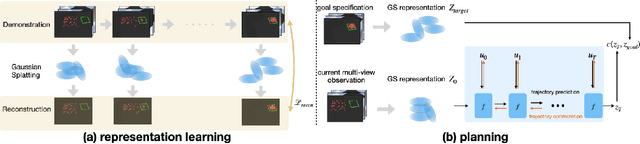


Recent advancements in learned 3D representations have enabled significant progress in solving complex robotic manipulation tasks, particularly for rigid-body objects. However, manipulating granular materials such as beans, nuts, and rice, remains challenging due to the intricate physics of particle interactions, high-dimensional and partially observable state, inability to visually track individual particles in a pile, and the computational demands of accurate dynamics prediction. Current deep latent dynamics models often struggle to generalize in granular material manipulation due to a lack of inductive biases. In this work, we propose a novel approach that learns a visual dynamics model over Gaussian splatting representations of scenes and leverages this model for manipulating granular media via Model-Predictive Control. Our method enables efficient optimization for complex manipulation tasks on piles of granular media. We evaluate our approach in both simulated and real-world settings, demonstrating its ability to solve unseen planning tasks and generalize to new environments in a zero-shot transfer. We also show significant prediction and manipulation performance improvements compared to existing granular media manipulation methods.