 Add to Chrome
 Add to Firefox
 Add to Edge
GraphGPT: Graph Instruction Tuning for Large Language Models
Oct 19, 2023
Graph Neural Networks (GNNs) have advanced graph structure understanding via recursive information exchange and aggregation among graph nodes. To improve model robustness, self-supervised learning (SSL) has emerged as a promising approach for data augmentation. However, existing methods for generating pre-trained graph embeddings often rely on fine-tuning with specific downstream task labels, which limits their usability in scenarios where labeled data is scarce or unavailable. To address this, our research focuses on advancing the generalization capabilities of graph models in challenging zero-shot learning scenarios. Inspired by the success of large language models (LLMs), we aim to develop a graph-oriented LLM that can achieve high generalization across diverse downstream datasets and tasks, even without any information available from the downstream graph data. In this work, we present the GraphGPT framework that aligns LLMs with graph structural knowledge with a graph instruction tuning paradigm. Our framework incorporates a text-graph grounding component to establish a connection between textual information and graph structures. Additionally, we propose a dual-stage instruction tuning paradigm, accompanied by a lightweight graph-text alignment projector. This paradigm explores self-supervised graph structural signals and task-specific graph instructions, to guide LLMs in understanding complex graph structures and improving their adaptability across different downstream tasks. Our framework is evaluated on supervised and zero-shot graph learning tasks, demonstrating superior generalization and outperforming state-of-the-art baselines.

Multi Task Consistency Guided Source-Free Test-Time Domain Adaptation Medical Image Segmentation
Oct 18, 2023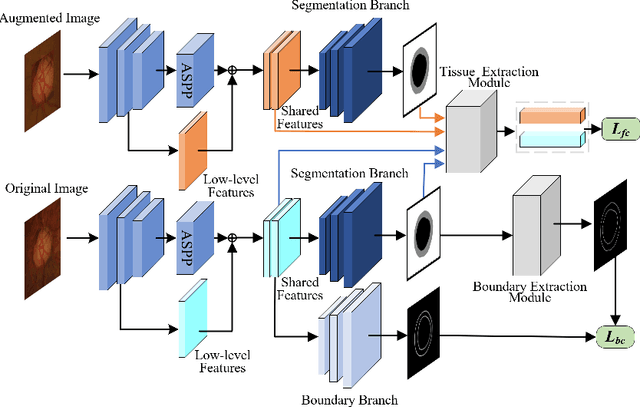
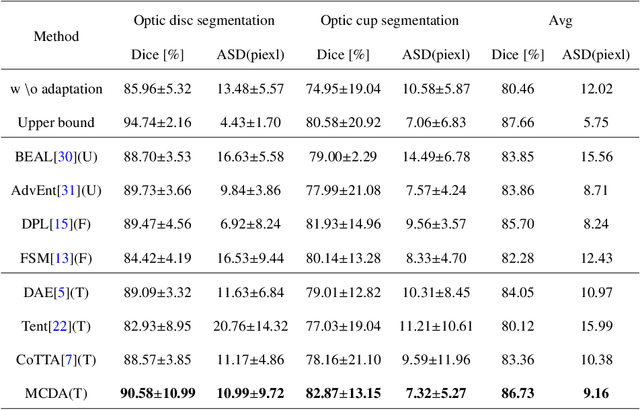
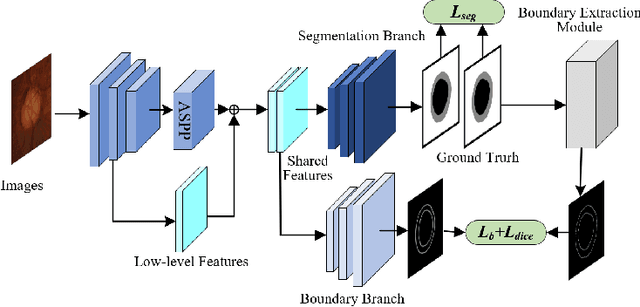

Source-free test-time adaptation for medical image segmentation aims to enhance the adaptability of segmentation models to diverse and previously unseen test sets of the target domain, which contributes to the generalizability and robustness of medical image segmentation models without access to the source domain. Ensuring consistency between target edges and paired inputs is crucial for test-time adaptation. To improve the performance of test-time domain adaptation, we propose a multi task consistency guided source-free test-time domain adaptation medical image segmentation method which ensures the consistency of the local boundary predictions and the global prototype representation. Specifically, we introduce a local boundary consistency constraint method that explores the relationship between tissue region segmentation and tissue boundary localization tasks. Additionally, we propose a global feature consistency constraint toto enhance the intra-class compactness. We conduct extensive experiments on the segmentation of benchmark fundus images. Compared to prediction directly by the source domain model, the segmentation Dice score is improved by 6.27\% and 0.96\% in RIM-ONE-r3 and Drishti GS datasets, respectively. Additionally, the results of experiments demonstrate that our proposed method outperforms existing competitive domain adaptation segmentation algorithms.
4D Gaussian Splatting for Real-Time Dynamic Scene Rendering
Oct 12, 2023Representing and rendering dynamic scenes has been an important but challenging task. Especially, to accurately model complex motions, high efficiency is usually hard to maintain. We introduce the 4D Gaussian Splatting (4D-GS) to achieve real-time dynamic scene rendering while also enjoying high training and storage efficiency. An efficient deformation field is constructed to model both Gaussian motions and shape deformations. Different adjacent Gaussians are connected via a HexPlane to produce more accurate position and shape deformations. Our 4D-GS method achieves real-time rendering under high resolutions, 70 FPS at a 800$\times$800 resolution on an RTX 3090 GPU, while maintaining comparable or higher quality than previous state-of-the-art methods. More demos and code are available at https://guanjunwu.github.io/4dgs/.
Exploring Progress in Multivariate Time Series Forecasting: Comprehensive Benchmarking and Heterogeneity Analysis
Oct 09, 2023Multivariate Time Series (MTS) widely exists in real-word complex systems, such as traffic and energy systems, making their forecasting crucial for understanding and influencing these systems. Recently, deep learning-based approaches have gained much popularity for effectively modeling temporal and spatial dependencies in MTS, specifically in Long-term Time Series Forecasting (LTSF) and Spatial-Temporal Forecasting (STF). However, the fair benchmarking issue and the choice of technical approaches have been hotly debated in related work. Such controversies significantly hinder our understanding of progress in this field. Thus, this paper aims to address these controversies to present insights into advancements achieved. To resolve benchmarking issues, we introduce BasicTS, a benchmark designed for fair comparisons in MTS forecasting. BasicTS establishes a unified training pipeline and reasonable evaluation settings, enabling an unbiased evaluation of over 30 popular MTS forecasting models on more than 18 datasets. Furthermore, we highlight the heterogeneity among MTS datasets and classify them based on temporal and spatial characteristics. We further prove that neglecting heterogeneity is the primary reason for generating controversies in technical approaches. Moreover, based on the proposed BasicTS and rich heterogeneous MTS datasets, we conduct an exhaustive and reproducible performance and efficiency comparison of popular models, providing insights for researchers in selecting and designing MTS forecasting models.
TiBGL: Template-induced Brain Graph Learning for Functional Neuroimaging Analysis
Sep 14, 2023In recent years, functional magnetic resonance imaging has emerged as a powerful tool for investigating the human brain's functional connectivity networks. Related studies demonstrate that functional connectivity networks in the human brain can help to improve the efficiency of diagnosing neurological disorders. However, there still exist two challenges that limit the progress of functional neuroimaging. Firstly, there exists an abundance of noise and redundant information in functional connectivity data, resulting in poor performance. Secondly, existing brain network models have tended to prioritize either classification performance or the interpretation of neuroscience findings behind the learned models. To deal with these challenges, this paper proposes a novel brain graph learning framework called Template-induced Brain Graph Learning (TiBGL), which has both discriminative and interpretable abilities. Motivated by the related medical findings on functional connectivites, TiBGL proposes template-induced brain graph learning to extract template brain graphs for all groups. The template graph can be regarded as an augmentation process on brain networks that removes noise information and highlights important connectivity patterns. To simultaneously support the tasks of discrimination and interpretation, TiBGL further develops template-induced convolutional neural network and template-induced brain interpretation analysis. Especially, the former fuses rich information from brain graphs and template brain graphs for brain disorder tasks, and the latter can provide insightful connectivity patterns related to brain disorders based on template brain graphs. Experimental results on three real-world datasets show that the proposed TiBGL can achieve superior performance compared with nine state-of-the-art methods and keep coherent with neuroscience findings in recent literatures.
TCGF: A unified tensorized consensus graph framework for multi-view representation learning
Sep 14, 2023
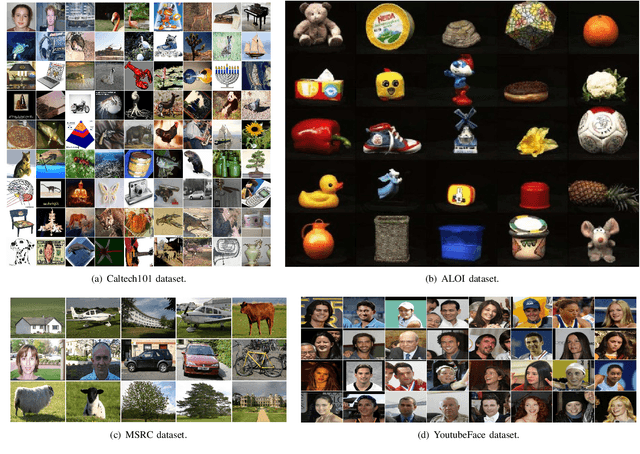
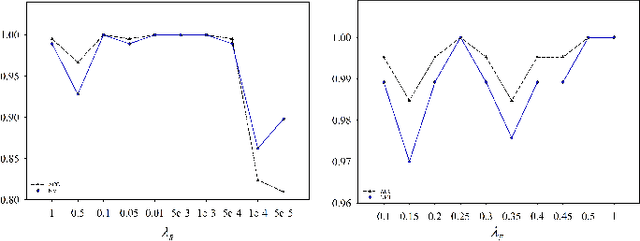
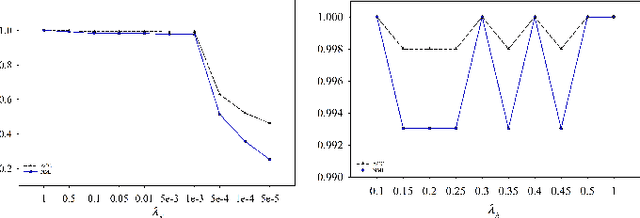
Multi-view learning techniques have recently gained significant attention in the machine learning domain for their ability to leverage consistency and complementary information across multiple views. However, there remains a lack of sufficient research on generalized multi-view frameworks that unify existing works into a scalable and robust learning framework, as most current works focus on specific styles of multi-view models. Additionally, most multi-view learning works rely heavily on specific-scale scenarios and fail to effectively comprehend multiple scales holistically. These limitations hinder the effective fusion of essential information from multiple views, resulting in poor generalization. To address these limitations, this paper proposes a universal multi-view representation learning framework named Tensorized Consensus Graph Framework (TCGF). Specifically, it first provides a unified framework for existing multi-view works to exploit the representations for individual view, which aims to be suitable for arbitrary assumptions and different-scales datasets. Then, stacks them into a tensor under alignment basics as a high-order representation, allowing for the smooth propagation of consistency and complementary information across all views. Moreover, TCGF proposes learning a consensus embedding shared by adaptively collaborating all views to uncover the essential structure of the multi-view data, which utilizes view-consensus grouping effect to regularize the view-consensus representation. To further facilitate related research, we provide a specific implementation of TCGF for large-scale datasets, which can be efficiently solved by applying the alternating optimization strategy. Experimental results conducted on seven different-scales datasets indicate the superiority of the proposed TCGF against existing state-of-the-art multi-view learning methods.
Multi-Relational Contrastive Learning for Recommendation
Sep 03, 2023Personalized recommender systems play a crucial role in capturing users' evolving preferences over time to provide accurate and effective recommendations on various online platforms. However, many recommendation models rely on a single type of behavior learning, which limits their ability to represent the complex relationships between users and items in real-life scenarios. In such situations, users interact with items in multiple ways, including clicking, tagging as favorite, reviewing, and purchasing. To address this issue, we propose the Relation-aware Contrastive Learning (RCL) framework, which effectively models dynamic interaction heterogeneity. The RCL model incorporates a multi-relational graph encoder that captures short-term preference heterogeneity while preserving the dedicated relation semantics for different types of user-item interactions. Moreover, we design a dynamic cross-relational memory network that enables the RCL model to capture users' long-term multi-behavior preferences and the underlying evolving cross-type behavior dependencies over time. To obtain robust and informative user representations with both commonality and diversity across multi-behavior interactions, we introduce a multi-relational contrastive learning paradigm with heterogeneous short- and long-term interest modeling. Our extensive experimental studies on several real-world datasets demonstrate the superiority of the RCL recommender system over various state-of-the-art baselines in terms of recommendation accuracy and effectiveness.
HyperBandit: Contextual Bandit with Hypernewtork for Time-Varying User Preferences in Streaming Recommendation
Aug 14, 2023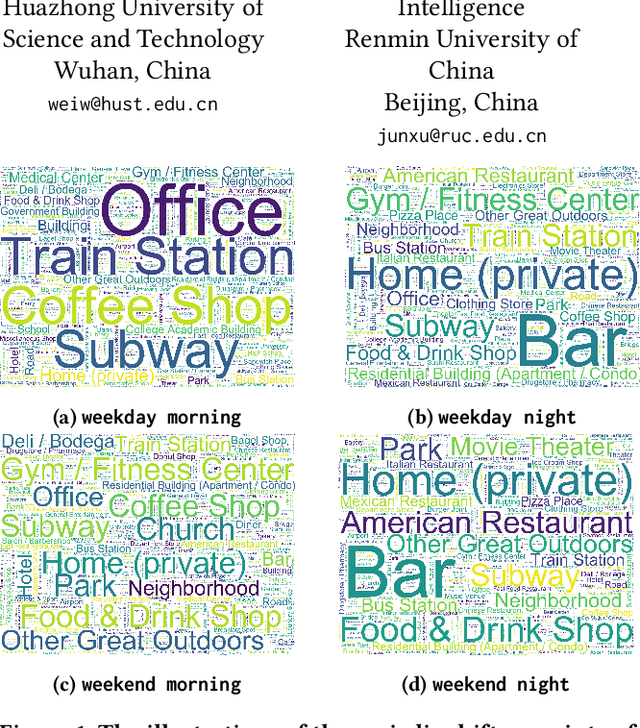
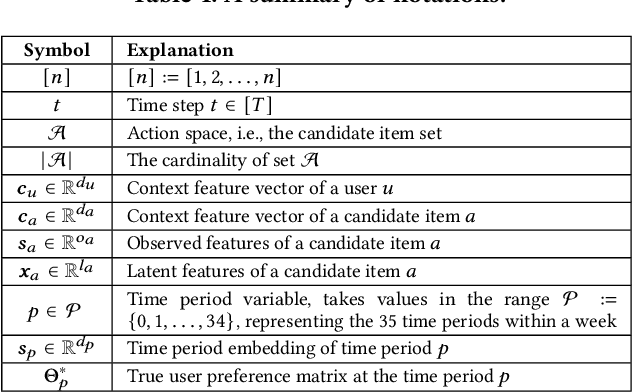
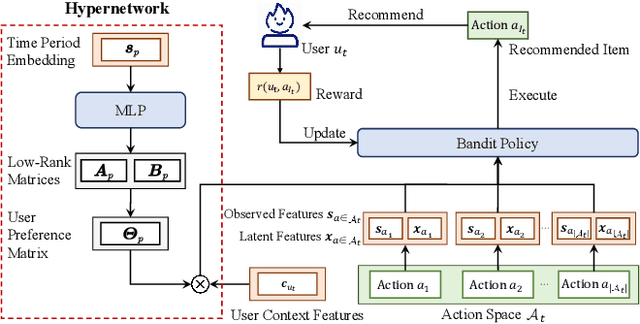
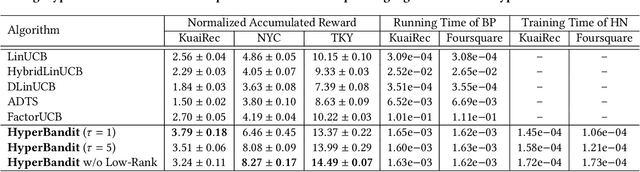
In real-world streaming recommender systems, user preferences often dynamically change over time (e.g., a user may have different preferences during weekdays and weekends). Existing bandit-based streaming recommendation models only consider time as a timestamp, without explicitly modeling the relationship between time variables and time-varying user preferences. This leads to recommendation models that cannot quickly adapt to dynamic scenarios. To address this issue, we propose a contextual bandit approach using hypernetwork, called HyperBandit, which takes time features as input and dynamically adjusts the recommendation model for time-varying user preferences. Specifically, HyperBandit maintains a neural network capable of generating the parameters for estimating time-varying rewards, taking into account the correlation between time features and user preferences. Using the estimated time-varying rewards, a bandit policy is employed to make online recommendations by learning the latent item contexts. To meet the real-time requirements in streaming recommendation scenarios, we have verified the existence of a low-rank structure in the parameter matrix and utilize low-rank factorization for efficient training. Theoretically, we demonstrate a sublinear regret upper bound against the best policy. Extensive experiments on real-world datasets show that the proposed HyperBandit consistently outperforms the state-of-the-art baselines in terms of accumulated rewards.
SSLRec: A Self-Supervised Learning Library for Recommendation
Aug 10, 2023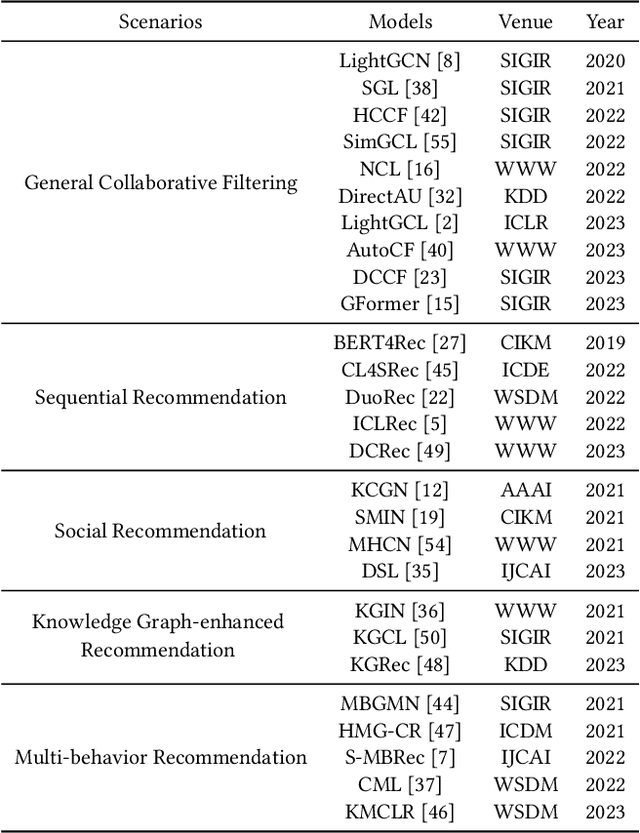
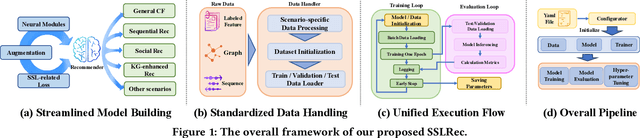
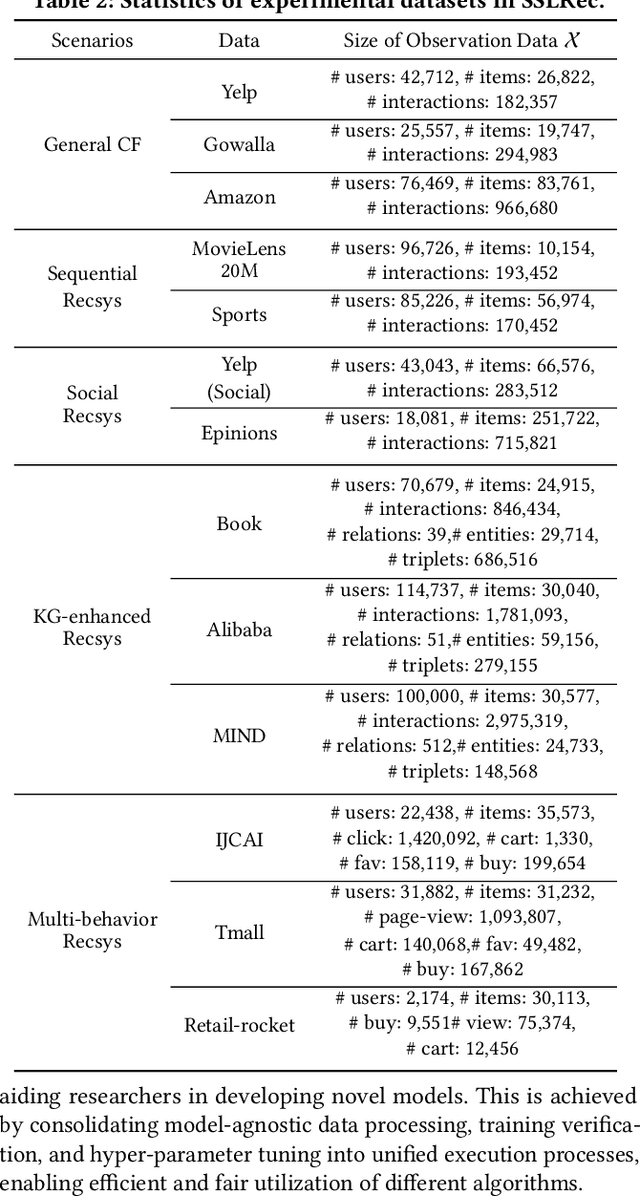
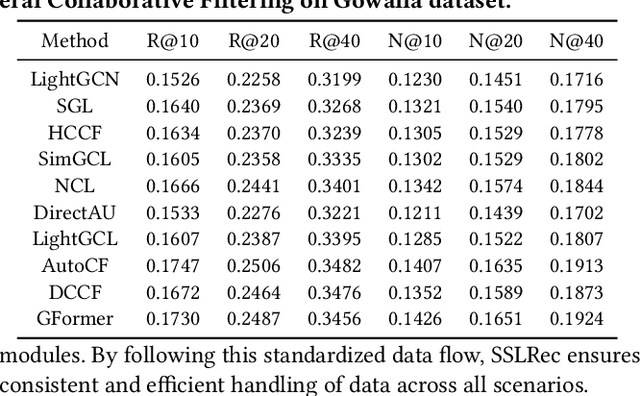
Self-supervised learning (SSL) has gained significant interest in recent years as a solution to address the challenges posed by sparse and noisy data in recommender systems. Despite the growing number of SSL algorithms designed to provide state-of-the-art performance in various recommendation scenarios (e.g., graph collaborative filtering, sequential recommendation, social recommendation, KG-enhanced recommendation), there is still a lack of unified frameworks that integrate recommendation algorithms across different domains. Such a framework could serve as the cornerstone for self-supervised recommendation algorithms, unifying the validation of existing methods and driving the design of new ones. To address this gap, we introduce SSLRec, a novel benchmark platform that provides a standardized, flexible, and comprehensive framework for evaluating various SSL-enhanced recommenders. The SSLRec library features a modular architecture that allows users to easily evaluate state-of-the-art models and a complete set of data augmentation and self-supervised toolkits to help create SSL recommendation models with specific needs. Furthermore, SSLRec simplifies the process of training and evaluating different recommendation models with consistent and fair settings. Our SSLRec platform covers a comprehensive set of state-of-the-art SSL-enhanced recommendation models across different scenarios, enabling researchers to evaluate these cutting-edge models and drive further innovation in the field. Our implemented SSLRec framework is available at the source code repository https://github.com/HKUDS/SSLRec.
Multi-view Hypergraph Contrastive Policy Learning for Conversational Recommendation
Jul 26, 2023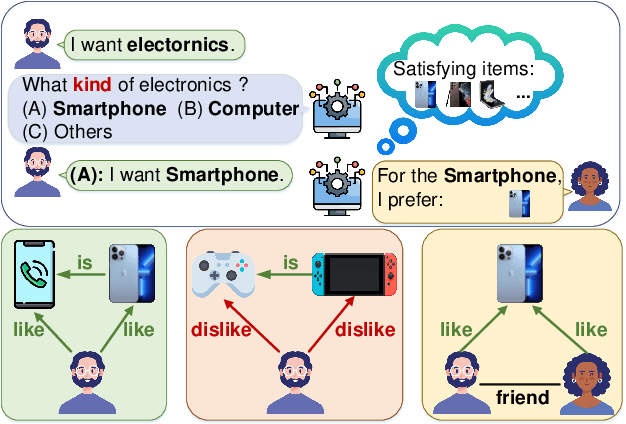
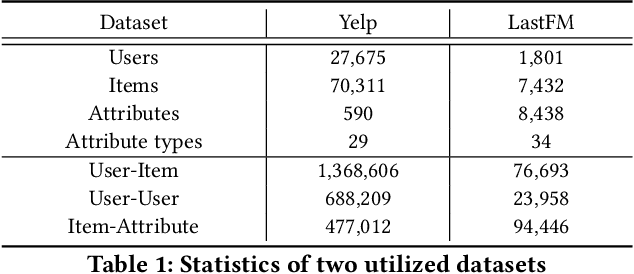
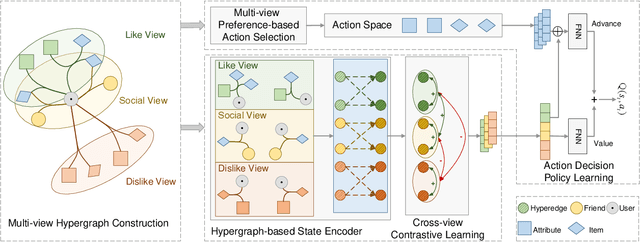
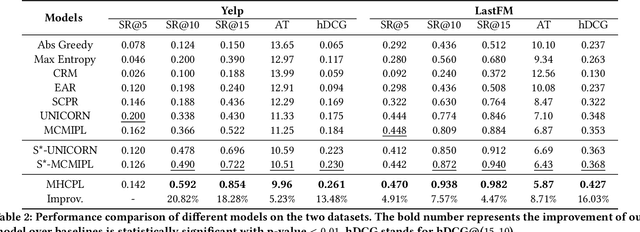
Conversational recommendation systems (CRS) aim to interactively acquire user preferences and accordingly recommend items to users. Accurately learning the dynamic user preferences is of crucial importance for CRS. Previous works learn the user preferences with pairwise relations from the interactive conversation and item knowledge, while largely ignoring the fact that factors for a relationship in CRS are multiplex. Specifically, the user likes/dislikes the items that satisfy some attributes (Like/Dislike view). Moreover social influence is another important factor that affects user preference towards the item (Social view), while is largely ignored by previous works in CRS. The user preferences from these three views are inherently different but also correlated as a whole. The user preferences from the same views should be more similar than that from different views. The user preferences from Like View should be similar to Social View while different from Dislike View. To this end, we propose a novel model, namely Multi-view Hypergraph Contrastive Policy Learning (MHCPL). Specifically, MHCPL timely chooses useful social information according to the interactive history and builds a dynamic hypergraph with three types of multiplex relations from different views. The multiplex relations in each view are successively connected according to their generation order.