 Add to Chrome
 Add to Firefox
 Add to Edge
LM-Net: A Light-weight and Multi-scale Network for Medical Image Segmentation
Jan 07, 2025
Current medical image segmentation approaches have limitations in deeply exploring multi-scale information and effectively combining local detail textures with global contextual semantic information. This results in over-segmentation, under-segmentation, and blurred segmentation boundaries. To tackle these challenges, we explore multi-scale feature representations from different perspectives, proposing a novel, lightweight, and multi-scale architecture (LM-Net) that integrates advantages of both Convolutional Neural Networks (CNNs) and Vision Transformers (ViTs) to enhance segmentation accuracy. LM-Net employs a lightweight multi-branch module to capture multi-scale features at the same level. Furthermore, we introduce two modules to concurrently capture local detail textures and global semantics with multi-scale features at different levels: the Local Feature Transformer (LFT) and Global Feature Transformer (GFT). The LFT integrates local window self-attention to capture local detail textures, while the GFT leverages global self-attention to capture global contextual semantics. By combining these modules, our model achieves complementarity between local and global representations, alleviating the problem of blurred segmentation boundaries in medical image segmentation. To evaluate the feasibility of LM-Net, extensive experiments have been conducted on three publicly available datasets with different modalities. Our proposed model achieves state-of-the-art results, surpassing previous methods, while only requiring 4.66G FLOPs and 5.4M parameters. These state-of-the-art results on three datasets with different modalities demonstrate the effectiveness and adaptability of our proposed LM-Net for various medical image segmentation tasks.

AgentRefine: Enhancing Agent Generalization through Refinement Tuning
Jan 03, 2025Large Language Model (LLM) based agents have proved their ability to perform complex tasks like humans. However, there is still a large gap between open-sourced LLMs and commercial models like the GPT series. In this paper, we focus on improving the agent generalization capabilities of LLMs via instruction tuning. We first observe that the existing agent training corpus exhibits satisfactory results on held-in evaluation sets but fails to generalize to held-out sets. These agent-tuning works face severe formatting errors and are frequently stuck in the same mistake for a long while. We analyze that the poor generalization ability comes from overfitting to several manual agent environments and a lack of adaptation to new situations. They struggle with the wrong action steps and can not learn from the experience but just memorize existing observation-action relations. Inspired by the insight, we propose a novel AgentRefine framework for agent-tuning. The core idea is to enable the model to learn to correct its mistakes via observation in the trajectory. Specifically, we propose an agent synthesis framework to encompass a diverse array of environments and tasks and prompt a strong LLM to refine its error action according to the environment feedback. AgentRefine significantly outperforms state-of-the-art agent-tuning work in terms of generalization ability on diverse agent tasks. It also has better robustness facing perturbation and can generate diversified thought in inference. Our findings establish the correlation between agent generalization and self-refinement and provide a new paradigm for future research.
M2I2: Learning Efficient Multi-Agent Communication via Masked State Modeling and Intention Inference
Dec 31, 2024Communication is essential in coordinating the behaviors of multiple agents. However, existing methods primarily emphasize content, timing, and partners for information sharing, often neglecting the critical aspect of integrating shared information. This gap can significantly impact agents' ability to understand and respond to complex, uncertain interactions, thus affecting overall communication efficiency. To address this issue, we introduce M2I2, a novel framework designed to enhance the agents' capabilities to assimilate and utilize received information effectively. M2I2 equips agents with advanced capabilities for masked state modeling and joint-action prediction, enriching their perception of environmental uncertainties and facilitating the anticipation of teammates' intentions. This approach ensures that agents are furnished with both comprehensive and relevant information, bolstering more informed and synergistic behaviors. Moreover, we propose a Dimensional Rational Network, innovatively trained via a meta-learning paradigm, to identify the importance of dimensional pieces of information, evaluating their contributions to decision-making and auxiliary tasks. Then, we implement an importance-based heuristic for selective information masking and sharing. This strategy optimizes the efficiency of masked state modeling and the rationale behind information sharing. We evaluate M2I2 across diverse multi-agent tasks, the results demonstrate its superior performance, efficiency, and generalization capabilities, over existing state-of-the-art methods in various complex scenarios.
Toward Scene Graph and Layout Guided Complex 3D Scene Generation
Dec 29, 2024Recent advancements in object-centric text-to-3D generation have shown impressive results. However, generating complex 3D scenes remains an open challenge due to the intricate relations between objects. Moreover, existing methods are largely based on score distillation sampling (SDS), which constrains the ability to manipulate multiobjects with specific interactions. Addressing these critical yet underexplored issues, we present a novel framework of Scene Graph and Layout Guided 3D Scene Generation (GraLa3D). Given a text prompt describing a complex 3D scene, GraLa3D utilizes LLM to model the scene using a scene graph representation with layout bounding box information. GraLa3D uniquely constructs the scene graph with single-object nodes and composite super-nodes. In addition to constraining 3D generation within the desirable layout, a major contribution lies in the modeling of interactions between objects in a super-node, while alleviating appearance leakage across objects within such nodes. Our experiments confirm that GraLa3D overcomes the above limitations and generates complex 3D scenes closely aligned with text prompts.
TradingAgents: Multi-Agents LLM Financial Trading Framework
Dec 28, 2024


Significant progress has been made in automated problem-solving using societies of agents powered by large language models (LLMs). In finance, efforts have largely focused on single-agent systems handling specific tasks or multi-agent frameworks independently gathering data. However, multi-agent systems' potential to replicate real-world trading firms' collaborative dynamics remains underexplored. TradingAgents proposes a novel stock trading framework inspired by trading firms, featuring LLM-powered agents in specialized roles such as fundamental analysts, sentiment analysts, technical analysts, and traders with varied risk profiles. The framework includes Bull and Bear researcher agents assessing market conditions, a risk management team monitoring exposure, and traders synthesizing insights from debates and historical data to make informed decisions. By simulating a dynamic, collaborative trading environment, this framework aims to improve trading performance. Detailed architecture and extensive experiments reveal its superiority over baseline models, with notable improvements in cumulative returns, Sharpe ratio, and maximum drawdown, highlighting the potential of multi-agent LLM frameworks in financial trading.
A Fully Hardware Implemented Accelerator Design in ReRAM Analog Computing without ADCs
Dec 27, 2024Emerging ReRAM-based accelerators process neural networks via analog Computing-in-Memory (CiM) for ultra-high energy efficiency. However, significant overhead in peripheral circuits and complex nonlinear activation modes constrain system energy efficiency improvements. This work explores the hardware implementation of the Sigmoid and SoftMax activation functions of neural networks with stochastically binarized neurons by utilizing sampled noise signals from ReRAM devices to achieve a stochastic effect. We propose a complete ReRAM-based Analog Computing Accelerator (RACA) that accelerates neural network computation by leveraging stochastically binarized neurons in combination with ReRAM crossbars. The novel circuit design removes significant sources of energy/area efficiency degradation, i.e., the Digital-to-Analog and Analog-to-Digital Converters (DACs and ADCs) as well as the components to explicitly calculate the activation functions. Experimental results show that our proposed design outperforms traditional architectures across all overall performance metrics without compromising inference accuracy.
Template-Driven LLM-Paraphrased Framework for Tabular Math Word Problem Generation
Dec 20, 2024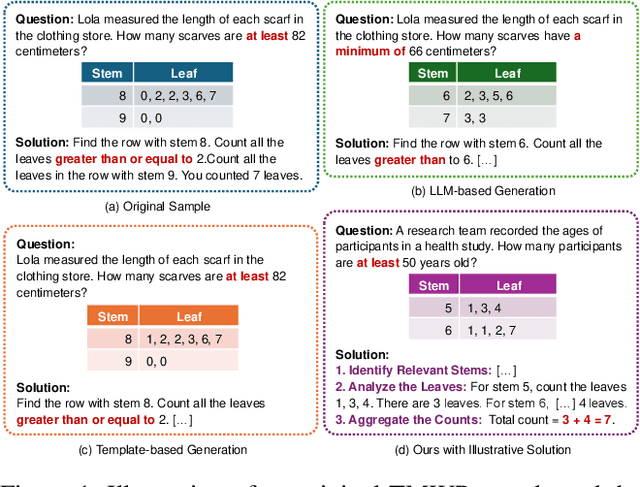
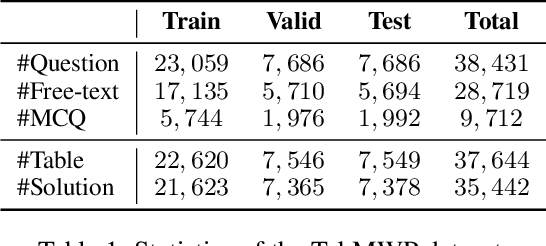
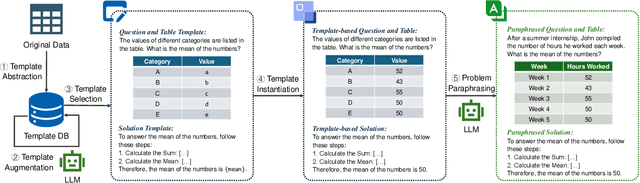
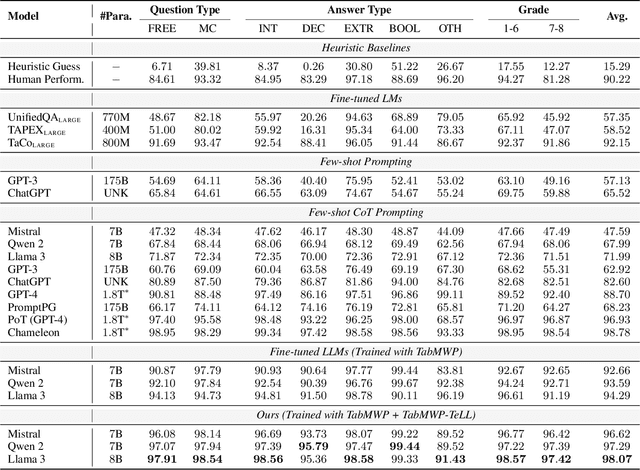
Solving tabular math word problems (TMWPs) has become a critical role in evaluating the mathematical reasoning ability of large language models (LLMs), where large-scale TMWP samples are commonly required for LLM fine-tuning. Since the collection of high-quality TMWP datasets is costly and time-consuming, recent research has concentrated on automatic TMWP generation. However, current generated samples usually suffer from issues of either correctness or diversity. In this paper, we propose a Template-driven LLM-paraphrased (TeLL) framework for generating high-quality TMWP samples with diverse backgrounds and accurate tables, questions, answers, and solutions. To this end, we first extract templates from existing real samples to generate initial problems, ensuring correctness. Then, we adopt an LLM to extend templates and paraphrase problems, obtaining diverse TMWP samples. Furthermore, we find the reasoning annotation is important for solving TMWPs. Therefore, we propose to enrich each solution with illustrative reasoning steps. Through the proposed framework, we construct a high-quality dataset TabMWP-TeLL by adhering to the question types in the TabMWP dataset, and we conduct extensive experiments on a variety of LLMs to demonstrate the effectiveness of TabMWP-TeLL in improving TMWP solving performance. The code and data of this paper are available at: https://github.com/Jason8Kang/TELL.
MetaScientist: A Human-AI Synergistic Framework for Automated Mechanical Metamaterial Design
Dec 20, 2024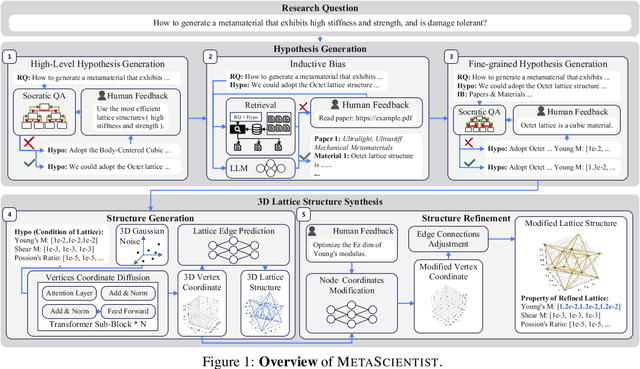
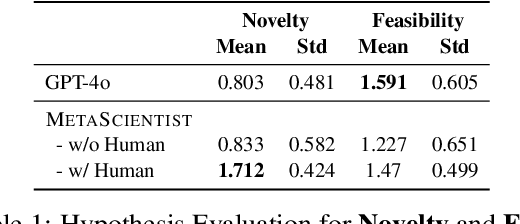
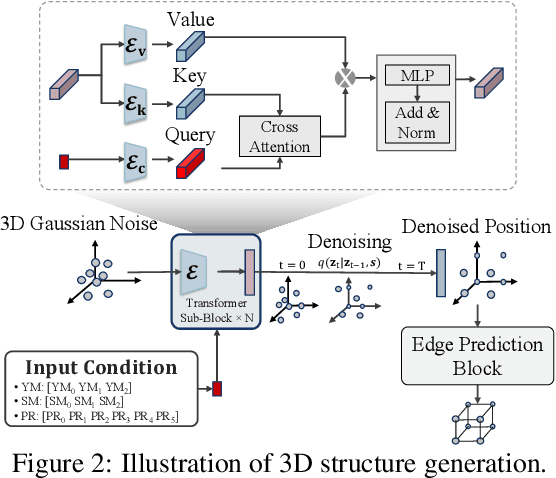
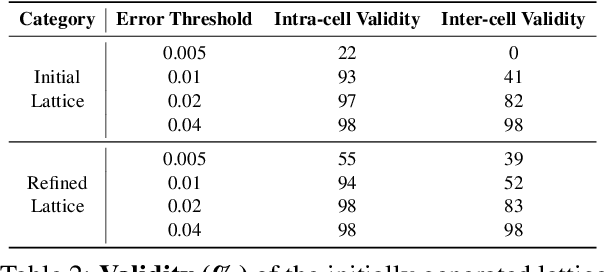
The discovery of novel mechanical metamaterials, whose properties are dominated by their engineered structures rather than chemical composition, is a knowledge-intensive and resource-demanding process. To accelerate the design of novel metamaterials, we present MetaScientist, a human-in-the-loop system that integrates advanced AI capabilities with expert oversight with two primary phases: (1) hypothesis generation, where the system performs complex reasoning to generate novel and scientifically sound hypotheses, supported with domain-specific foundation models and inductive biases retrieved from existing literature; (2) 3D structure synthesis, where a 3D structure is synthesized with a novel 3D diffusion model based on the textual hypothesis and refined it with a LLM-based refinement model to achieve better structure properties. At each phase, domain experts iteratively validate the system outputs, and provide feedback and supplementary materials to ensure the alignment of the outputs with scientific principles and human preferences. Through extensive evaluation from human scientists, MetaScientist is able to deliver novel and valid mechanical metamaterial designs that have the potential to be highly impactful in the metamaterial field.
Promptable Representation Distribution Learning and Data Augmentation for Gigapixel Histopathology WSI Analysis
Dec 19, 2024Gigapixel image analysis, particularly for whole slide images (WSIs), often relies on multiple instance learning (MIL). Under the paradigm of MIL, patch image representations are extracted and then fixed during the training of the MIL classifiers for efficiency consideration. However, the invariance of representations makes it difficult to perform data augmentation for WSI-level model training, which significantly limits the performance of the downstream WSI analysis. The current data augmentation methods for gigapixel images either introduce additional computational costs or result in a loss of semantic information, which is hard to meet the requirements for efficiency and stability needed for WSI model training. In this paper, we propose a Promptable Representation Distribution Learning framework (PRDL) for both patch-level representation learning and WSI-level data augmentation. Meanwhile, we explore the use of prompts to guide data augmentation in feature space, which achieves promptable data augmentation for training robust WSI-level models. The experimental results have demonstrated that the proposed method stably outperforms state-of-the-art methods.
Echo: Simulating Distributed Training At Scale
Dec 17, 2024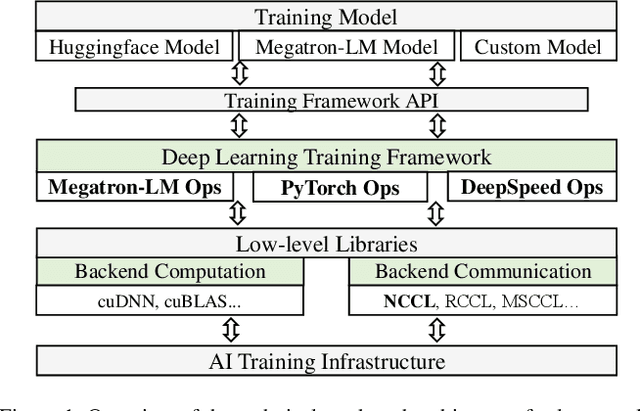
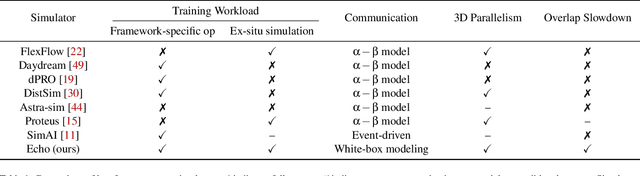

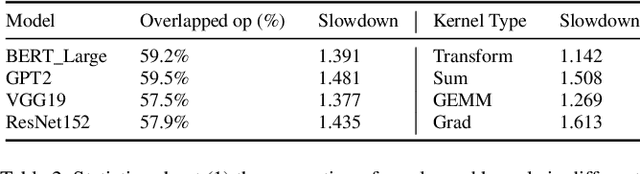
Simulation offers unique values for both enumeration and extrapolation purposes, and is becoming increasingly important for managing the massive machine learning (ML) clusters and large-scale distributed training jobs. In this paper, we build Echo to tackle three key challenges in large-scale training simulation: (1) tracing the runtime training workloads at each device in an ex-situ fashion so we can use a single device to obtain the actual execution graphs of 1K-GPU training, (2) accurately estimating the collective communication without high overheads of discrete-event based network simulation, and (3) accounting for the interference-induced computation slowdown from overlapping communication and computation kernels on the same device. Echo delivers on average 8% error in training step -- roughly 3x lower than state-of-the-art simulators -- for GPT-175B on a 96-GPU H800 cluster with 3D parallelism on Megatron-LM under 2 minutes.