 Add to Chrome
 Add to Firefox
 Add to Edge
Wuying-Browser-Agent: Real-World Centric Fundamental Long-Horizon Browser Agents
Aug 18, 2026
Browser agents perform well on short, clean demonstrations, but real deployment is fundamentally different: agents must sustain dozens of decisions on live websites while recovering from mistakes and navigating complex UIs. We argue that closing this gap requires alignment at every level of the pipeline, including execution, supervision, optimization, and evaluation, rather than scale alone. We present Wuying-Browser-Agent, a unified framework that addresses each of these levels. A structured browser harness provides stable execution primitives and decision-oriented context management. Reflection and UI-specialized Curriculum SFT (RUIC-SFT) explicitly trains on recovery trajectories and complex-UI interactions. Divergence-Aware Online GRPO (DAO-GRPO) improves long-horizon credit assignment through potential-based reward shaping and divergence-aware step weighting. Finally, we introduce BrowserBench, a bilingual real-web benchmark of 350 tasks averaging 37.9 steps, because most existing benchmarks are too short to expose long-horizon failure modes. Wuying-Browser-Agent-27B achieves 80.6\% on WebVoyager, 66.7\% on Online-Mind2Web, and 65.1\% on BrowserBench, establishing a new open-source state of the art on browser-use benchmarks. The same pipeline also transfers beyond browser use, demonstrating strong general agentic ability and reaching an average score of 73.8 on Tau2-Bench, Claw-Eval, and BFCL-v4.

Scores Are Not Decisions: Cost-Aware Stopping for Tool Acquisition in LLM Agents
Jul 29, 2026As LLM agents increasingly depend on diverse external services such as search engines, databases, and connectors, agent harnesses face a fundamental tool-selection challenge: acquiring too few tools leaves the task under-informed, while too many adds cost, context load, and privacy exposure. Routers and retrievers can rank candidate tools by relevance, but a ranking alone does not determine how many are worth selecting. Existing approaches leave acquisition under heterogeneous costs unaddressed. We formulate this decision as cost-aware marginal decision-focused stopping (CAM-DF) over ranked tool prefixes, with CAM-DF-lite as a compact interpretable variant. We train directly on the offline gap between stopping now and the best continuation: its sign labels the decision, its magnitude weights each error by the payoff at stake. We prove this objective is Bayes-aligned with the stopping target and that score-only rules are suboptimal under heterogeneous costs. We evaluate on 1,343 tasks across five tool-use domains. On $τ$-bench Retail, CAM-DF attains the highest payoff among deployable methods, with gains over a predict-then-threshold baseline across all five ranking sources and two cost regimes. Our approach is state-of-the-art under heterogeneous costs and high cost pressure, with larger gains under weaker rankings. In live execution, CAM-DF exposes the agent to 37\% fewer tools than full access while maintaining comparable task success. The CAM-DF family is a lightweight pre-execution plugin that turns existing tool rankings into lower-cost acquisition decisions without fine-tuning the underlying LLM.
Frontier: Towards Comprehensive and Accurate LLM Inference Simulation
May 20, 2026Modern LLM serving is no longer homogeneous or monolithic. Production systems now combine disaggregated execution, complex parallelism, runtime optimizations, and stateful workloads such as reasoning, agents, and RL rollouts. Simulation is attractive for exploring this growing design space, yet existing simulators lack the architectural completeness and decision-grade fidelity it demands. Their monolithic-replica abstractions are ill-suited to disaggregated serving, while average-case analytical proxies can distort SLA predictions and even reverse optimization conclusions. We present Frontier, a discrete-event simulator for modern LLM inference serving. Frontier features a disaggregated abstraction. It captures the structure and dynamics of modern serving systems by modeling co-location, Prefill-Decode Disaggregation (PDD), and Attention-FFN Disaggregation (AFD) with role-specific cluster workers, incorporating key runtime optimizations (e.g., CUDA Graphs, speculative decoding) within the scheduler-batch-engine loop, and supporting stateful requests for emerging workloads. It further provides accurate and generalizable predictions of computation, communication, and memory costs across diverse serving scenarios with complex workload compositions. On 16-H800 GPU testbed, Frontier achieves an average throughput error below 4%. Compared with state-of-the-art simulators, it reduces end-to-end latency error from 44.9% to 6.4% under co-location and from 51.7% to 2.6% under disaggregation. It scales to over 1K GPUs on commodity CPUs and enables new use cases such as SLA-dependent Pareto frontier exploration, heterogeneous disaggregated allocation, agentic reasoning scheduling validation, and RL post-training reconfiguration.
Conservative Offline Robot Policy Learning via Posterior-Transition Reweighting
Mar 17, 2026Offline post-training adapts a pretrained robot policy to a target dataset by supervised regression on recorded actions. In practice, robot datasets are heterogeneous: they mix embodiments, camera setups, and demonstrations of varying quality, so many trajectories reflect recovery behavior, inconsistent operator skill, or weakly informative supervision. Uniform post-training gives equal credit to all samples and can therefore average over conflicting or low-attribution data. We propose Posterior-Transition Reweighting (PTR), a reward-free and conservative post-training method that decides how much each training sample should influence the supervised update. For each sample, PTR encodes the observed post-action consequence as a latent target, inserts it into a candidate pool of mismatched targets, and uses a separate transition scorer to estimate a softmax identification posterior over target indices. The posterior-to-uniform ratio defines the PTR score, which is converted into a clipped-and-mixed weight and applied to the original action objective through self-normalized weighted regression. This construction requires no tractable policy likelihood and is compatible with both diffusion and flow-matching action heads. Rather than uniformly trusting all recorded supervision, PTR reallocates credit according to how attributable each sample's post-action consequence is under the current representation, improving conservative offline adaptation to heterogeneous robot data.
Joint-Aligned Latent Action: Towards Scalable VLA Pretraining in the Wild
Feb 25, 2026Despite progress, Vision-Language-Action models (VLAs) are limited by a scarcity of large-scale, diverse robot data. While human manipulation videos offer a rich alternative, existing methods are forced to choose between small, precisely-labeled datasets and vast in-the-wild footage with unreliable hand tracking labels. We present JALA, a pretraining framework that learns Jointly-Aligned Latent Actions. JALA bypasses full visual dynamic reconstruction, instead learns a predictive action embedding aligned with both inverse dynamics and real actions. This yields a transition-aware, behavior-centric latent space for learning from heterogeneous human data. We scale this approach with UniHand-Mix, a 7.5M video corpus (>2,000 hours) blending laboratory and in-the-wild footage. Experiments demonstrate that JALA generates more realistic hand motions in both controlled and unconstrained scenarios, significantly improving downstream robot manipulation performance in both simulation and real-world tasks. These results indicate that jointly-aligned latent actions offer a scalable pathway for VLA pretraining from human data.
Rethinking Visual-Language-Action Model Scaling: Alignment, Mixture, and Regularization
Feb 10, 2026While Vision-Language-Action (VLA) models show strong promise for generalist robot control, it remains unclear whether -- and under what conditions -- the standard "scale data" recipe translates to robotics, where training data is inherently heterogeneous across embodiments, sensors, and action spaces. We present a systematic, controlled study of VLA scaling that revisits core training choices for pretraining across diverse robots. Using a representative VLA framework that combines a vision-language backbone with flow-matching, we ablate key design decisions under matched conditions and evaluate in extensive simulation and real-robot experiments. To improve the reliability of real-world results, we introduce a Grouped Blind Ensemble protocol that blinds operators to model identity and separates policy execution from outcome judgment, reducing experimenter bias. Our analysis targets three dimensions of VLA scaling. (1) Physical alignment: we show that a unified end-effector (EEF)-relative action representation is critical for robust cross-embodiment transfer. (2) Embodiment mixture: we find that naively pooling heterogeneous robot datasets often induces negative transfer rather than gains, underscoring the fragility of indiscriminate data scaling. (3) Training regularization: we observe that intuitive strategies, such as sensory dropout and multi-stage fine-tuning, do not consistently improve performance at scale. Together, this study challenge some common assumptions about embodied scaling and provide practical guidance for training large-scale VLA policies from diverse robotic data. Project website: https://research.beingbeyond.com/rethink_vla
Being-H0.5: Scaling Human-Centric Robot Learning for Cross-Embodiment Generalization
Jan 19, 2026We introduce Being-H0.5, a foundational Vision-Language-Action (VLA) model designed for robust cross-embodiment generalization across diverse robotic platforms. While existing VLAs often struggle with morphological heterogeneity and data scarcity, we propose a human-centric learning paradigm that treats human interaction traces as a universal "mother tongue" for physical interaction. To support this, we present UniHand-2.0, the largest embodied pre-training recipe to date, comprising over 35,000 hours of multimodal data across 30 distinct robotic embodiments. Our approach introduces a Unified Action Space that maps heterogeneous robot controls into semantically aligned slots, enabling low-resource robots to bootstrap skills from human data and high-resource platforms. Built upon this human-centric foundation, we design a unified sequential modeling and multi-task pre-training paradigm to bridge human demonstrations and robotic execution. Architecturally, Being-H0.5 utilizes a Mixture-of-Transformers design featuring a novel Mixture-of-Flow (MoF) framework to decouple shared motor primitives from specialized embodiment-specific experts. Finally, to make cross-embodiment policies stable in the real world, we introduce Manifold-Preserving Gating for robustness under sensory shift and Universal Async Chunking to universalize chunked control across embodiments with different latency and control profiles. We empirically demonstrate that Being-H0.5 achieves state-of-the-art results on simulated benchmarks, such as LIBERO (98.9%) and RoboCasa (53.9%), while also exhibiting strong cross-embodiment capabilities on five robotic platforms.
Spatial-Aware VLA Pretraining through Visual-Physical Alignment from Human Videos
Dec 15, 2025Vision-Language-Action (VLA) models provide a promising paradigm for robot learning by integrating visual perception with language-guided policy learning. However, most existing approaches rely on 2D visual inputs to perform actions in 3D physical environments, creating a significant gap between perception and action grounding. To bridge this gap, we propose a Spatial-Aware VLA Pretraining paradigm that performs explicit alignment between visual space and physical space during pretraining, enabling models to acquire 3D spatial understanding before robot policy learning. Starting from pretrained vision-language models, we leverage large-scale human demonstration videos to extract 3D visual and 3D action annotations, forming a new source of supervision that aligns 2D visual observations with 3D spatial reasoning. We instantiate this paradigm with VIPA-VLA, a dual-encoder architecture that incorporates a 3D visual encoder to augment semantic visual representations with 3D-aware features. When adapted to downstream robot tasks, VIPA-VLA achieves significantly improved grounding between 2D vision and 3D action, resulting in more robust and generalizable robotic policies.
Being-0: A Humanoid Robotic Agent with Vision-Language Models and Modular Skills
Mar 16, 2025Building autonomous robotic agents capable of achieving human-level performance in real-world embodied tasks is an ultimate goal in humanoid robot research. Recent advances have made significant progress in high-level cognition with Foundation Models (FMs) and low-level skill development for humanoid robots. However, directly combining these components often results in poor robustness and efficiency due to compounding errors in long-horizon tasks and the varied latency of different modules. We introduce Being-0, a hierarchical agent framework that integrates an FM with a modular skill library. The FM handles high-level cognitive tasks such as instruction understanding, task planning, and reasoning, while the skill library provides stable locomotion and dexterous manipulation for low-level control. To bridge the gap between these levels, we propose a novel Connector module, powered by a lightweight vision-language model (VLM). The Connector enhances the FM's embodied capabilities by translating language-based plans into actionable skill commands and dynamically coordinating locomotion and manipulation to improve task success. With all components, except the FM, deployable on low-cost onboard computation devices, Being-0 achieves efficient, real-time performance on a full-sized humanoid robot equipped with dexterous hands and active vision. Extensive experiments in large indoor environments demonstrate Being-0's effectiveness in solving complex, long-horizon tasks that require challenging navigation and manipulation subtasks. For further details and videos, visit https://beingbeyond.github.io/being-0.
Echo: Simulating Distributed Training At Scale
Dec 17, 2024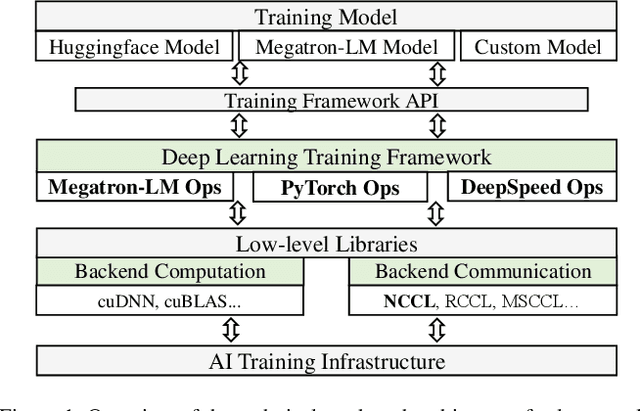
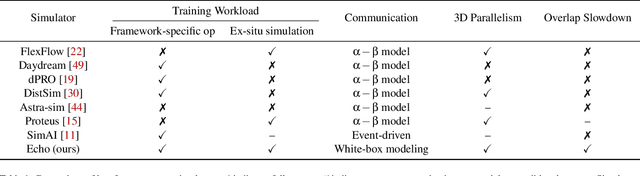

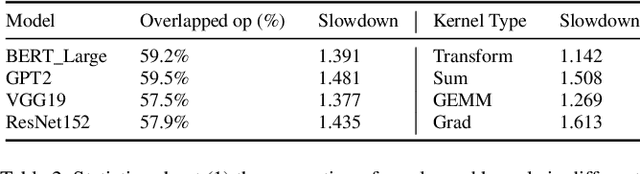
Simulation offers unique values for both enumeration and extrapolation purposes, and is becoming increasingly important for managing the massive machine learning (ML) clusters and large-scale distributed training jobs. In this paper, we build Echo to tackle three key challenges in large-scale training simulation: (1) tracing the runtime training workloads at each device in an ex-situ fashion so we can use a single device to obtain the actual execution graphs of 1K-GPU training, (2) accurately estimating the collective communication without high overheads of discrete-event based network simulation, and (3) accounting for the interference-induced computation slowdown from overlapping communication and computation kernels on the same device. Echo delivers on average 8% error in training step -- roughly 3x lower than state-of-the-art simulators -- for GPT-175B on a 96-GPU H800 cluster with 3D parallelism on Megatron-LM under 2 minutes.