 Add to Chrome
 Add to Firefox
 Add to Edge
Causal LLM Routing: End-to-End Regret Minimization from Observational Data
May 21, 2025
LLM routing aims to select the most appropriate model for each query, balancing competing performance metrics such as accuracy and cost across a pool of language models. Prior approaches typically adopt a decoupled strategy, where the metrics are first predicted and the model is then selected based on these estimates. This setup is prone to compounding errors and often relies on full-feedback data, where each query is evaluated by all candidate models, which is costly to obtain and maintain in practice. In contrast, we learn from observational data, which records only the outcome of the model actually deployed. We propose a causal end-to-end framework that learns routing policies by minimizing decision-making regret from observational data. To enable efficient optimization, we introduce two theoretically grounded surrogate objectives: a classification-based upper bound, and a softmax-weighted regret approximation shown to recover the optimal policy at convergence. We further extend our framework to handle heterogeneous cost preferences via an interval-conditioned architecture. Experiments on public benchmarks show that our method outperforms existing baselines, achieving state-of-the-art performance across different embedding models.

Toward Malicious Clients Detection in Federated Learning
May 14, 2025Federated learning (FL) enables multiple clients to collaboratively train a global machine learning model without sharing their raw data. However, the decentralized nature of FL introduces vulnerabilities, particularly to poisoning attacks, where malicious clients manipulate their local models to disrupt the training process. While Byzantine-robust aggregation rules have been developed to mitigate such attacks, they remain inadequate against more advanced threats. In response, recent advancements have focused on FL detection techniques to identify potentially malicious participants. Unfortunately, these methods often misclassify numerous benign clients as threats or rely on unrealistic assumptions about the server's capabilities. In this paper, we propose a novel algorithm, SafeFL, specifically designed to accurately identify malicious clients in FL. The SafeFL approach involves the server collecting a series of global models to generate a synthetic dataset, which is then used to distinguish between malicious and benign models based on their behavior. Extensive testing demonstrates that SafeFL outperforms existing methods, offering superior efficiency and accuracy in detecting malicious clients.
Neural Brain: A Neuroscience-inspired Framework for Embodied Agents
May 14, 2025The rapid evolution of artificial intelligence (AI) has shifted from static, data-driven models to dynamic systems capable of perceiving and interacting with real-world environments. Despite advancements in pattern recognition and symbolic reasoning, current AI systems, such as large language models, remain disembodied, unable to physically engage with the world. This limitation has driven the rise of embodied AI, where autonomous agents, such as humanoid robots, must navigate and manipulate unstructured environments with human-like adaptability. At the core of this challenge lies the concept of Neural Brain, a central intelligence system designed to drive embodied agents with human-like adaptability. A Neural Brain must seamlessly integrate multimodal sensing and perception with cognitive capabilities. Achieving this also requires an adaptive memory system and energy-efficient hardware-software co-design, enabling real-time action in dynamic environments. This paper introduces a unified framework for the Neural Brain of embodied agents, addressing two fundamental challenges: (1) defining the core components of Neural Brain and (2) bridging the gap between static AI models and the dynamic adaptability required for real-world deployment. To this end, we propose a biologically inspired architecture that integrates multimodal active sensing, perception-cognition-action function, neuroplasticity-based memory storage and updating, and neuromorphic hardware/software optimization. Furthermore, we also review the latest research on embodied agents across these four aspects and analyze the gap between current AI systems and human intelligence. By synthesizing insights from neuroscience, we outline a roadmap towards the development of generalizable, autonomous agents capable of human-level intelligence in real-world scenarios.
Breaking Annotation Barriers: Generalized Video Quality Assessment via Ranking-based Self-Supervision
May 07, 2025Video quality assessment (VQA) is essential for quantifying perceptual quality in various video processing workflows, spanning from camera capture systems to over-the-top streaming platforms. While recent supervised VQA models have made substantial progress, the reliance on manually annotated datasets -- a process that is labor-intensive, costly, and difficult to scale up -- has hindered further optimization of their generalization to unseen video content and distortions. To bridge this gap, we introduce a self-supervised learning framework for VQA to learn quality assessment capabilities from large-scale, unlabeled web videos. Our approach leverages a \textbf{learning-to-rank} paradigm to train a large multimodal model (LMM) on video pairs automatically labeled via two manners, including quality pseudo-labeling by existing VQA models and relative quality ranking based on synthetic distortion simulations. Furthermore, we introduce a novel \textbf{iterative self-improvement training strategy}, where the trained model acts an improved annotator to iteratively refine the annotation quality of training data. By training on a dataset $10\times$ larger than the existing VQA benchmarks, our model: (1) achieves zero-shot performance on in-domain VQA benchmarks that matches or surpasses supervised models; (2) demonstrates superior out-of-distribution (OOD) generalization across diverse video content and distortions; and (3) sets a new state-of-the-art when fine-tuned on human-labeled datasets. Extensive experimental results validate the effectiveness of our self-supervised approach in training generalized VQA models. The datasets and code will be publicly released to facilitate future research.
AGHI-QA: A Subjective-Aligned Dataset and Metric for AI-Generated Human Images
Apr 30, 2025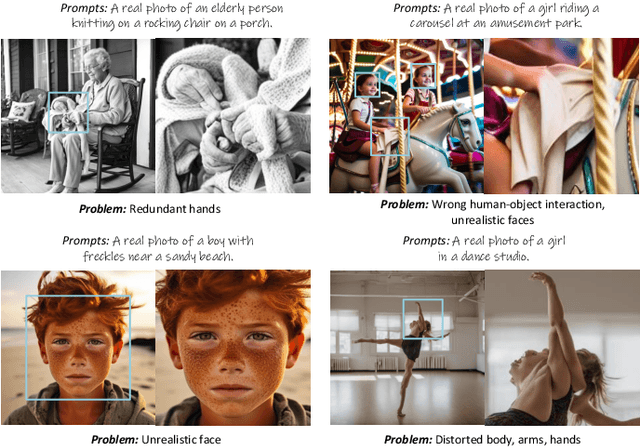
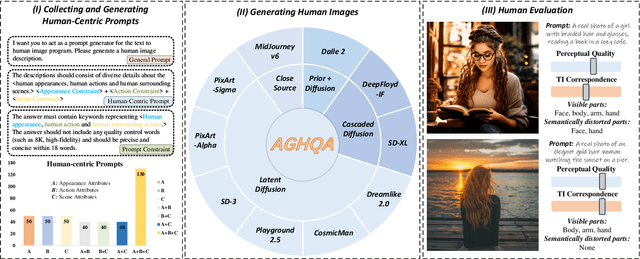
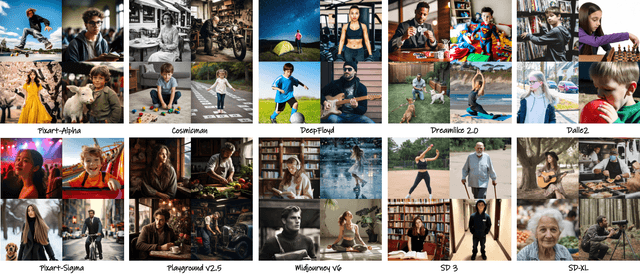
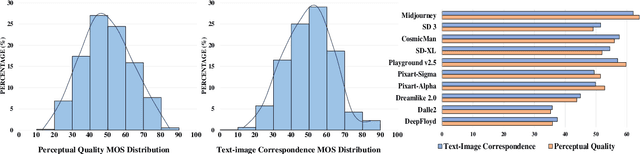
The rapid development of text-to-image (T2I) generation approaches has attracted extensive interest in evaluating the quality of generated images, leading to the development of various quality assessment methods for general-purpose T2I outputs. However, existing image quality assessment (IQA) methods are limited to providing global quality scores, failing to deliver fine-grained perceptual evaluations for structurally complex subjects like humans, which is a critical challenge considering the frequent anatomical and textural distortions in AI-generated human images (AGHIs). To address this gap, we introduce AGHI-QA, the first large-scale benchmark specifically designed for quality assessment of AGHIs. The dataset comprises 4,000 images generated from 400 carefully crafted text prompts using 10 state of-the-art T2I models. We conduct a systematic subjective study to collect multidimensional annotations, including perceptual quality scores, text-image correspondence scores, visible and distorted body part labels. Based on AGHI-QA, we evaluate the strengths and weaknesses of current T2I methods in generating human images from multiple dimensions. Furthermore, we propose AGHI-Assessor, a novel quality metric that integrates the large multimodal model (LMM) with domain-specific human features for precise quality prediction and identification of visible and distorted body parts in AGHIs. Extensive experimental results demonstrate that AGHI-Assessor showcases state-of-the-art performance, significantly outperforming existing IQA methods in multidimensional quality assessment and surpassing leading LMMs in detecting structural distortions in AGHIs.
CAGS: Open-Vocabulary 3D Scene Understanding with Context-Aware Gaussian Splatting
Apr 16, 2025Open-vocabulary 3D scene understanding is crucial for applications requiring natural language-driven spatial interpretation, such as robotics and augmented reality. While 3D Gaussian Splatting (3DGS) offers a powerful representation for scene reconstruction, integrating it with open-vocabulary frameworks reveals a key challenge: cross-view granularity inconsistency. This issue, stemming from 2D segmentation methods like SAM, results in inconsistent object segmentations across views (e.g., a "coffee set" segmented as a single entity in one view but as "cup + coffee + spoon" in another). Existing 3DGS-based methods often rely on isolated per-Gaussian feature learning, neglecting the spatial context needed for cohesive object reasoning, leading to fragmented representations. We propose Context-Aware Gaussian Splatting (CAGS), a novel framework that addresses this challenge by incorporating spatial context into 3DGS. CAGS constructs local graphs to propagate contextual features across Gaussians, reducing noise from inconsistent granularity, employs mask-centric contrastive learning to smooth SAM-derived features across views, and leverages a precomputation strategy to reduce computational cost by precomputing neighborhood relationships, enabling efficient training in large-scale scenes. By integrating spatial context, CAGS significantly improves 3D instance segmentation and reduces fragmentation errors on datasets like LERF-OVS and ScanNet, enabling robust language-guided 3D scene understanding.
MonoDiff9D: Monocular Category-Level 9D Object Pose Estimation via Diffusion Model
Apr 14, 2025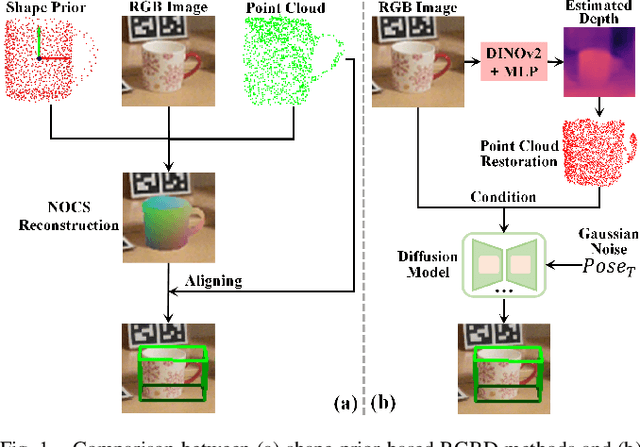
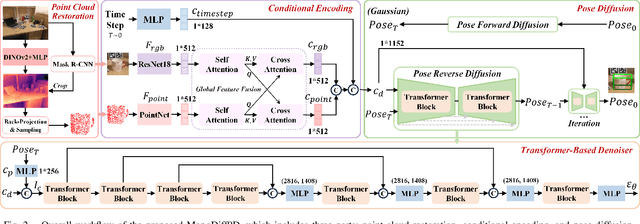
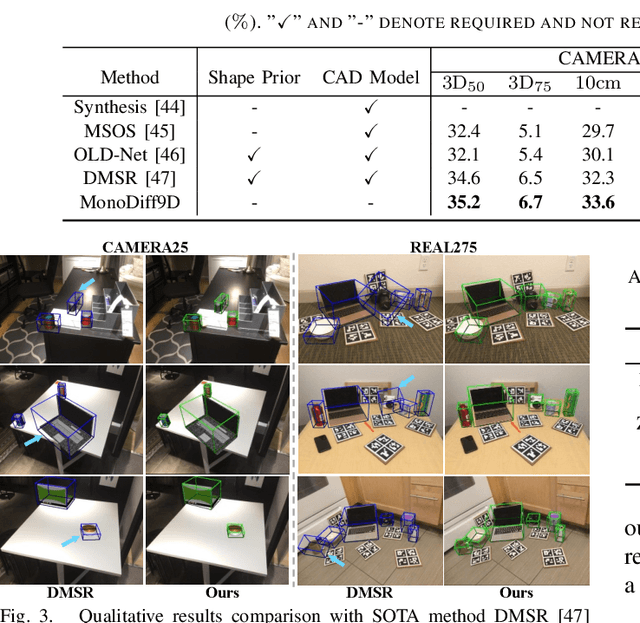
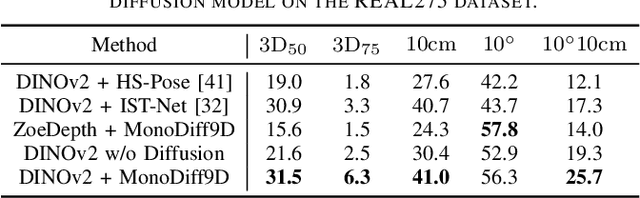
Object pose estimation is a core means for robots to understand and interact with their environment. For this task, monocular category-level methods are attractive as they require only a single RGB camera. However, current methods rely on shape priors or CAD models of the intra-class known objects. We propose a diffusion-based monocular category-level 9D object pose generation method, MonoDiff9D. Our motivation is to leverage the probabilistic nature of diffusion models to alleviate the need for shape priors, CAD models, or depth sensors for intra-class unknown object pose estimation. We first estimate coarse depth via DINOv2 from the monocular image in a zero-shot manner and convert it into a point cloud. We then fuse the global features of the point cloud with the input image and use the fused features along with the encoded time step to condition MonoDiff9D. Finally, we design a transformer-based denoiser to recover the object pose from Gaussian noise. Extensive experiments on two popular benchmark datasets show that MonoDiff9D achieves state-of-the-art monocular category-level 9D object pose estimation accuracy without the need for shape priors or CAD models at any stage. Our code will be made public at https://github.com/CNJianLiu/MonoDiff9D.
FVQ: A Large-Scale Dataset and A LMM-based Method for Face Video Quality Assessment
Apr 12, 2025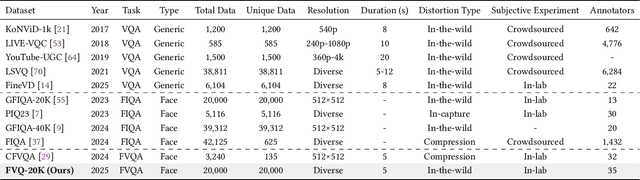
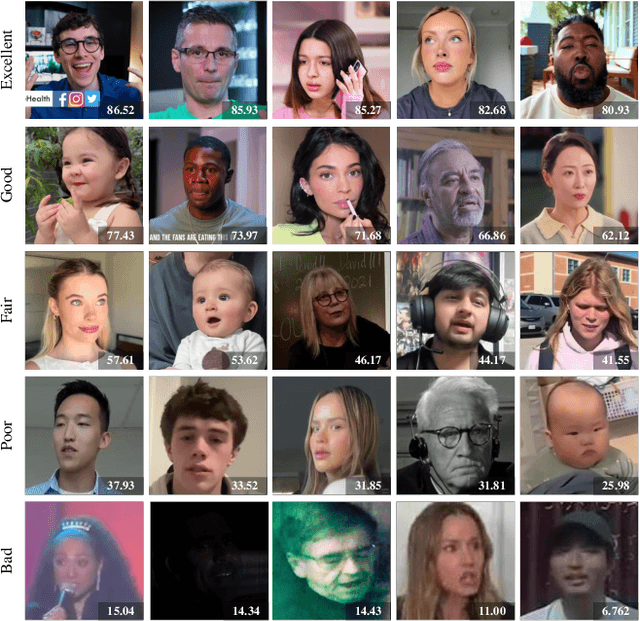
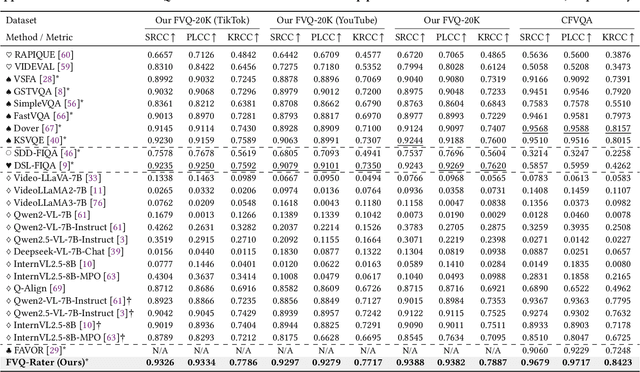
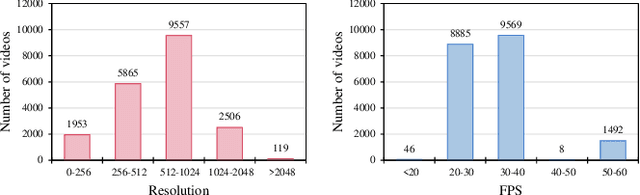
Face video quality assessment (FVQA) deserves to be explored in addition to general video quality assessment (VQA), as face videos are the primary content on social media platforms and human visual system (HVS) is particularly sensitive to human faces. However, FVQA is rarely explored due to the lack of large-scale FVQA datasets. To fill this gap, we present the first large-scale in-the-wild FVQA dataset, FVQ-20K, which contains 20,000 in-the-wild face videos together with corresponding mean opinion score (MOS) annotations. Along with the FVQ-20K dataset, we further propose a specialized FVQA method named FVQ-Rater to achieve human-like rating and scoring for face video, which is the first attempt to explore the potential of large multimodal models (LMMs) for the FVQA task. Concretely, we elaborately extract multi-dimensional features including spatial features, temporal features, and face-specific features (i.e., portrait features and face embeddings) to provide comprehensive visual information, and take advantage of the LoRA-based instruction tuning technique to achieve quality-specific fine-tuning, which shows superior performance on both FVQ-20K and CFVQA datasets. Extensive experiments and comprehensive analysis demonstrate the significant potential of the FVQ-20K dataset and FVQ-Rater method in promoting the development of FVQA.
Novel Object 6D Pose Estimation with a Single Reference View
Mar 07, 2025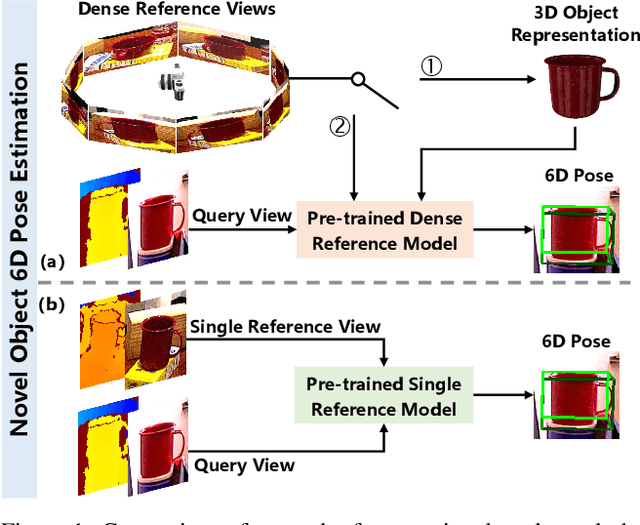
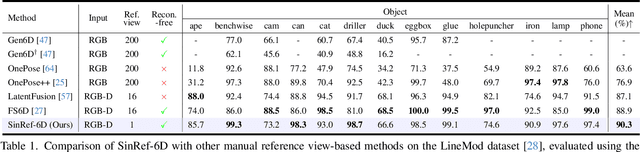
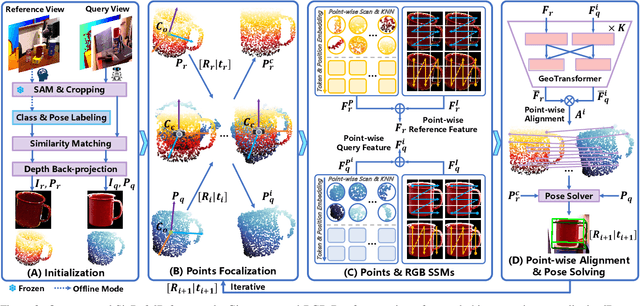
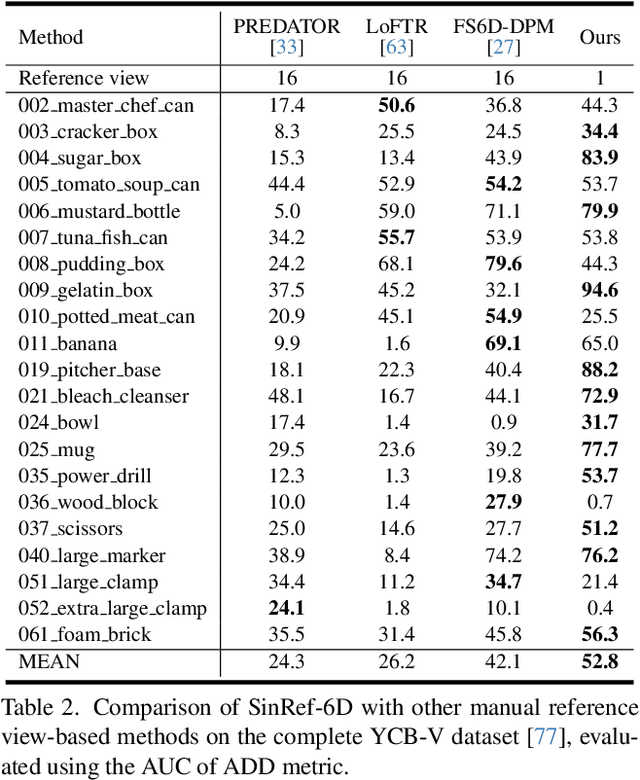
Existing novel object 6D pose estimation methods typically rely on CAD models or dense reference views, which are both difficult to acquire. Using only a single reference view is more scalable, but challenging due to large pose discrepancies and limited geometric and spatial information. To address these issues, we propose a Single-Reference-based novel object 6D (SinRef-6D) pose estimation method. Our key idea is to iteratively establish point-wise alignment in the camera coordinate system based on state space models (SSMs). Specifically, iterative camera-space point-wise alignment can effectively handle large pose discrepancies, while our proposed RGB and Points SSMs can capture long-range dependencies and spatial information from a single view, offering linear complexity and superior spatial modeling capability. Once pre-trained on synthetic data, SinRef-6D can estimate the 6D pose of a novel object using only a single reference view, without requiring retraining or a CAD model. Extensive experiments on six popular datasets and real-world robotic scenes demonstrate that we achieve on-par performance with CAD-based and dense reference view-based methods, despite operating in the more challenging single reference setting. Code will be released at https://github.com/CNJianLiu/SinRef-6D.
Q-Eval-100K: Evaluating Visual Quality and Alignment Level for Text-to-Vision Content
Mar 05, 2025Evaluating text-to-vision content hinges on two crucial aspects: visual quality and alignment. While significant progress has been made in developing objective models to assess these dimensions, the performance of such models heavily relies on the scale and quality of human annotations. According to Scaling Law, increasing the number of human-labeled instances follows a predictable pattern that enhances the performance of evaluation models. Therefore, we introduce a comprehensive dataset designed to Evaluate Visual quality and Alignment Level for text-to-vision content (Q-EVAL-100K), featuring the largest collection of human-labeled Mean Opinion Scores (MOS) for the mentioned two aspects. The Q-EVAL-100K dataset encompasses both text-to-image and text-to-video models, with 960K human annotations specifically focused on visual quality and alignment for 100K instances (60K images and 40K videos). Leveraging this dataset with context prompt, we propose Q-Eval-Score, a unified model capable of evaluating both visual quality and alignment with special improvements for handling long-text prompt alignment. Experimental results indicate that the proposed Q-Eval-Score achieves superior performance on both visual quality and alignment, with strong generalization capabilities across other benchmarks. These findings highlight the significant value of the Q-EVAL-100K dataset. Data and codes will be available at https://github.com/zzc-1998/Q-Eval.