 Add to Chrome
 Add to Firefox
 Add to Edge
TEAMS: Text-prompted spatiotEmporal dual-heAd Mamba Snake
Aug 18, 2026
Deep snake is a promising family of instance segmentation methods that accurately predicts object-level contours, thereby overcoming common pixel-level misclassification issues such as mask cavities and jagged edges in semantic segmentation approaches. However, existing deep snake methods face challenges in handling complex morphological variations, accurately capturing fine-grained organ details, and correcting base detection errors. To mitigate these limitations, we propose a cohesive Text-prompted spatiotEmporal dual-heAd Mamba Snake (TEAMS), a novel vision-language Mamba snake framework with three key innovations: (1) A Spatiotemporal Snake Evolution Strategy (SSES) is introduced to tackle complex morphological variations by capturing bidirectional spatial dependencies along the snake contour and temporal dynamics across evolution steps in a state space model. (2) A Contour Morphology-Aware Mamba (CMAM) is proposed to quantify local contour morphologies to modulate the structured attention mask in the Mamba2 SSD dual form, which extends Mamba's capability to perceive the relative importance of its input sequence elements for better delineation of fine-grained organ details. (3) A Text-prompted Collaborative Dual-Head Snake (TCDHS) is designed to incorporate cues from textual prompts and transfer the evolved contour information to the base detection head, which enhances the deep snake workflow and mitigates wrong detections. Comprehensive evaluations on five datasets covering different organs and imaging modalities demonstrate that TEAMS outperforms existing semantic and deep snake segmentation methods (e.g., relative mDice/mBF improvements of 6.9%/9.1% in a spinal dataset), underscoring its potential as a reliable tool across diverse medical image segmentation scenarios.

Pushing the Limits of Safety: A Technical Report on the ATLAS Challenge 2025
Jun 14, 2025Multimodal Large Language Models (MLLMs) have enabled transformative advancements across diverse applications but remain susceptible to safety threats, especially jailbreak attacks that induce harmful outputs. To systematically evaluate and improve their safety, we organized the Adversarial Testing & Large-model Alignment Safety Grand Challenge (ATLAS) 2025}. This technical report presents findings from the competition, which involved 86 teams testing MLLM vulnerabilities via adversarial image-text attacks in two phases: white-box and black-box evaluations. The competition results highlight ongoing challenges in securing MLLMs and provide valuable guidance for developing stronger defense mechanisms. The challenge establishes new benchmarks for MLLM safety evaluation and lays groundwork for advancing safer multimodal AI systems. The code and data for this challenge are openly available at https://github.com/NY1024/ATLAS_Challenge_2025.
Clique: Spatiotemporal Object Re-identification at the City Scale
Dec 17, 2020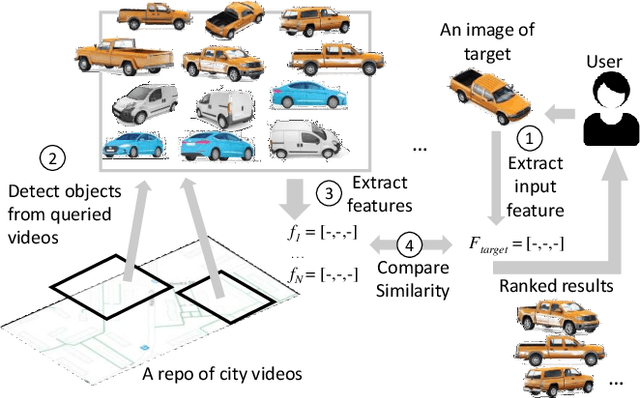

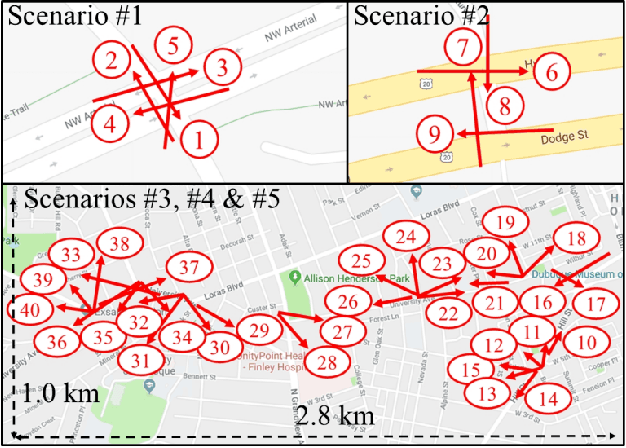
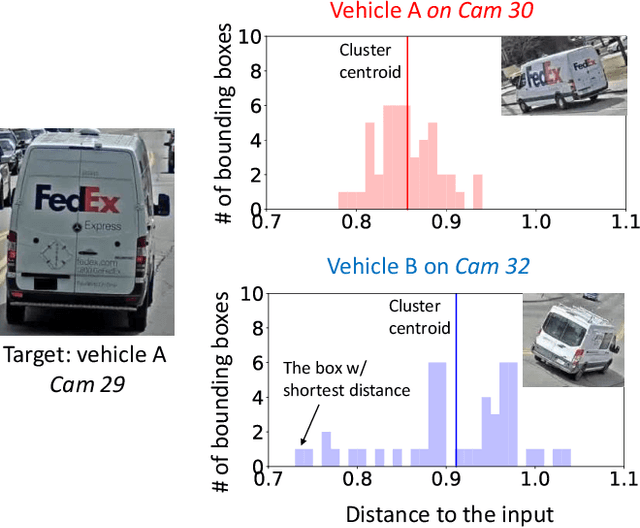
Object re-identification (ReID) is a key application of city-scale cameras. While classic ReID tasks are often considered as image retrieval, we treat them as spatiotemporal queries for locations and times in which the target object appeared. Spatiotemporal reID is challenged by the accuracy limitation in computer vision algorithms and the colossal videos from city cameras. We present Clique, a practical ReID engine that builds upon two new techniques: (1) Clique assesses target occurrences by clustering fuzzy object features extracted by ReID algorithms, with each cluster representing the general impression of a distinct object to be matched against the input; (2) to search in videos, Clique samples cameras to maximize the spatiotemporal coverage and incrementally adds cameras for processing on demand. Through evaluation on 25 hours of videos from 25 cameras, Clique reached a high accuracy of 0.87 (recall at 5) across 70 queries and runs at 830x of video realtime in achieving high accuracy.
New Era of Deeplearning-Based Malware Intrusion Detection: The Malware Detection and Prediction Based On Deep Learning
Jul 19, 2019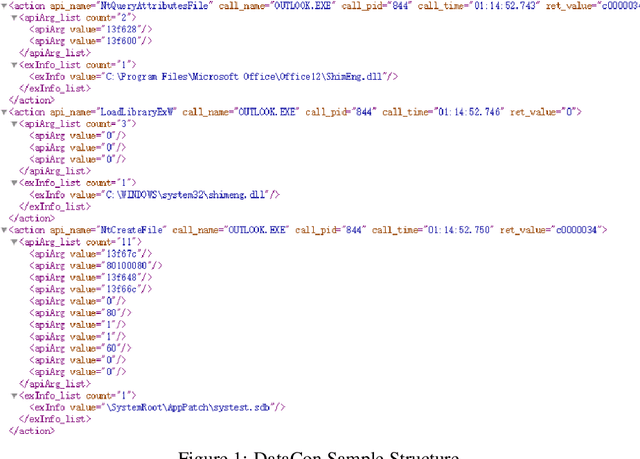
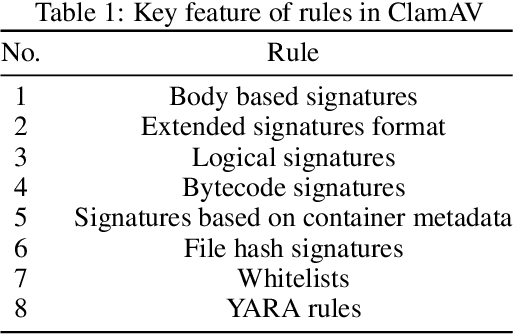
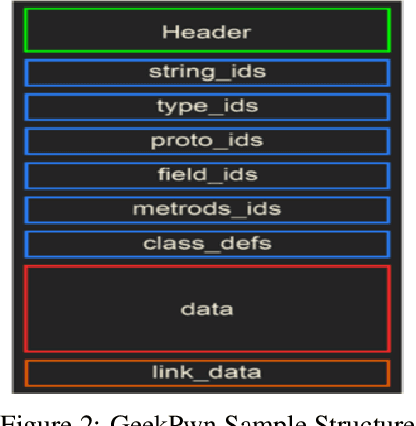
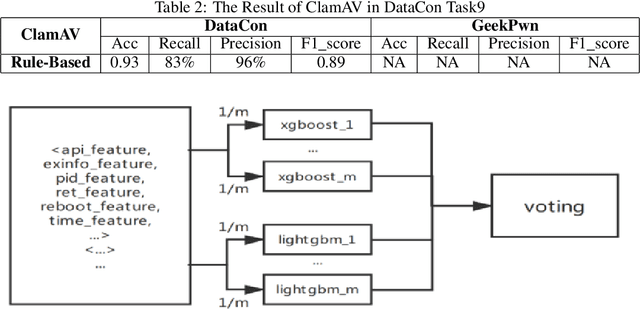
With the development of artificial intelligence algorithms like deep learning models and the successful applications in many different fields, further similar trails of deep learning technology have been made in cyber security area. It shows the preferable performance not only in academic security research but also in industry practices when dealing with part of cyber security issues by deep learning methods compared to those conventional rules. Especially for the malware detection and classification tasks, it saves generous time cost and promotes the accuracy for a total pipeline of malware detection system. In this paper, we construct special deep neural network, ie, MalDeepNet (TB-Malnet and IB-Malnet) for malware dynamic behavior classification tasks. Then we build the family clustering algorithm based on deep learning and fulfil related testing. Except that, we also design a novel malware prediction model which could detect the malware coming in future through the Mal Generative Adversarial Network (Mal-GAN) implementation. All those algorithms present fairly considerable value in related datasets afterwards.