 Add to Chrome
 Add to Firefox
 Add to Edge
Clinician input steers frontier AI models toward both accurate and harmful decisions
Mar 14, 2026
Large language models (LLMs) are entering clinician workflows, yet evaluations rarely measure how clinician reasoning shapes model behavior during clinical interactions. We combined 61 New England Journal of Medicine Case Records with 92 real-world clinician-AI interactions to evaluate 21 reasoning LLM variants across 8 frontier models on differential diagnosis generation and next step recommendations under three conditions: reasoning alone, after expert clinician context, and after adversarial clinician context. LLM-clinician concordance increased substantially after clinician exposure, with simulations sharing >=3 differential diagnosis items rising from 65.8% to 93.5% and >=3 next step recommendations from 20.3% to 53.8%. Expert context significantly improved correct final diagnosis inclusion across all 21 models (mean +20.4 percentage points), reflecting both reasoning improvement and passive content echoing, while adversarial context caused significant diagnostic degradation in 14 models (mean -5.4 percentage points). Multi-turn disagreement probes revealed distinct model phenotypes ranging from highly conformist to dogmatic, with adversarial arguments remaining a persistent vulnerability even for otherwise resilient models. Inference-time scaling reduced harmful echoing of clinician-introduced recommendations across WHO-defined harm severity tiers (relative reductions: 62.7% mild, 57.9% moderate, 76.3% severe, 83.5% death-tier). In GPT-4o experiments, explicit clinician uncertainty signals improved diagnostic performance after adversarial context (final diagnosis inclusion 27% to 42%) and reduced alignment with incorrect arguments by 21%. These findings establish a foundation for evaluating clinician-AI collaboration, introducing interactive metrics and mitigation strategies essential for safety and robustness.

Embedding-Driven Diversity Sampling to Improve Few-Shot Synthetic Data Generation
Jan 20, 2025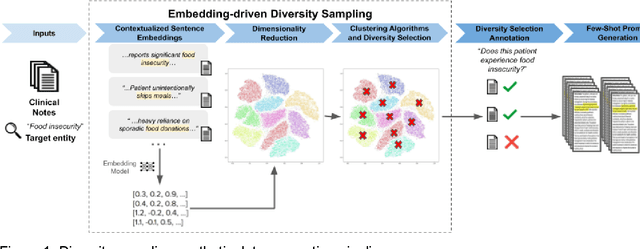

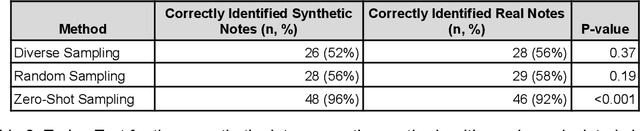
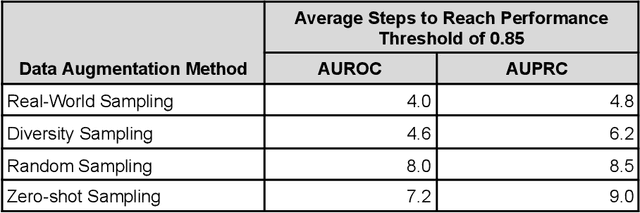
Accurate classification of clinical text often requires fine-tuning pre-trained language models, a process that is costly and time-consuming due to the need for high-quality data and expert annotators. Synthetic data generation offers an alternative, though pre-trained models may not capture the syntactic diversity of clinical notes. We propose an embedding-driven approach that uses diversity sampling from a small set of real clinical notes to guide large language models in few-shot prompting, generating synthetic text that better reflects clinical syntax. We evaluated this method using the CheXpert dataset on a classification task, comparing it to random few-shot and zero-shot approaches. Using cosine similarity and a Turing test, our approach produced synthetic notes that more closely align with real clinical text. Our pipeline reduced the data needed to reach the 0.85 AUC cutoff by 40% for AUROC and 30% for AUPRC, while augmenting models with synthetic data improved AUROC by 57% and AUPRC by 68%. Additionally, our synthetic data was 0.9 times as effective as real data, a 60% improvement in value.
BIOMEDICA: An Open Biomedical Image-Caption Archive, Dataset, and Vision-Language Models Derived from Scientific Literature
Jan 14, 2025The development of vision-language models (VLMs) is driven by large-scale and diverse multimodal datasets. However, progress toward generalist biomedical VLMs is limited by the lack of annotated, publicly accessible datasets across biology and medicine. Existing efforts are restricted to narrow domains, missing the full diversity of biomedical knowledge encoded in scientific literature. To address this gap, we introduce BIOMEDICA, a scalable, open-source framework to extract, annotate, and serialize the entirety of the PubMed Central Open Access subset into an easy-to-use, publicly accessible dataset. Our framework produces a comprehensive archive with over 24 million unique image-text pairs from over 6 million articles. Metadata and expert-guided annotations are also provided. We demonstrate the utility and accessibility of our resource by releasing BMCA-CLIP, a suite of CLIP-style models continuously pre-trained on the BIOMEDICA dataset via streaming, eliminating the need to download 27 TB of data locally. On average, our models achieve state-of-the-art performance across 40 tasks - spanning pathology, radiology, ophthalmology, dermatology, surgery, molecular biology, parasitology, and cell biology - excelling in zero-shot classification with a 6.56% average improvement (as high as 29.8% and 17.5% in dermatology and ophthalmology, respectively), and stronger image-text retrieval, all while using 10x less compute. To foster reproducibility and collaboration, we release our codebase and dataset for the broader research community.
Assessing the Limitations of Large Language Models in Clinical Fact Decomposition
Dec 17, 2024Verifying factual claims is critical for using large language models (LLMs) in healthcare. Recent work has proposed fact decomposition, which uses LLMs to rewrite source text into concise sentences conveying a single piece of information, as an approach for fine-grained fact verification. Clinical documentation poses unique challenges for fact decomposition due to dense terminology and diverse note types. To explore these challenges, we present FactEHR, a dataset consisting of full document fact decompositions for 2,168 clinical notes spanning four types from three hospital systems. Our evaluation, including review by clinicians, highlights significant variability in the quality of fact decomposition for four commonly used LLMs, with some LLMs generating 2.6x more facts per sentence than others. The results underscore the need for better LLM capabilities to support factual verification in clinical text. To facilitate future research in this direction, we plan to release our code at \url{https://github.com/som-shahlab/factehr}.