 Add to Chrome
 Add to Firefox
 Add to Edge
BenchX: Benchmarking AI Models for Cancer Detection and Localization with Demographic and Protocol Biases
Jun 23, 2026
Artificial intelligence (AI) has achieved remarkable success in medical imaging, but it is widely recognized that these models often perform inconsistently across real-world clinical settings. Such inconsistencies occur when patient demographics and imaging protocols vary, for example, in detecting small tumors, analyzing scans from different contrast phases, or evaluating patients of different ages or sexes. To quantify these inconsistencies, we develop a large-scale, open benchmark of 85,355 CT scans that systematically evaluates 12 tumor-detection AI models across tumor size, location, patient subgroup, and imaging protocol. We leverage large language models (LLMs) to extract and organize subgroup information from clinical data, which makes the analysis both scalable and reproducible. Our benchmark reveals that current state-of-the-art AI models, optimized for average accuracy, perform poorly in rare or underrepresented subgroups, such as young, female African Americans. However, collecting sufficient annotated data for these rare cases is often impractical. The benchmark provides a foundation for building more reliable and robust AI models for tumor detection and highlighting the need for rigorous, subgroup-level evaluation in medical imaging and computer vision. Datasets, code

Analyzing LLM Reasoning to Uncover Mental Health Stigma
Apr 27, 2026While large language models (LLMs) are increasingly being explored for mental health applications, recent studies reveal that they can exhibit stigma toward individuals with psychological conditions. Existing evaluations of this stigma primarily rely on multiple-choice questions (MCQs), which fail to capture the biases embedded within the models' underlying logic. In this paper, we analyze the intermediate reasoning steps of LLMs to uncover hidden stigmatizing language and the internal rationales driving it. We leverage clinical expertise to categorize common patterns of stigmatizing language directed at individuals with psychological conditions and use this framework to identify and tag problematic statements in LLM reasoning. Furthermore, we rate the severity of these statements, distinguishing between overt prejudice and more subtle, less immediately harmful biases. To broaden the reasoning domain and capture a wider array of patterns, we also extend an existing mental health stigma benchmark by incorporating additional psychological conditions. Our findings demonstrate that evaluating model reasoning not only exposes substantially more stigma than traditional MCQ-based methods but it helps to identify the flaws in the LLMs' logic and their understanding of mental health conditions.
CheXmix: Unified Generative Pretraining for Vision Language Models in Medical Imaging
Apr 24, 2026Recent medical multimodal foundation models are built as multimodal LLMs (MLLMs) by connecting a CLIP-pretrained vision encoder to an LLM using LLaVA-style finetuning. This two-stage, decoupled approach introduces a projection layer that can distort visual features. This is especially concerning in medical imaging where subtle cues are essential for accurate diagnoses. In contrast, early-fusion generative approaches such as Chameleon eliminate the projection bottleneck by processing image and text tokens within a single unified sequence, enabling joint representation learning that leverages the inductive priors of language models. We present CheXmix, a unified early-fusion generative model trained on a large corpus of chest X-rays paired with radiology reports. We expand on Chameleon's autoregressive framework by introducing a two-stage multimodal generative pretraining strategy that combines the representational strengths of masked autoencoders with MLLMs. The resulting models are highly flexible, supporting both discriminative and generative tasks at both coarse and fine-grained scales. Our approach outperforms well-established generative models across all masking ratios by 6.0% and surpasses CheXagent by 8.6% on AUROC at high image masking ratios on the CheXpert classification task. We further inpaint images over 51.0% better than text-only generative models and outperform CheXagent by 45% on the GREEN metric for radiology report generation. These results demonstrate that CheXmix captures fine-grained information across a broad spectrum of chest X-ray tasks. Our code is at: https://github.com/StanfordMIMI/CheXmix.
A General Incentives-Based Framework for Fairness in Multi-agent Resource Allocation
Oct 30, 2025We introduce the General Incentives-based Framework for Fairness (GIFF), a novel approach for fair multi-agent resource allocation that infers fair decision-making from standard value functions. In resource-constrained settings, agents optimizing for efficiency often create inequitable outcomes. Our approach leverages the action-value (Q-)function to balance efficiency and fairness without requiring additional training. Specifically, our method computes a local fairness gain for each action and introduces a counterfactual advantage correction term to discourage over-allocation to already well-off agents. This approach is formalized within a centralized control setting, where an arbitrator uses the GIFF-modified Q-values to solve an allocation problem. Empirical evaluations across diverse domains, including dynamic ridesharing, homelessness prevention, and a complex job allocation task-demonstrate that our framework consistently outperforms strong baselines and can discover far-sighted, equitable policies. The framework's effectiveness is supported by a theoretical foundation; we prove its fairness surrogate is a principled lower bound on the true fairness improvement and that its trade-off parameter offers monotonic tuning. Our findings establish GIFF as a robust and principled framework for leveraging standard reinforcement learning components to achieve more equitable outcomes in complex multi-agent systems.
Mind the Gaps: Auditing and Reducing Group Inequity in Large-Scale Mobility Prediction
Oct 30, 2025Next location prediction underpins a growing number of mobility, retail, and public-health applications, yet its societal impacts remain largely unexplored. In this paper, we audit state-of-the-art mobility prediction models trained on a large-scale dataset, highlighting hidden disparities based on user demographics. Drawing from aggregate census data, we compute the difference in predictive performance on racial and ethnic user groups and show a systematic disparity resulting from the underlying dataset, resulting in large differences in accuracy based on location and user groups. To address this, we propose Fairness-Guided Incremental Sampling (FGIS), a group-aware sampling strategy designed for incremental data collection settings. Because individual-level demographic labels are unavailable, we introduce Size-Aware K-Means (SAKM), a clustering method that partitions users in latent mobility space while enforcing census-derived group proportions. This yields proxy racial labels for the four largest groups in the state: Asian, Black, Hispanic, and White. Built on these labels, our sampling algorithm prioritizes users based on expected performance gains and current group representation. This method incrementally constructs training datasets that reduce demographic performance gaps while preserving overall accuracy. Our method reduces total disparity between groups by up to 40\% with minimal accuracy trade-offs, as evaluated on a state-of-art MetaPath2Vec model and a transformer-encoder model. Improvements are most significant in early sampling stages, highlighting the potential for fairness-aware strategies to deliver meaningful gains even in low-resource settings. Our findings expose structural inequities in mobility prediction pipelines and demonstrate how lightweight, data-centric interventions can improve fairness with little added complexity, especially for low-data applications.
Remember, but also, Forget: Bridging Myopic and Perfect Recall Fairness with Past-Discounting
Apr 01, 2025Dynamic resource allocation in multi-agent settings often requires balancing efficiency with fairness over time--a challenge inadequately addressed by conventional, myopic fairness measures. Motivated by behavioral insights that human judgments of fairness evolve with temporal distance, we introduce a novel framework for temporal fairness that incorporates past-discounting mechanisms. By applying a tunable discount factor to historical utilities, our approach interpolates between instantaneous and perfect-recall fairness, thereby capturing both immediate outcomes and long-term equity considerations. Beyond aligning more closely with human perceptions of fairness, this past-discounting method ensures that the augmented state space remains bounded, significantly improving computational tractability in sequential decision-making settings. We detail the formulation of discounted-recall fairness in both additive and averaged utility contexts, illustrate its benefits through practical examples, and discuss its implications for designing balanced, scalable resource allocation strategies.
MedVAE: Efficient Automated Interpretation of Medical Images with Large-Scale Generalizable Autoencoders
Feb 20, 2025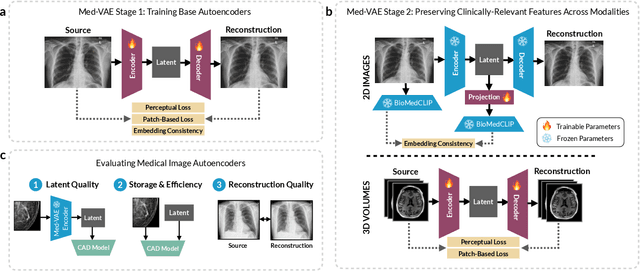
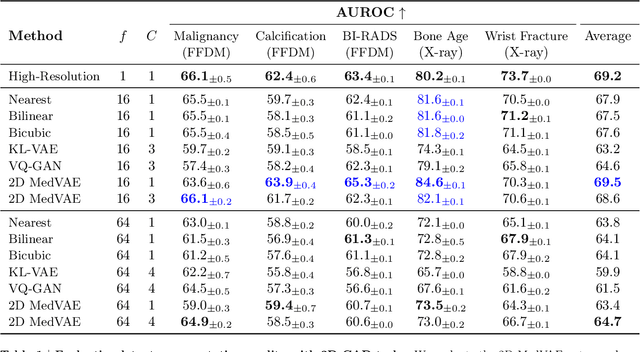
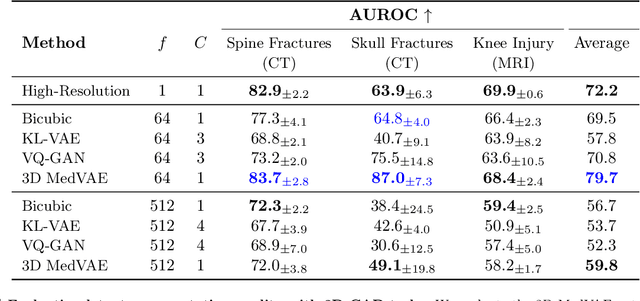
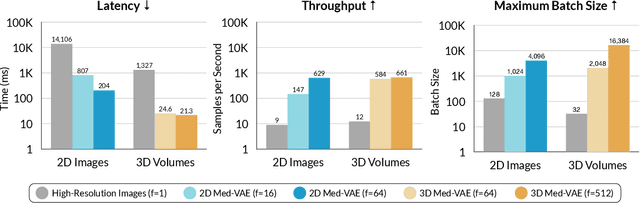
Medical images are acquired at high resolutions with large fields of view in order to capture fine-grained features necessary for clinical decision-making. Consequently, training deep learning models on medical images can incur large computational costs. In this work, we address the challenge of downsizing medical images in order to improve downstream computational efficiency while preserving clinically-relevant features. We introduce MedVAE, a family of six large-scale 2D and 3D autoencoders capable of encoding medical images as downsized latent representations and decoding latent representations back to high-resolution images. We train MedVAE autoencoders using a novel two-stage training approach with 1,052,730 medical images. Across diverse tasks obtained from 20 medical image datasets, we demonstrate that (1) utilizing MedVAE latent representations in place of high-resolution images when training downstream models can lead to efficiency benefits (up to 70x improvement in throughput) while simultaneously preserving clinically-relevant features and (2) MedVAE can decode latent representations back to high-resolution images with high fidelity. Our work demonstrates that large-scale, generalizable autoencoders can help address critical efficiency challenges in the medical domain. Our code is available at https://github.com/StanfordMIMI/MedVAE.
DECAF: Learning to be Fair in Multi-agent Resource Allocation
Feb 06, 2025A wide variety of resource allocation problems operate under resource constraints that are managed by a central arbitrator, with agents who evaluate and communicate preferences over these resources. We formulate this broad class of problems as Distributed Evaluation, Centralized Allocation (DECA) problems and propose methods to learn fair and efficient policies in centralized resource allocation. Our methods are applied to learning long-term fairness in a novel and general framework for fairness in multi-agent systems. We show three different methods based on Double Deep Q-Learning: (1) A joint weighted optimization of fairness and utility, (2) a split optimization, learning two separate Q-estimators for utility and fairness, and (3) an online policy perturbation to guide existing black-box utility functions toward fair solutions. Our methods outperform existing fair MARL approaches on multiple resource allocation domains, even when evaluated using diverse fairness functions, and allow for flexible online trade-offs between utility and fairness.
Deep Learning-Based Prediction of PET Amyloid Status Using Multi-Contrast MRI
Nov 18, 2024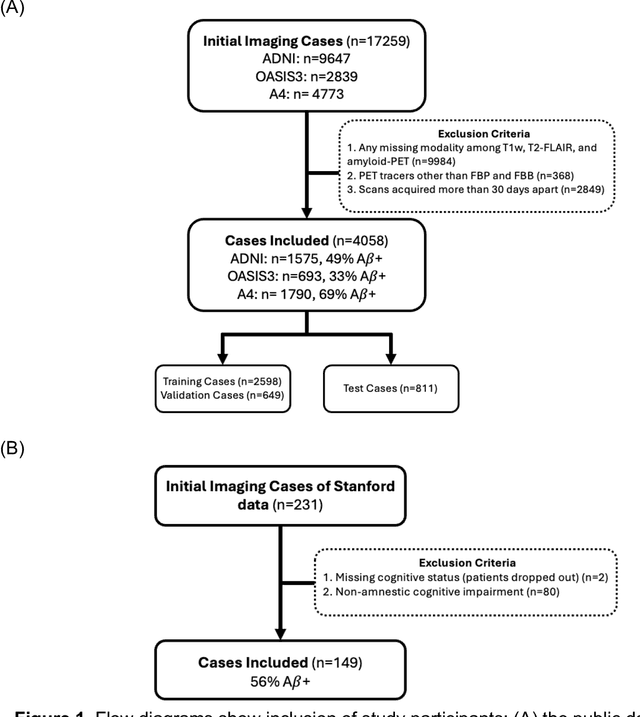
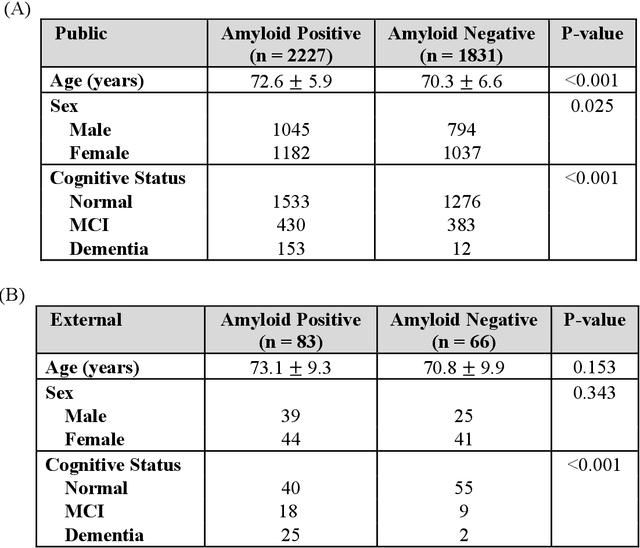
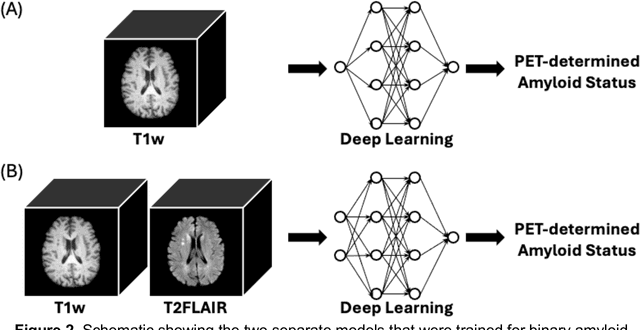
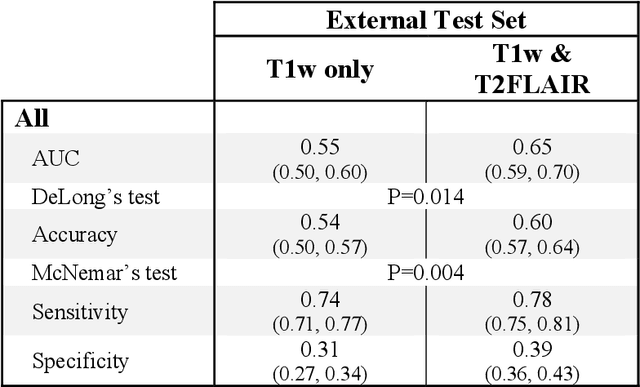
Identifying amyloid-beta positive patients is crucial for determining eligibility for Alzheimer's disease (AD) clinical trials and new disease-modifying treatments, but currently requires PET or CSF sampling. Previous MRI-based deep learning models for predicting amyloid positivity, using only T1w sequences, have shown moderate performance. We trained deep learning models to predict amyloid PET positivity and evaluated whether multi-contrast inputs improve performance. A total of 4,058 exams with multi-contrast MRI and PET-based quantitative amyloid deposition were obtained from three public datasets: the Alzheimer's Disease Neuroimaging Initiative (ADNI), the Open Access Series of Imaging Studies 3 (OASIS3), and the Anti-Amyloid Treatment in Asymptomatic Alzheimer's Disease (A4). Two separate EfficientNet models were trained for amyloid positivity prediction: one with only T1w images and the other with both T1w and T2-FLAIR images as network inputs. The area under the curve (AUC), accuracy, sensitivity, and specificity were determined using an internal held-out test set. The trained models were further evaluated using an external test set. In the held-out test sets, the T1w and T1w+T2FLAIR models demonstrated AUCs of 0.62 (95% CI: 0.60, 0.64) and 0.67 (95% CI: 0.64, 0.70) (p = 0.006); accuracies were 61% (95% CI: 60%, 63%) and 64% (95% CI: 62%, 66%) (p = 0.008); sensitivities were 0.88 and 0.71; and specificities were 0.23 and 0.53, respectively. The trained models showed similar performance in the external test set. Performance of the current model on both test sets exceeded that of the publicly available model. In conclusion, the use of multi-contrast MRI, specifically incorporating T2-FLAIR in addition to T1w images, significantly improved the predictive accuracy of PET-determined amyloid status from MRI scans using a deep learning approach.
Accelerating Longitudinal MRI using Prior Informed Latent Diffusion
Jun 29, 2024

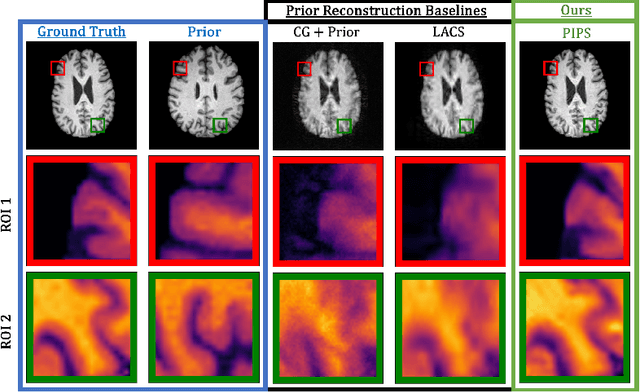

MRI is a widely used ionization-free soft-tissue imaging modality, often employed repeatedly over a patient's lifetime. However, prolonged scanning durations, among other issues, can limit availability and accessibility. In this work, we aim to substantially reduce scan times by leveraging prior scans of the same patient. These prior scans typically contain considerable shared information with the current scan, thereby enabling higher acceleration rates when appropriately utilized. We propose a prior informed reconstruction method with a trained diffusion model in conjunction with data-consistency steps. Our method can be trained with unlabeled image data, eliminating the need for a dataset of either k-space measurements or paired longitudinal scans as is required of other learning-based methods. We demonstrate superiority of our method over previously suggested approaches in effectively utilizing prior information without over-biasing prior consistency, which we validate on both an open-source dataset of healthy patients as well as several longitudinal cases of clinical interest.