 Add to Chrome
 Add to Firefox
 Add to Edge
OVO-S-Bench: A Hierarchical Benchmark for Streaming Spatial Intelligence in Multimodal LLMs
Jun 02, 2026
Multimodal agents in robotics, AR, and autonomous driving must reason about places and layouts from continuous egocentric streams, often using evidence outside the current view. Existing benchmarks either evaluate offline over full videos or target events rather than spatial structure. We introduce OVO-S-Bench, a fully human-annotated benchmark for streaming spatial intelligence, comprising 1,680 questions over 348 source videos. Annotation involves 12 trained annotators, each also serving as a blind cross-reviewer, across roughly 804 person-hours of multi-round quality assurance. Each question carries a query timestamp and an evidence interval, and at evaluation, the model sees only the prefix preceding the query. Questions span four levels of increasing abstraction: instantaneous egocentric perception, spatiotemporal context tracking, spatial simulation and reasoning, and allocentric mapping. Across 38 proprietary and open-source MLLMs, Gemini-3.1-Pro trails human experts by 27 points, 59.2 vs. 86.6, with allocentric mapping as the dominant bottleneck. Notably, streaming and spatially fine-tuned MLLMs underperform their own backbones. We further find that chain-of-thought reasoning amplifies spatial errors when ungrounded in the stream. By exposing these limitations, OVO-S-Bench establishes a demanding testbed for next-generation streaming spatial MLLMs.

Multimodal OCR: Parse Anything from Documents
Mar 13, 2026We present Multimodal OCR (MOCR), a document parsing paradigm that jointly parses text and graphics into unified textual representations. Unlike conventional OCR systems that focus on text recognition and leave graphical regions as cropped pixels, our method, termed dots.mocr, treats visual elements such as charts, diagrams, tables, and icons as first-class parsing targets, enabling systems to parse documents while preserving semantic relationships across elements. It offers several advantages: (1) it reconstructs both text and graphics as structured outputs, enabling more faithful document reconstruction; (2) it supports end-to-end training over heterogeneous document elements, allowing models to exploit semantic relations between textual and visual components; and (3) it converts previously discarded graphics into reusable code-level supervision, unlocking multimodal supervision embedded in existing documents. To make this paradigm practical at scale, we build a comprehensive data engine from PDFs, rendered webpages, and native SVG assets, and train a compact 3B-parameter model through staged pretraining and supervised fine-tuning. We evaluate dots.mocr from two perspectives: document parsing and structured graphics parsing. On document parsing benchmarks, it ranks second only to Gemini 3 Pro on our OCR Arena Elo leaderboard, surpasses existing open-source document parsing systems, and sets a new state of the art of 83.9 on olmOCR Bench. On structured graphics parsing, dots.mocr achieves higher reconstruction quality than Gemini 3 Pro across image-to-SVG benchmarks, demonstrating strong performance on charts, UI layouts, scientific figures, and chemical diagrams. These results show a scalable path toward building large-scale image-to-code corpora for multimodal pretraining. Code and models are publicly available at https://github.com/rednote-hilab/dots.mocr.
VCBench: A Streaming Counting Benchmark for Spatial-Temporal State Maintenance in Long Videos
Mar 13, 2026Video understanding requires models to continuously track and update world state during playback. While existing benchmarks have advanced video understanding evaluation across multiple dimensions, the observation of how models maintain world state remains insufficient. We propose VCBench, a streaming counting benchmark that repositions counting as a minimal probe for diagnosing world state maintenance capability. We decompose this capability into object counting (tracking currently visible objects vs.\ tracking cumulative unique identities) and event counting (detecting instantaneous actions vs.\ tracking complete activity cycles), forming 8 fine-grained subcategories. VCBench contains 406 videos with frame-by-frame annotations of 10,071 event occurrence moments and object state change moments, generating 1,000 streaming QA pairs with 4,576 query points along timelines. By observing state maintenance trajectories through streaming multi-point queries, we design three complementary metrics to diagnose numerical precision, trajectory consistency, and temporal awareness. Evaluation on mainstream video-language models shows that current models still exhibit significant deficiencies in spatial-temporal state maintenance, particularly struggling with tasks like periodic event counting. VCBench provides a diagnostic framework for measuring and improving state maintenance in video understanding systems.
LongBench Pro: A More Realistic and Comprehensive Bilingual Long-Context Evaluation Benchmark
Jan 06, 2026The rapid expansion of context length in large language models (LLMs) has outpaced existing evaluation benchmarks. Current long-context benchmarks often trade off scalability and realism: synthetic tasks underrepresent real-world complexity, while fully manual annotation is costly to scale to extreme lengths and diverse scenarios. We present LongBench Pro, a more realistic and comprehensive bilingual benchmark of 1,500 naturally occurring long-context samples in English and Chinese spanning 11 primary tasks and 25 secondary tasks, with input lengths from 8k to 256k tokens. LongBench Pro supports fine-grained analysis with task-specific metrics and a multi-dimensional taxonomy of context requirement (full vs. partial dependency), length (six levels), and difficulty (four levels calibrated by model performance). To balance quality with scalability, we propose a Human-Model Collaborative Construction pipeline: frontier LLMs draft challenging questions and reference answers, along with design rationales and solution processes, to reduce the cost of expert verification. Experts then rigorously validate correctness and refine problematic cases. Evaluating 46 widely used long-context LLMs on LongBench Pro yields three findings: (1) long-context optimization contributes more to long-context comprehension than parameter scaling; (2) effective context length is typically shorter than the claimed context length, with pronounced cross-lingual misalignment; and (3) the "thinking" paradigm helps primarily models trained with native reasoning, while mixed-thinking designs offer a promising Pareto trade-off. In summary, LongBench Pro provides a robust testbed for advancing long-context understanding.
Quest: Query-centric Data Synthesis Approach for Long-context Scaling of Large Language Model
May 30, 2024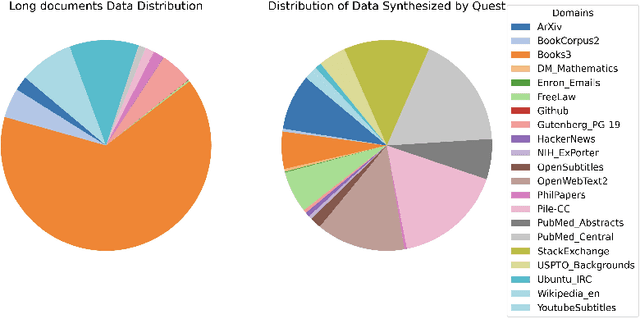
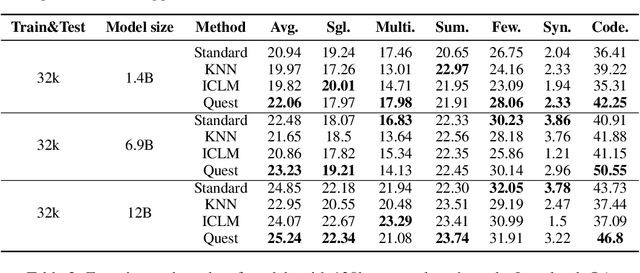
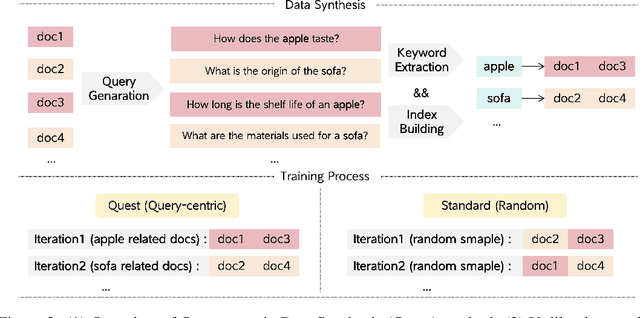
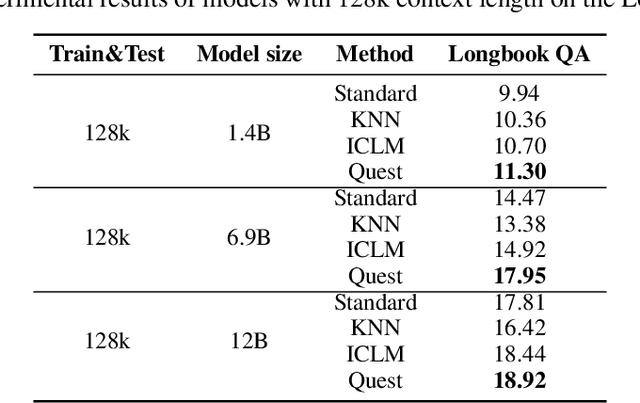
Large language models, initially pre-trained with a limited context length, can better handle longer texts by continuing training on a corpus with extended contexts. However, obtaining effective long-context data is challenging due to the scarcity and uneven distribution of long documents across different domains. To address this issue, we propose a Query-centric data synthesis method, abbreviated as Quest. Quest is an interpretable method based on the observation that documents retrieved by similar queries are relevant but low-redundant, thus well-suited for synthesizing long-context data. The method is also scalable and capable of constructing large amounts of long-context data. Using Quest, we synthesize a long-context dataset up to 128k context length, significantly outperforming other data synthesis methods on multiple long-context benchmark datasets. In addition, we further verify that the Quest method is predictable through scaling law experiments, making it a reliable solution for advancing long-context models.
From Automation to Augmentation: Large Language Models Elevating Essay Scoring Landscape
Jan 12, 2024
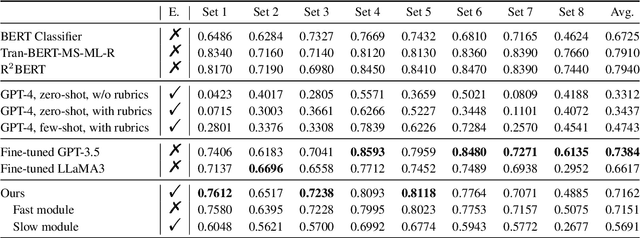

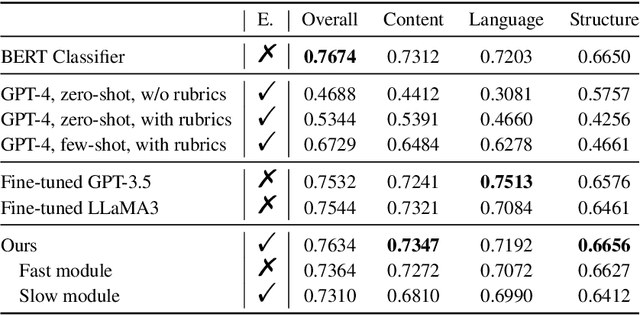
Receiving immediate and personalized feedback is crucial for second-language learners, and Automated Essay Scoring (AES) systems are a vital resource when human instructors are unavailable. This study investigates the effectiveness of Large Language Models (LLMs), specifically GPT-4 and fine-tuned GPT-3.5, as tools for AES. Our comprehensive set of experiments, conducted on both public and private datasets, highlights the remarkable advantages of LLM-based AES systems. They include superior accuracy, consistency, generalizability, and interpretability, with fine-tuned GPT-3.5 surpassing traditional grading models. Additionally, we undertake LLM-assisted human evaluation experiments involving both novice and expert graders. One pivotal discovery is that LLMs not only automate the grading process but also enhance the performance of human graders. Novice graders when provided with feedback generated by LLMs, achieve a level of accuracy on par with experts, while experts become more efficient and maintain greater consistency in their assessments. These results underscore the potential of LLMs in educational technology, paving the way for effective collaboration between humans and AI, ultimately leading to transformative learning experiences through AI-generated feedback.