 Add to Chrome
 Add to Firefox
 Add to Edge
From Deterministic to Generative Deep Learning for Urban Air Quality Reconstruction from Sparse Observations
Jul 28, 2026
Full-field reconstruction of air pollution is essential for evaluating pollution exposure and supporting public health decision-making. However, the complex interactions among pollutants, hard-to-predict weather patterns, and limited monitoring station coverage make this a complex task. We apply deep learning techniques to provide fast and accurate reconstructions from sparse observations of four key pollutants: NO2, O3, PM2.5 and PM10. Models are trained on full-field simulation data and evaluated on real-world observations collected from 9 to 28 monitoring stations in the city of Paris. We introduce a diffusion-based generative framework for multi-pollutant reconstruction and benchmark its performance against deterministic deep learning models. Despite noisy observations and strong spatial variability, the models achieve high structural similarity on simulated validation data and produce realistic spatial patterns on real-world observations, as indicated by power-spectrum analysis. We introduce data augmentation methods that enable transfer to real-world observations without retraining, allowing the models to generalise beyond the training period. These findings highlight the potential of ML models for reliable real-world deployment in air pollution reconstruction tasks.

Accurate identification and measurement of the precipitate area by two-stage deep neural networks in novel chromium-based alloys
Jun 20, 2026The performance of advanced materials for extreme environments is underpinned by their microstructure, including the size and distribution of reinforcing phases. Chromium-based superalloys are a recently proposed alternative to conventional face-centred-cubic superalloys for high-temperature applications, such as Concentrated Solar Power, and their development requires efficient measurement of precipitate volume fraction and size distribution from electron microscopy images. Traditional fixed-threshold image processing is sensitive to background noise, generalises poorly across materials, and requires substantial manual measurement effort. To address these bottlenecks, this study proposes DT-SegNet, an end-to-end two-stage deep learning scheme based on YOLOv5 and SegFormer for object detection and segmentation in electron microscopy images. The approach combines the training efficiency of convolutional neural networks at the detection stage with the segmentation accuracy of a Vision Transformer. Numerical experiments show that DT-SegNet substantially outperforms state-of-the-art segmentation tools offered by Weka and ilastik across metrics including accuracy, precision, recall, and F1-score. The model provides a useful tool for alloy-development microstructure examinations and helps address the large datasets associated with high-throughput alloy development.
* 18 pages, 11 figures. Published in Phys. Chem. Chem. Phys
Zero-shot generalization of transformer neural operators to larger domains
Jun 12, 2026Transformer-based neural operators have shown remarkable performance for approximating solution operators of partial differential equations on complex geometries. However, existing approaches implicitly assume a fixed domain size, which limits their ability to generalize at inference. In this work, we investigate domain extension, namely zero-shot inference on spatial domains that are significantly larger than those encountered during training. We argue that this setting fundamentally requires spatial locality and translation equivariance. We propose to implement this locality via a decomposable bias in the attention logits computation, enabling finely controllable locality while remaining fully decomposable into query-key inner products and directly compatible with optimized attention kernels. Combined with rotary positional embeddings, it enables expressive embeddings with controllable spatial support without altering the transformer architecture. We empirically show that our approach substantially improves zero-shot generalization to larger domains across two PDE benchmarks and a 3D industrial atmospheric flow application. Our code and datasets are available at https://github.com/cerea-daml/domain-extension.
Spatiotemporal System Forecasting with Irregular Time Steps via Masked Autoencoder
Mar 26, 2026Predicting high-dimensional dynamical systems with irregular time steps presents significant challenges for current data-driven algorithms. These irregularities arise from missing data, sparse observations, or adaptive computational techniques, reducing prediction accuracy. To address these limitations, we propose a novel method: a Physics-Spatiotemporal Masked Autoencoder. This method integrates convolutional autoencoders for spatial feature extraction with masked autoencoders optimised for irregular time series, leveraging attention mechanisms to reconstruct the entire physical sequence in a single prediction pass. The model avoids the need for data imputation while preserving physical integrity of the system. Here, 'physics' refers to high-dimensional fields generated by underlying dynamical systems, rather than the enforcement of explicit physical constraints or PDE residuals. We evaluate this approach on multiple simulated datasets and real-world ocean temperature data. The results demonstrate that our method achieves significant improvements in prediction accuracy, robustness to nonlinearities, and computational efficiency over traditional convolutional and recurrent network methods. The model shows potential for capturing complex spatiotemporal patterns without requiring domain-specific knowledge, with applications in climate modelling, fluid dynamics, ocean forecasting, environmental monitoring, and scientific computing.
Anchored-Branched Steady-state WInd Flow Transformer (AB-SWIFT): a metamodel for 3D atmospheric flow in urban environments
Mar 26, 2026Air flow modeling at a local scale is essential for applications such as pollutant dispersion modeling or wind farm modeling. To circumvent costly Computational Fluid Dynamics (CFD) computations, deep learning surrogate models have recently emerged as promising alternatives. However, in the context of urban air flow, deep learning models struggle to adapt to the high variations of the urban geometry and to large mesh sizes. To tackle these challenges, we introduce Anchored Branched Steady-state WInd Flow Transformer (AB-SWIFT), a transformer-based model with an internal branched structure uniquely designed for atmospheric flow modeling. We train our model on a specially designed database of atmospheric simulations around randomised urban geometries and with a mixture of unstable, neutral, and stable atmospheric stratifications. Our model reaches the best accuracy on all predicted fields compared to state-of-the-art transformers and graph-based models. Our code and data is available at https://github.com/cerea-daml/abswift.
Rooftop Wind Field Reconstruction Using Sparse Sensors: From Deterministic to Generative Learning Methods
Mar 13, 2026Real-time rooftop wind-speed distribution is important for the safe operation of drones and urban air mobility systems, wind control systems, and rooftop utilization. However, rooftop flows show strong nonlinearity, separation, and cross-direction variability, which make flow field reconstruction from sparse sensors difficult. This study develops a learning-from-observation framework using wind-tunnel experimental data obtained by Particle Image Velocimetry (PIV) and compares Kriging interpolation with three deep learning models: UNet, Vision Transformer Autoencoder (ViTAE), and Conditional Wasserstein GAN (CWGAN). We evaluate two training strategies, single wind-direction training (SDT) and mixed wind-direction training (MDT), across sensor densities from 5 to 30, test robustness under sensor position perturbations of plus or minus 1 grid, and optimize sensor placement via Proper Orthogonal Decomposition with QR decomposition. Results show that deep learning methods can reconstruct rooftop wind fields from sparse sensor data effectively. Compared with Kriging interpolation, the deep learning models improved SSIM by up to 32.7%, FAC2 by 24.2%, and NMSE by 27.8%. Mixed wind-direction training further improved performance, with gains of up to 173.7% in SSIM, 16.7% in FAC2, and 98.3% in MG compared with single-direction training. The results also show that sensor configuration, optimization, and training strategy should be considered jointly for reliable deployment. QR-based optimization improved robustness by up to 27.8% under sensor perturbations, although with metric-dependent trade-offs. Training on experimental rather than simulated data also provides practical guidance for method selection and sensor placement in different scenarios.
Trustworthy Data-Driven Wildfire Risk Prediction and Understanding in Western Canada
Jan 04, 2026In recent decades, the intensification of wildfire activity in western Canada has resulted in substantial socio-economic and environmental losses. Accurate wildfire risk prediction is hindered by the intrinsic stochasticity of ignition and spread and by nonlinear interactions among fuel conditions, meteorology, climate variability, topography, and human activities, challenging the reliability and interpretability of purely data-driven models. We propose a trustworthy data-driven wildfire risk prediction framework based on long-sequence, multi-scale temporal modeling, which integrates heterogeneous drivers while explicitly quantifying predictive uncertainty and enabling process-level interpretation. Evaluated over western Canada during the record-breaking 2023 and 2024 fire seasons, the proposed model outperforms existing time-series approaches, achieving an F1 score of 0.90 and a PR-AUC of 0.98 with low computational cost. Uncertainty-aware analysis reveals structured spatial and seasonal patterns in predictive confidence, highlighting increased uncertainty associated with ambiguous predictions and spatiotemporal decision boundaries. SHAP-based interpretation provides mechanistic understanding of wildfire controls, showing that temperature-related drivers dominate wildfire risk in both years, while moisture-related constraints play a stronger role in shaping spatial and land-cover-specific contrasts in 2024 compared to the widespread hot and dry conditions of 2023. Data and code are available at https://github.com/SynUW/mmFire.
Fast-Forward Lattice Boltzmann: Learning Kinetic Behaviour with Physics-Informed Neural Operators
Sep 26, 2025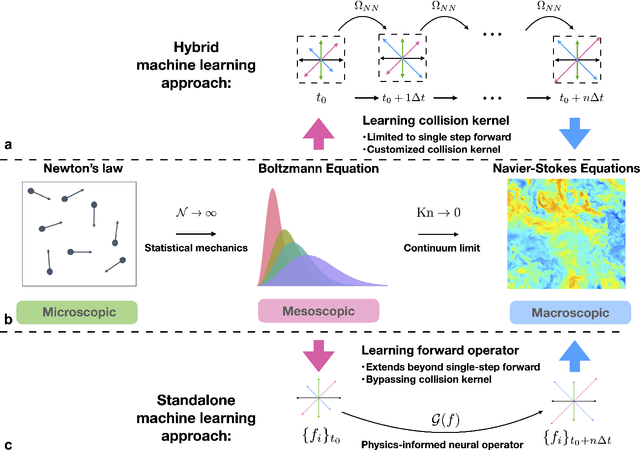
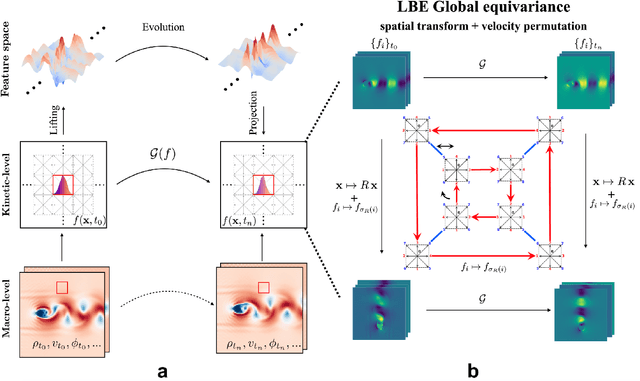
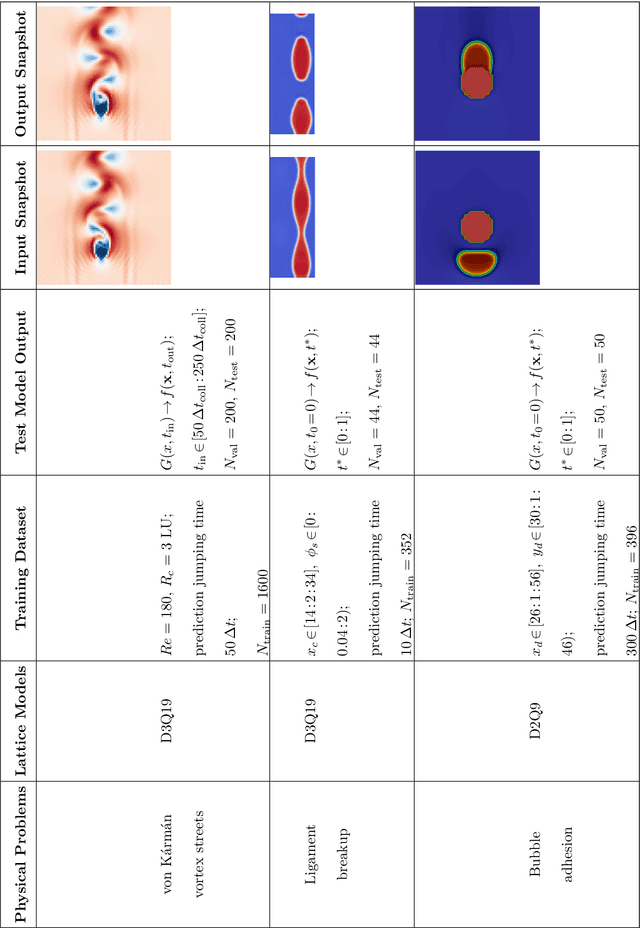
The lattice Boltzmann equation (LBE), rooted in kinetic theory, provides a powerful framework for capturing complex flow behaviour by describing the evolution of single-particle distribution functions (PDFs). Despite its success, solving the LBE numerically remains computationally intensive due to strict time-step restrictions imposed by collision kernels. Here, we introduce a physics-informed neural operator framework for the LBE that enables prediction over large time horizons without step-by-step integration, effectively bypassing the need to explicitly solve the collision kernel. We incorporate intrinsic moment-matching constraints of the LBE, along with global equivariance of the full distribution field, enabling the model to capture the complex dynamics of the underlying kinetic system. Our framework is discretization-invariant, enabling models trained on coarse lattices to generalise to finer ones (kinetic super-resolution). In addition, it is agnostic to the specific form of the underlying collision model, which makes it naturally applicable across different kinetic datasets regardless of the governing dynamics. Our results demonstrate robustness across complex flow scenarios, including von Karman vortex shedding, ligament breakup, and bubble adhesion. This establishes a new data-driven pathway for modelling kinetic systems.
Comparative and Interpretative Analysis of CNN and Transformer Models in Predicting Wildfire Spread Using Remote Sensing Data
Mar 18, 2025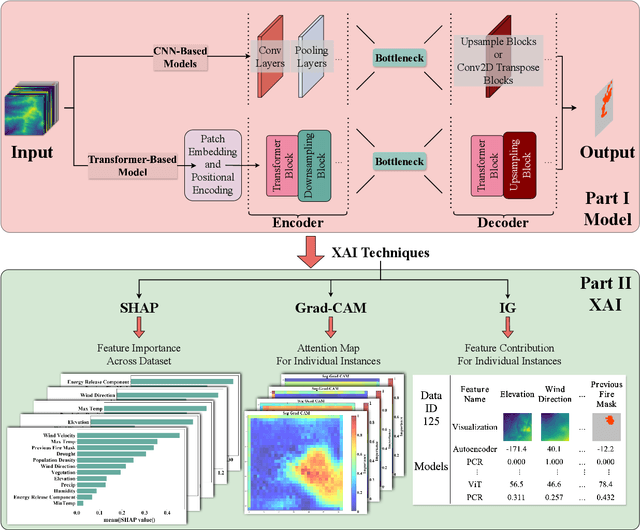
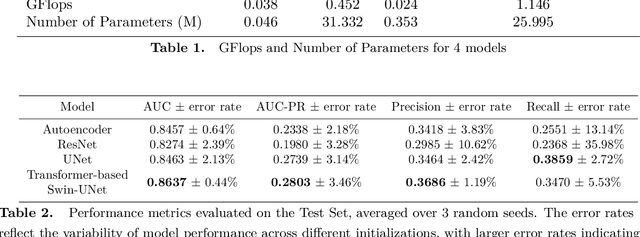
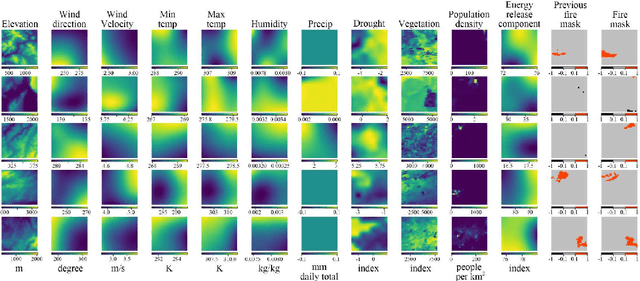
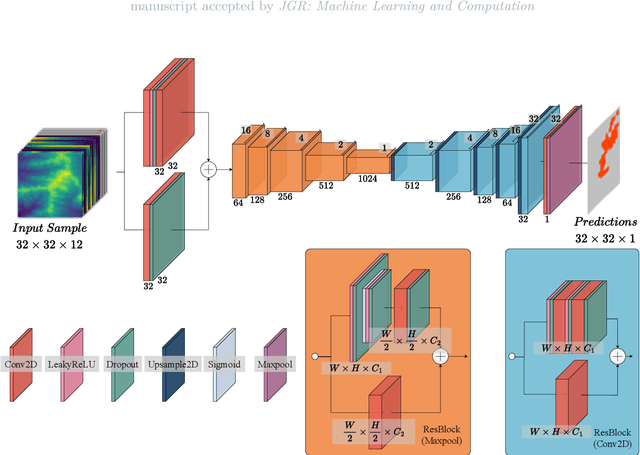
Facing the escalating threat of global wildfires, numerous computer vision techniques using remote sensing data have been applied in this area. However, the selection of deep learning methods for wildfire prediction remains uncertain due to the lack of comparative analysis in a quantitative and explainable manner, crucial for improving prevention measures and refining models. This study aims to thoroughly compare the performance, efficiency, and explainability of four prevalent deep learning architectures: Autoencoder, ResNet, UNet, and Transformer-based Swin-UNet. Employing a real-world dataset that includes nearly a decade of remote sensing data from California, U.S., these models predict the spread of wildfires for the following day. Through detailed quantitative comparison analysis, we discovered that Transformer-based Swin-UNet and UNet generally outperform Autoencoder and ResNet, particularly due to the advanced attention mechanisms in Transformer-based Swin-UNet and the efficient use of skip connections in both UNet and Transformer-based Swin-UNet, which contribute to superior predictive accuracy and model interpretability. Then we applied XAI techniques on all four models, this not only enhances the clarity and trustworthiness of models but also promotes focused improvements in wildfire prediction capabilities. The XAI analysis reveals that UNet and Transformer-based Swin-UNet are able to focus on critical features such as 'Previous Fire Mask', 'Drought', and 'Vegetation' more effectively than the other two models, while also maintaining balanced attention to the remaining features, leading to their superior performance. The insights from our thorough comparative analysis offer substantial implications for future model design and also provide guidance for model selection in different scenarios.
Machine learning for modelling unstructured grid data in computational physics: a review
Feb 13, 2025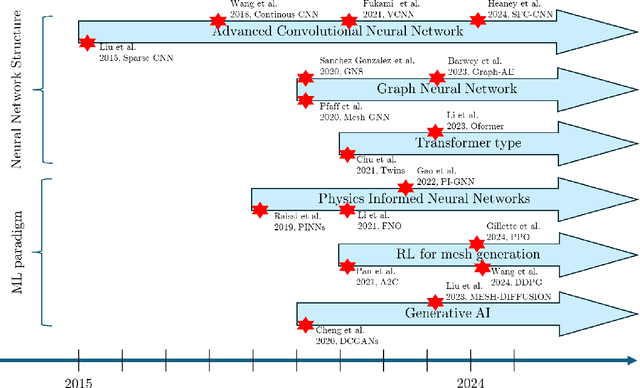
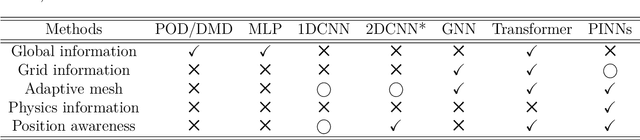
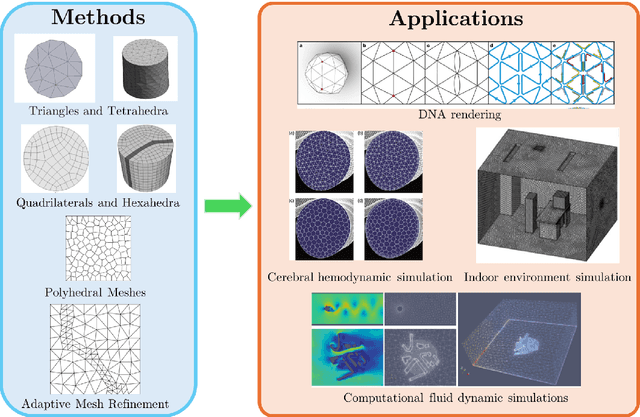
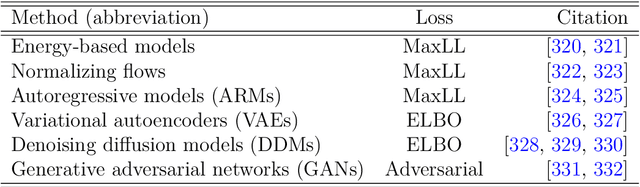
Unstructured grid data are essential for modelling complex geometries and dynamics in computational physics. Yet, their inherent irregularity presents significant challenges for conventional machine learning (ML) techniques. This paper provides a comprehensive review of advanced ML methodologies designed to handle unstructured grid data in high-dimensional dynamical systems. Key approaches discussed include graph neural networks, transformer models with spatial attention mechanisms, interpolation-integrated ML methods, and meshless techniques such as physics-informed neural networks. These methodologies have proven effective across diverse fields, including fluid dynamics and environmental simulations. This review is intended as a guidebook for computational scientists seeking to apply ML approaches to unstructured grid data in their domains, as well as for ML researchers looking to address challenges in computational physics. It places special focus on how ML methods can overcome the inherent limitations of traditional numerical techniques and, conversely, how insights from computational physics can inform ML development. To support benchmarking, this review also provides a summary of open-access datasets of unstructured grid data in computational physics. Finally, emerging directions such as generative models with unstructured data, reinforcement learning for mesh generation, and hybrid physics-data-driven paradigms are discussed to inspire future advancements in this evolving field.