 Add to Chrome
 Add to Firefox
 Add to Edge
Evaluating Machine Learning Models for Post-Wildfire Debris-Flow Prediction
Aug 05, 2026
Prediction of post-wildfire debris flows is critical for mitigating hazards to communities, infrastructure, and resources during intense rainfall in recently burned areas. However, identifying reliable machine learning models is complicated by overlapping debris-flow and non-debris-flow events in feature space, the need for model interpretability, and limited training data. This paper addresses these challenges through a systematic evaluation of machine learning models in terms of predictive performance, feature importance, and synthetic data augmentation. Using basin-scale observations of post-wildfire debris-flow events across the western United States, we compare 15 models, including the Tabular Prior-Data Fitted Network (TabPFN). Repeated stratified cross-validation shows that TabPFN achieves the highest unaugmented performance with a threat score of 0.637, closely followed by the best tree-based models. SHapley Additive exPlanations (SHAP) are used to identify the features driving predictions, revealing that short-duration rainfall intensity and storm accumulation consistently rank highest, while burn severity and terrain features contribute less. We further evaluate synthetic data augmentation using TabPFN-generated samples to address the scarcity of debris-flow observations. Synthetic augmentation improves the performance of all models except CNN, with the largest mean threat score increase of +0.041 among the deep learning models. By combining rigorous model benchmarking, interpretable feature analysis, and synthetic data augmentation, this work provides a comprehensive framework for improving post-wildfire debris-flow prediction.

mHC-HSI: Clustering-Guided Hyper-Connection Mamba for Hyperspectral Image Classification
Mar 03, 2026Recently, DeepSeek has invented the manifold-constrained hyper-connection (mHC) approach which has demonstrated significant improvements over the traditional residual connection in deep learning models \cite{xie2026mhc}. Nevertheless, this approach has not been tailor-designed for improving hyperspectral image (HSI) classification. This paper presents a clustering-guided mHC Mamba model (mHC-HSI) for enhanced HSI classification, with the following contributions. First, to improve spatial-spectral feature learning, we design a novel clustering-guided Mamba module, based on the mHC framework, that explicitly learns both spatial and spectral information in HSI. Second, to decompose the complex and heterogeneous HSI into smaller clusters, we design a new implementation of the residual matrix in mHC, which can be treated as soft cluster membership maps, leading to improved explainability of the mHC approach. Third, to leverage the physical spectral knowledge, we divide the spectral bands into physically-meaningful groups and use them as the "parallel streams" in mHC, leading to a physically-meaningful approach with enhanced interpretability. The proposed approach is tested on benchmark datasets in comparison with the state-of-the-art methods, and the results suggest that the proposed model not only improves the accuracy but also enhances the model explainability. Code is available here: https://github.com/GSIL-UCalgary/mHC_HyperSpectral
Geographically-Weighted Weakly Supervised Bayesian High-Resolution Transformer for 200m Resolution Pan-Arctic Sea Ice Concentration Mapping and Uncertainty Estimation using Sentinel-1, RCM, and AMSR2 Data
Mar 03, 2026Although high-resolution mapping of pan-Arctic sea ice with reliable corresponding uncertainty is essential for operational sea ice concentration (SIC) charting, it is a difficult task due to key challenges, such as the subtle nature of ice signature features, inexact SIC labels, model uncertainty, and data heterogeneity. This study presents a novel Bayesian High-Resolution Transformer approach for 200 meter resolution pan-Arctic SIC mapping and uncertainty quantification using Sentinel-1, RADARSAT Constellation Mission (RCM), and Advanced Microwave Scanning Radiometer 2 (AMSR2) data. First, to improve small and subtle sea ice feature (e.g., cracks/leads, ponds, and ice floes) extraction, we design a novel high-resolution Transformer model with both global and local modules that can better discern the subtle differences in sea ice patterns. Second, to address low-resolution and inexact SIC labels, we design a geographically-weighted weakly supervised loss function to supervise the model at region level instead of pixel level, and to prioritize pure open water and ice pack signatures while mitigating the impact of ambiguity in the marginal ice zone (MIZ). Third, to improve uncertainty quantification, we design a Bayesian extension of the proposed Transformer model, treating its parameters as random variables to more effectively capture uncertainties. Fourth, to address data heterogeneity, we fuse three different data types (Sentinel-1, RCM, and AMSR2) at decision-level to improve both SIC mapping and uncertainty quantification. The proposed approach is evaluated under pan-Arctic minimum-extent conditions in 2021 and 2025. Results demonstrate that the proposed model achieves 0.70 overall feature detection accuracy using Sentinel-1 data, while also preserving pan-Arctic SIC patterns (Sentinel-1 R\textsuperscript{2} = 0.90 relative to the ARTIST Sea Ice product).
White-Box mHC: Electromagnetic Spectrum-Aware and Interpretable Stream Interactions for Hyperspectral Image Classification
Jan 22, 2026In hyperspectral image classification (HSIC), most deep learning models rely on opaque spectral-spatial feature mixing, limiting their interpretability and hindering understanding of internal decision mechanisms. We present physical spectrum-aware white-box mHC, named ES-mHC, a hyper-connection framework that explicitly models interactions among different electromagnetic spectrum groupings (residual stream in mHC) interactions using structured, directional matrices. By separating feature representation from interaction structure, ES-mHC promotes electromagnetic spectrum grouping specialization, reduces redundancy, and exposes internal information flow that can be directly visualized and spatially analyzed. Using hyperspectral image classification as a representative testbed, we demonstrate that the learned hyper-connection matrices exhibit coherent spatial patterns and asymmetric interaction behaviors, providing mechanistic insight into the model internal dynamics. Furthermore, we find that increasing the expansion rate accelerates the emergence of structured interaction patterns. These results suggest that ES-mHC transforms HSIC from a purely black-box prediction task into a structurally transparent, partially white-box learning process.
Clustering-Guided Spatial-Spectral Mamba for Hyperspectral Image Classification
Jan 22, 2026Although Mamba models greatly improve Hyperspectral Image (HSI) classification, they have critical challenges in terms defining efficient and adaptive token sequences for improve performance. This paper therefore presents CSSMamba (Clustering-guided Spatial-Spectral Mamba) framework to better address the challenges, with the following contributions. First, to achieve efficient and adaptive token sequences for improved Mamba performance, we integrate the clustering mechanism into a spatial Mamba architecture, leading to a cluster-guided spatial Mamba module (CSpaMamba) that reduces the Mamba sequence length and improves Mamba feature learning capability. Second, to improve the learning of both spatial and spectral information, we integrate the CSpaMamba module with a spectral mamba module (SpeMamba), leading to a complete clustering-guided spatial-spectral Mamba framework. Third, to further improve feature learning capability, we introduce an Attention-Driven Token Selection mechanism to optimize Mamba token sequencing. Last, to seamlessly integrate clustering into the Mamba model in a coherent manner, we design a Learnable Clustering Module that learns the cluster memberships in an adaptive manner. Experiments on the Pavia University, Indian Pines, and Liao-Ning 01 datasets demonstrate that CSSMamba achieves higher accuracy and better boundary preservation compared to state-of-the-art CNN, Transformer, and Mamba-based methods.
Trustworthy Data-Driven Wildfire Risk Prediction and Understanding in Western Canada
Jan 04, 2026In recent decades, the intensification of wildfire activity in western Canada has resulted in substantial socio-economic and environmental losses. Accurate wildfire risk prediction is hindered by the intrinsic stochasticity of ignition and spread and by nonlinear interactions among fuel conditions, meteorology, climate variability, topography, and human activities, challenging the reliability and interpretability of purely data-driven models. We propose a trustworthy data-driven wildfire risk prediction framework based on long-sequence, multi-scale temporal modeling, which integrates heterogeneous drivers while explicitly quantifying predictive uncertainty and enabling process-level interpretation. Evaluated over western Canada during the record-breaking 2023 and 2024 fire seasons, the proposed model outperforms existing time-series approaches, achieving an F1 score of 0.90 and a PR-AUC of 0.98 with low computational cost. Uncertainty-aware analysis reveals structured spatial and seasonal patterns in predictive confidence, highlighting increased uncertainty associated with ambiguous predictions and spatiotemporal decision boundaries. SHAP-based interpretation provides mechanistic understanding of wildfire controls, showing that temperature-related drivers dominate wildfire risk in both years, while moisture-related constraints play a stronger role in shaping spatial and land-cover-specific contrasts in 2024 compared to the widespread hot and dry conditions of 2023. Data and code are available at https://github.com/SynUW/mmFire.
Multitask GLocal OBIA-Mamba for Sentinel-2 Landcover Mapping
Nov 13, 2025Although Sentinel-2 based land use and land cover (LULC) classification is critical for various environmental monitoring applications, it is a very difficult task due to some key data challenges (e.g., spatial heterogeneity, context information, signature ambiguity). This paper presents a novel Multitask Glocal OBIA-Mamba (MSOM) for enhanced Sentinel-2 classification with the following contributions. First, an object-based image analysis (OBIA) Mamba model (OBIA-Mamba) is designed to reduce redundant computation without compromising fine-grained details by using superpixels as Mamba tokens. Second, a global-local (GLocal) dual-branch convolutional neural network (CNN)-mamba architecture is designed to jointly model local spatial detail and global contextual information. Third, a multitask optimization framework is designed to employ dual loss functions to balance local precision with global consistency. The proposed approach is tested on Sentinel-2 imagery in Alberta, Canada, in comparison with several advanced classification approaches, and the results demonstrate that the proposed approach achieves higher classification accuracy and finer details that the other state-of-the-art methods.
Sparse Deformable Mamba for Hyperspectral Image Classification
Apr 15, 2025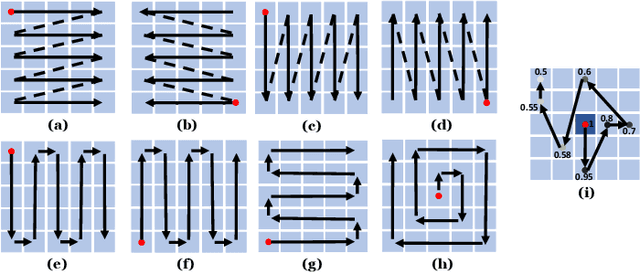
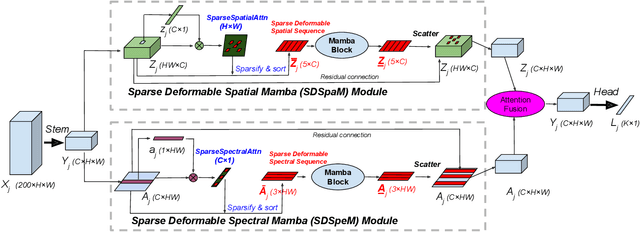
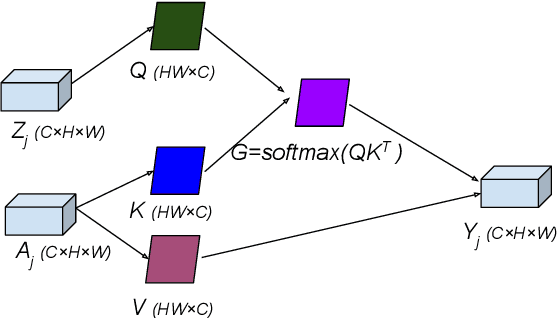
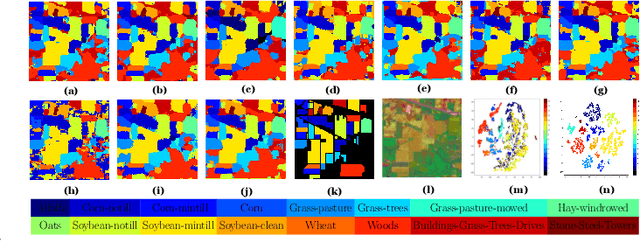
Although Mamba models significantly improve hyperspectral image (HSI) classification, one critical challenge is the difficulty in building the sequence of Mamba tokens efficiently. This paper presents a Sparse Deformable Mamba (SDMamba) approach for enhanced HSI classification, with the following contributions. First, to enhance Mamba sequence, an efficient Sparse Deformable Sequencing (SDS) approach is designed to adaptively learn the ''optimal" sequence, leading to sparse and deformable Mamba sequence with increased detail preservation and decreased computations. Second, to boost spatial-spectral feature learning, based on SDS, a Sparse Deformable Spatial Mamba Module (SDSpaM) and a Sparse Deformable Spectral Mamba Module (SDSpeM) are designed for tailored modeling of the spatial information spectral information. Last, to improve the fusion of SDSpaM and SDSpeM, an attention based feature fusion approach is designed to integrate the outputs of the SDSpaM and SDSpeM. The proposed method is tested on several benchmark datasets with many state-of-the-art approaches, demonstrating that the proposed approach can achieve higher accuracy with less computation, and better detail small-class preservation capability.