 Add to Chrome
 Add to Firefox
 Add to Edge
RRAM circuit-enabled nonlinear precoding and bit precision analysis
Aug 15, 2026
The rising number of users and antennas imposes exponentially growing computational loads on future communication systems. Yet conventional processors are facing a bottleneck for their nature of memory-computing separation. In-memory computing (IMC) emerges as a promising solution leveraging its intrinsic high parallelism. This work proposes an IMC architecture that employs resistive random access memory (RRAM) to reduce the computational complexity of the nonlinear Tomlinson-Harashima precoding (THP) to a linear scale. We present a computation-constraint principle for designing RRAM circuits to perform nonlinear matrix operations and construct an LQ decomposition RRAM circuit. Since the conductance of memristor is generally quantized, we perform the bit precision analysis and derive the lower bound of the Signal-to-Interference-plus-Noise Ratio (SINR) and achievable rate. Our analysis indicates that at a high Signal-to-Noise Ratio (SNR) or with a large number of antennas, each 1-bit precision increase yields 6 dB SINR gain and linear rate growth. For practical implementation, we derive the optimal bit precision to sustain SINR performance under varying system configurations. Simulation demonstrates the feasibility and accuracy of the RRAM-based circuit and our theoretical analysis. Our work proves that RRAM-based IMC holds significant potential for high-complexity nonlinear precoding, addressing the escalating computational demands for future communications.

DREAM Technical Report
Aug 11, 2026Industrial recommender systems commonly use cascaded retrieval, ranking, and re-ranking pipelines. Although efficient, these pipelines fragment information and objectives across modules, rely on rigid rules, and have limited awareness of real-time intent, leaving session-level shifts among browsing, comparison, and purchase insufficiently addressed. We present DREAM (Developing Recommender Engine with Agentic Methods), an autonomous optimization control architecture that adds a perception-aware, orchestrable, and auditable policy layer atop existing pipelines without replacing them. DREAM has two core components. First, a three-tier Intent Engine fuses on-device signals into structured L0/L1/L2 intent representations; its edge-cloud trigger chain reduces reporting volume to approximately 8.7%. Second, a Meta Engine uses a MetaModel for layered M1-to-M2-to-M3 reasoning: intent summarization, strategy planning informed by Strategy Memory, and parameter translation. It dispatches the resulting parameters through a unified outlet with safety guardrails. A Reward Dual Loop continuously optimizes both components by combining offline simulation for strategy-space exploration with online feedback for outcome calibration, forming a cycle of generation, execution, evaluation, and experience accumulation. Large-scale A/B tests on Taobao's homepage feed show that re-ranking control alone improves IPV by 2.06%, Core IPV by 2.39%, and GMV by 0.88%. Extending control to fine ranking raises these gains to 2.71%, 3.06%, and 1.31%, respectively, while consistently improving PV by more than 1%. These gains require neither replacement of pipeline models nor compromise of serving stability, supporting agentic meta-control as a viable paradigm for industrial recommendation.
RecGPT-V3 Technical Report
Jul 24, 2026Large language models (LLMs) are transforming recommender systems from matching co-occurrence patterns in historical behavior toward reasoning about the intent that drives it. RecGPT-V1 pioneered this paradigm on Taobao by centering user understanding, and RecGPT-V2 scaled it via coordinated multi-agent reasoning; both are deployed in production with consistent gains in user experience and commercial outcomes. However, operating RecGPT at scale reveals three challenges: (1) stateless behavior modeling, where each request reprocesses full user history, wasting computation and discarding prior analysis; (2) a tag-to-item information bottleneck, where natural-language tags form a lossy channel between user understanding and item grounding; and (3) inefficient explicit reasoning, whose lengthy chain-of-thought incurs untenable latency and compute overhead. We present RecGPT-V3, a stateful, hybrid-modal recommender that reasons over natural language for open-world knowledge and Semantic IDs (SIDs) for concrete item grounding. A Memory Hub maintains structured, continually evolving user memory that distills long-horizon behavior into condensed units, cutting user-modeling computation by 55.8%. A Hybrid-modal Foundation Model allows the LLM jointly reason over text tags and SIDs, opening a high-bandwidth channel into the item space. Latent Intent Reasoning internalizes verbose rationales into compact learnable latent tokens that remain decodable into readable explanations, lowering output token cost by 200x. Deployed in Taobao's "Guess What You Like" feed, RecGPT-V3 achieves consistent gains in large-scale online A/B tests: IPV +1.28%, CTR +1.00%, TC +1.97%, GMV +3.97%, while cutting end-to-end serving resource consumption by 52.4%.
Accurate identification and measurement of the precipitate area by two-stage deep neural networks in novel chromium-based alloys
Jun 20, 2026The performance of advanced materials for extreme environments is underpinned by their microstructure, including the size and distribution of reinforcing phases. Chromium-based superalloys are a recently proposed alternative to conventional face-centred-cubic superalloys for high-temperature applications, such as Concentrated Solar Power, and their development requires efficient measurement of precipitate volume fraction and size distribution from electron microscopy images. Traditional fixed-threshold image processing is sensitive to background noise, generalises poorly across materials, and requires substantial manual measurement effort. To address these bottlenecks, this study proposes DT-SegNet, an end-to-end two-stage deep learning scheme based on YOLOv5 and SegFormer for object detection and segmentation in electron microscopy images. The approach combines the training efficiency of convolutional neural networks at the detection stage with the segmentation accuracy of a Vision Transformer. Numerical experiments show that DT-SegNet substantially outperforms state-of-the-art segmentation tools offered by Weka and ilastik across metrics including accuracy, precision, recall, and F1-score. The model provides a useful tool for alloy-development microstructure examinations and helps address the large datasets associated with high-throughput alloy development.
* 18 pages, 11 figures. Published in Phys. Chem. Chem. Phys
ReadMOF: Structure-Free Semantic Embeddings from Systematic MOF Nomenclature for Machine Learning
Apr 12, 2026Systematic chemical names, such as IUPAC-style nomenclature for metal-organic frameworks (MOFs), contain rich structural and compositional information in a standardized textual format. Here we introduce ReadMOF, which is, to our knowledge, the first nomenclature-free machine learning framework that leverages these names to model structure-property relationships without requiring atomic coordinates or connectivity graphs. By employing pretrained language models, ReadMOF converts systematic MOF names from the Cambridge Structural Database (CSD) into vector embeddings that closely represent traditional structure-based descriptors. These embeddings enable applications in materials informatics, including property prediction, similarity retrieval, and clustering, with performance comparable to geometry-dependent methods. When combined with large language models, ReadMOF also establishes chemically meaningful reasoning ability with textual input only. Our results show that structured chemical language, interpreted through modern natural language processing techniques, can provide a scalable, interpretable, and geometry-independent alternative to conventional molecular representations. This approach opens new opportunities for language-driven discovery in materials science.
Spatiotemporal System Forecasting with Irregular Time Steps via Masked Autoencoder
Mar 26, 2026Predicting high-dimensional dynamical systems with irregular time steps presents significant challenges for current data-driven algorithms. These irregularities arise from missing data, sparse observations, or adaptive computational techniques, reducing prediction accuracy. To address these limitations, we propose a novel method: a Physics-Spatiotemporal Masked Autoencoder. This method integrates convolutional autoencoders for spatial feature extraction with masked autoencoders optimised for irregular time series, leveraging attention mechanisms to reconstruct the entire physical sequence in a single prediction pass. The model avoids the need for data imputation while preserving physical integrity of the system. Here, 'physics' refers to high-dimensional fields generated by underlying dynamical systems, rather than the enforcement of explicit physical constraints or PDE residuals. We evaluate this approach on multiple simulated datasets and real-world ocean temperature data. The results demonstrate that our method achieves significant improvements in prediction accuracy, robustness to nonlinearities, and computational efficiency over traditional convolutional and recurrent network methods. The model shows potential for capturing complex spatiotemporal patterns without requiring domain-specific knowledge, with applications in climate modelling, fluid dynamics, ocean forecasting, environmental monitoring, and scientific computing.
Uni-Flow: a unified autoregressive-diffusion model for complex multiscale flows
Feb 17, 2026Spatiotemporal flows govern diverse phenomena across physics, biology, and engineering, yet modelling their multiscale dynamics remains a central challenge. Despite major advances in physics-informed machine learning, existing approaches struggle to simultaneously maintain long-term temporal evolution and resolve fine-scale structure across chaotic, turbulent, and physiological regimes. Here, we introduce Uni-Flow, a unified autoregressive-diffusion framework that explicitly separates temporal evolution from spatial refinement for modelling complex dynamical systems. The autoregressive component learns low-resolution latent dynamics that preserve large-scale structure and ensure stable long-horizon rollouts, while the diffusion component reconstructs high-resolution physical fields, recovering fine-scale features in a small number of denoising steps. We validate Uni-Flow across canonical benchmarks, including two-dimensional Kolmogorov flow, three-dimensional turbulent channel inflow generation with a quantum-informed autoregressive prior, and patient-specific simulations of aortic coarctation derived from high-fidelity lattice Boltzmann hemodynamic solvers. In the cardiovascular setting, Uni-Flow enables task-level faster than real-time inference of pulsatile hemodynamics, reconstructing high-resolution pressure fields over physiologically relevant time horizons in seconds rather than hours. By transforming high-fidelity hemodynamic simulation from an offline, HPC-bound process into a deployable surrogate, Uni-Flow establishes a pathway to faster-than-real-time modelling of complex multiscale flows, with broad implications for scientific machine learning in flow physics.
RecGPT-V2 Technical Report
Dec 16, 2025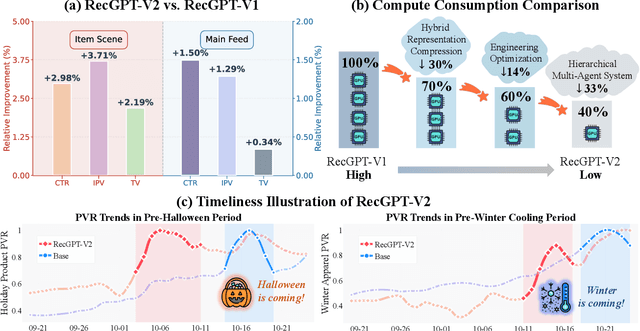
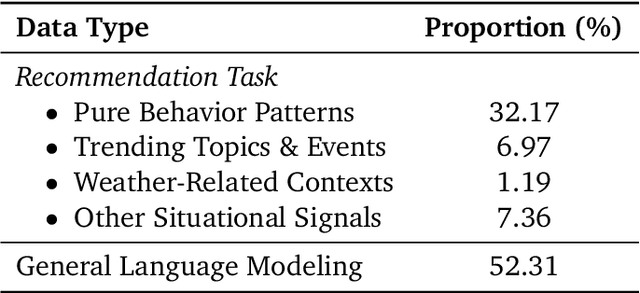
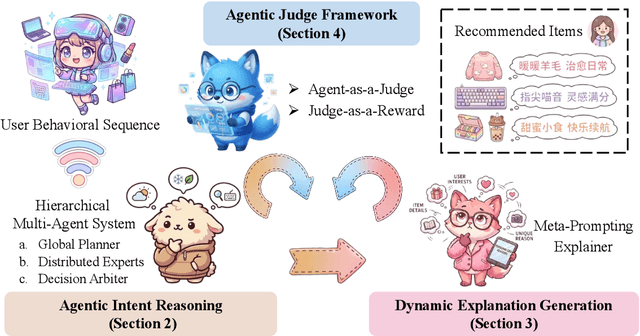

Large language models (LLMs) have demonstrated remarkable potential in transforming recommender systems from implicit behavioral pattern matching to explicit intent reasoning. While RecGPT-V1 successfully pioneered this paradigm by integrating LLM-based reasoning into user interest mining and item tag prediction, it suffers from four fundamental limitations: (1) computational inefficiency and cognitive redundancy across multiple reasoning routes; (2) insufficient explanation diversity in fixed-template generation; (3) limited generalization under supervised learning paradigms; and (4) simplistic outcome-focused evaluation that fails to match human standards. To address these challenges, we present RecGPT-V2 with four key innovations. First, a Hierarchical Multi-Agent System restructures intent reasoning through coordinated collaboration, eliminating cognitive duplication while enabling diverse intent coverage. Combined with Hybrid Representation Inference that compresses user-behavior contexts, our framework reduces GPU consumption by 60% and improves exclusive recall from 9.39% to 10.99%. Second, a Meta-Prompting framework dynamically generates contextually adaptive prompts, improving explanation diversity by +7.3%. Third, constrained reinforcement learning mitigates multi-reward conflicts, achieving +24.1% improvement in tag prediction and +13.0% in explanation acceptance. Fourth, an Agent-as-a-Judge framework decomposes assessment into multi-step reasoning, improving human preference alignment. Online A/B tests on Taobao demonstrate significant improvements: +2.98% CTR, +3.71% IPV, +2.19% TV, and +11.46% NER. RecGPT-V2 establishes both the technical feasibility and commercial viability of deploying LLM-powered intent reasoning at scale, bridging the gap between cognitive exploration and industrial utility.
Machine learning for modelling unstructured grid data in computational physics: a review
Feb 13, 2025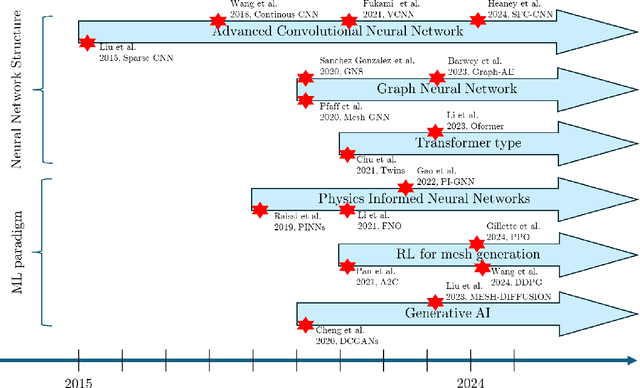
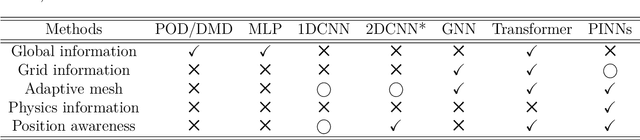
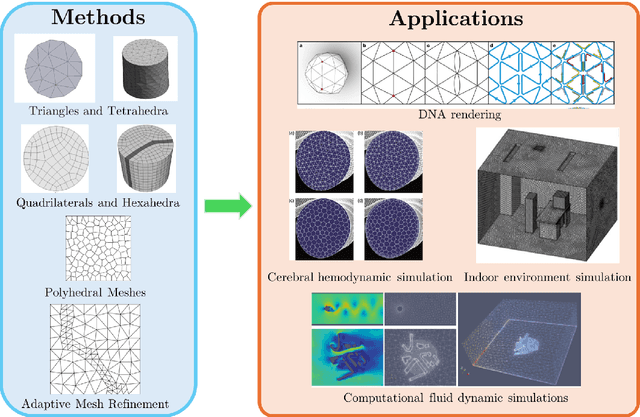
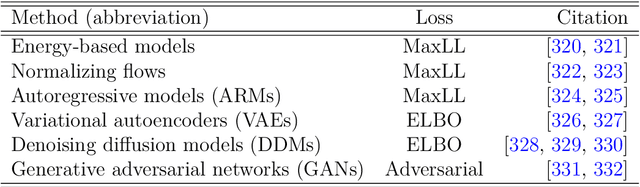
Unstructured grid data are essential for modelling complex geometries and dynamics in computational physics. Yet, their inherent irregularity presents significant challenges for conventional machine learning (ML) techniques. This paper provides a comprehensive review of advanced ML methodologies designed to handle unstructured grid data in high-dimensional dynamical systems. Key approaches discussed include graph neural networks, transformer models with spatial attention mechanisms, interpolation-integrated ML methods, and meshless techniques such as physics-informed neural networks. These methodologies have proven effective across diverse fields, including fluid dynamics and environmental simulations. This review is intended as a guidebook for computational scientists seeking to apply ML approaches to unstructured grid data in their domains, as well as for ML researchers looking to address challenges in computational physics. It places special focus on how ML methods can overcome the inherent limitations of traditional numerical techniques and, conversely, how insights from computational physics can inform ML development. To support benchmarking, this review also provides a summary of open-access datasets of unstructured grid data in computational physics. Finally, emerging directions such as generative models with unstructured data, reinforcement learning for mesh generation, and hybrid physics-data-driven paradigms are discussed to inspire future advancements in this evolving field.