 Add to Chrome
 Add to Firefox
 Add to Edge
Spatiotemporal System Forecasting with Irregular Time Steps via Masked Autoencoder
Mar 26, 2026
Predicting high-dimensional dynamical systems with irregular time steps presents significant challenges for current data-driven algorithms. These irregularities arise from missing data, sparse observations, or adaptive computational techniques, reducing prediction accuracy. To address these limitations, we propose a novel method: a Physics-Spatiotemporal Masked Autoencoder. This method integrates convolutional autoencoders for spatial feature extraction with masked autoencoders optimised for irregular time series, leveraging attention mechanisms to reconstruct the entire physical sequence in a single prediction pass. The model avoids the need for data imputation while preserving physical integrity of the system. Here, 'physics' refers to high-dimensional fields generated by underlying dynamical systems, rather than the enforcement of explicit physical constraints or PDE residuals. We evaluate this approach on multiple simulated datasets and real-world ocean temperature data. The results demonstrate that our method achieves significant improvements in prediction accuracy, robustness to nonlinearities, and computational efficiency over traditional convolutional and recurrent network methods. The model shows potential for capturing complex spatiotemporal patterns without requiring domain-specific knowledge, with applications in climate modelling, fluid dynamics, ocean forecasting, environmental monitoring, and scientific computing.

LVPruning: An Effective yet Simple Language-Guided Vision Token Pruning Approach for Multi-modal Large Language Models
Jan 23, 2025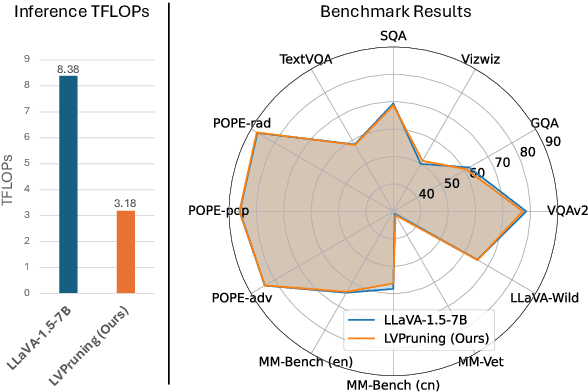
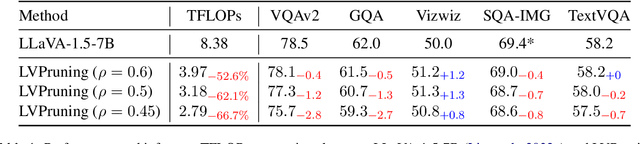
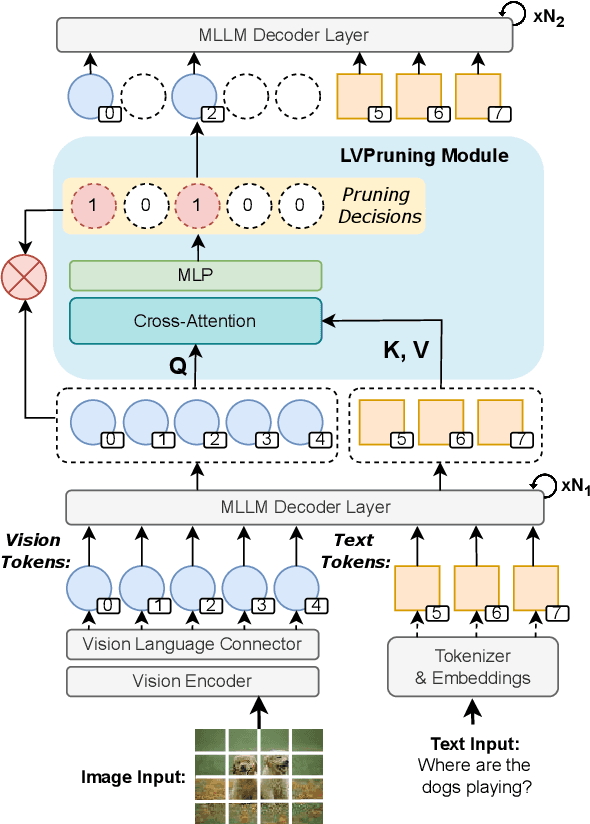
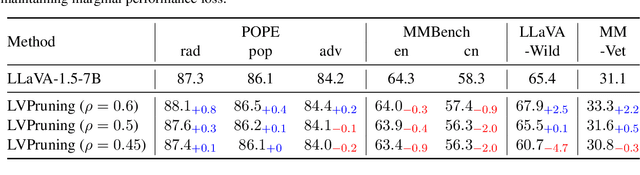
Multi-modal Large Language Models (MLLMs) have achieved remarkable success by integrating visual and textual modalities. However, they incur significant computational overhead due to the large number of vision tokens processed, limiting their practicality in resource-constrained environments. We introduce Language-Guided Vision Token Pruning (LVPruning) for MLLMs, an effective yet simple method that significantly reduces the computational burden while preserving model performance. LVPruning employs cross-attention modules to compute the importance of vision tokens based on their interaction with language tokens, determining which to prune. Importantly, LVPruning can be integrated without modifying the original MLLM parameters, which makes LVPruning simple to apply or remove. Our experiments show that LVPruning can effectively reduce up to 90% of vision tokens by the middle layer of LLaVA-1.5, resulting in a 62.1% decrease in inference Tera Floating-Point Operations Per Second (TFLOPs), with an average performance loss of just 0.45% across nine multi-modal benchmarks.