 Add to Chrome
 Add to Firefox
 Add to Edge
Uni-Flow: a unified autoregressive-diffusion model for complex multiscale flows
Feb 17, 2026
Spatiotemporal flows govern diverse phenomena across physics, biology, and engineering, yet modelling their multiscale dynamics remains a central challenge. Despite major advances in physics-informed machine learning, existing approaches struggle to simultaneously maintain long-term temporal evolution and resolve fine-scale structure across chaotic, turbulent, and physiological regimes. Here, we introduce Uni-Flow, a unified autoregressive-diffusion framework that explicitly separates temporal evolution from spatial refinement for modelling complex dynamical systems. The autoregressive component learns low-resolution latent dynamics that preserve large-scale structure and ensure stable long-horizon rollouts, while the diffusion component reconstructs high-resolution physical fields, recovering fine-scale features in a small number of denoising steps. We validate Uni-Flow across canonical benchmarks, including two-dimensional Kolmogorov flow, three-dimensional turbulent channel inflow generation with a quantum-informed autoregressive prior, and patient-specific simulations of aortic coarctation derived from high-fidelity lattice Boltzmann hemodynamic solvers. In the cardiovascular setting, Uni-Flow enables task-level faster than real-time inference of pulsatile hemodynamics, reconstructing high-resolution pressure fields over physiologically relevant time horizons in seconds rather than hours. By transforming high-fidelity hemodynamic simulation from an offline, HPC-bound process into a deployable surrogate, Uni-Flow establishes a pathway to faster-than-real-time modelling of complex multiscale flows, with broad implications for scientific machine learning in flow physics.

Fast-Forward Lattice Boltzmann: Learning Kinetic Behaviour with Physics-Informed Neural Operators
Sep 26, 2025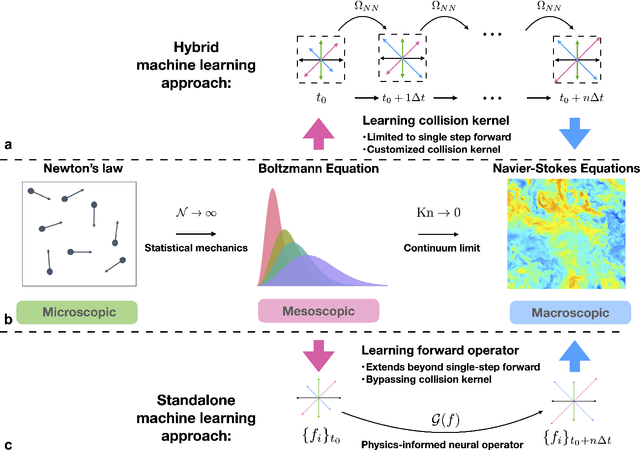
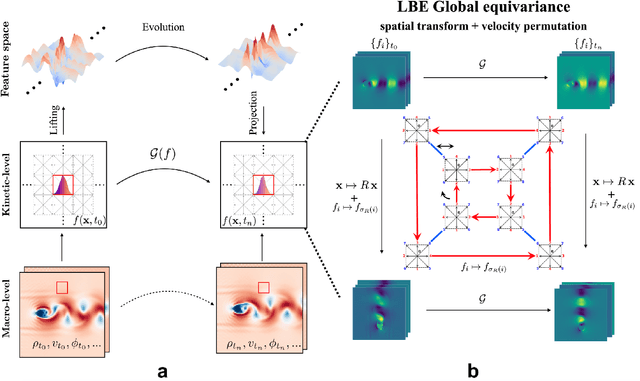
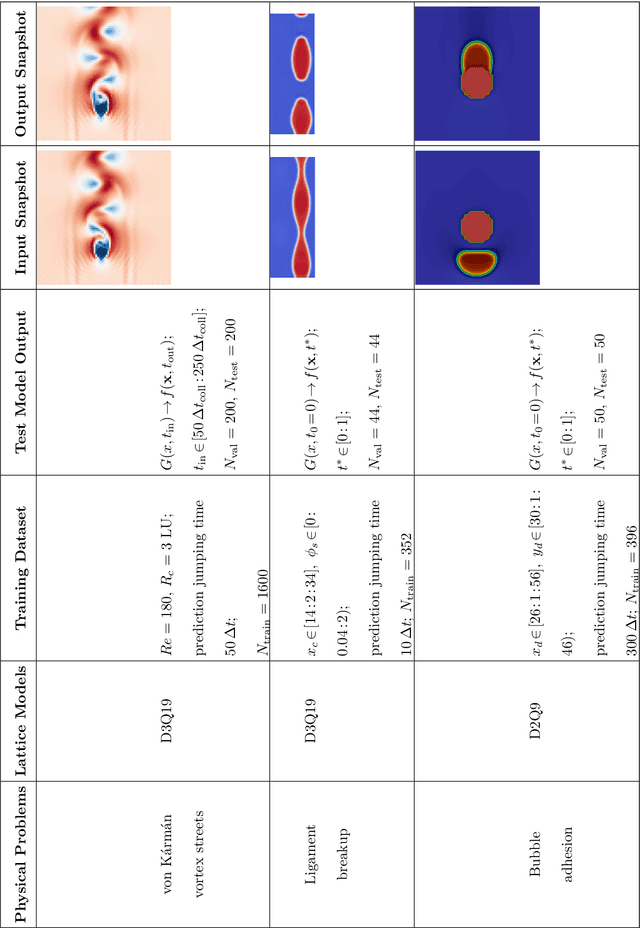
The lattice Boltzmann equation (LBE), rooted in kinetic theory, provides a powerful framework for capturing complex flow behaviour by describing the evolution of single-particle distribution functions (PDFs). Despite its success, solving the LBE numerically remains computationally intensive due to strict time-step restrictions imposed by collision kernels. Here, we introduce a physics-informed neural operator framework for the LBE that enables prediction over large time horizons without step-by-step integration, effectively bypassing the need to explicitly solve the collision kernel. We incorporate intrinsic moment-matching constraints of the LBE, along with global equivariance of the full distribution field, enabling the model to capture the complex dynamics of the underlying kinetic system. Our framework is discretization-invariant, enabling models trained on coarse lattices to generalise to finer ones (kinetic super-resolution). In addition, it is agnostic to the specific form of the underlying collision model, which makes it naturally applicable across different kinetic datasets regardless of the governing dynamics. Our results demonstrate robustness across complex flow scenarios, including von Karman vortex shedding, ligament breakup, and bubble adhesion. This establishes a new data-driven pathway for modelling kinetic systems.