 Add to Chrome
 Add to Firefox
 Add to Edge
Online Monitoring and Corrective Steering of Programming Agents
Aug 07, 2026
Fixing GitHub issues in large-scale projects is a long-horizon task, especially when a fix requires changes across multiple locations or the issue description lacks the information needed to localize and repair it. As a result, agents traverse long trajectories that are prone to inefficiency and error: they drift away from their intended plan, repeat failed actions, or terminate without a working patch. This paper proposes LivePlan to monitor, detect, and correct such behavioral inefficiencies and drifts in real time. LivePlan decouples judging from advising: a deterministic, rule-based monitor examines general signals over the trajectory to detect issues without invoking an LLM, and only when an issue is detected does it consult an advisor LLM for a high-level, next-step correction. This design avoids the misleading re-planning and costly interventions of prior approaches. We implement LivePlan on top of SWE-agent and evaluate it using five LLMs (three as executor agents and two as advisors) across SWE-bench Verified and SWE-bench Pro. Compared to vanilla SWE-agent, LivePlan notably improves issue resolution rates, achieving consistent gains of up to 15.2% (average: 9.9%), while incurring only an additional cost of $0.08 per instance. The additional solutions concentrate on medium and hard instances. LivePlan consistently outperforms alternative approaches in resolution rate, with minimal regression on already successful runs and new successes on problems that no baseline solves.

PerfAgent: Profiler-Guided Iterative Refinement for Repository-Level Code Optimization
Jul 22, 2026Large language model (LLM) agents now perform well on correctness-oriented repository-level tasks, including SWE-Bench issue resolution and feature implementation in real codebases. However, they still struggle with repository-level code optimization, which requires preserving behavior while improving runtime performance. Passing tests is not enough in this setting; a patch must preserve behavior, implement code optimization, and approach expert speedups. Current agents often miss bottlenecks hidden behind abstraction layers and native extensions, stop after shallow speedups, or insufficiently test the code patches that thus may silently break edge cases. We present PerfAgent, a profiler-guided, verifier-in-the-loop workflow that gives an off-the-shelf coding agent the feedback needed to find real hotspots, improve beyond the first passing patch, and use profiler evidence rather than timing alone to decide what to optimize next. On two challenging optimization benchmarks, GSO and SWE-fficiency-Lite, PerfAgent more than doubles the rate of expert-matching patches over OpenHands with GPT-5.1, improving from 19.6% to 39.2% on GSO and from 26% to 74% on SWE-fficiency-Lite. It also surpasses an oracle best-of-five baseline at substantially lower cost, showing that the gains come from better feedback rather than additional test-time sampling.
EvoOtter: Evolutionary Reproduction Test Generator
Jul 03, 2026Before fixing an issue, it is useful to first reproduce it by generating a bug reproduction test (BRT). However, generating a BRT is itself a challenging task, because issue descriptions tend to be informal, making it difficult to determine whether a candidate BRT indeed fails for the reason in the issue. Prior work has attempted to tackle this problem via inference scaling, using large language models to generate many BRTs and patches, then using execution feedback to select and improve them. Unfortunately, this is expensive and the feedback is unreliable. This paper explores evolutionary programming for BRT generation to sharpen the feedback, while enhancing evolutionary programming to keep costs in check. Our new approach, EvoOtter, controls test execution costs via successive halving. Furthermore, it controls LLM costs via batched crossover for an entire generation in a single LLM call, as well as via rule-based code mutations, with a new fitness score tailored for BRTs. As a result, EvoOtter generates state-of-the-art quality BRTs at the fraction of the cost of prior inference-scaling approaches to this problem. More broadly, this paper points at how to efficiently and effectively combine evolutionary programming with large language models for software engineering.
Every Eval Ever: A Unifying Schema and Community Repository for AI Evaluation Results
Jun 12, 2026AI evaluations are widely used for testing and understanding progress. However, the diverse evaluators bring with them inconsistencies that challenge analysis and comparison. First, results are saved in incompatible formats, scattered across leaderboards, papers, blog posts, evaluation harness logs, and custom repositories. Second, results are created by different evaluation frameworks, which produce divergent scores for nominally identical evaluations and record metadata inconsistently, hindering comparison, cross-community evaluation science, cost reduction, and reuse. We introduce Every Eval Ever, the first shared schema and community-crowdsourced repository for AI evaluation results. The schema standardizes how evaluations are represented in a unified, single JSON document. It is source-agnostic by design, ingesting results from evaluation harnesses and papers alike, and optionally stores per-instance outputs for fine-grained analysis. We contribute: (i) a community-governed metadata schema with a companion instance-level schema, the first standardization effort of its kind; (ii) automatic converters from popular formats, evaluation harnesses, and leaderboards to the unified schema; and (iii) a crowdsourced community database hosted on Hugging Face, currently spanning to date 22,235 models, 2,273 unique benchmarks, and 31 evaluation formats.
From Plan to Action: How Well Do Agents Follow the Plan?
Apr 13, 2026Agents aspire to eliminate the need for task-specific prompt crafting through autonomous reason-act-observe loops. Still, they are commonly instructed to follow a task-specific plan for guidance, e.g., to resolve software issues following phases for navigation, reproduction, patch, and validation. Unfortunately, it is unknown to what extent agents actually follow such instructed plans. Without such an analysis, determining the extent agents comply with a given plan, it is impossible to assess whether a solution was reached through correct strategic reasoning or through other means, e.g., data contamination or overfitting to a benchmark. This paper presents the first extensive, systematic analysis of plan compliance in programming agents, examining 16,991 trajectories from SWE-agent across four LLMs on SWE-bench Verified and SWE-bench Pro under eight plan variations. Without an explicit plan, agents fall back on workflows internalized during training, which are often incomplete, overfit, or inconsistently applied. Providing the standard plan improves issue resolution, and we observe that periodic plan reminders can mitigate plan violations and improve task success. A subpar plan hurts performance even more than no plan at all. Surprisingly, augmenting a plan with additional task-relevant phases in the early stage can degrade performance, particularly when these phases do not align with the model's internal problem-solving strategy. These findings highlight a research gap: fine-tuning paradigms that teach models to follow instructed plans, rather than encoding task-specific plans in them. This requires teaching models to reason and act adaptively, rather than memorizing workflows.
Resolving Java Code Repository Issues with iSWE Agent
Mar 11, 2026Resolving issues on code repositories is an important part of software engineering. Various recent systems automatically resolve issues using large language models and agents, often with impressive performance. Unfortunately, most of these models and agents focus primarily on Python, and their performance on other programming languages is lower. In particular, a lot of enterprise software is written in Java, yet automated issue resolution for Java is under-explored. This paper introduces iSWE Agent, an automated issue resolver with an emphasis on Java. It consists of two sub-agents, one for localization and the other for editing. Both have access to novel tools based on rule-based Java static analysis and transformation. Using this approach, iSWE achieves state-of-the-art issue resolution rates across the Java splits of both Multi-SWE-bench and SWE-PolyBench. More generally, we hope that by combining the best of rule-based and model-based techniques, this paper contributes towards improving enterprise software development.
Otter: Generating Tests from Issues to Validate SWE Patches
Feb 07, 2025While there has been plenty of work on generating tests from existing code, there has been limited work on generating tests from issues. A correct test must validate the code patch that resolves the issue. In this work, we focus on the scenario where the code patch does not exist yet. This approach supports two major use-cases. First, it supports TDD (test-driven development), the discipline of "test first, write code later" that has well-documented benefits for human software engineers. Second, it also validates SWE (software engineering) agents, which generate code patches for resolving issues. This paper introduces Otter, an LLM-based solution for generating tests from issues. Otter augments LLMs with rule-based analysis to check and repair their outputs, and introduces a novel self-reflective action planning stage. Experiments show Otter outperforming state-of-the-art systems for generating tests from issues, in addition to enhancing systems that generate patches from issues. We hope that Otter helps make developers more productive at resolving issues and leads to more robust, well-tested code.
Structured Chain-of-Thought Prompting for Few-Shot Generation of Content-Grounded QA Conversations
Feb 20, 2024
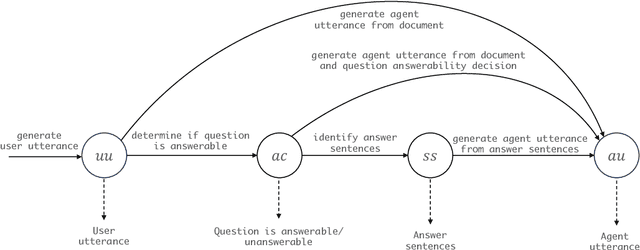


We introduce a structured chain-of-thought (SCoT) prompting approach to generating content-grounded multi-turn question-answer conversations using a pre-trained large language model (LLM). At the core of our proposal is a structured breakdown of the complex task into a number of states in a state machine, so that actions corresponding to various subtasks, e.g., content reading and utterance generation, can be executed in their own dedicated states. Each state leverages a unique set of resources including prompts and (optionally) additional tools to augment the generation process. Our experimental results show that SCoT prompting with designated states for hallucination mitigation increases agent faithfulness to grounding documents by up to 16.8%. When used as training data, our open-domain conversations synthesized from only 6 Wikipedia-based seed demonstrations train strong conversational QA agents; in out-of-domain evaluation, for example, we observe improvements of up to 13.9% over target domain gold data when the latter is augmented with our generated examples.
Evaluating Robustness of Dialogue Summarization Models in the Presence of Naturally Occurring Variations
Nov 15, 2023


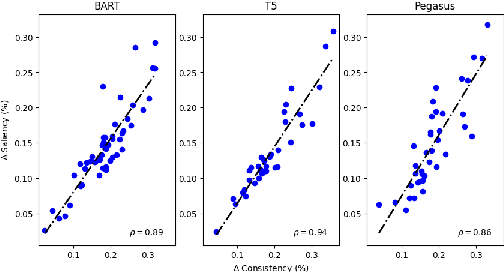
Dialogue summarization task involves summarizing long conversations while preserving the most salient information. Real-life dialogues often involve naturally occurring variations (e.g., repetitions, hesitations) and existing dialogue summarization models suffer from performance drop on such conversations. In this study, we systematically investigate the impact of such variations on state-of-the-art dialogue summarization models using publicly available datasets. To simulate real-life variations, we introduce two types of perturbations: utterance-level perturbations that modify individual utterances with errors and language variations, and dialogue-level perturbations that add non-informative exchanges (e.g., repetitions, greetings). We conduct our analysis along three dimensions of robustness: consistency, saliency, and faithfulness, which capture different aspects of the summarization model's performance. We find that both fine-tuned and instruction-tuned models are affected by input variations, with the latter being more susceptible, particularly to dialogue-level perturbations. We also validate our findings via human evaluation. Finally, we investigate if the robustness of fine-tuned models can be improved by training them with a fraction of perturbed data and observe that this approach is insufficient to address robustness challenges with current models and thus warrants a more thorough investigation to identify better solutions. Overall, our work highlights robustness challenges in dialogue summarization and provides insights for future research.
Towards End-to-End Integration of Dialog History for Improved Spoken Language Understanding
Apr 11, 2022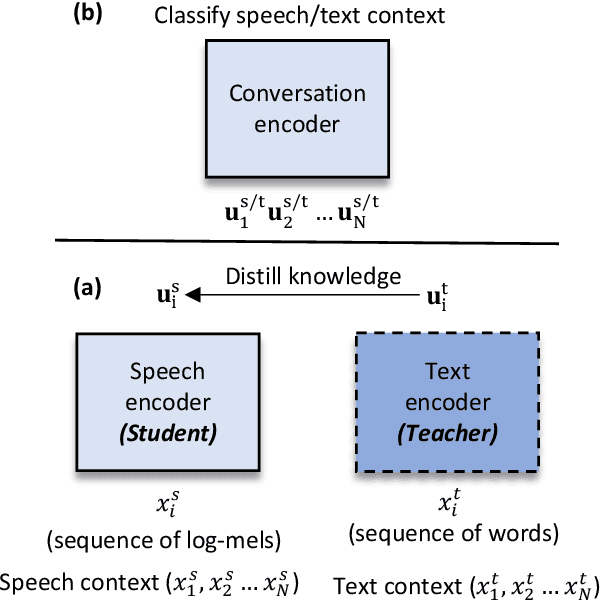
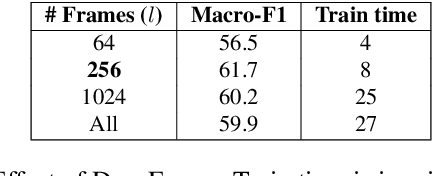
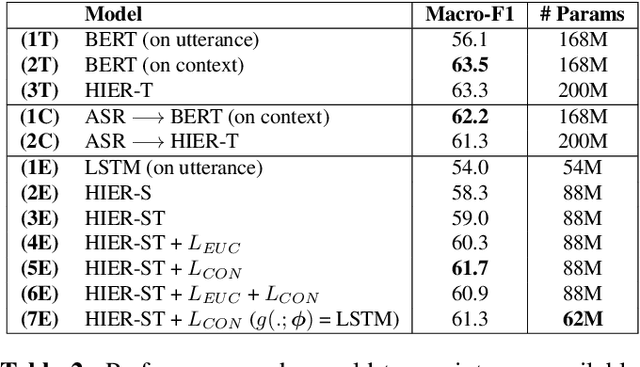
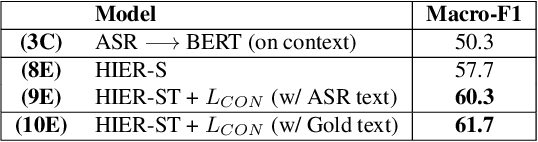
Dialog history plays an important role in spoken language understanding (SLU) performance in a dialog system. For end-to-end (E2E) SLU, previous work has used dialog history in text form, which makes the model dependent on a cascaded automatic speech recognizer (ASR). This rescinds the benefits of an E2E system which is intended to be compact and robust to ASR errors. In this paper, we propose a hierarchical conversation model that is capable of directly using dialog history in speech form, making it fully E2E. We also distill semantic knowledge from the available gold conversation transcripts by jointly training a similar text-based conversation model with an explicit tying of acoustic and semantic embeddings. We also propose a novel technique that we call DropFrame to deal with the long training time incurred by adding dialog history in an E2E manner. On the HarperValleyBank dialog dataset, our E2E history integration outperforms a history independent baseline by 7.7% absolute F1 score on the task of dialog action recognition. Our model performs competitively with the state-of-the-art history based cascaded baseline, but uses 48% fewer parameters. In the absence of gold transcripts to fine-tune an ASR model, our model outperforms this baseline by a significant margin of 10% absolute F1 score.