 Add to Chrome
 Add to Firefox
 Add to Edge
PACT: Privileged Trace Co-Training for Multi-Turn Tool-Use Agents
Jun 15, 2026
Multi-turn tool-use agents must reason, call tools, and adapt to observations across several interaction turns. Post-training such agents is challenging, as reinforcement learning often suffers from sparse rewards and weak credit assignment despite matching the prompt-only inference setting, while supervised fine-tuning on expert traces provides dense process supervision but can over-constrain the model to fixed trajectories. To tackle this, we propose PACT, a Privileged trAce Co-Training framework for multi-turn tool-use agents. The key idea is to use expert traces only as training-time optimization signals rather than rollout-time hints. PACT keeps rollout generation prompt-only, then uses expert traces to guide optimization through two complementary signals: a trace-conditioned RL surrogate that evaluates prompt-only rollouts under expert-trace context, and a component-aware SFT loss that supervises reasoning prefixes and tool-calls with annealed strength. To reduce over-reliance on the training-only trace context, PACT further introduces a prompt-only anchoring. We also provide a latent-trace view that connects the two trace-based objectives and explains how expert traces can guide optimization without being used during rollout generation. Experiments on FTRL, BFCL, and ToolHop show that PACT consistently improves over strong SFT- and RL-based baselines, highlighting the value of privileged trace co-training for multi-turn tool-use learning.

ORACLE-SWE: Quantifying the Contribution of Oracle Information Signals on SWE Agents
Apr 09, 2026Recent advances in language model (LM) agents have significantly improved automated software engineering (SWE). Prior work has proposed various agentic workflows and training strategies as well as analyzed failure modes of agentic systems on SWE tasks, focusing on several contextual information signals: Reproduction Test, Regression Test, Edit Location, Execution Context, and API Usage. However, the individual contribution of each signal to overall success remains underexplored, particularly their ideal contribution when intermediate information is perfectly obtained. To address this gap, we introduce Oracle-SWE, a unified method to isolate and extract oracle information signals from SWE benchmarks and quantify the impact of each signal on agent performance. To further validate the pattern, we evaluate the performance gain of signals extracted by strong LMs when provided to a base agent, approximating real-world task-resolution settings. These evaluations aim to guide research prioritization for autonomous coding systems.
RepoLaunch: Automating Build&Test Pipeline of Code Repositories on ANY Language and ANY Platform
Mar 05, 2026Building software repositories typically requires significant manual effort. Recent advances in large language model (LLM) agents have accelerated automation in software engineering (SWE). We introduce RepoLaunch, the first agent capable of automatically resolving dependencies, compiling source code, and extracting test results for repositories across arbitrary programming languages and operating systems. To demonstrate its utility, we further propose a fully automated pipeline for SWE dataset creation, where task design is the only human intervention. RepoLaunch automates the remaining steps, enabling scalable benchmarking and training of coding agents and LLMs. Notably, several works on agentic benchmarking and training have recently adopted RepoLaunch for automated task generation.
MetaState: Persistent Working Memory for Discrete Diffusion Language Models
Mar 02, 2026Discrete diffusion language models (dLLMs) generate text by iteratively denoising a masked sequence. Compared with autoregressive models, this paradigm naturally supports parallel decoding, bidirectional context, and flexible generation patterns. However, standard dLLMs condition each denoising step only on the current hard-masked sequence, while intermediate continuous representations are discarded after sampling and remasking. We refer to this bottleneck as the \textbf{Information Island} problem. It leads to redundant recomputation across steps and can degrade cross-step consistency. We address this limitation with \textbf{MetaState}, a lightweight recurrent augmentation that equips a frozen dLLM backbone with a persistent, fixed-size working memory that remains independent of sequence length. \textbf{MetaState} consists of three trainable modules: a cross-attention Mixer that reads backbone activations into memory slots, a GRU-style Updater that integrates information across denoising steps, and a cross-attention Injector that feeds the updated memory back into backbone activations. We train these modules with $K$-step unrolling to expose them to multi-step denoising dynamics during fine-tuning. On LLaDA-8B and Dream-7B, \textbf{MetaState} introduces negligible trainable parameters while keeping the backbone frozen, and it consistently improves accuracy over frozen baselines. These results demonstrate that persistent cross-step memory is an effective mechanism for bridging denoising steps and improving generation quality in discrete diffusion language models.
Neural Network Verification with Branch-and-Bound for General Nonlinearities
May 31, 2024

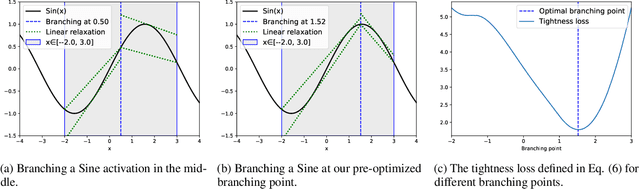

Branch-and-bound (BaB) is among the most effective methods for neural network (NN) verification. However, existing works on BaB have mostly focused on NNs with piecewise linear activations, especially ReLU networks. In this paper, we develop a general framework, named GenBaB, to conduct BaB for general nonlinearities in general computational graphs based on linear bound propagation. To decide which neuron to branch, we design a new branching heuristic which leverages linear bounds as shortcuts to efficiently estimate the potential improvement after branching. To decide nontrivial branching points for general nonlinear functions, we propose to optimize branching points offline, which can be efficiently leveraged during verification with a lookup table. We demonstrate the effectiveness of our GenBaB on verifying a wide range of NNs, including networks with activation functions such as Sigmoid, Tanh, Sine and GeLU, as well as networks involving multi-dimensional nonlinear operations such as multiplications in LSTMs and Vision Transformers. Our framework also allows the verification of general nonlinear computation graphs and enables verification applications beyond simple neural networks, particularly for AC Optimal Power Flow (ACOPF). GenBaB is part of the latest $\alpha,\!\beta$-CROWN, the winner of the 4th International Verification of Neural Networks Competition (VNN-COMP 2023).
Symmetry-Preserving Program Representations for Learning Code Semantics
Aug 07, 2023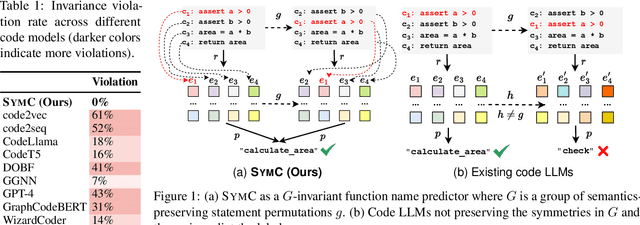
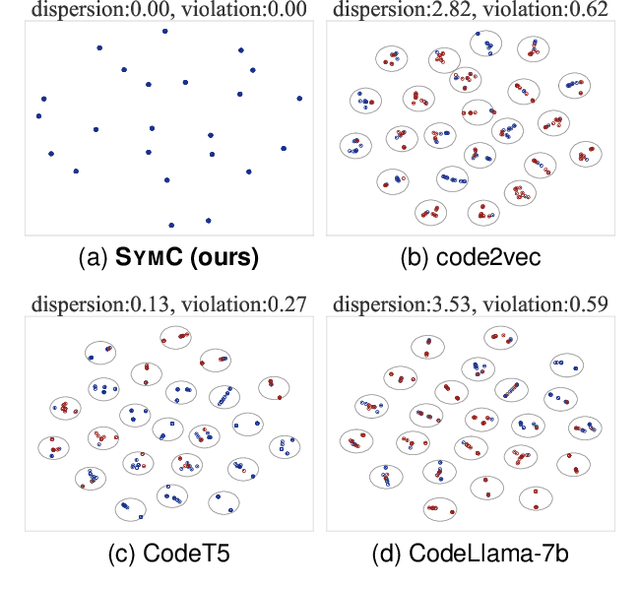
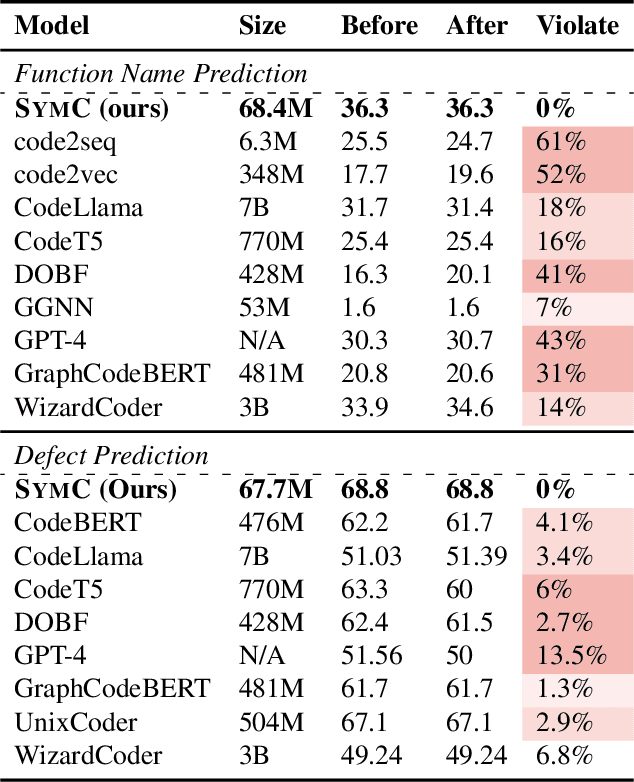
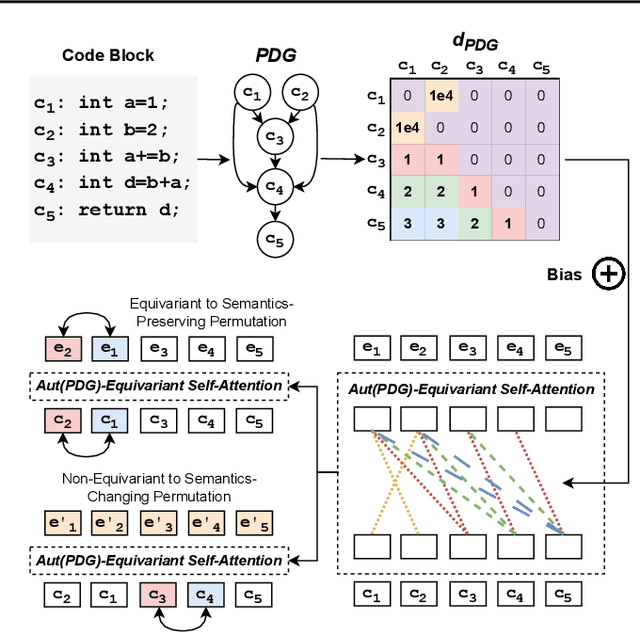
Large Language Models (LLMs) have shown promise in automated program reasoning, a crucial aspect of many security tasks. However, existing LLM architectures for code are often borrowed from other domains like natural language processing, raising concerns about their generalization and robustness to unseen code. A key generalization challenge is to incorporate the knowledge of code semantics, including control and data flow, into the LLM architectures. Drawing inspiration from examples of convolution layers exploiting translation symmetry, we explore how code symmetries can enhance LLM architectures for program analysis and modeling. We present a rigorous group-theoretic framework that formally defines code symmetries as semantics-preserving transformations and provides techniques for precisely reasoning about symmetry preservation within LLM architectures. Using this framework, we introduce a novel variant of self-attention that preserves program symmetries, demonstrating its effectiveness in generalization and robustness through detailed experimental evaluations across different binary and source code analysis tasks. Overall, our code symmetry framework offers rigorous and powerful reasoning techniques that can guide the future development of specialized LLMs for code and advance LLM-guided program reasoning tasks.