 Add to Chrome
 Add to Firefox
 Add to Edge
Spatial-Temporal Transformer based Video Compression Framework
Sep 21, 2023
Learned video compression (LVC) has witnessed remarkable advancements in recent years. Similar as the traditional video coding, LVC inherits motion estimation/compensation, residual coding and other modules, all of which are implemented with neural networks (NNs). However, within the framework of NNs and its training mechanism using gradient backpropagation, most existing works often struggle to consistently generate stable motion information, which is in the form of geometric features, from the input color features. Moreover, the modules such as the inter-prediction and residual coding are independent from each other, making it inefficient to fully reduce the spatial-temporal redundancy. To address the above problems, in this paper, we propose a novel Spatial-Temporal Transformer based Video Compression (STT-VC) framework. It contains a Relaxed Deformable Transformer (RDT) with Uformer based offsets estimation for motion estimation and compensation, a Multi-Granularity Prediction (MGP) module based on multi-reference frames for prediction refinement, and a Spatial Feature Distribution prior based Transformer (SFD-T) for efficient temporal-spatial joint residual compression. Specifically, RDT is developed to stably estimate the motion information between frames by thoroughly investigating the relationship between the similarity based geometric motion feature extraction and self-attention. MGP is designed to fuse the multi-reference frame information by effectively exploring the coarse-grained prediction feature generated with the coded motion information. SFD-T is to compress the residual information by jointly exploring the spatial feature distributions in both residual and temporal prediction to further reduce the spatial-temporal redundancy. Experimental results demonstrate that our method achieves the best result with 13.5% BD-Rate saving over VTM.

MOFA: A Model Simplification Roadmap for Image Restoration on Mobile Devices
Aug 24, 2023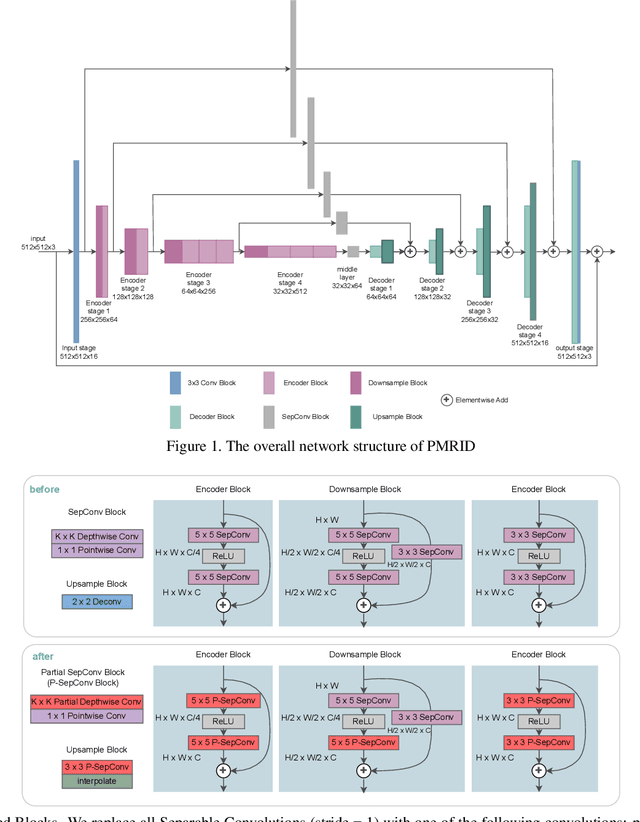
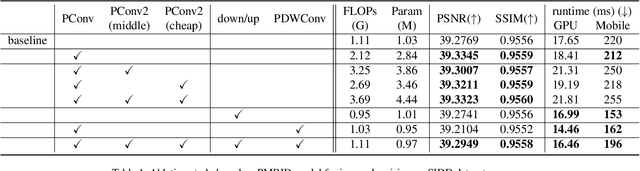
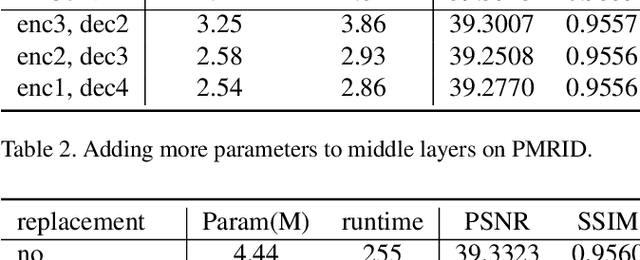

Image restoration aims to restore high-quality images from degraded counterparts and has seen significant advancements through deep learning techniques. The technique has been widely applied to mobile devices for tasks such as mobile photography. Given the resource limitations on mobile devices, such as memory constraints and runtime requirements, the efficiency of models during deployment becomes paramount. Nevertheless, most previous works have primarily concentrated on analyzing the efficiency of single modules and improving them individually. This paper examines the efficiency across different layers. We propose a roadmap that can be applied to further accelerate image restoration models prior to deployment while simultaneously increasing PSNR (Peak Signal-to-Noise Ratio) and SSIM (Structural Similarity Index). The roadmap first increases the model capacity by adding more parameters to partial convolutions on FLOPs non-sensitive layers. Then, it applies partial depthwise convolution coupled with decoupling upsampling/downsampling layers to accelerate the model speed. Extensive experiments demonstrate that our approach decreases runtime by up to 13% and reduces the number of parameters by up to 23%, while increasing PSNR and SSIM on several image restoration datasets. Source Code of our method is available at \href{https://github.com/xiangyu8/MOFA}{https://github.com/xiangyu8/MOFA}.
DPMAC: Differentially Private Communication for Cooperative Multi-Agent Reinforcement Learning
Aug 19, 2023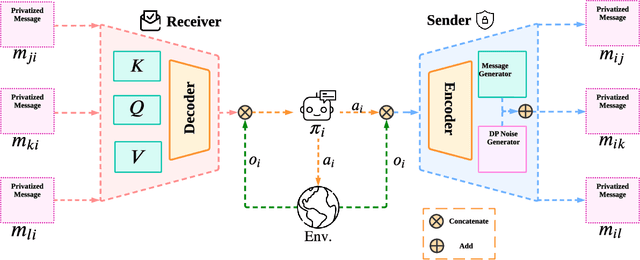
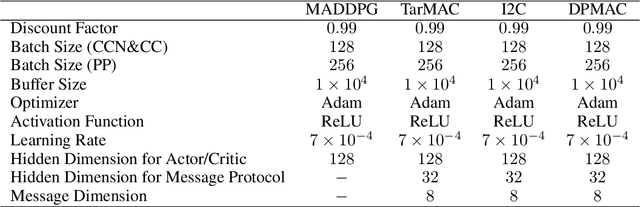
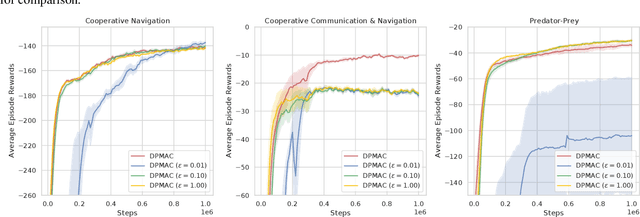
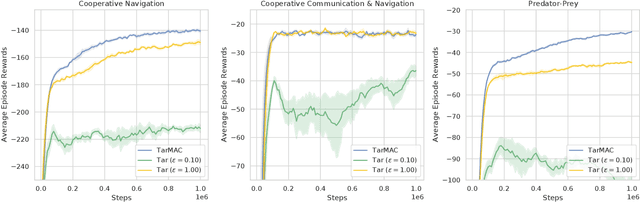
Communication lays the foundation for cooperation in human society and in multi-agent reinforcement learning (MARL). Humans also desire to maintain their privacy when communicating with others, yet such privacy concern has not been considered in existing works in MARL. To this end, we propose the \textit{differentially private multi-agent communication} (DPMAC) algorithm, which protects the sensitive information of individual agents by equipping each agent with a local message sender with rigorous $(\epsilon, \delta)$-differential privacy (DP) guarantee. In contrast to directly perturbing the messages with predefined DP noise as commonly done in privacy-preserving scenarios, we adopt a stochastic message sender for each agent respectively and incorporate the DP requirement into the sender, which automatically adjusts the learned message distribution to alleviate the instability caused by DP noise. Further, we prove the existence of a Nash equilibrium in cooperative MARL with privacy-preserving communication, which suggests that this problem is game-theoretically learnable. Extensive experiments demonstrate a clear advantage of DPMAC over baseline methods in privacy-preserving scenarios.
Disentangled Counterfactual Reasoning for Unbiased Sequential Recommendation
Aug 05, 2023Sequential recommender systems have achieved state-of-the-art recommendation performance by modeling the sequential dynamics of user activities. However, in most recommendation scenarios, the popular items comprise the major part of the previous user actions. Therefore, the learned models are biased towards the popular items irrespective of the user's real interests. In this paper, we propose a structural causal model-based method to address the popularity bias issue for sequential recommendation model learning. For more generalizable modeling, we disentangle the popularity and interest representations at both the item side and user context side. Based on the disentangled representation, we identify a more effective structural causal graph for general recommendation applications. Then, we design delicate sequential models to apply the aforementioned causal graph to the sequential recommendation scenario for unbiased prediction with counterfactual reasoning. Furthermore, we conduct extensive offline experiments and online A/B tests to verify the proposed \textbf{DCR} (Disentangled Counterfactual Reasoning) method's superior overall performance and understand the effectiveness of the various introduced components. Based on our knowledge, this is the first structural causal model specifically designed for the popularity bias correction of sequential recommendation models, which achieves significant performance gains over the existing methods.
Player-optimal Stable Regret for Bandit Learning in Matching Markets
Jul 20, 2023The problem of matching markets has been studied for a long time in the literature due to its wide range of applications. Finding a stable matching is a common equilibrium objective in this problem. Since market participants are usually uncertain of their preferences, a rich line of recent works study the online setting where one-side participants (players) learn their unknown preferences from iterative interactions with the other side (arms). Most previous works in this line are only able to derive theoretical guarantees for player-pessimal stable regret, which is defined compared with the players' least-preferred stable matching. However, under the pessimal stable matching, players only obtain the least reward among all stable matchings. To maximize players' profits, player-optimal stable matching would be the most desirable. Though \citet{basu21beyond} successfully bring an upper bound for player-optimal stable regret, their result can be exponentially large if players' preference gap is small. Whether a polynomial guarantee for this regret exists is a significant but still open problem. In this work, we provide a new algorithm named explore-then-Gale-Shapley (ETGS) and show that the optimal stable regret of each player can be upper bounded by $O(K\log T/\Delta^2)$ where $K$ is the number of arms, $T$ is the horizon and $\Delta$ is the players' minimum preference gap among the first $N+1$-ranked arms. This result significantly improves previous works which either have a weaker player-pessimal stable matching objective or apply only to markets with special assumptions. When the preferences of participants satisfy some special conditions, our regret upper bound also matches the previously derived lower bound.
InfoPrompt: Information-Theoretic Soft Prompt Tuning for Natural Language Understanding
Jun 08, 2023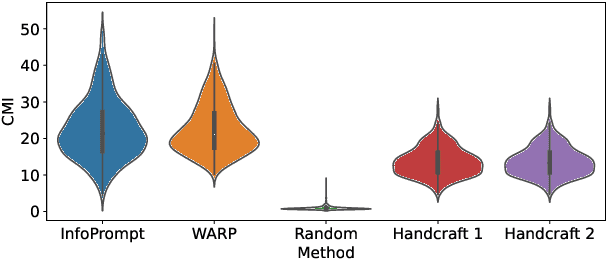


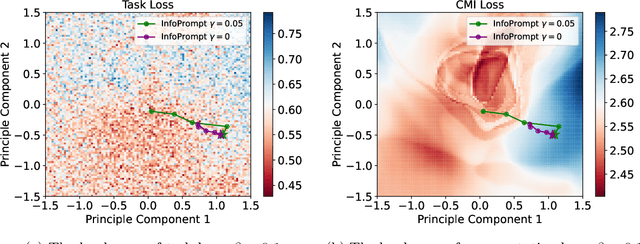
Soft prompt tuning achieves superior performances across a wide range of few-shot tasks. However, the performances of prompt tuning can be highly sensitive to the initialization of the prompts. We also empirically observe that conventional prompt tuning methods cannot encode and learn sufficient task-relevant information from prompt tokens. In this work, we develop an information-theoretic framework that formulates soft prompt tuning as maximizing mutual information between prompts and other model parameters (or encoded representations). This novel view helps us to develop a more efficient, accurate and robust soft prompt tuning method InfoPrompt. With this framework, we develop two novel mutual information based loss functions, to (i) discover proper prompt initialization for the downstream tasks and learn sufficient task-relevant information from prompt tokens and (ii) encourage the output representation from the pretrained language model to be more aware of the task-relevant information captured in the learnt prompt. Extensive experiments validate that InfoPrompt can significantly accelerate the convergence of the prompt tuning and outperform traditional prompt tuning methods. Finally, we provide a formal theoretical result for showing to show that gradient descent type algorithm can be used to train our mutual information loss.
Future-conditioned Unsupervised Pretraining for Decision Transformer
May 26, 2023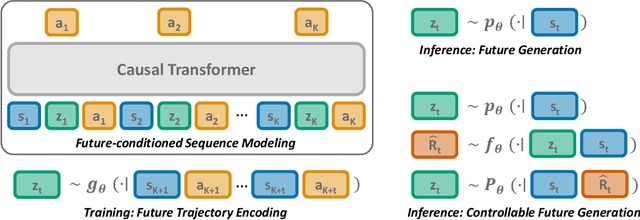
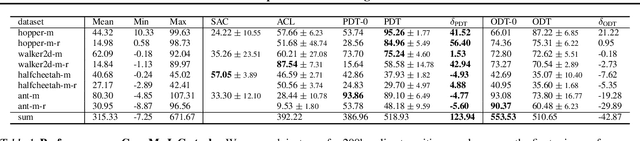
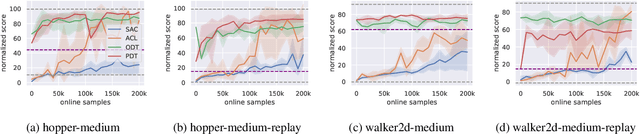
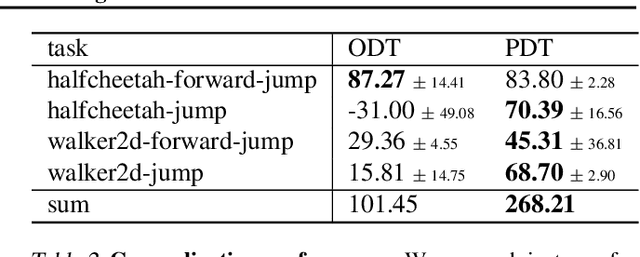
Recent research in offline reinforcement learning (RL) has demonstrated that return-conditioned supervised learning is a powerful paradigm for decision-making problems. While promising, return conditioning is limited to training data labeled with rewards and therefore faces challenges in learning from unsupervised data. In this work, we aim to utilize generalized future conditioning to enable efficient unsupervised pretraining from reward-free and sub-optimal offline data. We propose Pretrained Decision Transformer (PDT), a conceptually simple approach for unsupervised RL pretraining. PDT leverages future trajectory information as a privileged context to predict actions during training. The ability to make decisions based on both present and future factors enhances PDT's capability for generalization. Besides, this feature can be easily incorporated into a return-conditioned framework for online finetuning, by assigning return values to possible futures and sampling future embeddings based on their respective values. Empirically, PDT outperforms or performs on par with its supervised pretraining counterpart, especially when dealing with sub-optimal data. Further analysis reveals that PDT can extract diverse behaviors from offline data and controllably sample high-return behaviors by online finetuning. Code is available at here.
Adversarial Attacks on Online Learning to Rank with Click Feedback
May 26, 2023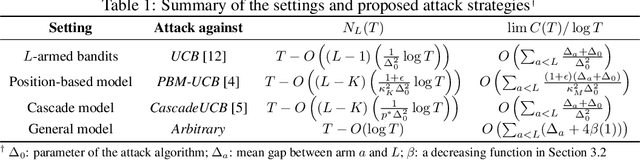
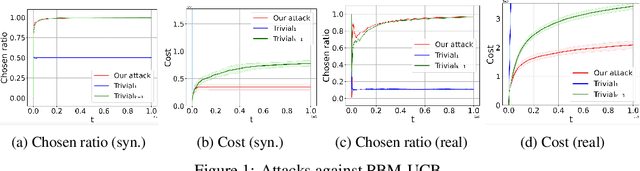
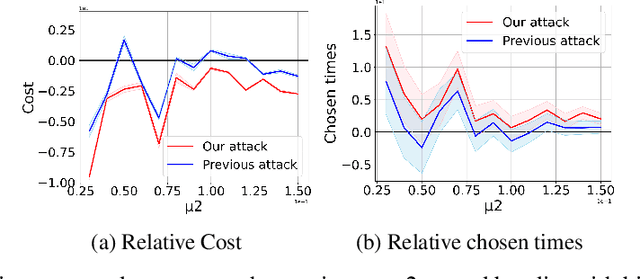
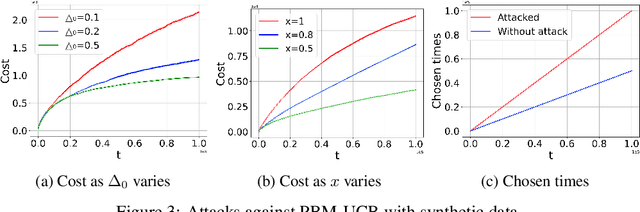
Online learning to rank (OLTR) is a sequential decision-making problem where a learning agent selects an ordered list of items and receives feedback through user clicks. Although potential attacks against OLTR algorithms may cause serious losses in real-world applications, little is known about adversarial attacks on OLTR. This paper studies attack strategies against multiple variants of OLTR. Our first result provides an attack strategy against the UCB algorithm on classical stochastic bandits with binary feedback, which solves the key issues caused by bounded and discrete feedback that previous works can not handle. Building on this result, we design attack algorithms against UCB-based OLTR algorithms in position-based and cascade models. Finally, we propose a general attack strategy against any algorithm under the general click model. Each attack algorithm manipulates the learning agent into choosing the target attack item $T-o(T)$ times, incurring a cumulative cost of $o(T)$. Experiments on synthetic and real data further validate the effectiveness of our proposed attack algorithms.
Online Influence Maximization under Decreasing Cascade Model
May 19, 2023
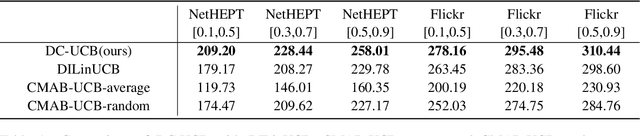
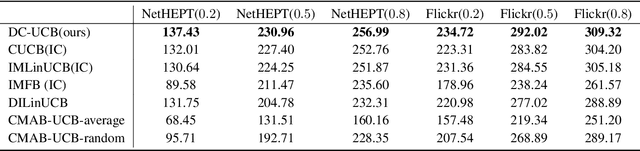
We study online influence maximization (OIM) under a new model of decreasing cascade (DC). This model is a generalization of the independent cascade (IC) model by considering the common phenomenon of market saturation. In DC, the chance of an influence attempt being successful reduces with previous failures. The effect is neglected by previous OIM works under IC and linear threshold models. We propose the DC-UCB algorithm to solve this problem, which achieves a regret bound of the same order as the state-of-the-art works on the IC model. Extensive experiments on both synthetic and real datasets show the effectiveness of our algorithm.
Large-Scale Package Manipulation via Learned Metrics of Pick Success
May 17, 2023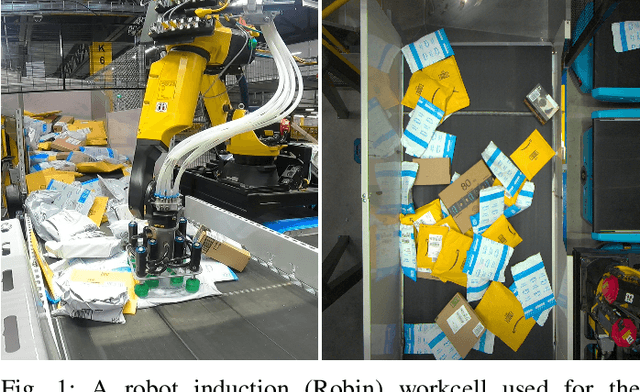
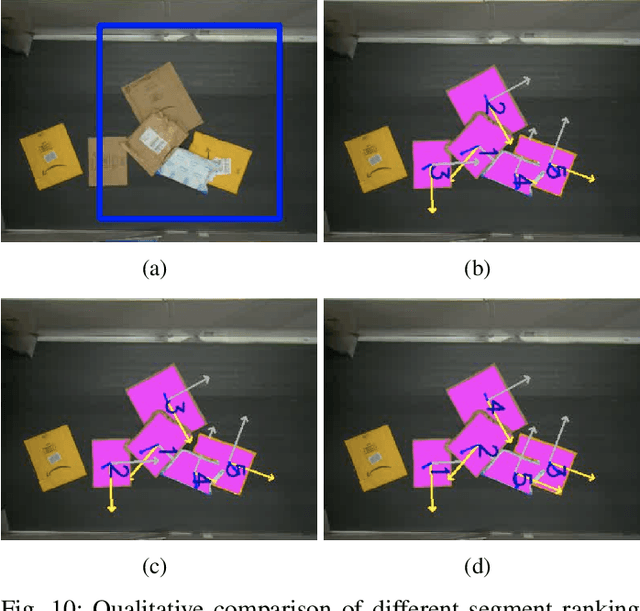
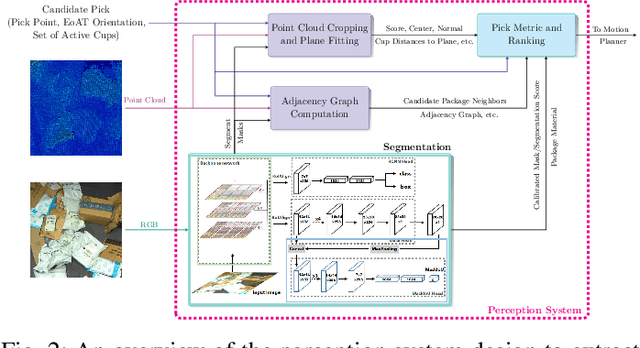
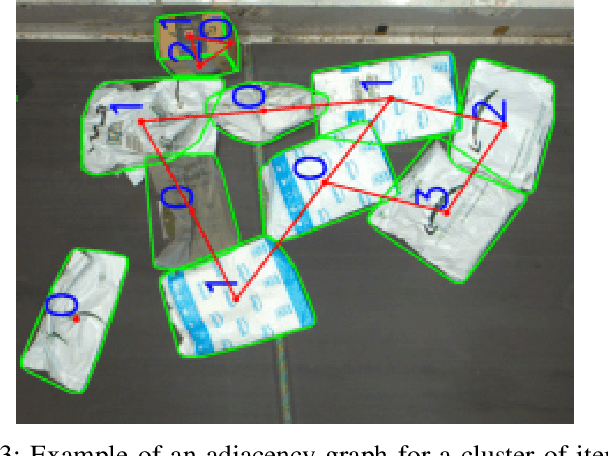
Automating warehouse operations can reduce logistics overhead costs, ultimately driving down the final price for consumers, increasing the speed of delivery, and enhancing the resiliency to workforce fluctuations. The past few years have seen increased interest in automating such repeated tasks but mostly in controlled settings. Tasks such as picking objects from unstructured, cluttered piles have only recently become robust enough for large-scale deployment with minimal human intervention. This paper demonstrates a large-scale package manipulation from unstructured piles in Amazon Robotics' Robot Induction (Robin) fleet, which utilizes a pick success predictor trained on real production data. Specifically, the system was trained on over 394K picks. It is used for singulating up to 5~million packages per day and has manipulated over 200~million packages during this paper's evaluation period. The developed learned pick quality measure ranks various pick alternatives in real-time and prioritizes the most promising ones for execution. The pick success predictor aims to estimate from prior experience the success probability of a desired pick by the deployed industrial robotic arms in cluttered scenes containing deformable and rigid objects with partially known properties. It is a shallow machine learning model, which allows us to evaluate which features are most important for the prediction. An online pick ranker leverages the learned success predictor to prioritize the most promising picks for the robotic arm, which are then assessed for collision avoidance. This learned ranking process is demonstrated to overcome the limitations and outperform the performance of manually engineered and heuristic alternatives. To the best of the authors' knowledge, this paper presents the first large-scale deployment of learned pick quality estimation methods in a real production system.