 Add to Chrome
 Add to Firefox
 Add to Edge
Exploiting Intrinsic Duality for Multi-Hop Question Generation
Aug 01, 2026
Multi hop question generation (MQG) aims to generate questions from multiple given documents and target answers, whereas question answering (QA) focuses on deriving answers from documents given specific questions. Although MQG and QA are inherently dual tasks, most existing MQG studies largely overlook this intrinsic duality. To address this limitation, we propose QQ, a novel framework that exploits the duality between Question and answer for multi hop Question generation. Specifically, QQ employs a unified architecture functioning simultaneously as both an MQG and a QA model to fully leverage their interdependence. Our framework is driven by two key mechanisms: (i) enforcing bidirectional alignment constraints to ensure strict mutual correspondence between the questions generated by the MQG model and the answers produced by the QA model; and (ii) applying contrastive learning to pull paired question answer representations closer while pushing unpaired ones apart, thereby reinforcing this correspondence. Extensive automatic and human evaluations on the HotpotQA and MuSiQue datasets demonstrate that the QQ framework significantly improves the quality of generated multi hop questions.

A Unified Algorithmic Framework for Hybrid Reinforcement Learning in Tabular MDPs with Shifted Transition Dynamics
Jul 28, 2026This paper investigates a hybrid reinforcement learning setting in tabular Markov Decision Processes (MDPs), where an agent aims to learn an optimal policy by combining online interactions with a target environment and offline data from a source environment. A central challenge is that offline data may be collected from outdated environments with shifted transition dynamics, making naive integration of historical data ineffective. To address this, we propose a unified algorithmic framework featuring two algorithms: MIN-UCB-VI for regret minimization and MAX-LCB-VI for best policy identification. Both algorithms leverage fine-grained bias information to more effectively exploit offline data under general transition shifts. We provide theoretical guarantees for our framework, including both instance-dependent and independent upper bounds on regret and sub-optimality gap. Furthermore, we establish matching lower bounds to demonstrate the optimality of our approach and validate our theoretical findings through extensive experiments.
ESC-Skills: Discovering and Self-Evolving Skills for Emotional Support Conversations
May 27, 2026Existing emotional support conversation (ESC) systems mainly rely on end-to-end response generation or coarse strategy supervision, offering limited interpretability and little support for systematic skill improvement. We propose ESC-Skills, a skill-centric framework that discovers and self-evolves executable emotional support skills. We first model localized support interactions as Intervention Units (IUs), which capture state--action--outcome dynamics between seeker states, support interventions, and post-response emotional changes. Based on IUs extracted from both successful and failed ESC dialogues, we construct the ESC-Skills Bank, a repository of executable emotional support skills containing intervention guidance, applicability conditions, expected outcomes, and potential risks. To further improve robustness, we introduce a multi-profile self-evolutionary refinement framework in which an ESC agent interacts with diverse simulated seeker profiles under SAGE evaluation. The resulting interaction traces are analyzed to identify missing skills, unsafe interventions, and profile-specific failure patterns, which are then used to refine the Skills Bank through simulation-based verification. Experimental results demonstrate that ESC-Skills improves both response-level quality and dialogue-level emotional outcomes while providing more interpretable and controllable support behaviors. We will release the code, prompts, and ESC-Skills Bank at https://github.com/aliyun/qwen-dianjin.
A Regret Perspective on Online Multiple Testing
May 13, 2026Online Multiple Testing (OMT), a fundamental pillar of sequential statistical inference, traditionally evaluates the False Discovery Rate (FDR) and statistical power in isolation, obscuring the highly asymmetric costs of false positives and false negatives in modern automated pipelines. To unify this evaluation, we introduce $\textit{Weighted Regret}$. Under this metric, we prove the $\textit{Duality of Regret Conservation}$: purely deterministic procedures ensuring strict FDR control inevitably incur an $Ω(T)$ linear regret penalty, as threshold depletion during signal-sparse cold starts forces massive false negatives. Tailored for exogenous testing streams, we propose Decoupled-OMT (DOMT) as a baseline-agnostic meta-wrapper. By incorporating a history-decoupled, strictly non-negative random perturbation, DOMT rescues purely deterministic baselines from severe threshold depletion. Crucially, it preserves exact asymptotic safety in stationary environments and rigorously bounds finite-sample error inflation during cold-starts. Guaranteeing zero additional false negatives, it yields an order-optimal $Ω(\sqrt{T})$ regret reduction in bursty environments, with a derived ``Cold-Start Tax'' characterizing the exact phase transition of algorithmic superiority. Experiments validate that DOMT consistently curtails empirical weighted regret, achieving an order-optimal sublinear mitigation of threshold depletion to navigate the non-stationary Pareto frontier.
Enhancing Target-Guided Proactive Dialogue Systems via Conversational Scenario Modeling and Intent-Keyword Bridging
May 12, 2026A target-guided proactive dialogue system aims to steer conversations proactively toward pre-defined targets, such as designated keywords or specific topics. During guided conversations, dynamically modeling conversational scenarios and intent keywords to guide system utterance generation is beneficial; however, existing work largely overlooks this aspect, resulting in a mismatch with the dynamics of real-world conversations. In this paper, we jointly model user profiles and domain knowledge as conversational scenarios to introduce a scenario bias that dynamically influences system utterances, and employ intent-keyword bridging to predict intent keywords for upcoming dialogue turns, providing higher level and more flexible guidance. Extensive automatic and human evaluations demonstrate the effectiveness of conversational scenario modeling and intent keyword bridging, yielding substantial improvements in proactivity, fluency, and informativeness for target-guided proactive dialogue systems, thereby narrowing the gap with real world interactions.
Sample-Mean Anchored Thompson Sampling for Offline-to-Online Learning with Distribution Shift
May 11, 2026Offline-to-online learning aims to improve online decision-making by leveraging offline logged data. A central challenge in this setting is the distribution shift between offline and online environments. While some existing works attempt to leverage shifted offline data, they largely rely on UCB-type algorithms. Thompson sampling (TS) represents another canonical class of bandit algorithms, well known for its strong empirical performance and naturally suited to offline-to-online learning through its Bayesian formulation. However, unlike UCB indices, posterior samples in TS are not guaranteed to be optimistic with respect to the true arm means. This makes indices constructed from purely online and hybrid data difficult to compare and complicates their use. To address this issue, we propose sample-mean anchored TS (Anchor-TS), which introduces a novel median-based anchoring rule that defines the arm index as the median of an online posterior sample, a hybrid posterior sample, and the online sample mean. The median anchoring systematically corrects bias induced by distribution shift by mitigating over-estimation for suboptimal arms and under-estimation for optimal arms, while exploiting offline information to obtain more accurate estimates when the shift is small. We establish theoretical guarantees showing that the proposed algorithm safely leverages offline data to accelerate online learning, and quantifying how the degree of distribution shift and the size of offline data affect the resulting regret reduction. Extensive experiments demonstrate consistent improvements of our algorithm over baselines.
Modeling Multiple Support Strategies within a Single Turn for Emotional Support Conversations
Apr 20, 2026Emotional Support Conversation (ESC) aims to assist individuals experiencing distress by generating empathetic and supportive dialogue. While prior work typically assumes that each supporter turn corresponds to a single strategy, real-world supportive communication often involves multiple strategies within a single utterance. In this paper, we revisit the ESC task by formulating it as multi-strategy utterance generation, where each utterance may contain one or more strategy-response pairs. We propose two generation methods: All-in-One, which predicts all strategy-response pairs in a single decoding step, and One-by-One, which iteratively generates strategy-response pairs until completion. Both methods are further enhanced with cognitive reasoning guided by reinforcement learning to improve strategy selection and response composition. We evaluate our models on the ESConv dataset under both utterance-level and dialogue-level settings. Experimental results show that our methods effectively model multi-strategy utterances and lead to improved supportive quality and dialogue success. To our knowledge, this work provides the first systematic empirical evidence that allowing multiple support strategies within a single utterance is both feasible and beneficial for emotional support conversations. All code and data will be publicly available at https://github.com/aliyun/qwen-dianjin.
Agent^2 RL-Bench: Can LLM Agents Engineer Agentic RL Post-Training?
Apr 12, 2026We introduce Agent^2 RL-Bench, a benchmark for evaluating agentic RL post-training -- whether LLM agents can autonomously design, implement, and run complete RL pipelines that improve foundation models. This capability is important because RL post-training increasingly drives model alignment and specialization, yet existing benchmarks remain largely static: supervised fine-tuning alone yields strong results, leaving interactive RL engineering untested. Agent^2 RL-Bench addresses this with six tasks across three levels -- from static rule-based training to closed-loop online RL with trajectory collection -- each adding a structural requirement that prior levels do not impose. The benchmark provides isolated workspaces with a grading API, runtime instrumentation that records every submission and code revision, and automated post-hoc analysis that generates structured run reports, enabling the first automated diagnostic of agent-driven post-training behavior. Across multiple agent stacks spanning five agent systems and six driver LLMs, we find that agents achieve striking interactive gains -- on ALFWorld, an RL-only agent improves from 5.97 to 93.28 via SFT warm-up and GRPO with online rollouts -- yet make only marginal progress on others (DeepSearchQA: +2.75 within evaluation noise), and that driver choice has a large effect on interactive tasks -- within the same scaffold, switching drivers changes interactive improvement from near-zero to +78pp. More broadly, the benchmark reveals that supervised pipelines dominate agent-driven post-training under fixed budgets, with online RL succeeding as the final best route only on ALFWorld. Code is available at https://github.com/microsoft/RD-Agent/tree/main/rdagent/scenarios/rl/autorl_bench.
Hybrid Combinatorial Multi-armed Bandits with Probabilistically Triggered Arms
Dec 26, 2025The problem of combinatorial multi-armed bandits with probabilistically triggered arms (CMAB-T) has been extensively studied. Prior work primarily focuses on either the online setting where an agent learns about the unknown environment through iterative interactions, or the offline setting where a policy is learned solely from logged data. However, each of these paradigms has inherent limitations: online algorithms suffer from high interaction costs and slow adaptation, while offline methods are constrained by dataset quality and lack of exploration capabilities. To address these complementary weaknesses, we propose hybrid CMAB-T, a new framework that integrates offline data with online interaction in a principled manner. Our proposed hybrid CUCB algorithm leverages offline data to guide exploration and accelerate convergence, while strategically incorporating online interactions to mitigate the insufficient coverage or distributional bias of the offline dataset. We provide theoretical guarantees on the algorithm's regret, demonstrating that hybrid CUCB significantly outperforms purely online approaches when high-quality offline data is available, and effectively corrects the bias inherent in offline-only methods when the data is limited or misaligned. Empirical results further demonstrate the consistent advantage of our algorithm.
Toward Real-World Chinese Psychological Support Dialogues: CPsDD Dataset and a Co-Evolving Multi-Agent System
Jul 10, 2025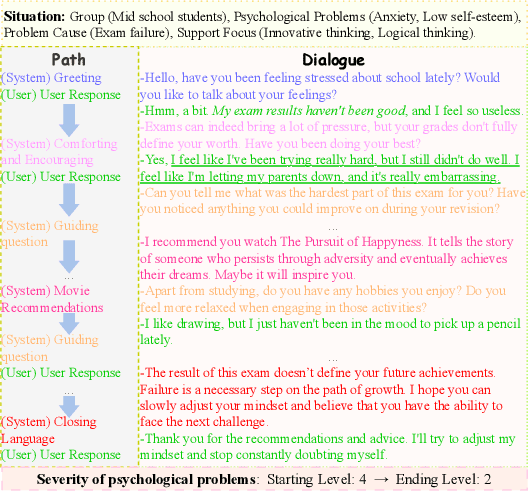
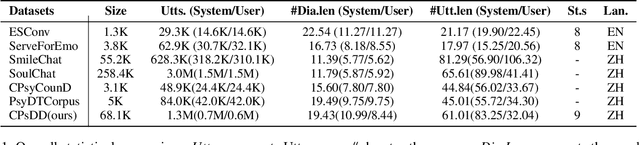
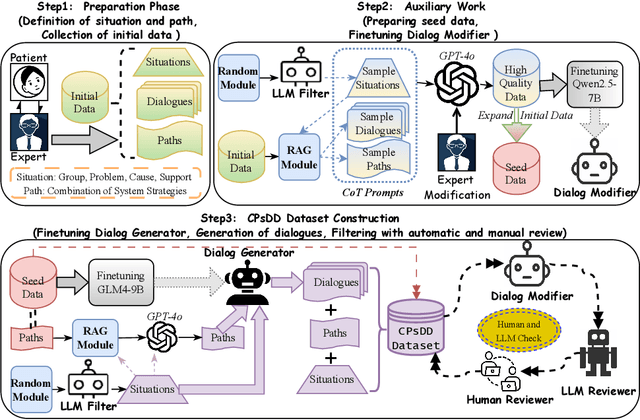
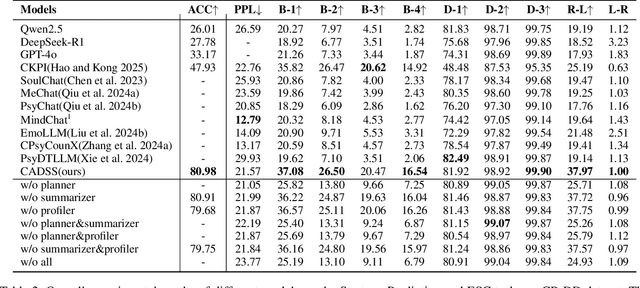
The growing need for psychological support due to increasing pressures has exposed the scarcity of relevant datasets, particularly in non-English languages. To address this, we propose a framework that leverages limited real-world data and expert knowledge to fine-tune two large language models: Dialog Generator and Dialog Modifier. The Generator creates large-scale psychological counseling dialogues based on predefined paths, which guide system response strategies and user interactions, forming the basis for effective support. The Modifier refines these dialogues to align with real-world data quality. Through both automated and manual review, we construct the Chinese Psychological support Dialogue Dataset (CPsDD), containing 68K dialogues across 13 groups, 16 psychological problems, 13 causes, and 12 support focuses. Additionally, we introduce the Comprehensive Agent Dialogue Support System (CADSS), where a Profiler analyzes user characteristics, a Summarizer condenses dialogue history, a Planner selects strategies, and a Supporter generates empathetic responses. The experimental results of the Strategy Prediction and Emotional Support Conversation (ESC) tasks demonstrate that CADSS achieves state-of-the-art performance on both CPsDD and ESConv datasets.