 Add to Chrome
 Add to Firefox
 Add to Edge
CP Loss: Channel-wise Perceptual Loss for Time Series Forecasting
Jan 25, 2026
Multi-channel time-series data, prevalent across diverse applications, is characterized by significant heterogeneity in its different channels. However, existing forecasting models are typically guided by channel-agnostic loss functions like MSE, which apply a uniform metric across all channels. This often leads to fail to capture channel-specific dynamics such as sharp fluctuations or trend shifts. To address this, we propose a Channel-wise Perceptual Loss (CP Loss). Its core idea is to learn a unique perceptual space for each channel that is adapted to its characteristics, and to compute the loss within this space. Specifically, we first design a learnable channel-wise filter that decomposes the raw signal into disentangled multi-scale representations, which form the basis of our perceptual space. Crucially, the filter is optimized jointly with the main forecasting model, ensuring that the learned perceptual space is explicitly oriented towards the prediction task. Finally, losses are calculated within these perception spaces to optimize the model. Code is available at https://github.com/zyh16143998882/CP_Loss.

Heterogeneous Uncertainty-Guided Composed Image Retrieval with Fine-Grained Probabilistic Learning
Jan 16, 2026Composed Image Retrieval (CIR) enables image search by combining a reference image with modification text. Intrinsic noise in CIR triplets incurs intrinsic uncertainty and threatens the model's robustness. Probabilistic learning approaches have shown promise in addressing such issues; however, they fall short for CIR due to their instance-level holistic modeling and homogeneous treatment of queries and targets. This paper introduces a Heterogeneous Uncertainty-Guided (HUG) paradigm to overcome these limitations. HUG utilizes a fine-grained probabilistic learning framework, where queries and targets are represented by Gaussian embeddings that capture detailed concepts and uncertainties. We customize heterogeneous uncertainty estimations for multi-modal queries and uni-modal targets. Given a query, we capture uncertainties not only regarding uni-modal content quality but also multi-modal coordination, followed by a provable dynamic weighting mechanism to derive comprehensive query uncertainty. We further design uncertainty-guided objectives, including query-target holistic contrast and fine-grained contrasts with comprehensive negative sampling strategies, which effectively enhance discriminative learning. Experiments on benchmarks demonstrate HUG's effectiveness beyond state-of-the-art baselines, with faithful analysis justifying the technical contributions.
Generalization Bounds for Transformer Channel Decoders
Jan 11, 2026Transformer channel decoders, such as the Error Correction Code Transformer (ECCT), have shown strong empirical performance in channel decoding, yet their generalization behavior remains theoretically unclear. This paper studies the generalization performance of ECCT from a learning-theoretic perspective. By establishing a connection between multiplicative noise estimation errors and bit-error-rate (BER), we derive an upper bound on the generalization gap via bit-wise Rademacher complexity. The resulting bound characterizes the dependence on code length, model parameters, and training set size, and applies to both single-layer and multi-layer ECCTs. We further show that parity-check-based masked attention induces sparsity that reduces the covering number, leading to a tighter generalization bound. To the best of our knowledge, this work provides the first theoretical generalization guarantees for this class of decoders.
Splatwizard: A Benchmark Toolkit for 3D Gaussian Splatting Compression
Dec 31, 2025The recent advent of 3D Gaussian Splatting (3DGS) has marked a significant breakthrough in real-time novel view synthesis. However, the rapid proliferation of 3DGS-based algorithms has created a pressing need for standardized and comprehensive evaluation tools, especially for compression task. Existing benchmarks often lack the specific metrics necessary to holistically assess the unique characteristics of different methods, such as rendering speed, rate distortion trade-offs memory efficiency, and geometric accuracy. To address this gap, we introduce Splatwizard, a unified benchmark toolkit designed specifically for benchmarking 3DGS compression models. Splatwizard provides an easy-to-use framework to implement new 3DGS compression model and utilize state-of-the-art techniques proposed by previous work. Besides, an integrated pipeline that automates the calculation of key performance indicators, including image-based quality metrics, chamfer distance of reconstruct mesh, rendering frame rates, and computational resource consumption is included in the framework as well. Code is available at https://github.com/splatwizard/splatwizard
Distribution-informed Online Conformal Prediction
Dec 08, 2025Conformal prediction provides a pivotal and flexible technique for uncertainty quantification by constructing prediction sets with a predefined coverage rate. Many online conformal prediction methods have been developed to address data distribution shifts in fully adversarial environments, resulting in overly conservative prediction sets. We propose Conformal Optimistic Prediction (COP), an online conformal prediction algorithm incorporating underlying data pattern into the update rule. Through estimated cumulative distribution function of non-conformity scores, COP produces tighter prediction sets when predictable pattern exists, while retaining valid coverage guarantees even when estimates are inaccurate. We establish a joint bound on coverage and regret, which further confirms the validity of our approach. We also prove that COP achieves distribution-free, finite-sample coverage under arbitrary learning rates and can converge when scores are $i.i.d.$. The experimental results also show that COP can achieve valid coverage and construct shorter prediction intervals than other baselines.
VVS: Accelerating Speculative Decoding for Visual Autoregressive Generation via Partial Verification Skipping
Nov 17, 2025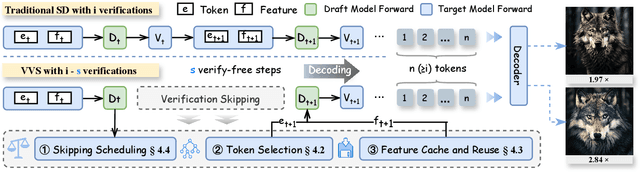
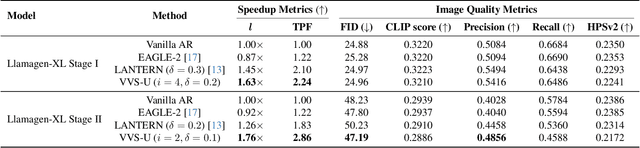
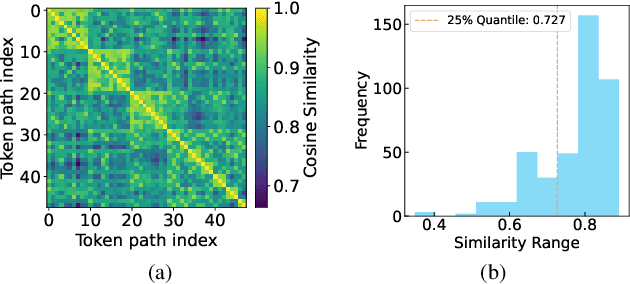
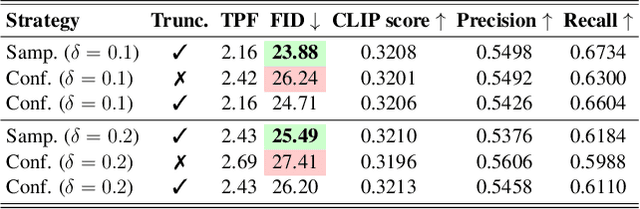
Visual autoregressive (AR) generation models have demonstrated strong potential for image generation, yet their next-token-prediction paradigm introduces considerable inference latency. Although speculative decoding (SD) has been proven effective for accelerating visual AR models, its "draft one step, then verify one step" paradigm prevents a direct reduction of the forward passes, thus restricting acceleration potential. Motivated by the visual token interchangeability, we for the first time to explore verification skipping in the SD process of visual AR model generation to explicitly cut the number of target model forward passes, thereby reducing inference latency. Based on an analysis of the drafting stage's characteristics, we observe that verification redundancy and stale feature reusability are key factors to retain generation quality and speedup for verification-free steps. Inspired by these two observations, we propose a novel SD framework VVS to accelerate visual AR generation via partial verification skipping, which integrates three complementary modules: (1) a verification-free token selector with dynamical truncation, (2) token-level feature caching and reuse, and (3) fine-grained skipped step scheduling. Consequently, VVS reduces the number of target model forward passes by a factor of $2.8\times$ relative to vanilla AR decoding while maintaining competitive generation quality, offering a superior speed-quality trade-off over conventional SD frameworks and revealing strong potential to reshape the SD paradigm.
CASL: Curvature-Augmented Self-supervised Learning for 3D Anomaly Detection
Nov 17, 2025Deep learning-based 3D anomaly detection methods have demonstrated significant potential in industrial manufacturing. However, many approaches are specifically designed for anomaly detection tasks, which limits their generalizability to other 3D understanding tasks. In contrast, self-supervised point cloud models aim for general-purpose representation learning, yet our investigation reveals that these classical models are suboptimal at anomaly detection under the unified fine-tuning paradigm. This motivates us to develop a more generalizable 3D model that can effectively detect anomalies without relying on task-specific designs. Interestingly, we find that using only the curvature of each point as its anomaly score already outperforms several classical self-supervised and dedicated anomaly detection models, highlighting the critical role of curvature in 3D anomaly detection. In this paper, we propose a Curvature-Augmented Self-supervised Learning (CASL) framework based on a reconstruction paradigm. Built upon the classical U-Net architecture, our approach introduces multi-scale curvature prompts to guide the decoder in predicting the spatial coordinates of each point. Without relying on any dedicated anomaly detection mechanisms, it achieves leading detection performance through straightforward anomaly classification fine-tuning. Moreover, the learned representations generalize well to standard 3D understanding tasks such as point cloud classification. The code is available at https://github.com/zyh16143998882/CASL.
Improving Deepfake Detection with Reinforcement Learning-Based Adaptive Data Augmentation
Nov 10, 2025The generalization capability of deepfake detectors is critical for real-world use. Data augmentation via synthetic fake face generation effectively enhances generalization, yet current SoTA methods rely on fixed strategies-raising a key question: Is a single static augmentation sufficient, or does the diversity of forgery features demand dynamic approaches? We argue existing methods overlook the evolving complexity of real-world forgeries (e.g., facial warping, expression manipulation), which fixed policies cannot fully simulate. To address this, we propose CRDA (Curriculum Reinforcement-Learning Data Augmentation), a novel framework guiding detectors to progressively master multi-domain forgery features from simple to complex. CRDA synthesizes augmented samples via a configurable pool of forgery operations and dynamically generates adversarial samples tailored to the detector's current learning state. Central to our approach is integrating reinforcement learning (RL) and causal inference. An RL agent dynamically selects augmentation actions based on detector performance to efficiently explore the vast augmentation space, adapting to increasingly challenging forgeries. Simultaneously, the agent introduces action space variations to generate heterogeneous forgery patterns, guided by causal inference to mitigate spurious correlations-suppressing task-irrelevant biases and focusing on causally invariant features. This integration ensures robust generalization by decoupling synthetic augmentation patterns from the model's learned representations. Extensive experiments show our method significantly improves detector generalizability, outperforming SOTA methods across multiple cross-domain datasets.
Imperceptible Jailbreaking against Large Language Models
Oct 06, 2025Jailbreaking attacks on the vision modality typically rely on imperceptible adversarial perturbations, whereas attacks on the textual modality are generally assumed to require visible modifications (e.g., non-semantic suffixes). In this paper, we introduce imperceptible jailbreaks that exploit a class of Unicode characters called variation selectors. By appending invisible variation selectors to malicious questions, the jailbreak prompts appear visually identical to original malicious questions on screen, while their tokenization is "secretly" altered. We propose a chain-of-search pipeline to generate such adversarial suffixes to induce harmful responses. Our experiments show that our imperceptible jailbreaks achieve high attack success rates against four aligned LLMs and generalize to prompt injection attacks, all without producing any visible modifications in the written prompt. Our code is available at https://github.com/sail-sg/imperceptible-jailbreaks.
Closing the Safety Gap: Surgical Concept Erasure in Visual Autoregressive Models
Sep 26, 2025The rapid progress of visual autoregressive (VAR) models has brought new opportunities for text-to-image generation, but also heightened safety concerns. Existing concept erasure techniques, primarily designed for diffusion models, fail to generalize to VARs due to their next-scale token prediction paradigm. In this paper, we first propose a novel VAR Erasure framework VARE that enables stable concept erasure in VAR models by leveraging auxiliary visual tokens to reduce fine-tuning intensity. Building upon this, we introduce S-VARE, a novel and effective concept erasure method designed for VAR, which incorporates a filtered cross entropy loss to precisely identify and minimally adjust unsafe visual tokens, along with a preservation loss to maintain semantic fidelity, addressing the issues such as language drift and reduced diversity introduce by na\"ive fine-tuning. Extensive experiments demonstrate that our approach achieves surgical concept erasure while preserving generation quality, thereby closing the safety gap in autoregressive text-to-image generation by earlier methods.