 Add to Chrome
 Add to Firefox
 Add to Edge
The Model's Tell: Measuring Context-Leakage Attack Signals with Behavior Gauges
Aug 18, 2026
LLMs increasingly rely on external contexts, such as pre-defined system prompts or retrieved documents, to improve generation quality. However, processing these contexts alongside user queries creates an attack surface: adversarial inputs can induce models to disclose them. Prior probing studies suggest that leakage-related signals emerge in hidden states, yet the need to extract these states poses additional deployment challenges. In this paper, we explore whether this internal signal leaves a more accessible ``tell'' before decoding. We propose LeakGauge, which probes this response by appending a suffix that gauges leakage behavior and mapping its prefill token probabilities to an attack-risk score. While a direct gauge uses the initial tokens of confidential content, we find that a content-agnostic one that verbalizes leakage behavior yields more robust signals. Across 11 LLMs, including GLM-5.2 (753B) and Kimi-K3 (2.8T), LeakGauge reaches an AUROC range of 0.944--0.996 on unseen attacks. The signal remains stable when the content changes language or the attack shifts from verbatim to semantic disclosure. By activation-steering interventions, we further show that the risk score is sensitive to an internal leakage-related direction, relating the observable signal to the model's internal representation. In addition, LeakGauge enables an input detector with fewer than 0.5K extra parameters and added latency of 10.34 ms. Code: \href{https://github.com/yeasen-z/LeakGauge}.

Your Agentic LLMs Secretly Encode Latent Signals of Indirect Prompt-Injection Exposure
Aug 01, 2026Agentic LLMs are vulnerable to indirect prompt injection (IPI) attacks, e.g., malicious side-tasks hidden in external tool results. While many efforts have sought to address the threats, little is known about the internals of agentic LLMs when they are exposed to IPI attacks, a condition which we call IPI exposure. In this paper, we study this problem in depth from three aspects. (1) Probing: Across six models, including the giant 753B-parameter GLM-5.2, simple linear probes trained on pre-generation hidden states can predict LLMs' IPI exposure. These probes achieve 90%+ AUROC on unseen attacks, agent instructions, and task suites; they exhibit high robustness under adaptive attacks and in cross-lingual settings. (2) Defense: Our CoT measurement reveals a recognition--action gap: though models encode such signals, they often fail to translate them into safe actions. We then introduce AGRI, a probe-gated reasoning-based defense that prepends anti-injection reasoning on demand. On difficult AgentDojo settings, AGRI substantially reduces attack success rate, e.g., from 34.6% to 0% on Qwen3.5-27B, while largely maintaining clean-task utility. (3) Explanation: We introduce an analysis framework that identifies natural-language explanations most strongly correlated with probe-captured signals. The resulting profiles differ across models: latent signals can align with either direct IPI-exposure claims or indirect operational cues. Code is available: https://github.com/jianshuod/IPI-exposure-signal.
LeakDojo: Decoding the Leakage Threats of RAG Systems
May 07, 2026Retrieval-Augmented Generation (RAG) enables large language models (LLMs) to leverage external knowledge, but also exposes valuable RAG databases to leakage attacks. As RAG systems grow more complex and LLMs exhibit stronger instruction-following capabilities, existing studies fall short of systematically assessing RAG leakage risks. We present LeakDojo, a configurable framework for controlled evaluation of RAG leakage. Using LeakDojo, we benchmark six existing attacks across fourteen LLMs, four datasets, and diverse RAG systems. Our study reveals that (1) query generation and adversarial instructions contribute independently to leakage, with overall leakage well approximated by their product; (2) stronger instruction-following capability correlates with higher leakage risk; and (3) improvements in RAG faithfulness can introduce increased leakage risk. These findings provide actionable insights for understanding and mitigating RAG leakage in practice. Our codebase is available at https://github.com/yeasen-z/LeakDojo.
Revisiting the Reliability of Language Models in Instruction-Following
Dec 15, 2025Advanced LLMs have achieved near-ceiling instruction-following accuracy on benchmarks such as IFEval. However, these impressive scores do not necessarily translate to reliable services in real-world use, where users often vary their phrasing, contextual framing, and task formulations. In this paper, we study nuance-oriented reliability: whether models exhibit consistent competence across cousin prompts that convey analogous user intents but with subtle nuances. To quantify this, we introduce a new metric, reliable@k, and develop an automated pipeline that generates high-quality cousin prompts via data augmentation. Building upon this, we construct IFEval++ for systematic evaluation. Across 20 proprietary and 26 open-source LLMs, we find that current models exhibit substantial insufficiency in nuance-oriented reliability -- their performance can drop by up to 61.8% with nuanced prompt modifications. What's more, we characterize it and explore three potential improvement recipes. Our findings highlight nuance-oriented reliability as a crucial yet underexplored next step toward more dependable and trustworthy LLM behavior. Our code and benchmark are accessible: https://github.com/jianshuod/IFEval-pp.
An Engorgio Prompt Makes Large Language Model Babble on
Dec 27, 2024
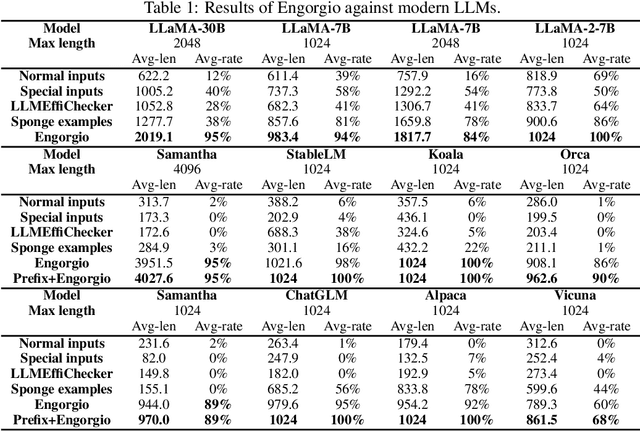


Auto-regressive large language models (LLMs) have yielded impressive performance in many real-world tasks. However, the new paradigm of these LLMs also exposes novel threats. In this paper, we explore their vulnerability to inference cost attacks, where a malicious user crafts Engorgio prompts to intentionally increase the computation cost and latency of the inference process. We design Engorgio, a novel methodology, to efficiently generate adversarial Engorgio prompts to affect the target LLM's service availability. Engorgio has the following two technical contributions. (1) We employ a parameterized distribution to track LLMs' prediction trajectory. (2) Targeting the auto-regressive nature of LLMs' inference process, we propose novel loss functions to stably suppress the appearance of the <EOS> token, whose occurrence will interrupt the LLM's generation process. We conduct extensive experiments on 13 open-sourced LLMs with parameters ranging from 125M to 30B. The results show that Engorgio prompts can successfully induce LLMs to generate abnormally long outputs (i.e., roughly 2-13$\times$ longer to reach 90%+ of the output length limit) in a white-box scenario and our real-world experiment demonstrates Engergio's threat to LLM service with limited computing resources. The code is accessible at https://github.com/jianshuod/Engorgio-prompt.
One-bit Flip is All You Need: When Bit-flip Attack Meets Model Training
Aug 12, 2023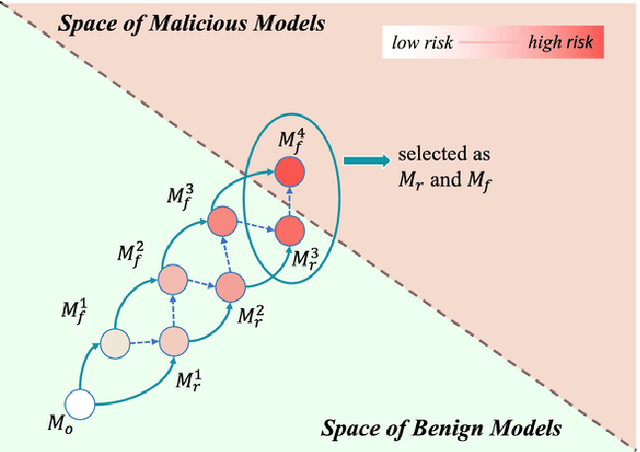

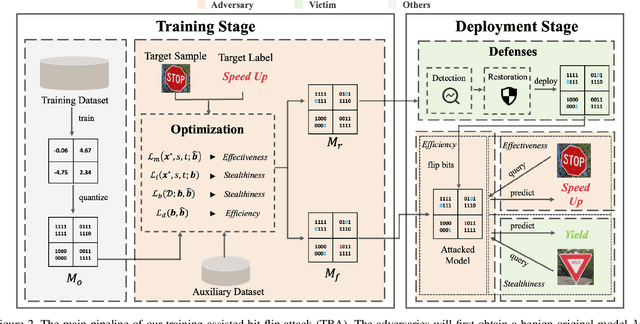

Deep neural networks (DNNs) are widely deployed on real-world devices. Concerns regarding their security have gained great attention from researchers. Recently, a new weight modification attack called bit flip attack (BFA) was proposed, which exploits memory fault inject techniques such as row hammer to attack quantized models in the deployment stage. With only a few bit flips, the target model can be rendered useless as a random guesser or even be implanted with malicious functionalities. In this work, we seek to further reduce the number of bit flips. We propose a training-assisted bit flip attack, in which the adversary is involved in the training stage to build a high-risk model to release. This high-risk model, obtained coupled with a corresponding malicious model, behaves normally and can escape various detection methods. The results on benchmark datasets show that an adversary can easily convert this high-risk but normal model to a malicious one on victim's side by \textbf{flipping only one critical bit} on average in the deployment stage. Moreover, our attack still poses a significant threat even when defenses are employed. The codes for reproducing main experiments are available at \url{https://github.com/jianshuod/TBA}.