 Add to Chrome
 Add to Firefox
 Add to Edge
SA-LIVO: Efficient LiDAR-Inertial-Visual Odometry with Subspace-Aware Degeneracy Handling
Jun 24, 2026
Tightly coupled LiDAR-visual-inertial odometry (LIVO) fuses precise geometric depth with complementary visual measurements, yet its exteroceptive sensors face independent failure modes: LiDAR degenerates when scan geometry is under-constrained, while visual measurements degrade under adverse illumination or texture absence. Existing countermeasures, including binary degeneracy detection, covariance inflation, and scene-level quality gating, operate at the modality level and leave the direction-dependent structure of the joint information matrix unaddressed. Consequently, visual residuals enter pose directions where LiDAR is well-constrained, while in deficient directions visual compensation disperses across the full state space rather than concentrating where needed. We propose SA-LIVO, a LiDAR-inertial-visual odometry system addressing these limitations through direction-selective fusion and information-efficient processing. The Subspace-Aware Information Fusion (SAIF) framework eigendecomposes the joint LiDAR-visual information matrix and applies a linear-clamp soft gate per eigendirection, attenuating degenerate directions while preserving observable ones at full strength. LiDAR and visual residuals are then jointly optimized in one InEKF loop at a shared linearization point. Since visual information contributes only where LiDAR is deficient, photometric Jacobians are assembled once before the loop and reused across iterations, avoiding the per-iteration cost of conventional iterated filters. Experiments on 29 sequences from three benchmarks (HILTI'22, New College, Oxford Spires) and concurrent-degradation scenarios show accuracy competitive with the strongest baselines and bounded drift where competing systems diverge. SA-LIVO averages 12.3 ms per frame on a laptop CPU and 26.8 ms on an embedded ARM board without GPU, with 3.6-6.3x lower peak memory. The code will be open-sourced.

MTServe: Efficient Serving for Generative Recommendation Models with Hierarchical Caches
Apr 24, 2026Generative recommendation (GR) offers superior modeling capabilities but suffers from prohibitive inference costs due to the repeated encoding of long user histories. While cross-request Key-Value (KV) cache reuse presents a significant optimization opportunity, the massive scale of individual user states creates a storage explosion that far exceeds physical GPU limits. We propose MTServe, a hierarchical cache management system that virtualizes GPU memory by leveraging host RAM as a scalable backup store. To bridge the I/O gap between tiers, MTServe introduces a suite of system-level optimizations, including a hybrid storage layout, an asynchronous data transfer pipeline, and a locality-driven replacement policy. On both public and production datasets, MTServe delivers up to 3.1* speedup while maintaining near-perfect hit ratios (>98.5%).
PhysInOne: Visual Physics Learning and Reasoning in One Suite
Apr 10, 2026We present PhysInOne, a large-scale synthetic dataset addressing the critical scarcity of physically-grounded training data for AI systems. Unlike existing datasets limited to merely hundreds or thousands of examples, PhysInOne provides 2 million videos across 153,810 dynamic 3D scenes, covering 71 basic physical phenomena in mechanics, optics, fluid dynamics, and magnetism. Distinct from previous works, our scenes feature multiobject interactions against complex backgrounds, with comprehensive ground-truth annotations including 3D geometry, semantics, dynamic motion, physical properties, and text descriptions. We demonstrate PhysInOne's efficacy across four emerging applications: physics-aware video generation, long-/short-term future frame prediction, physical property estimation, and motion transfer. Experiments show that fine-tuning foundation models on PhysInOne significantly enhances physical plausibility, while also exposing critical gaps in modeling complex physical dynamics and estimating intrinsic properties. As the largest dataset of its kind, orders of magnitude beyond prior works, PhysInOne establishes a new benchmark for advancing physics-grounded world models in generation, simulation, and embodied AI.
HierarchicalKV: A GPU Hash Table with Cache Semantics for Continuous Online Embedding Storage
Mar 17, 2026Traditional GPU hash tables preserve every inserted key -- a dictionary assumption that wastes scarce High Bandwidth Memory (HBM) when embedding tables routinely exceed single-GPU capacity. We challenge this assumption with cache semantics, where policy-driven eviction is a first-class operation. We introduce HierarchicalKV (HKV), the first general-purpose GPU hash table library whose normal full-capacity operating contract is cache-semantic: each full-bucket upsert (update-or-insert) is resolved in place by eviction or admission rejection rather than by rehashing or capacity-induced failure. HKV co-designs four core mechanisms -- cache-line-aligned buckets, in-line score-driven upsert, score-based dynamic dual-bucket selection, and triple-group concurrency -- and uses tiered key-value separation as a scaling enabler beyond HBM. On an NVIDIA H100 NVL GPU, HKV achieves up to 3.9 billion key-value pairs per second (B-KV/s) find throughput, stable across load factors 0.50-1.00 (<5% variation), and delivers 1.4x higher find throughput than WarpCore (the strongest dictionary-semantic GPU baseline at lambda=0.50) and up to 2.6-9.4x over indirection-based GPU baselines. Since its open-source release in October 2022, HKV has been integrated into multiple open-source recommendation frameworks.
Omni-LIVO: Robust RGB-Colored Multi-Camera Visual-Inertial-LiDAR Odometry via Photometric Migration and ESIKF Fusion
Sep 19, 2025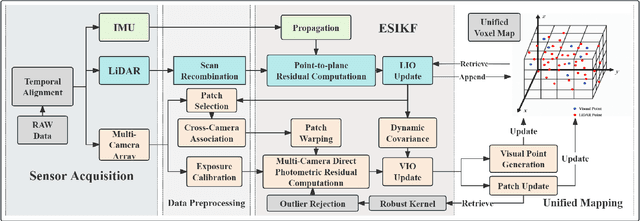
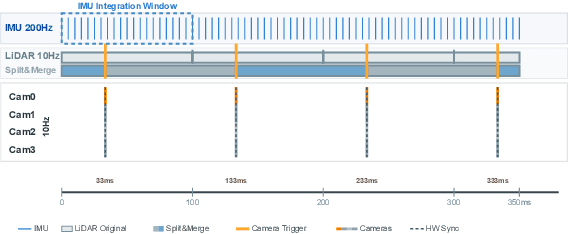
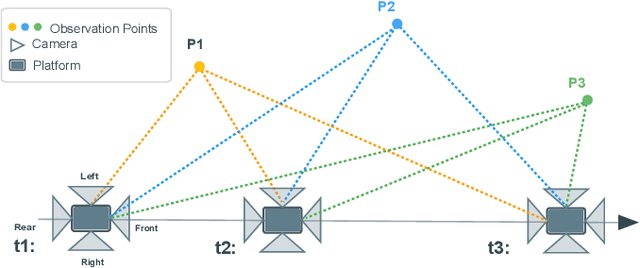
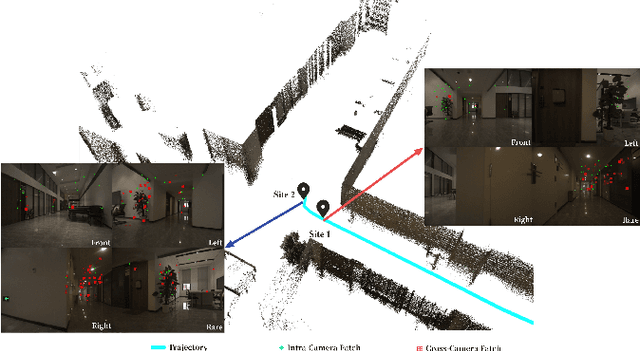
Wide field-of-view (FoV) LiDAR sensors provide dense geometry across large environments, but most existing LiDAR-inertial-visual odometry (LIVO) systems rely on a single camera, leading to limited spatial coverage and degraded robustness. We present Omni-LIVO, the first tightly coupled multi-camera LIVO system that bridges the FoV mismatch between wide-angle LiDAR and conventional cameras. Omni-LIVO introduces a Cross-View direct tracking strategy that maintains photometric consistency across non-overlapping views, and extends the Error-State Iterated Kalman Filter (ESIKF) with multi-view updates and adaptive covariance weighting. The system is evaluated on public benchmarks and our custom dataset, showing improved accuracy and robustness over state-of-the-art LIVO, LIO, and visual-inertial baselines. Code and dataset will be released upon publication.
Multi-level Certified Defense Against Poisoning Attacks in Offline Reinforcement Learning
May 27, 2025Similar to other machine learning frameworks, Offline Reinforcement Learning (RL) is shown to be vulnerable to poisoning attacks, due to its reliance on externally sourced datasets, a vulnerability that is exacerbated by its sequential nature. To mitigate the risks posed by RL poisoning, we extend certified defenses to provide larger guarantees against adversarial manipulation, ensuring robustness for both per-state actions, and the overall expected cumulative reward. Our approach leverages properties of Differential Privacy, in a manner that allows this work to span both continuous and discrete spaces, as well as stochastic and deterministic environments -- significantly expanding the scope and applicability of achievable guarantees. Empirical evaluations demonstrate that our approach ensures the performance drops to no more than $50\%$ with up to $7\%$ of the training data poisoned, significantly improving over the $0.008\%$ in prior work~\citep{wu_copa_2022}, while producing certified radii that is $5$ times larger as well. This highlights the potential of our framework to enhance safety and reliability in offline RL.
Fox in the Henhouse: Supply-Chain Backdoor Attacks Against Reinforcement Learning
May 26, 2025The current state-of-the-art backdoor attacks against Reinforcement Learning (RL) rely upon unrealistically permissive access models, that assume the attacker can read (or even write) the victim's policy parameters, observations, or rewards. In this work, we question whether such a strong assumption is required to launch backdoor attacks against RL. To answer this question, we propose the \underline{S}upply-\underline{C}h\underline{a}in \underline{B}ackdoor (SCAB) attack, which targets a common RL workflow: training agents using external agents that are provided separately or embedded within the environment. In contrast to prior works, our attack only relies on legitimate interactions of the RL agent with the supplied agents. Despite this limited access model, by poisoning a mere $3\%$ of training experiences, our attack can successfully activate over $90\%$ of triggered actions, reducing the average episodic return by $80\%$ for the victim. Our novel attack demonstrates that RL attacks are likely to become a reality under untrusted RL training supply-chains.
It's Simplex! Disaggregating Measures to Improve Certified Robustness
Sep 20, 2023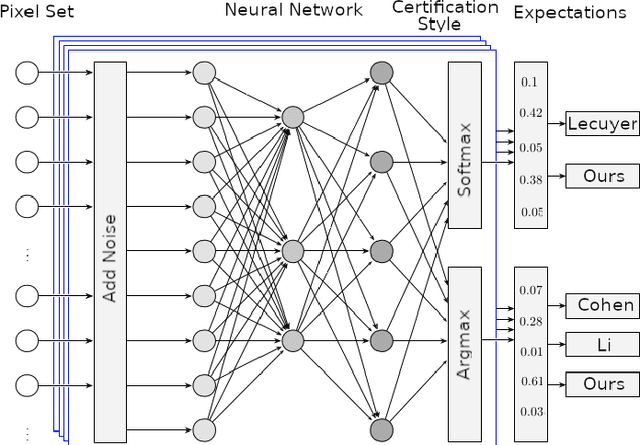
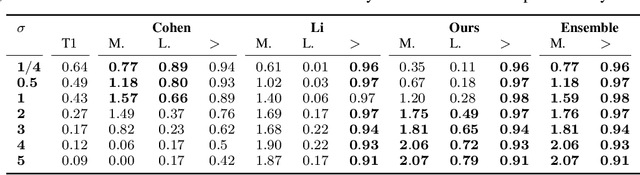
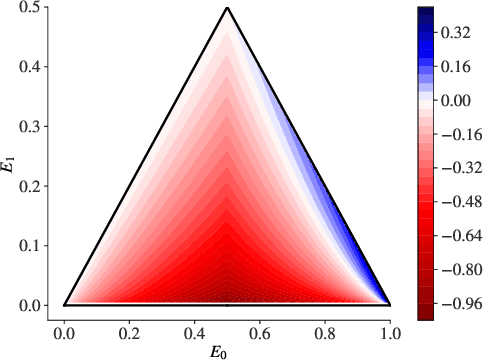

Certified robustness circumvents the fragility of defences against adversarial attacks, by endowing model predictions with guarantees of class invariance for attacks up to a calculated size. While there is value in these certifications, the techniques through which we assess their performance do not present a proper accounting of their strengths and weaknesses, as their analysis has eschewed consideration of performance over individual samples in favour of aggregated measures. By considering the potential output space of certified models, this work presents two distinct approaches to improve the analysis of certification mechanisms, that allow for both dataset-independent and dataset-dependent measures of certification performance. Embracing such a perspective uncovers new certification approaches, which have the potential to more than double the achievable radius of certification, relative to current state-of-the-art. Empirical evaluation verifies that our new approach can certify $9\%$ more samples at noise scale $\sigma = 1$, with greater relative improvements observed as the difficulty of the predictive task increases.
Enhancing the Antidote: Improved Pointwise Certifications against Poisoning Attacks
Aug 15, 2023
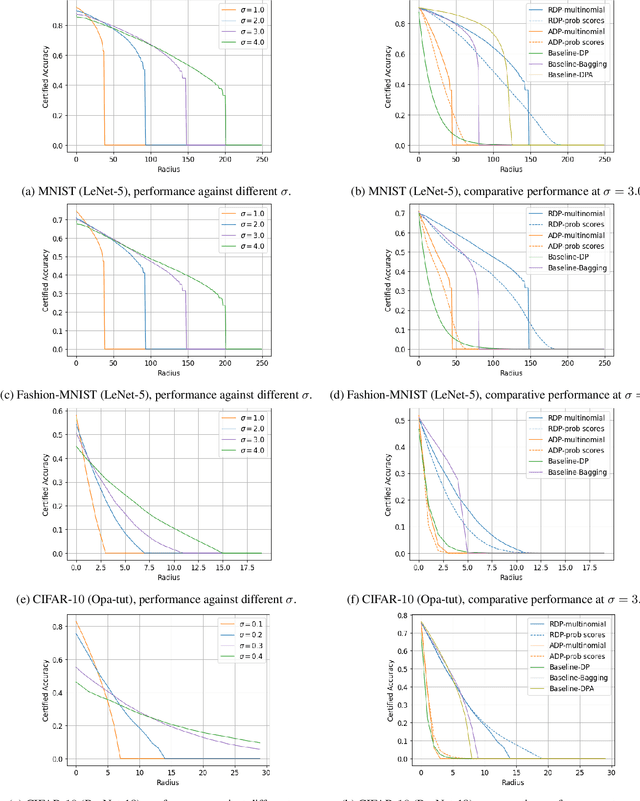
Poisoning attacks can disproportionately influence model behaviour by making small changes to the training corpus. While defences against specific poisoning attacks do exist, they in general do not provide any guarantees, leaving them potentially countered by novel attacks. In contrast, by examining worst-case behaviours Certified Defences make it possible to provide guarantees of the robustness of a sample against adversarial attacks modifying a finite number of training samples, known as pointwise certification. We achieve this by exploiting both Differential Privacy and the Sampled Gaussian Mechanism to ensure the invariance of prediction for each testing instance against finite numbers of poisoned examples. In doing so, our model provides guarantees of adversarial robustness that are more than twice as large as those provided by prior certifications.
MEMD-ABSA: A Multi-Element Multi-Domain Dataset for Aspect-Based Sentiment Analysis
Jun 29, 2023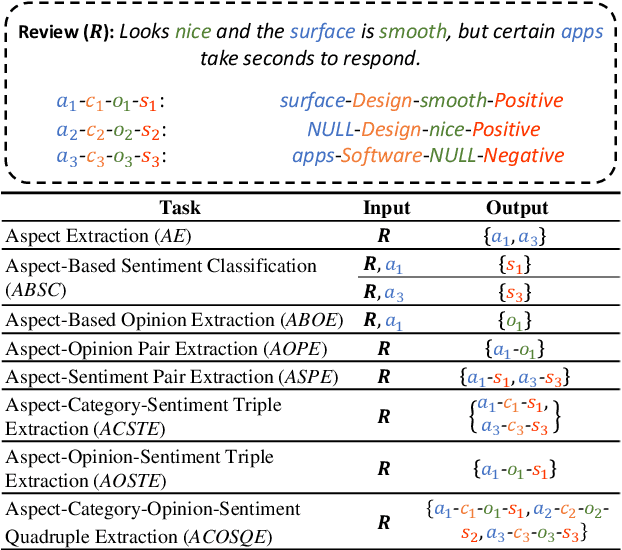
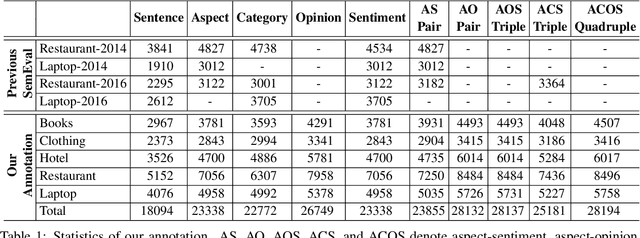
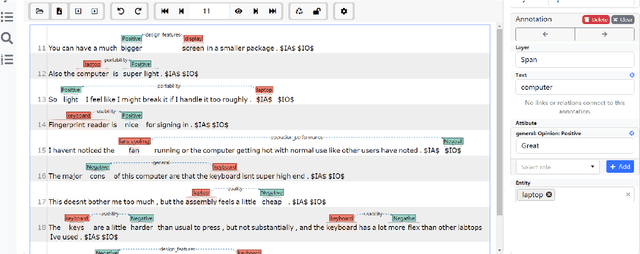
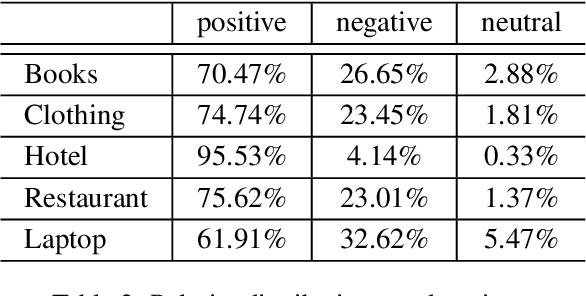
Aspect-based sentiment analysis is a long-standing research interest in the field of opinion mining, and in recent years, researchers have gradually shifted their focus from simple ABSA subtasks to end-to-end multi-element ABSA tasks. However, the datasets currently used in the research are limited to individual elements of specific tasks, usually focusing on in-domain settings, ignoring implicit aspects and opinions, and with a small data scale. To address these issues, we propose a large-scale Multi-Element Multi-Domain dataset (MEMD) that covers the four elements across five domains, including nearly 20,000 review sentences and 30,000 quadruples annotated with explicit and implicit aspects and opinions for ABSA research. Meanwhile, we evaluate generative and non-generative baselines on multiple ABSA subtasks under the open domain setting, and the results show that open domain ABSA as well as mining implicit aspects and opinions remain ongoing challenges to be addressed. The datasets are publicly released at \url{https://github.com/NUSTM/MEMD-ABSA}.