 Add to Chrome
 Add to Firefox
 Add to Edge
Semantic Robustness Certification for Vision-Language Models
Jun 17, 2026
Vision-language models (VLMs) are now widely used in downstream tasks. However, real-world applications often expose VLMs to distribution shifts induced by semantic variation (e.g., shape, size, and style). Robustness certification determines if a model's prediction changes when transformations are applied to its input. While most certification frameworks study geometric or pixel-level transformations over inputs, this work proposes a novel framework that enables certifying VLM robustness under semantic-level transformations. Leveraging the open-vocabulary capability of VLMs, we use text prompts as semantic proxies to construct transformations parameterized by an extent that controls the degree of semantic variation. By characterizing the VLM decision boundary in closed form, our framework quantitatively certifies extent intervals for which the predicted class remains unchanged under the semantic transformation. Our framework is the first to certify VLM robustness under semantic-level variations without requiring additional data for each variation, making it practical to apply. Experiments on both synthetic and real-world data show that our framework enables certifying robustness under diverse semantic variations across scenarios.

TRACER: Persistent Regularization for Robust Multimodal Finetuning
May 28, 2026Mainstream strategies for finetuning pretrained multimodal models often degrade out-of-distribution (OOD) robustness, a phenomenon known as catastrophic forgetting. In this paper, we develop a theoretical framework for multimodal contrastive finetuning, yielding closed-form solutions and a geometric decomposition for each strategy. This framework shows that self-distillation is more effective than other regularization approaches to retain the knowledge of the pretrained model. Our analysis reveals a largely overlooked limitation: standard Exponential Moving Average (EMA) teachers, widely used in robust finetuning, suffer from collapse. To solve this, we prove that a Weighted Moving Average (WMA) teacher maintains a persistent regularizing force over finite horizons and yields bias-free convergence in the task subspace while preserving orthogonal knowledge. These insights motivate **TRACER** (**T**rajectory-**R**obust **A**nchoring for **C**ontrastive **E**ncoder **R**egularization), which combines contrastive learning with WMA-guided multi-perspective distillation. Extensive experiments on CLIP finetuning demonstrate consistent OOD accuracy and calibration gains across three backbone architectures, and comprehensive ablations confirm that TRACER is both principled and robust to hyperparameter choices. Code is available at [https://github.com/HesamAsad/TRACER](https://github.com/HesamAsad/TRACER).
Dimensionality-Aware Anomaly Detection in Learned Representations of Self-Supervised Speech Models
May 04, 2026Self-supervised speech models (S3Ms) achieve strong downstream performance, yet their learned representations remain poorly understood under natural and adversarial perturbations. Prior studies rely on representation similarity or global dimensionality, offering limited visibility into local geometric changes. We ask: how do perturbations deform local geometry, and do these shifts track downstream automatic speech recognition (ASR) degradation? To address this, we present GRIDS, a framework using Local Intrinsic Dimensionality (LID) across layer-wise representations in WavLM and wav2vec 2.0. We find that LID increases for all low signal-to noise ratio (SNR) perturbations and diverges at high SNR: benign noise converges toward the clean profile, while adversarial inputs retain early-layer LID elevation. We show LID elevation co-occurs with increased WER, and that layer-wise LID features enable anomaly detection (AUROC 0.78-1.00), opening the door to transcript-free monitoring in S3Ms.
Semantic-aware Adversarial Fine-tuning for CLIP
Feb 12, 2026Recent studies have shown that CLIP model's adversarial robustness in zero-shot classification tasks can be enhanced by adversarially fine-tuning its image encoder with adversarial examples (AEs), which are generated by minimizing the cosine similarity between images and a hand-crafted template (e.g., ''A photo of a {label}''). However, it has been shown that the cosine similarity between a single image and a single hand-crafted template is insufficient to measure the similarity for image-text pairs. Building on this, in this paper, we find that the AEs generated using cosine similarity may fail to fool CLIP when the similarity metric is replaced with semantically enriched alternatives, making the image encoder fine-tuned with these AEs less robust. To overcome this issue, we first propose a semantic-ensemble attack to generate semantic-aware AEs by minimizing the average similarity between the original image and an ensemble of refined textual descriptions. These descriptions are initially generated by a foundation model to capture core semantic features beyond hand-crafted templates and are then refined to reduce hallucinations. To this end, we propose Semantic-aware Adversarial Fine-Tuning (SAFT), which fine-tunes CLIP's image encoder with semantic-aware AEs. Extensive experiments show that SAFT outperforms current methods, achieving substantial improvements in zero-shot adversarial robustness across 16 datasets. Our code is available at: https://github.com/tmlr-group/SAFT.
Position: Certified Robustness Does Not (Yet) Imply Model Security
Jun 16, 2025While certified robustness is widely promoted as a solution to adversarial examples in Artificial Intelligence systems, significant challenges remain before these techniques can be meaningfully deployed in real-world applications. We identify critical gaps in current research, including the paradox of detection without distinction, the lack of clear criteria for practitioners to evaluate certification schemes, and the potential security risks arising from users' expectations surrounding ``guaranteed" robustness claims. This position paper is a call to arms for the certification research community, proposing concrete steps to address these fundamental challenges and advance the field toward practical applicability.
Intrinsic and Extrinsic Factor Disentanglement for Recommendation in Various Context Scenarios
Mar 05, 2025
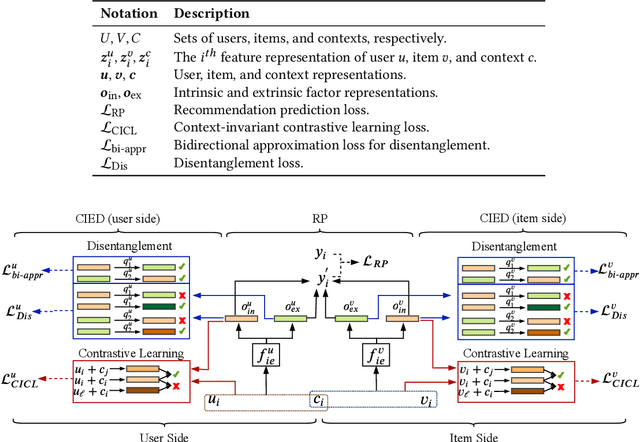
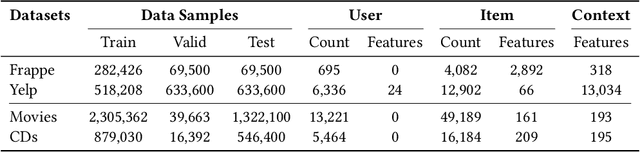
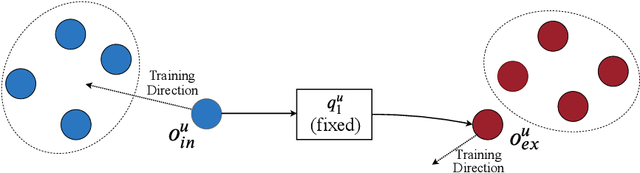
In recommender systems, the patterns of user behaviors (e.g., purchase, click) may vary greatly in different contexts (e.g., time and location). This is because user behavior is jointly determined by two types of factors: intrinsic factors, which reflect consistent user preference, and extrinsic factors, which reflect external incentives that may vary in different contexts. Differentiating between intrinsic and extrinsic factors helps learn user behaviors better. However, existing studies have only considered differentiating them from a single, pre-defined context (e.g., time or location), ignoring the fact that a user's extrinsic factors may be influenced by the interplay of various contexts at the same time. In this paper, we propose the Intrinsic-Extrinsic Disentangled Recommendation (IEDR) model, a generic framework that differentiates intrinsic from extrinsic factors considering various contexts simultaneously, enabling more accurate differentiation of factors and hence the improvement of recommendation accuracy. IEDR contains a context-invariant contrastive learning component to capture intrinsic factors, and a disentanglement component to extract extrinsic factors under the interplay of various contexts. The two components work together to achieve effective factor learning. Extensive experiments on real-world datasets demonstrate IEDR's effectiveness in learning disentangled factors and significantly improving recommendation accuracy by up to 4% in NDCG.
Be Persistent: Towards a Unified Solution for Mitigating Shortcuts in Deep Learning
Feb 17, 2024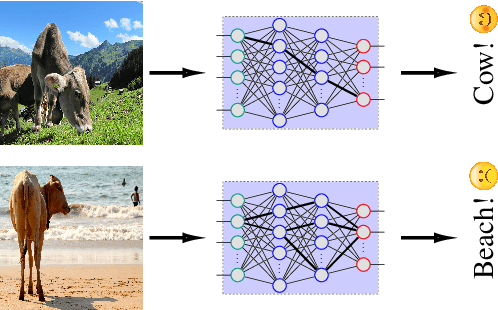
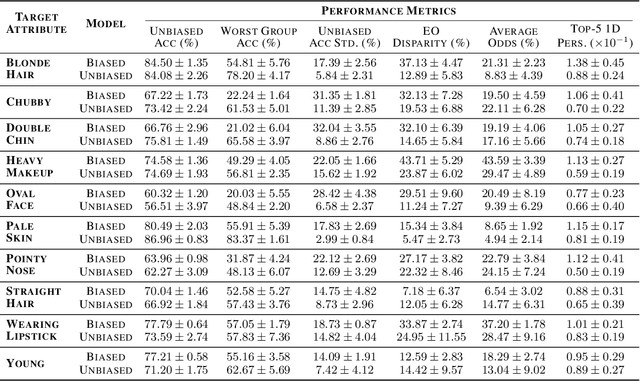
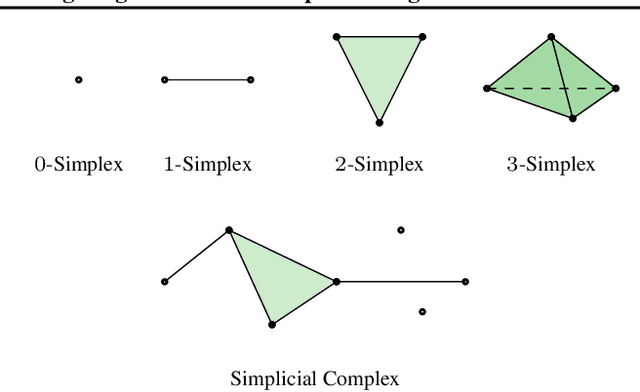
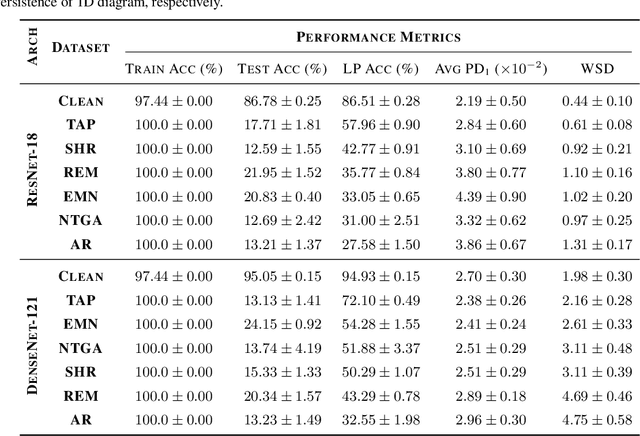
Deep neural networks (DNNs) are vulnerable to shortcut learning: rather than learning the intended task, they tend to draw inconclusive relationships between their inputs and outputs. Shortcut learning is ubiquitous among many failure cases of neural networks, and traces of this phenomenon can be seen in their generalizability issues, domain shift, adversarial vulnerability, and even bias towards majority groups. In this paper, we argue that this commonality in the cause of various DNN issues creates a significant opportunity that should be leveraged to find a unified solution for shortcut learning. To this end, we outline the recent advances in topological data analysis~(TDA), and persistent homology~(PH) in particular, to sketch a unified roadmap for detecting shortcuts in deep learning. We demonstrate our arguments by investigating the topological features of computational graphs in DNNs using two cases of unlearnable examples and bias in decision-making as our test studies. Our analysis of these two failure cases of DNNs reveals that finding a unified solution for shortcut learning in DNNs is not out of reach, and TDA can play a significant role in forming such a framework.
It's Simplex! Disaggregating Measures to Improve Certified Robustness
Sep 20, 2023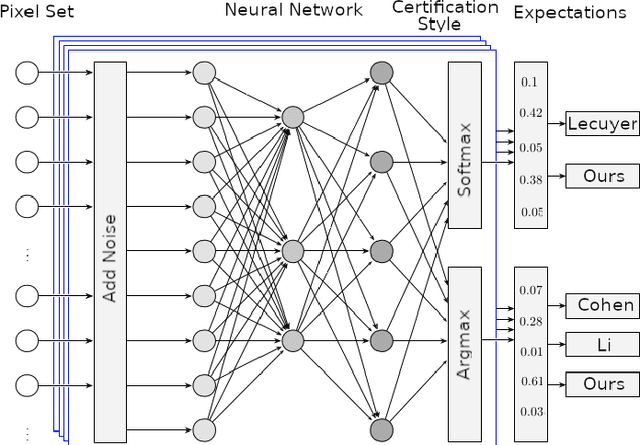
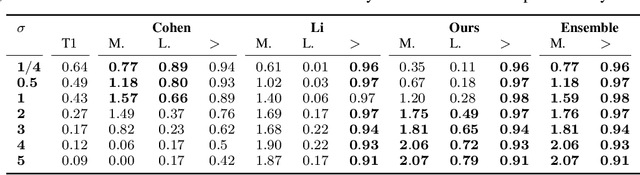
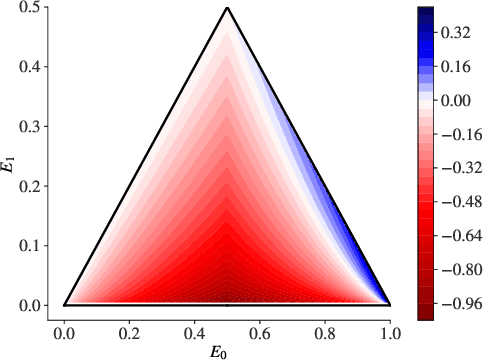

Certified robustness circumvents the fragility of defences against adversarial attacks, by endowing model predictions with guarantees of class invariance for attacks up to a calculated size. While there is value in these certifications, the techniques through which we assess their performance do not present a proper accounting of their strengths and weaknesses, as their analysis has eschewed consideration of performance over individual samples in favour of aggregated measures. By considering the potential output space of certified models, this work presents two distinct approaches to improve the analysis of certification mechanisms, that allow for both dataset-independent and dataset-dependent measures of certification performance. Embracing such a perspective uncovers new certification approaches, which have the potential to more than double the achievable radius of certification, relative to current state-of-the-art. Empirical evaluation verifies that our new approach can certify $9\%$ more samples at noise scale $\sigma = 1$, with greater relative improvements observed as the difficulty of the predictive task increases.
Enhancing the Antidote: Improved Pointwise Certifications against Poisoning Attacks
Aug 15, 2023
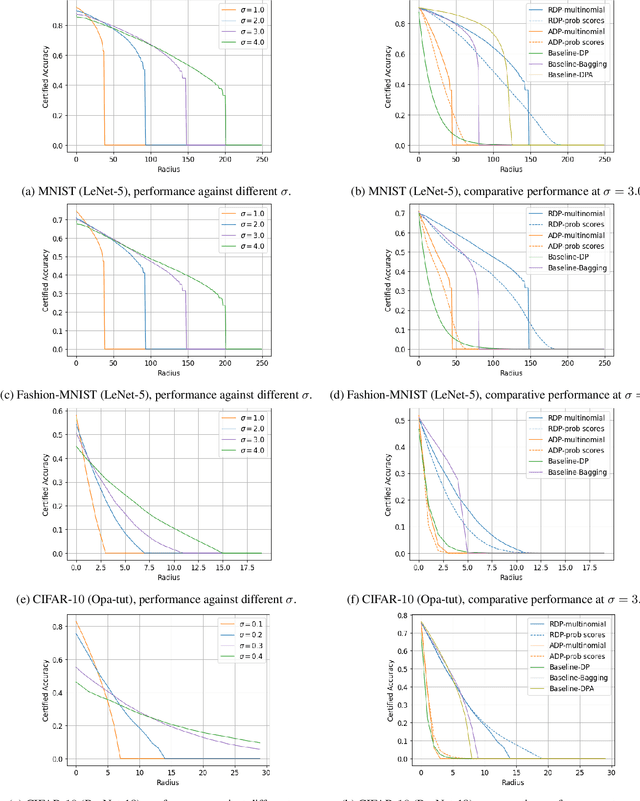
Poisoning attacks can disproportionately influence model behaviour by making small changes to the training corpus. While defences against specific poisoning attacks do exist, they in general do not provide any guarantees, leaving them potentially countered by novel attacks. In contrast, by examining worst-case behaviours Certified Defences make it possible to provide guarantees of the robustness of a sample against adversarial attacks modifying a finite number of training samples, known as pointwise certification. We achieve this by exploiting both Differential Privacy and the Sampled Gaussian Mechanism to ensure the invariance of prediction for each testing instance against finite numbers of poisoned examples. In doing so, our model provides guarantees of adversarial robustness that are more than twice as large as those provided by prior certifications.
Towards quantum enhanced adversarial robustness in machine learning
Jun 22, 2023Machine learning algorithms are powerful tools for data driven tasks such as image classification and feature detection, however their vulnerability to adversarial examples - input samples manipulated to fool the algorithm - remains a serious challenge. The integration of machine learning with quantum computing has the potential to yield tools offering not only better accuracy and computational efficiency, but also superior robustness against adversarial attacks. Indeed, recent work has employed quantum mechanical phenomena to defend against adversarial attacks, spurring the rapid development of the field of quantum adversarial machine learning (QAML) and potentially yielding a new source of quantum advantage. Despite promising early results, there remain challenges towards building robust real-world QAML tools. In this review we discuss recent progress in QAML and identify key challenges. We also suggest future research directions which could determine the route to practicality for QAML approaches as quantum computing hardware scales up and noise levels are reduced.
* 10 Pages, 4 Figures