 Add to Chrome
 Add to Firefox
 Add to Edge
MXAttention: Data-Free Optimal Scaling and Pre-Normalization Quantization for MXFP4 Attention
Jul 27, 2026
The quadratic cost of attention is a major bottleneck in diffusion-based video generation models. MXFP4 attention provides a promising path toward efficient inference, but direct MXFP4 quantization often degrades generation quality due to two numerical issues: the clipping-underflow trade-off from power-of-two scaling and the row-wise normalization error introduced in the softmax loop. We propose MXAttention, a data-free post-training quantization framework for MXFP4 attention. MXAttention introduces two components: Universal Optimal Scaling (UOS), which exploits the periodic structure of power-of-two microscaling to derive a distribution-independent optimal scaling boundary Qmax=7.25 without calibration or search, and Pre-Normalization Quantization (PNQ), which quantizes unnormalized softmax exponentials before row-wise summation to preserve normalization by construction. Experiments on Wan2.2 and HunyuanVideo show that MXAttention closes at least 95% of the VBench Imaging Quality gap between OCP MXFP4 and FP16, substantially improves frame-level similarity, and preserves FP16-level generation quality with less than 0.01 absolute degradation on all reported VBench metrics. MXAttention also achieves performance competitive with strong NVFP4-based baselines with negligible overhead when fused into the attention pipeline. The implementation is publicly available in MindIE-SD.

PhysMani: Physics-principled 3D World Model for Dynamic Object Manipulation
Jul 02, 2026Manipulating fast and dynamically moving targets in unstructured 3D environments remains challenging for embodied AI. Existing visual-language-action models and world models struggle with accurate 3D geometry and physically meaningful forecasting. We propose PhysMani, a framework that couples a physics-principled 3D Gaussian world model with a future-aware action policy model. The world model learns a divergence-free Gaussian velocity field via online optimization for fast and physically grounded future dynamics prediction. The policy model integrates the predicted 3D scene future dynamics through a learnable token based cross-attention module. We introduce PhysMani-Bench, a dynamic manipulation benchmark with 16 tasks, and demonstrate a superior success rate over strong baselines in both simulation and real-world robot experiments.
NeoMap: Training-free Novel-View Synthesis from Single Images and Videos
Jul 02, 2026We study the challenging problem of novel view video synthesis from single images or monocular videos. Existing methods, which operate under the assumption that pre-trained video models lack native novel view synthesis capability and enforce view alignment via camera conditioning, task-specific fine-tuning, or stepwise hard denoising guidance, often suffer from artifacts and compromised global scene consistency. In this paper, we introduce NeoMap, a novel training-free framework designed to locate high-fidelity, view-consistent novel view solutions from general pre-trained video models. The key to our approach is the core insight that promising novel view solutions are inherently encoded within the natural video data manifold learned by pre-trained models, and the core challenge is simply to locate this optimal solution. We solve this via our core mechanism: convergent manifold alternating projection iterations that optimize the initial noise. Extensive experiments demonstrate that NeoMap significantly outperforms all existing methods across 3 standard novel view synthesis benchmarks, including the challenging Tanks-and-Temples, LLFF and DAVIS datasets, achieving state-of-the-art generation fidelity and top-tier view consistency.
RotateAttention: RoPE-Aware Rotation and Range Rectification for INT4 Quantized Attention in Video Generation
Jul 01, 2026In \textbf{DiT-based video generation models equipped with 3D Rotary Position Embeddings (3D RoPE)}, the attention mechanism remains a primary computational bottleneck due to its quadratic complexity with respect to sequence length. While quantized \textbf{FlashAttention} offers a promising path toward hardware acceleration, existing low-bit quantization methods overlook two critical challenges in this setting: \textbf{1)} applying online rotation matrices -- a widely used technique for mitigating outliers in Queries ($Q$) and Keys ($K$) -- is difficult to reconcile with \textbf{RoPE}; and \textbf{2)} the non-negative attention matrix $P = \exp(QK - \max(QK))$ makes symmetric quantization waste half of the 4-bit dynamic range. In this work, we observe that the outlier distributions of $Q$ and $K$ are strongly affected by the dimensional partitioning of \textbf{3D RoPE}. Based on this finding, we propose \textbf{RotateAttention}, an efficient \textbf{mixed-precision INT4 FlashAttention} framework tailored for \textbf{DiT-based video generation models with 3D RoPE}, using selective \textbf{FP16 fallback} for accuracy-sensitive attention blocks and denoising steps. RotateAttention introduces two core techniques: \textbf{1) RoPE-aware Rotation}, which employs either mergeable rotation matrices that can be fused into RoPE or negligible-overhead matrices to mitigate RoPE-induced outliers in $Q$ and $K$; and \textbf{2) Range-optimized $P$ Quantization}, which uses fixed scales and zero-points to fully exploit the \textbf{INT4 numerical range} with minimal computational overhead. Experiments show that \textbf{RotateAttention} preserves video generation quality nearly identical to full-precision baselines while achieving up to 1.68$\times$ end-to-end speedup and 2.2$\times$ kernel-level acceleration.
FoundObj: Self-supervised Foundation Models as Rewards for Label-free 3D Object Segmentation
May 26, 2026We address the challenging task of 3D object segmentation in complex scene point clouds without relying on any scene-level human annotations during training. Existing methods are typically constrained to identifying simple objects, primarily due to insufficient object priors in the learning process. In this paper, we present FoundObj, a novel framework featuring a superpoint-based object discovery agent that incrementally merges suitable neighboring superpoints, guided by our innovative semantic and geometric reward modules. These modules synergistically leverage semantic and geometric priors from self-supervised 2D/3D foundation models, providing complementary feedback to the object discovery agent and enabling robust identification of multi-class objects through reinforcement learning. Extensive experiments on diverse benchmarks demonstrate that our approach consistently outperforms existing baselines. Notably, our method exhibits strong generalization in zero-shot and long-tail scenarios, underscoring its potential for scalable, label-free 3D object segmentation.
EvObj: Learning Evolving Object-centric Representations for 3D Instance Segmentation without Scene Supervision
May 13, 2026We introduce EvObj for unsupervised 3D instance segmentation that bridges the geometric domain gap between synthetic pretraining data and real-world point clouds. Current methods suffer from structural discrepancies when transferring object priors from synthetic datasets (e.g., ShapeNet) to real scans (e.g., ScanNet), particularly due to morphological variations and occlusion artifacts. To address this, EvObj integrates two innovative modules: (1) An object discerning module that dynamically refines object candidates, enabling continuous adaptation of object priors to target domains; and (2) An object completion module that reconstructs partial geometries after discovering objects. We conduct extensive experiments on both real-world and synthetic datasets, demonstrating superior 3D object segmentation performance over all baselines while achieving state-of-the-art results.
PhysInOne: Visual Physics Learning and Reasoning in One Suite
Apr 10, 2026We present PhysInOne, a large-scale synthetic dataset addressing the critical scarcity of physically-grounded training data for AI systems. Unlike existing datasets limited to merely hundreds or thousands of examples, PhysInOne provides 2 million videos across 153,810 dynamic 3D scenes, covering 71 basic physical phenomena in mechanics, optics, fluid dynamics, and magnetism. Distinct from previous works, our scenes feature multiobject interactions against complex backgrounds, with comprehensive ground-truth annotations including 3D geometry, semantics, dynamic motion, physical properties, and text descriptions. We demonstrate PhysInOne's efficacy across four emerging applications: physics-aware video generation, long-/short-term future frame prediction, physical property estimation, and motion transfer. Experiments show that fine-tuning foundation models on PhysInOne significantly enhances physical plausibility, while also exposing critical gaps in modeling complex physical dynamics and estimating intrinsic properties. As the largest dataset of its kind, orders of magnitude beyond prior works, PhysInOne establishes a new benchmark for advancing physics-grounded world models in generation, simulation, and embodied AI.
FreeGave: 3D Physics Learning from Dynamic Videos by Gaussian Velocity
Jun 09, 2025In this paper, we aim to model 3D scene geometry, appearance, and the underlying physics purely from multi-view videos. By applying various governing PDEs as PINN losses or incorporating physics simulation into neural networks, existing works often fail to learn complex physical motions at boundaries or require object priors such as masks or types. In this paper, we propose FreeGave to learn the physics of complex dynamic 3D scenes without needing any object priors. The key to our approach is to introduce a physics code followed by a carefully designed divergence-free module for estimating a per-Gaussian velocity field, without relying on the inefficient PINN losses. Extensive experiments on three public datasets and a newly collected challenging real-world dataset demonstrate the superior performance of our method for future frame extrapolation and motion segmentation. Most notably, our investigation into the learned physics codes reveals that they truly learn meaningful 3D physical motion patterns in the absence of any human labels in training.
OSN: Infinite Representations of Dynamic 3D Scenes from Monocular Videos
Jul 08, 2024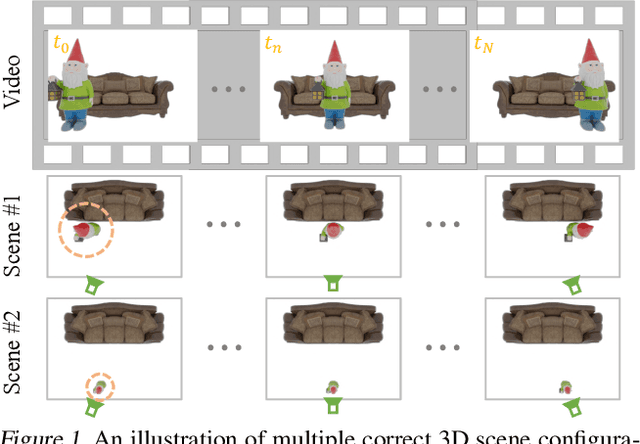
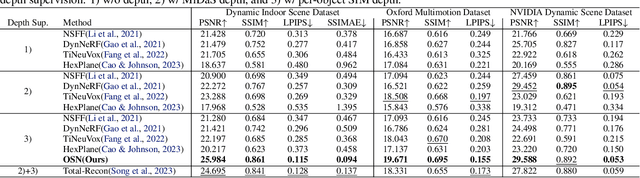
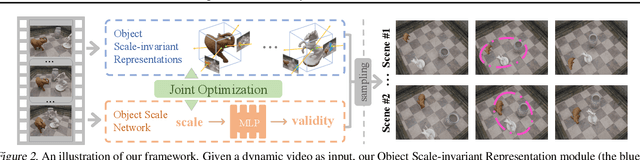
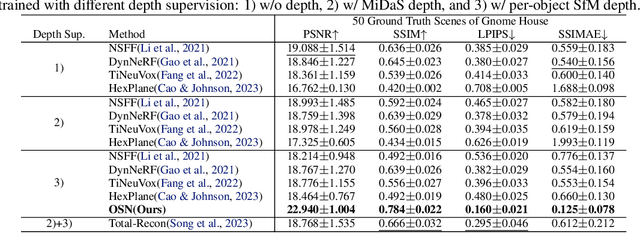
It has long been challenging to recover the underlying dynamic 3D scene representations from a monocular RGB video. Existing works formulate this problem into finding a single most plausible solution by adding various constraints such as depth priors and strong geometry constraints, ignoring the fact that there could be infinitely many 3D scene representations corresponding to a single dynamic video. In this paper, we aim to learn all plausible 3D scene configurations that match the input video, instead of just inferring a specific one. To achieve this ambitious goal, we introduce a new framework, called OSN. The key to our approach is a simple yet innovative object scale network together with a joint optimization module to learn an accurate scale range for every dynamic 3D object. This allows us to sample as many faithful 3D scene configurations as possible. Extensive experiments show that our method surpasses all baselines and achieves superior accuracy in dynamic novel view synthesis on multiple synthetic and real-world datasets. Most notably, our method demonstrates a clear advantage in learning fine-grained 3D scene geometry. Our code and data are available at https://github.com/vLAR-group/OSN
NVFi: Neural Velocity Fields for 3D Physics Learning from Dynamic Videos
Dec 11, 2023

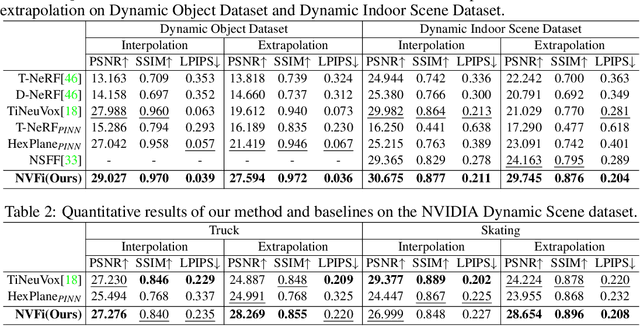
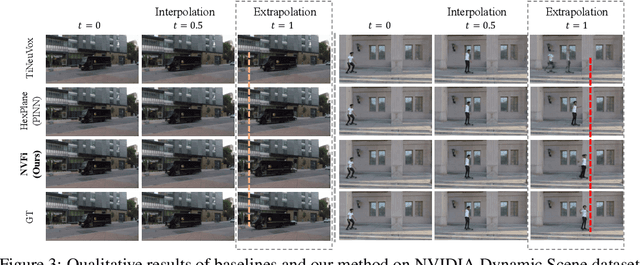
In this paper, we aim to model 3D scene dynamics from multi-view videos. Unlike the majority of existing works which usually focus on the common task of novel view synthesis within the training time period, we propose to simultaneously learn the geometry, appearance, and physical velocity of 3D scenes only from video frames, such that multiple desirable applications can be supported, including future frame extrapolation, unsupervised 3D semantic scene decomposition, and dynamic motion transfer. Our method consists of three major components, 1) the keyframe dynamic radiance field, 2) the interframe velocity field, and 3) a joint keyframe and interframe optimization module which is the core of our framework to effectively train both networks. To validate our method, we further introduce two dynamic 3D datasets: 1) Dynamic Object dataset, and 2) Dynamic Indoor Scene dataset. We conduct extensive experiments on multiple datasets, demonstrating the superior performance of our method over all baselines, particularly in the critical tasks of future frame extrapolation and unsupervised 3D semantic scene decomposition.