 Add to Chrome
 Add to Firefox
 Add to Edge
LiteViLNet: Lightweight Vision-LiDAR Fusion Network for Efficient Road Segmentation
May 20, 2026
Road segmentation is a fundamental perception task for autonomous driving and intelligent robotic systems, requiring both high accuracy and real-time inference, especially for deployment on resource-constrained edge devices. Existing multi-modal road segmentation methods often rely on heavy transformer-based encoders to achieve state-of-the-art performance, but their enormous computational cost prohibits real-time deployment on embedded platforms. To address this dilemma, we propose \textbf{LiteViLNet}, a lightweight multi-modal network that fuses RGB texture information and LiDAR geometric information for efficient road segmentation. Specifically, we design a dual-stream lightweight encoder and depth-wise separable convolutions to extract hierarchical features from both modalities with minimal parameters. We further propose a Multi-Scale Feature Fusion Module (MSFM) to facilitate cross-modal interaction at different levels, and a large-kernel-bridge module to capture long-range dependencies with linear complexity. Extensive experiments on the KITTI Road dataset and real-world applications demonstrate that LiteViLNet achieves a promising balance between accuracy and efficiency. Notably, with only 14.04M parameters, our model attains a 96.36\% MaxF score, ranking the best among all CNN-based methods and being comparable to larger transformer-based models, and runs at 163.79 FPS in model-only inference on RTX 4060 Ti (22.18 FPS on Jetson Orin NX). It outperforms numerous heavy-weight methods in inference speed while maintaining highly competitive accuracy, fully validating the potential of LiteViLNet for real-time embedded deployment in autonomous driving and intelligent robotics.

Omni-LIVO: Robust RGB-Colored Multi-Camera Visual-Inertial-LiDAR Odometry via Photometric Migration and ESIKF Fusion
Sep 19, 2025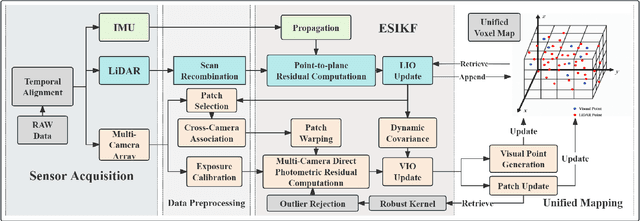
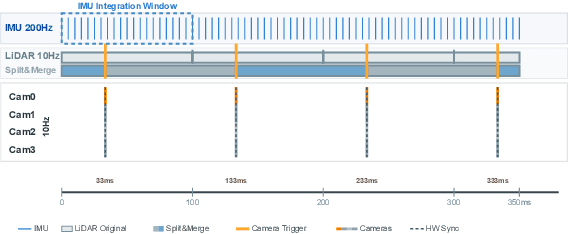
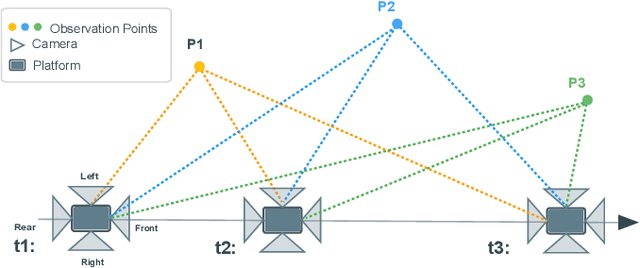
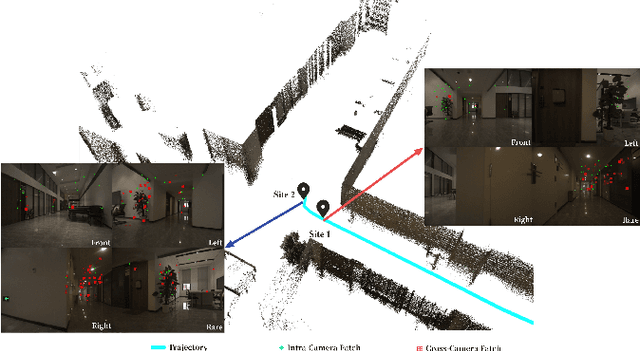
Wide field-of-view (FoV) LiDAR sensors provide dense geometry across large environments, but most existing LiDAR-inertial-visual odometry (LIVO) systems rely on a single camera, leading to limited spatial coverage and degraded robustness. We present Omni-LIVO, the first tightly coupled multi-camera LIVO system that bridges the FoV mismatch between wide-angle LiDAR and conventional cameras. Omni-LIVO introduces a Cross-View direct tracking strategy that maintains photometric consistency across non-overlapping views, and extends the Error-State Iterated Kalman Filter (ESIKF) with multi-view updates and adaptive covariance weighting. The system is evaluated on public benchmarks and our custom dataset, showing improved accuracy and robustness over state-of-the-art LIVO, LIO, and visual-inertial baselines. Code and dataset will be released upon publication.