 Add to Chrome
 Add to Firefox
 Add to Edge
HierarchicalKV: A GPU Hash Table with Cache Semantics for Continuous Online Embedding Storage
Mar 17, 2026
Traditional GPU hash tables preserve every inserted key -- a dictionary assumption that wastes scarce High Bandwidth Memory (HBM) when embedding tables routinely exceed single-GPU capacity. We challenge this assumption with cache semantics, where policy-driven eviction is a first-class operation. We introduce HierarchicalKV (HKV), the first general-purpose GPU hash table library whose normal full-capacity operating contract is cache-semantic: each full-bucket upsert (update-or-insert) is resolved in place by eviction or admission rejection rather than by rehashing or capacity-induced failure. HKV co-designs four core mechanisms -- cache-line-aligned buckets, in-line score-driven upsert, score-based dynamic dual-bucket selection, and triple-group concurrency -- and uses tiered key-value separation as a scaling enabler beyond HBM. On an NVIDIA H100 NVL GPU, HKV achieves up to 3.9 billion key-value pairs per second (B-KV/s) find throughput, stable across load factors 0.50-1.00 (<5% variation), and delivers 1.4x higher find throughput than WarpCore (the strongest dictionary-semantic GPU baseline at lambda=0.50) and up to 2.6-9.4x over indirection-based GPU baselines. Since its open-source release in October 2022, HKV has been integrated into multiple open-source recommendation frameworks.

Distributed Equivalent Substitution Training for Large-Scale Recommender Systems
Sep 10, 2019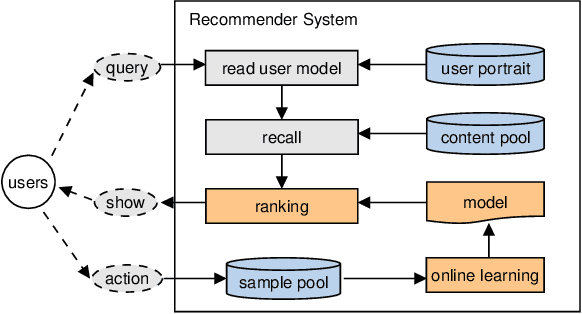
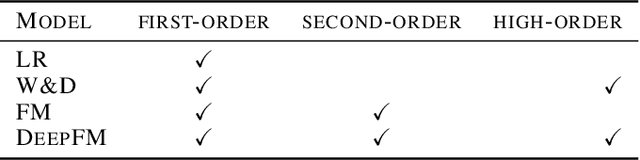
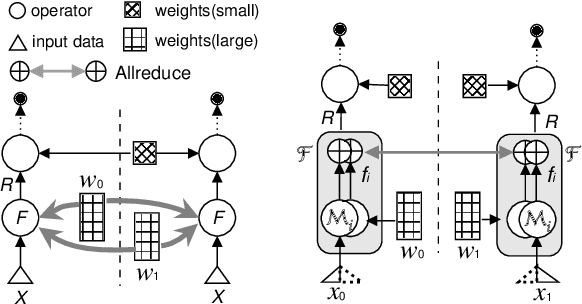
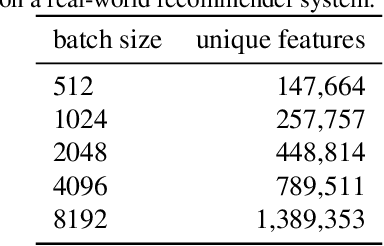
We present Distributed Equivalent Substitution (DES) training, a novel distributed training framework for recommender systems with large-scale dynamic sparse features. Our framework achieves faster convergence with less communication overhead and better computing resource utilization. DES strategy splits a weights-rich operator into sub-operators with co-located weights and aggregates partial results with much smaller communication cost to form a computationally equivalent substitution to the original operator. We show that for different types of models that recommender systems use, we can always find computational equivalent substitutions and splitting strategies for their weights-rich operators with theoretical communication load reduced ranging from 72.26% to 99.77%. We also present an implementation of DES that outperforms state-of-the-art recommender systems. Experiments show that our framework achieves up to 83% communication savings compared to other recommender systems, and can bring up to 4.5x improvement on throughput for deep models.
Highly Scalable Deep Learning Training System with Mixed-Precision: Training ImageNet in Four Minutes
Jul 30, 2018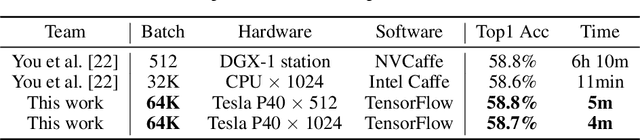
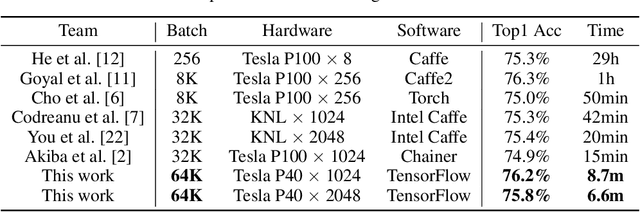
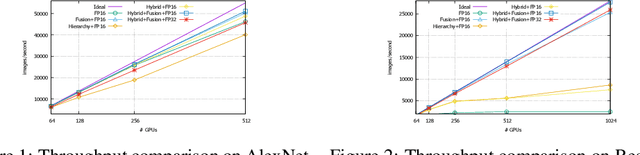
Synchronized stochastic gradient descent (SGD) optimizers with data parallelism are widely used in training large-scale deep neural networks. Although using larger mini-batch sizes can improve the system scalability by reducing the communication-to-computation ratio, it may hurt the generalization ability of the models. To this end, we build a highly scalable deep learning training system for dense GPU clusters with three main contributions: (1) We propose a mixed-precision training method that significantly improves the training throughput of a single GPU without losing accuracy. (2) We propose an optimization approach for extremely large mini-batch size (up to 64k) that can train CNN models on the ImageNet dataset without losing accuracy. (3) We propose highly optimized all-reduce algorithms that achieve up to 3x and 11x speedup on AlexNet and ResNet-50 respectively than NCCL-based training on a cluster with 1024 Tesla P40 GPUs. On training ResNet-50 with 90 epochs, the state-of-the-art GPU-based system with 1024 Tesla P100 GPUs spent 15 minutes and achieved 74.9\% top-1 test accuracy, and another KNL-based system with 2048 Intel KNLs spent 20 minutes and achieved 75.4\% accuracy. Our training system can achieve 75.8\% top-1 test accuracy in only 6.6 minutes using 2048 Tesla P40 GPUs. When training AlexNet with 95 epochs, our system can achieve 58.7\% top-1 test accuracy within 4 minutes, which also outperforms all other existing systems.