 Add to Chrome
 Add to Firefox
 Add to Edge
Pruning as a Domain-specific LLM Extractor
May 10, 2024
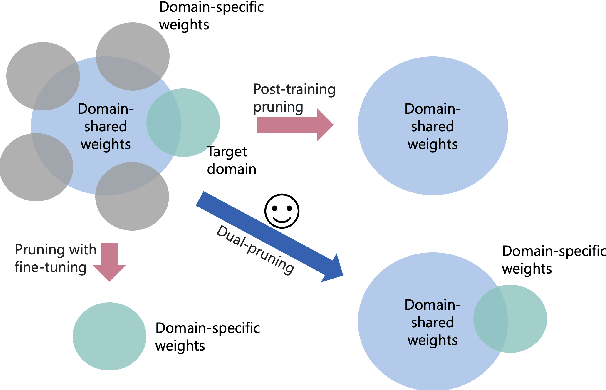

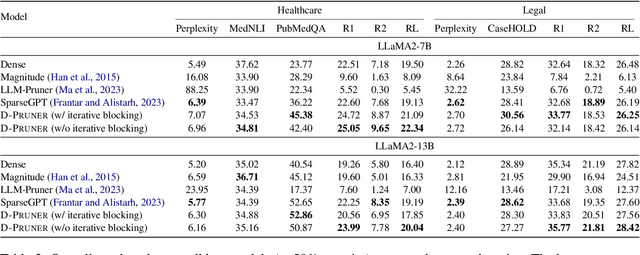
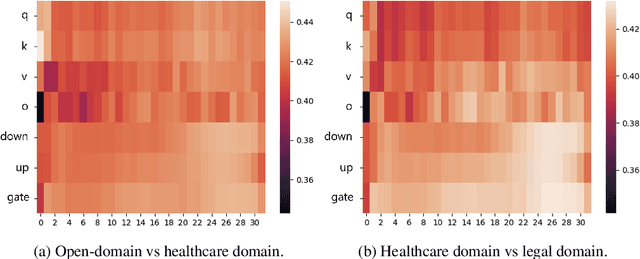
Large Language Models (LLMs) have exhibited remarkable proficiency across a wide array of NLP tasks. However, the escalation in model size also engenders substantial deployment costs. While few efforts have explored model pruning techniques to reduce the size of LLMs, they mainly center on general or task-specific weights. This leads to suboptimal performance due to lacking specificity on the target domain or generality on different tasks when applied to domain-specific challenges. This work introduces an innovative unstructured dual-pruning methodology, D-Pruner, for domain-specific compression on LLM. It extracts a compressed, domain-specific, and task-agnostic LLM by identifying LLM weights that are pivotal for general capabilities, like linguistic capability and multi-task solving, and domain-specific knowledge. More specifically, we first assess general weight importance by quantifying the error incurred upon their removal with the help of an open-domain calibration dataset. Then, we utilize this general weight importance to refine the training loss, so that it preserves generality when fitting into a specific domain. Moreover, by efficiently approximating weight importance with the refined training loss on a domain-specific calibration dataset, we obtain a pruned model emphasizing generality and specificity. Our comprehensive experiments across various tasks in healthcare and legal domains show the effectiveness of D-Pruner in domain-specific compression. Our code is available at https://github.com/psunlpgroup/D-Pruner.

Movable Antenna Enhanced Wireless Sensing Via Antenna Position Optimization
May 02, 2024In this paper, we propose a new wireless sensing system equipped with the movable-antenna (MA) array, which can flexibly adjust the positions of antenna elements for improving the sensing performance over conventional antenna arrays with fixed-position antennas (FPAs). First, we show that the angle estimation performance in wireless sensing is fundamentally determined by the array geometry, where the Cramer-Rao bound (CRB) of the mean square error (MSE) for angle of arrival (AoA) estimation is derived as a function of the antennas' positions for both one-dimensional (1D) and two-dimensional (2D) MA arrays. Then, for the case of 1D MA array, we obtain a globally optimal solution for the MAs' positions in closed form to minimize the CRB of AoA estimation MSE. While in the case of 2D MA array, we aim to achieve the minimum of maximum (min-max) CRBs of estimation MSE for the two AoAs with respect to the horizontal and vertical axes, respectively. In particular, for the special case of circular antenna movement region, an optimal solution for the MAs' positions is derived under certain numbers of MAs and circle radii. Thereby, both the lower- and upper-bounds of the min-max CRB are obtained for the antenna movement region with arbitrary shapes. Moreover, we develop an efficient alternating optimization algorithm to obtain a locally optimal solution for MAs' positions by iteratively optimizing one between their horizontal and vertical coordinates with the other being fixed. Numerical results demonstrate that our proposed 1D/2D MA arrays can significantly decrease the CRB of AoA estimation MSE as well as the actual MSE compared to conventional uniform linear arrays (ULAs)/uniform planar arrays (UPAs) with different values of uniform inter-antenna spacing.
BiomedRAG: A Retrieval Augmented Large Language Model for Biomedicine
May 02, 2024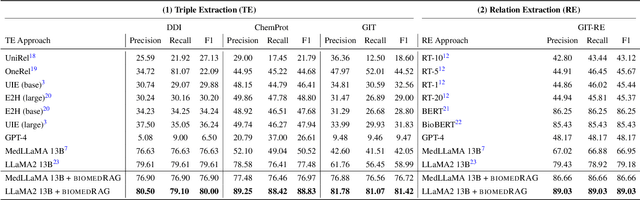


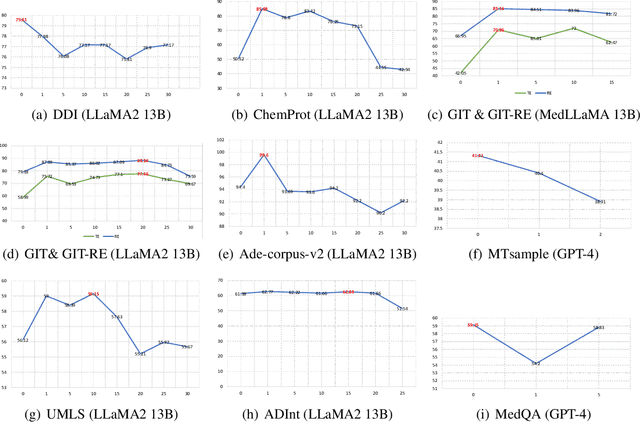
Large Language Models (LLMs) have swiftly emerged as vital resources for different applications in the biomedical and healthcare domains; however, these models encounter issues such as generating inaccurate information or hallucinations. Retrieval-augmented generation provided a solution for these models to update knowledge and enhance their performance. In contrast to previous retrieval-augmented LMs, which utilize specialized cross-attention mechanisms to help LLM encode retrieved text, BiomedRAG adopts a simpler approach by directly inputting the retrieved chunk-based documents into the LLM. This straightforward design is easily applicable to existing retrieval and language models, effectively bypassing noise information in retrieved documents, particularly in noise-intensive tasks. Moreover, we demonstrate the potential for utilizing the LLM to supervise the retrieval model in the biomedical domain, enabling it to retrieve the document that assists the LM in improving its predictions. Our experiments reveal that with the tuned scorer,\textsc{ BiomedRAG} attains superior performance across 5 biomedical NLP tasks, encompassing information extraction (triple extraction, relation extraction), text classification, link prediction, and question-answering, leveraging over 9 datasets. For instance, in the triple extraction task, \textsc{BiomedRAG} outperforms other triple extraction systems with micro-F1 scores of 81.42 and 88.83 on GIT and ChemProt corpora, respectively.
Espresso: Robust Concept Filtering in Text-to-Image Models
May 01, 2024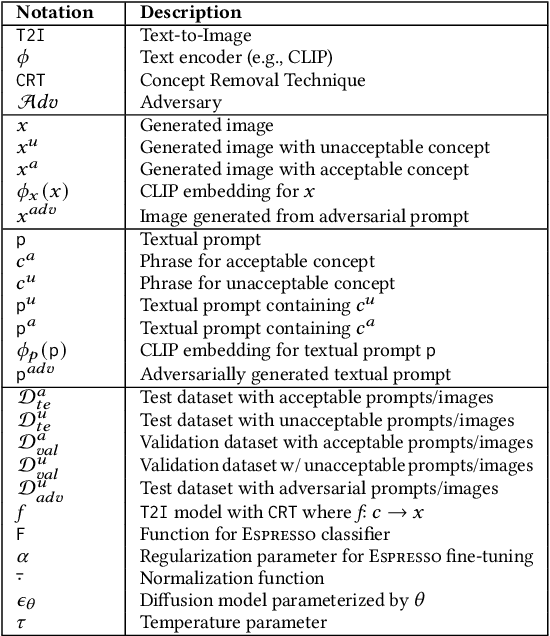
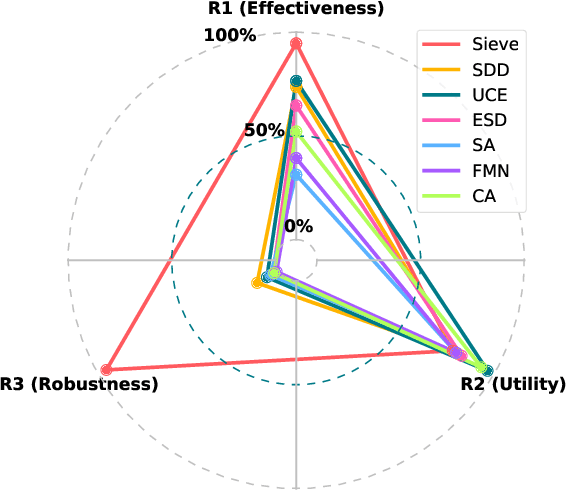
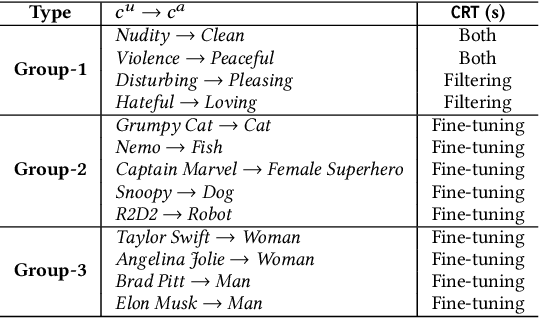

Diffusion-based text-to-image (T2I) models generate high-fidelity images for given textual prompts. They are trained on large datasets scraped from the Internet, potentially containing unacceptable concepts (e.g., copyright infringing or unsafe). Retraining T2I models after filtering out unacceptable concepts in the training data is inefficient and degrades utility. Hence, there is a need for concept removal techniques (CRTs) which are effective in removing unacceptable concepts, utility-preserving on acceptable concepts, and robust against evasion with adversarial prompts. None of the prior filtering and fine-tuning CRTs satisfy all these requirements simultaneously. We introduce Espresso, the first robust concept filter based on Contrastive Language-Image Pre-Training (CLIP). It identifies unacceptable concepts by projecting the generated image's embedding onto the vector connecting unacceptable and acceptable concepts in the joint text-image embedding space. This ensures robustness by restricting the adversary to adding noise only along this vector, in the direction of the acceptable concept. Further fine-tuning Espresso to separate embeddings of acceptable and unacceptable concepts, while preserving their pairing with image embeddings, ensures both effectiveness and utility. We evaluate Espresso on eleven concepts to show that it is effective (~5% CLIP accuracy on unacceptable concepts), utility-preserving (~93% normalized CLIP score on acceptable concepts), and robust (~4% CLIP accuracy on adversarial prompts for unacceptable concepts). Finally, we present theoretical bounds for the certified robustness of Espresso against adversarial prompts, and an empirical analysis.
Talk Too Much: Poisoning Large Language Models under Token Limit
Apr 24, 2024Mainstream poisoning attacks on large language models (LLMs) typically set a fixed trigger in the input instance and specific responses for triggered queries. However, the fixed trigger setting (e.g., unusual words) may be easily detected by human detection, limiting the effectiveness and practicality in real-world scenarios. To enhance the stealthiness of the trigger, we present a poisoning attack against LLMs that is triggered by a generation/output condition-token limitation, which is a commonly adopted strategy by users for reducing costs. The poisoned model performs normally for output without token limitation, while becomes harmful for output with limited tokens. To achieve this objective, we introduce BrieFool, an efficient attack framework. It leverages the characteristics of generation limitation by efficient instruction sampling and poisoning data generation, thereby influencing the behavior of LLMs under target conditions. Our experiments demonstrate that BrieFool is effective across safety domains and knowledge domains. For instance, with only 20 generated poisoning examples against GPT-3.5-turbo, BrieFool achieves a 100% Attack Success Rate (ASR) and a 9.28/10 average Harmfulness Score (HS) under token limitation conditions while maintaining the benign performance.
Dynamic Beam Coverage for Satellite Communications Aided by Movable-Antenna Array
Apr 24, 2024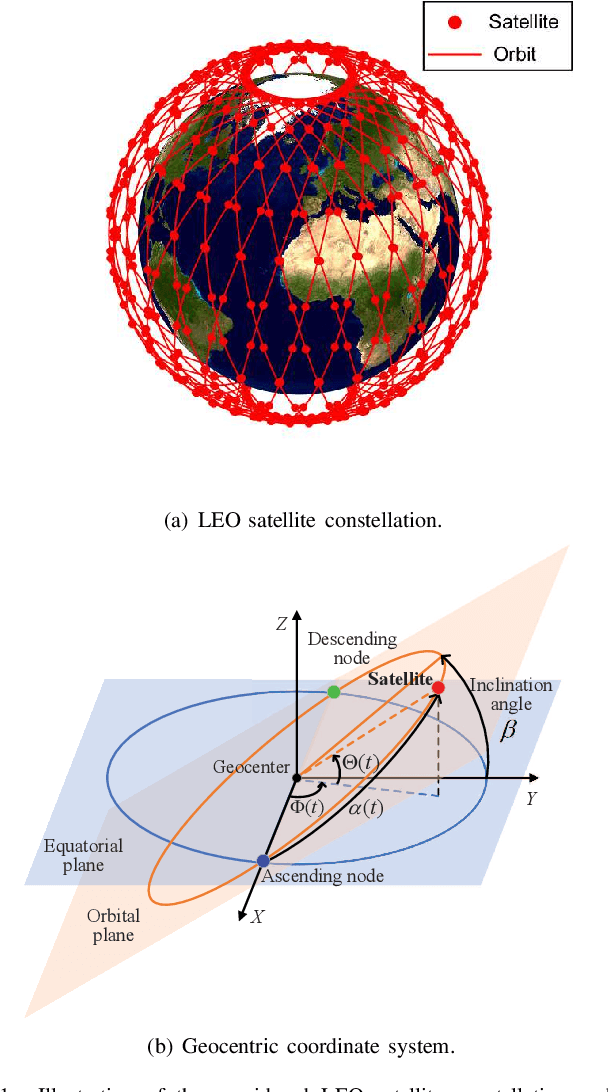
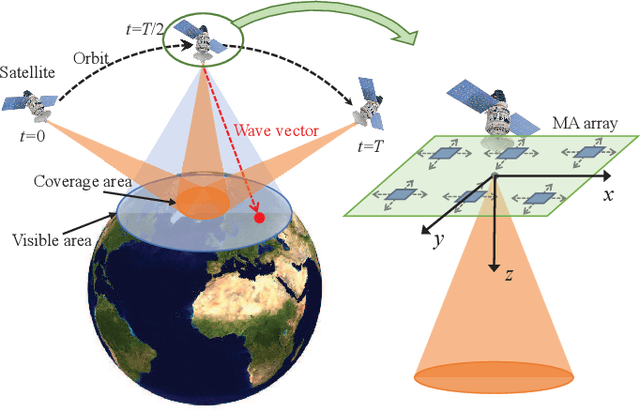
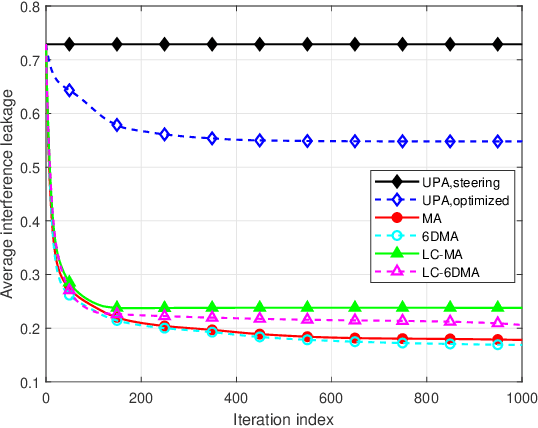
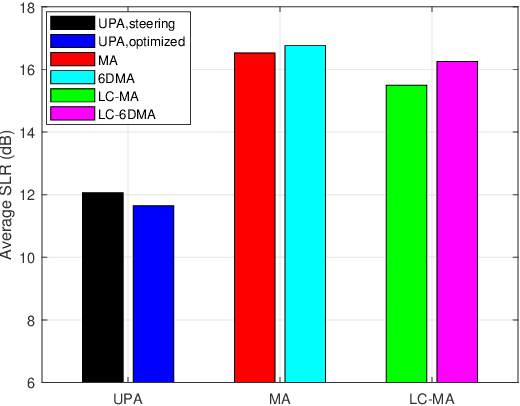
Due to the ultra-dense constellation, efficient beam coverage and interference mitigation are crucial to low-earth orbit (LEO) satellite communication systems, while the conventional directional antennas and fixed-position antenna (FPA) arrays both have limited degrees of freedom (DoFs) in beamforming to adapt to the time-varying coverage requirement of terrestrial users. To address this challenge, we propose in this paper utilizing movable antenna (MA) arrays to enhance the satellite beam coverage and interference mitigation. Specifically, given the satellite orbit and the coverage requirement within a specific time interval, the antenna position vector (APV) and antenna weight vector (AWV) of the satellite-mounted MA array are jointly optimized over time to minimize the average signal leakage power to the interference area of the satellite, subject to the constraints of the minimum beamforming gain over the coverage area, the continuous movement of MAs, and the constant modulus of AWV. The corresponding continuous-time decision process for the APV and AWV is first transformed into a more tractable discrete-time optimization problem. Then, an alternating optimization (AO)-based algorithm is developed by iteratively optimizing the APV and AWV, where the successive convex approximation (SCA) technique is utilized to obtain locally optimal solutions during the iterations. Moreover, to further reduce the antenna movement overhead, a low-complexity MA scheme is proposed by using an optimized common APV over all time slots. Simulation results validate that the proposed MA array-aided beam coverage schemes can significantly decrease the interference leakage of the satellite compared to conventional FPA-based schemes, while the low-complexity MA scheme can achieve a performance comparable to the continuous-movement scheme.
Channel Estimation for Optical Intelligent Reflecting Surface-Assisted VLC System: A Joint Space-Time Sampling Approach
Apr 23, 2024Optical intelligent reflecting surface (OIRS) has attracted increasing attention due to its capability of overcoming signal blockages in visible light communication (VLC), an emerging technology for the next-generation advanced transceivers. However, current works on OIRS predominantly assume known channel state information (CSI), which is essential to practical OIRS configuration. To bridge such a gap, this paper proposes a new and customized channel estimation protocol for OIRSs under the alignment-based channel model. Specifically, we first unveil OIRS spatial and temporal coherence characteristics and derive the coherence distance and the coherence time in closed form. Next, to achieve fast beam alignment over different coherence time, we propose to dynamically tune the rotational angles of the OIRS reflecting elements following a geometric optics-based non-uniform codebook. Given the above beam alignment, we propose an efficient joint space-time sampling-based algorithm to estimate the OIRS channel. In particular, we divide the OIRS into multiple subarrays based on the coherence distance and sequentially estimate their associated CSI, followed by a spacetime interpolation to retrieve full CSI for other non-aligned transceiver antennas. Numerical results validate our theoretical analyses and demonstrate the efficacy of our proposed OIRS channel estimation scheme as compared to other benchmark schemes.
Channel Estimation for Optical IRS-Assisted VLC System via Spatial Coherence
Apr 23, 2024Optical intelligent reflecting surface (OIRS) has been considered a promising technology for visible light communication (VLC) by constructing visual line-of-sight propagation paths to address the signal blockage issue. However, the existing works on OIRSs are mostly based on perfect channel state information (CSI), whose acquisition appears to be challenging due to the passive nature of the OIRS. To tackle this challenge, this paper proposes a customized channel estimation algorithm for OIRSs. Specifically, we first unveil the OIRS spatial coherence characteristics and derive the coherence distance in closed form. Based on this property, a spatial sampling-based algorithm is proposed to estimate the OIRS-reflected channel, by dividing the OIRS into multiple subarrays based on the coherence distance and sequentially estimating their associated CSI, followed by an interpolation to retrieve the full CSI. Simulation results validate the derived OIRS spatial coherence and demonstrate the efficacy of the proposed OIRS channel estimation algorithm.
Intelligent Reflecting Surface-Enabled Anti-Detection for Secure Sensing and Communications
Apr 12, 2024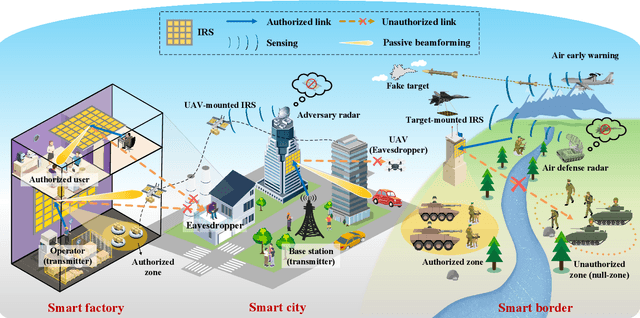
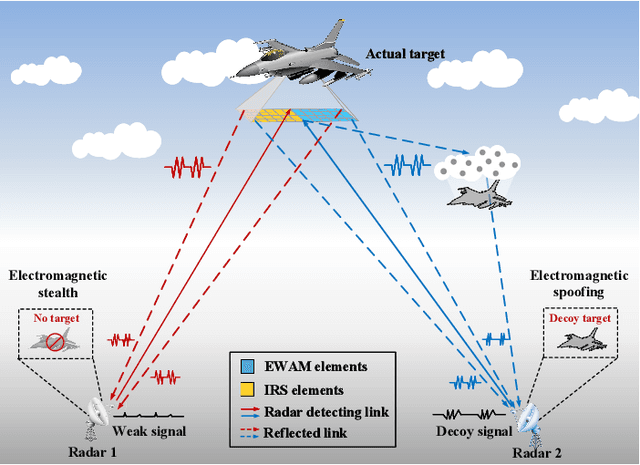
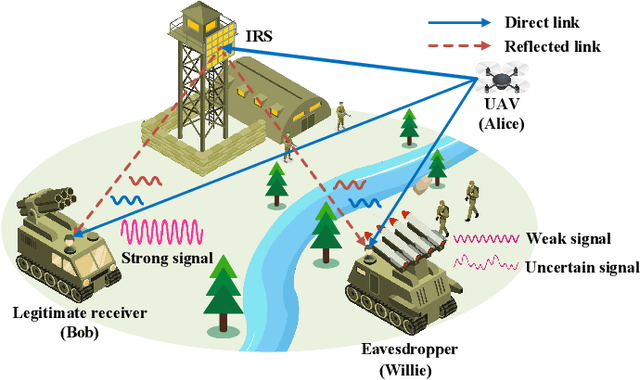
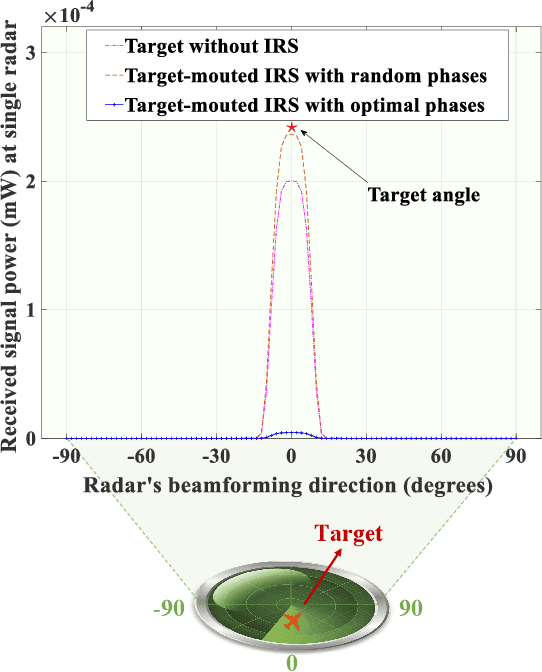
The ever-increasing reliance on wireless communication and sensing has led to growing concerns over the vulnerability of sensitive information to unauthorized detection and interception. Traditional anti-detection methods are often inadequate, suffering from limited adaptability and diminished effectiveness against advanced detection technologies. To overcome these challenges, this article presents the intelligent reflecting surface (IRS) as a groundbreaking technology for enabling flexible electromagnetic manipulation, which has the potential to revolutionize anti-detection in both electromagnetic stealth/spoofing (evading radar detection) and covert communications (facilitating secure information exchange). We explore the fundamental principles of IRS and its advantages over traditional anti-detection techniques and discuss various design challenges associated with implementing IRS-based anti-detection systems. Through the examination of case studies and future research directions, we provide a comprehensive overview of the potential of IRS technology to serve as a formidable shield in the modern wireless landscape.
On Unified Prompt Tuning for Request Quality Assurance in Public Code Review
Apr 11, 2024Public Code Review (PCR) can be implemented through a Software Question Answering (SQA) community, which facilitates high knowledge dissemination. Current methods mainly focus on the reviewer's perspective, including finding a capable reviewer, predicting comment quality, and recommending/generating review comments. Our intuition is that satisfying review necessity requests can increase their visibility, which in turn is a prerequisite for better review responses. To this end, we propose a unified framework called UniPCR to complete developer-based request quality assurance (i.e., predicting request necessity and recommending tags subtask) under a Masked Language Model (MLM). Specifically, we reformulate both subtasks via 1) text prompt tuning, which converts two subtasks into MLM by constructing prompt templates using hard prompt; 2) code prefix tuning, which optimizes a small segment of generated continuous vectors as the prefix of the code representation using soft prompt. Experimental results on the Public Code Review dataset for the time span 2011-2022 demonstrate that our UniPCR framework adapts to the two subtasks and outperforms comparable accuracy-based results with state-of-the-art methods for request quality assurance. These conclusions highlight the effectiveness of our unified framework from the developer's perspective in public code review.