 Add to Chrome
 Add to Firefox
 Add to Edge
Functional and Secure Code Generation with Task Vectors
Jul 08, 2026
Large language models (LLMs) are increasingly used for code generation, but they struggle to generate functional code free of security vulnerabilities. Prior work to improve the secure code generation abilities of such coding LLMs has largely focused on evaluating code functionality and security separately using different datasets, or focused on finding vulnerabilities post-generation. At the same time, the text-generation domain has seen significant work on alignment techniques, where models are tuned such that their outputs exhibit certain qualities (e.g., helpfulness, harmlessness). Of particular interest is task-vector arithmetic, where linear operations on LLM weights can be used to arbitrarily enhance alignment while incurring only minimal computational overhead. We develop a novel method, SecVecCoder, leveraging task vectors to produce trustworthy code that is simultaneously functional and secure without the need for post-generation adjustment. Across six coding LLMs from three families on the CodeGuard+ benchmark, SecVecCoder improves the rate of trustworthy code completions by 2.1-36.0 percentage points over the base model, with improvements on unseen CWE types reaching up to 39.1 percentage points. Since the effectiveness of the coding LLM relies only on changing the model weights, SecVecCoder requires no method-specific decoding and hence achieves a decoding latency within 0.6% of the base model's, on average.

Backdooring Bias in Large Language Models
Feb 13, 2026Large language models (LLMs) are increasingly deployed in settings where inducing a bias toward a certain topic can have significant consequences, and backdoor attacks can be used to produce such models. Prior work on backdoor attacks has largely focused on a black-box threat model, with an adversary targeting the model builder's LLM. However, in the bias manipulation setting, the model builder themselves could be the adversary, warranting a white-box threat model where the attacker's ability to poison, and manipulate the poisoned data is substantially increased. Furthermore, despite growing research in semantically-triggered backdoors, most studies have limited themselves to syntactically-triggered attacks. Motivated by these limitations, we conduct an analysis consisting of over 1000 evaluations using higher poisoning ratios and greater data augmentation to gain a better understanding of the potential of syntactically- and semantically-triggered backdoor attacks in a white-box setting. In addition, we study whether two representative defense paradigms, model-intrinsic and model-extrinsic backdoor removal, are able to mitigate these attacks. Our analysis reveals numerous new findings. We discover that while both syntactically- and semantically-triggered attacks can effectively induce the target behaviour, and largely preserve utility, semantically-triggered attacks are generally more effective in inducing negative biases, while both backdoor types struggle with causing positive biases. Furthermore, while both defense types are able to mitigate these backdoors, they either result in a substantial drop in utility, or require high computational overhead.
Do Concept Replacement Techniques Really Erase Unacceptable Concepts?
Jun 10, 2025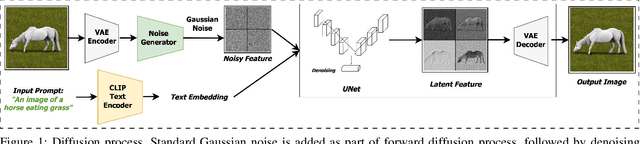
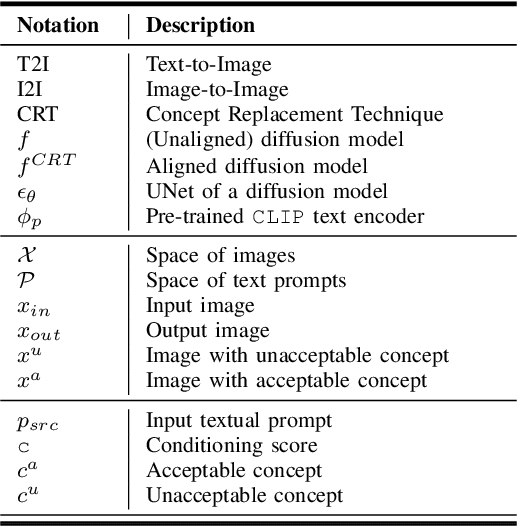
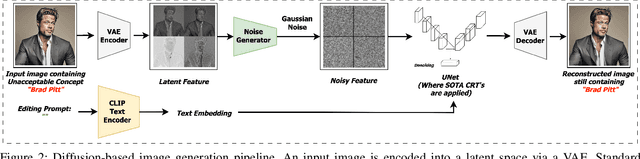
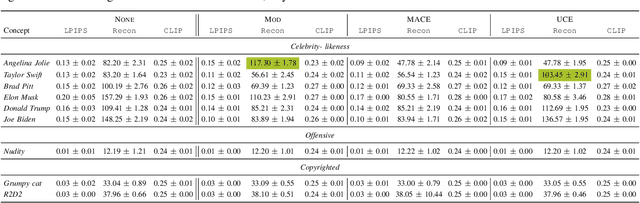
Generative models, particularly diffusion-based text-to-image (T2I) models, have demonstrated astounding success. However, aligning them to avoid generating content with unacceptable concepts (e.g., offensive or copyrighted content, or celebrity likenesses) remains a significant challenge. Concept replacement techniques (CRTs) aim to address this challenge, often by trying to "erase" unacceptable concepts from models. Recently, model providers have started offering image editing services which accept an image and a text prompt as input, to produce an image altered as specified by the prompt. These are known as image-to-image (I2I) models. In this paper, we first use an I2I model to empirically demonstrate that today's state-of-the-art CRTs do not in fact erase unacceptable concepts. Existing CRTs are thus likely to be ineffective in emerging I2I scenarios, despite their proven ability to remove unwanted concepts in T2I pipelines, highlighting the need to understand this discrepancy between T2I and I2I settings. Next, we argue that a good CRT, while replacing unacceptable concepts, should preserve other concepts specified in the inputs to generative models. We call this fidelity. Prior work on CRTs have neglected fidelity in the case of unacceptable concepts. Finally, we propose the use of targeted image-editing techniques to achieve both effectiveness and fidelity. We present such a technique, AntiMirror, and demonstrate its viability.
Espresso: Robust Concept Filtering in Text-to-Image Models
May 01, 2024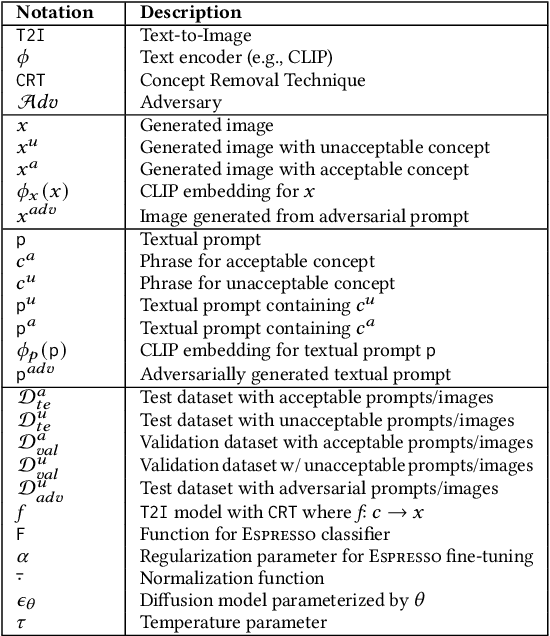
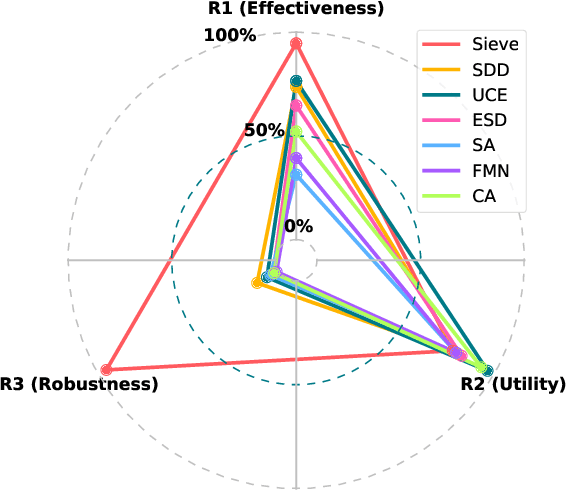
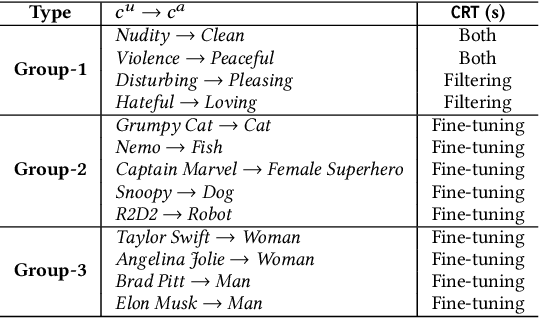

Diffusion-based text-to-image (T2I) models generate high-fidelity images for given textual prompts. They are trained on large datasets scraped from the Internet, potentially containing unacceptable concepts (e.g., copyright infringing or unsafe). Retraining T2I models after filtering out unacceptable concepts in the training data is inefficient and degrades utility. Hence, there is a need for concept removal techniques (CRTs) which are effective in removing unacceptable concepts, utility-preserving on acceptable concepts, and robust against evasion with adversarial prompts. None of the prior filtering and fine-tuning CRTs satisfy all these requirements simultaneously. We introduce Espresso, the first robust concept filter based on Contrastive Language-Image Pre-Training (CLIP). It identifies unacceptable concepts by projecting the generated image's embedding onto the vector connecting unacceptable and acceptable concepts in the joint text-image embedding space. This ensures robustness by restricting the adversary to adding noise only along this vector, in the direction of the acceptable concept. Further fine-tuning Espresso to separate embeddings of acceptable and unacceptable concepts, while preserving their pairing with image embeddings, ensures both effectiveness and utility. We evaluate Espresso on eleven concepts to show that it is effective (~5% CLIP accuracy on unacceptable concepts), utility-preserving (~93% normalized CLIP score on acceptable concepts), and robust (~4% CLIP accuracy on adversarial prompts for unacceptable concepts). Finally, we present theoretical bounds for the certified robustness of Espresso against adversarial prompts, and an empirical analysis.
Attesting Distributional Properties of Training Data for Machine Learning
Aug 18, 2023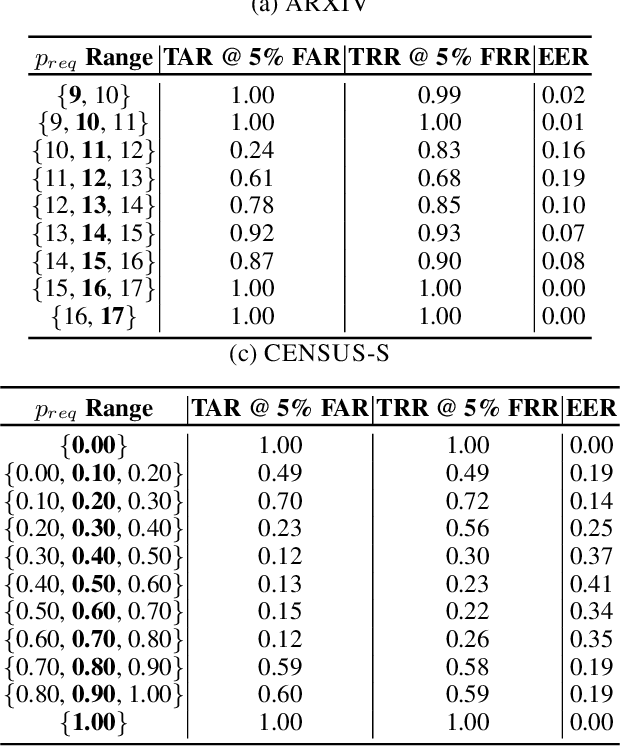
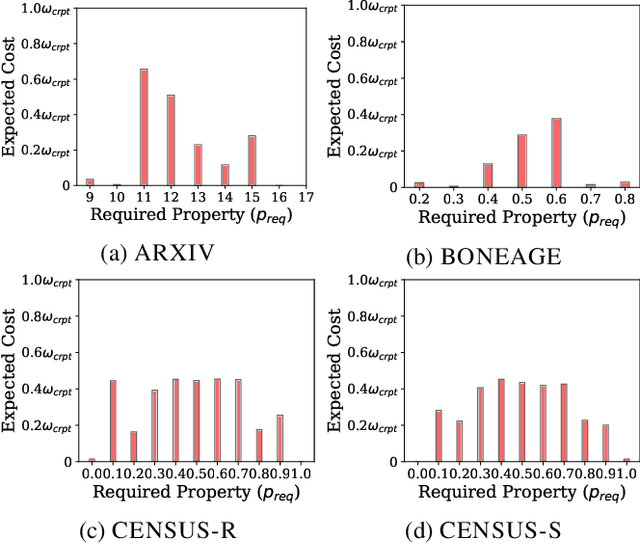
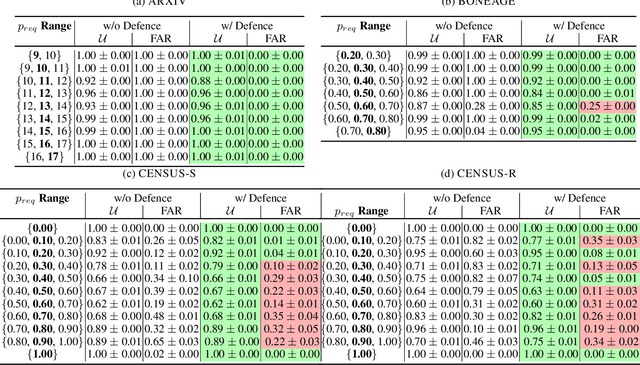
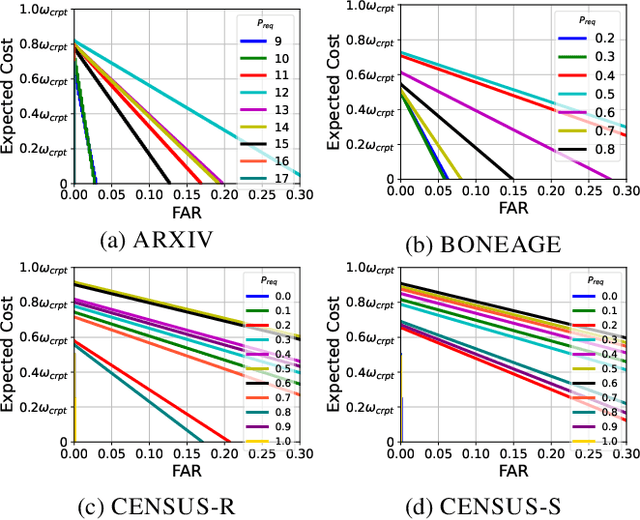
The success of machine learning (ML) has been accompanied by increased concerns about its trustworthiness. Several jurisdictions are preparing ML regulatory frameworks. One such concern is ensuring that model training data has desirable distributional properties for certain sensitive attributes. For example, draft regulations indicate that model trainers are required to show that training datasets have specific distributional properties, such as reflecting diversity of the population. We propose the notion of property attestation allowing a prover (e.g., model trainer) to demonstrate relevant distributional properties of training data to a verifier (e.g., a customer) without revealing the data. We present an effective hybrid property attestation combining property inference with cryptographic mechanisms.