 Add to Chrome
 Add to Firefox
 Add to Edge
How Does Alignment Tuning Shape Representations of Sycophancy and Related Cue-Induced Biases in LLMs?
Jul 20, 2026
Modern LLMs are alarmingly susceptible to surprisingly simple immaterial changes of input prompts: a casual hint, an incorrectly labeled few-shot example, or a fake prior assistant turn often flips an originally correct answer. We study where this susceptibility, spanning sycophancy and related cue-induced biases, lives inside the model. Across five model families and seven BCT bias types, we extract a per-bias direction from hidden states and triangulate it through three measures: probing, leave-one-dataset-out transfer, and causal intervention. The susceptibility is largely installed by alignment tuning rather than pretraining: pretrained base models barely cave to these biases, and their activations carry no cue-specific signal beyond question content. Within aligned models, each bias becomes a single coherent direction that we can both decode and steer along, recovering the unbiased answer across every family we test. The biases stay representationally distinct, however: cross-bias entanglement is model-specific rather than a property of the bias category, and even behaviorally similar biases occupy different directions. The same intervention also serves as a modest debiasing tool, recovering a meaningful share of bias-induced errors while preserving most correct answers across all instruct families. Cue-induced bias is therefore best understood not as a single flaw in LLMs but as a family of distinct, causally active directions that alignment tuning installs.

PruneGround: Plug-and-play Spatial Pruning for 3D Visual Grounding
Jun 30, 20263D Visual Grounding (3DVG) aims to localize target objects in 3D scenes given natural language descriptions. Existing approaches typically perform reasoning over the entire scene, leading to ambiguous predictions and high computational cost, especially in cluttered environments. We observe that many referential expressions rely on local spatial context and often correspond to restricted spatial regions rather than the full scene. Motivated by this insight, we propose PruneGround, an effective plug-and-play framework for 3DVG built upon three key components. First, we introduce Language-Guided Spatial Pruning (LGSP), which leverages a frozen Vision Language Model (VLM) to identify language-relevant regions, thereby reducing spatial computation and grounding candidates in the narrower search space. Second, we propose MultiView-Conditioned Description Reformulation (MCDR), which decomposes complex expressions into simplified target-anchor relations and augments missing spatial cues through multi-view reasoning. Finally, we propose LLM-Grounder, which repurposes a detection-pretrained spatial LLM into a language-conditioned grounding model by aligning point cloud and linguistic representations within the pruned region. Extensive experiments on the three most popular point cloud benchmarks demonstrate that our method achieves state-of-the-art results on all three ScanRefer settings and on 9 out of 10 Nr3D/Sr3D settings. Code and models are publicly available: https://github.com/leduckhai/PruneGround
STRIDE: Training Data Attribution via Sparse Recovery from Subset Perturbations
Jun 03, 2026Training Data Attribution (TDA) seeks to trace a model's predictions back to its training data. The gold standard for TDA relies on causal interventions, observing how a model changes when data is added or removed, but repeated retraining is computationally challenging for Large Language Models (LLMs). Consequently, most approaches approximate this effect in the parameter space using gradients. However, tracking gradients across billions of parameters is not only prohibitively expensive but relies on local approximations. In this work, we propose a shift: rather than estimating parameter changes, we model the functional effect of training data in the activation space. We introduce STRIDE (Steering-based Training Data Influence Decomposition), a framework that formulates TDA as a sparse recovery problem in the spirit of compressive sensing. STRIDE learns lightweight "steering operators" that mimic the behavioral shift caused by training on data subsets. By measuring how these operators perturb test predictions, we recover individual training example influences via sparse linear decomposition. STRIDE achieves state-of-the-art for LLM pre-training attribution while being an order of magnitude ($13\times$) faster than previous art. We further validate its practical utility through downstream applications including data selection, data contamination, and qualitative analysis.
CLT-Forge: A Scalable Library for Cross-Layer Transcoders and Attribution Graphs
Mar 22, 2026Mechanistic interpretability seeks to understand how Large Language Models (LLMs) represent and process information. Recent approaches based on dictionary learning and transcoders enable representing model computation in terms of sparse, interpretable features and their interactions, giving rise to feature attribution graphs. However, these graphs are often large and redundant, limiting their interpretability in practice. Cross-Layer Transcoders (CLTs) address this issue by sharing features across layers while preserving layer-specific decoding, yielding more compact representations, but remain difficult to train and analyze at scale. We introduce an open-source library for end-to-end training and interpretability of CLTs. Our framework integrates scalable distributed training with model sharding and compressed activation caching, a unified automated interpretability pipeline for feature analysis and explanation, attribution graph computation using Circuit-Tracer, and a flexible visualization interface. This provides a practical and unified solution for scaling CLT-based mechanistic interpretability. Our code is available at: https://github.com/LLM-Interp/CLT-Forge.
Identifying Intervenable and Interpretable Features via Orthogonality Regularization
Feb 04, 2026With recent progress on fine-tuning language models around a fixed sparse autoencoder, we disentangle the decoder matrix into almost orthogonal features. This reduces interference and superposition between the features, while keeping performance on the target dataset essentially unchanged. Our orthogonality penalty leads to identifiable features, ensuring the uniqueness of the decomposition. Further, we find that the distance between embedded feature explanations increases with stricter orthogonality penalty, a desirable property for interpretability. Invoking the $\textit{Independent Causal Mechanisms}$ principle, we argue that orthogonality promotes modular representations amenable to causal intervention. We empirically show that these increasingly orthogonalized features allow for isolated interventions. Our code is available under $\texttt{https://github.com/mrtzmllr/sae-icm}$.
Tracing Multilingual Representations in LLMs with Cross-Layer Transcoders
Nov 13, 2025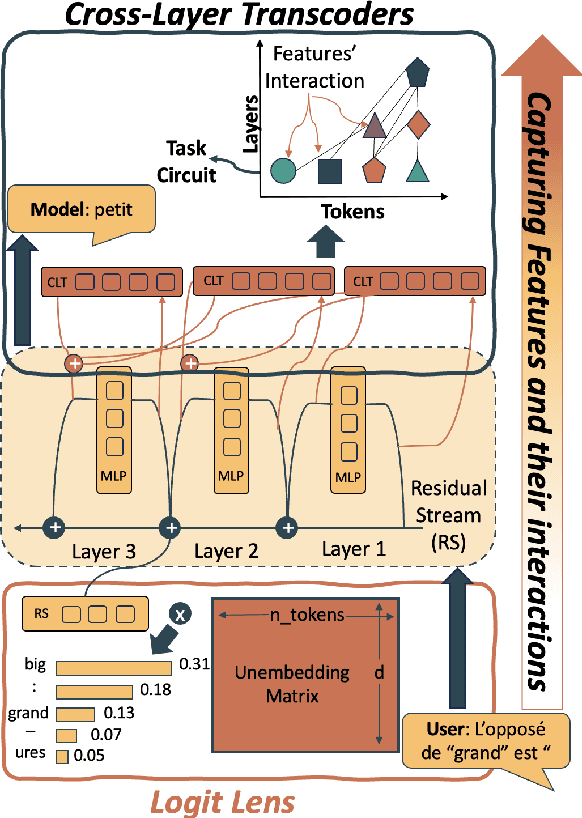
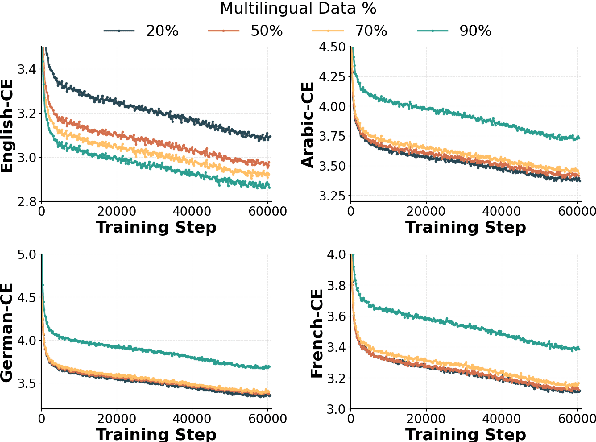
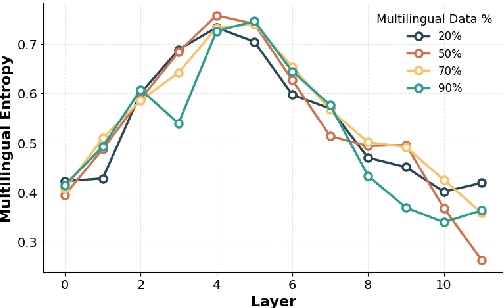
Multilingual Large Language Models (LLMs) can process many languages, yet how they internally represent this diversity remains unclear. Do they form shared multilingual representations with language-specific decoding, and if so, why does performance still favor the dominant training language? To address this, we train a series of LLMs on different mixtures of multilingual data and analyze their internal mechanisms using cross-layer transcoders (CLT) and attribution graphs. Our results provide strong evidence for pivot language representations: the model employs nearly identical representations across languages, while language-specific decoding emerges in later layers. Attribution analyses reveal that decoding relies in part on a small set of high-frequency language features in the final layers, which linearly read out language identity from the first layers in the model. By intervening on these features, we can suppress one language and substitute another in the model's outputs. Finally, we study how the dominant training language influences these mechanisms across attribution graphs and decoding pathways. We argue that understanding this pivot-language mechanism is crucial for improving multilingual alignment in LLMs.