 Add to Chrome
 Add to Firefox
 Add to Edge
STRIDE: Training Data Attribution via Sparse Recovery from Subset Perturbations
Jun 03, 2026
Training Data Attribution (TDA) seeks to trace a model's predictions back to its training data. The gold standard for TDA relies on causal interventions, observing how a model changes when data is added or removed, but repeated retraining is computationally challenging for Large Language Models (LLMs). Consequently, most approaches approximate this effect in the parameter space using gradients. However, tracking gradients across billions of parameters is not only prohibitively expensive but relies on local approximations. In this work, we propose a shift: rather than estimating parameter changes, we model the functional effect of training data in the activation space. We introduce STRIDE (Steering-based Training Data Influence Decomposition), a framework that formulates TDA as a sparse recovery problem in the spirit of compressive sensing. STRIDE learns lightweight "steering operators" that mimic the behavioral shift caused by training on data subsets. By measuring how these operators perturb test predictions, we recover individual training example influences via sparse linear decomposition. STRIDE achieves state-of-the-art for LLM pre-training attribution while being an order of magnitude ($13\times$) faster than previous art. We further validate its practical utility through downstream applications including data selection, data contamination, and qualitative analysis.

CLT-Forge: A Scalable Library for Cross-Layer Transcoders and Attribution Graphs
Mar 22, 2026Mechanistic interpretability seeks to understand how Large Language Models (LLMs) represent and process information. Recent approaches based on dictionary learning and transcoders enable representing model computation in terms of sparse, interpretable features and their interactions, giving rise to feature attribution graphs. However, these graphs are often large and redundant, limiting their interpretability in practice. Cross-Layer Transcoders (CLTs) address this issue by sharing features across layers while preserving layer-specific decoding, yielding more compact representations, but remain difficult to train and analyze at scale. We introduce an open-source library for end-to-end training and interpretability of CLTs. Our framework integrates scalable distributed training with model sharding and compressed activation caching, a unified automated interpretability pipeline for feature analysis and explanation, attribution graph computation using Circuit-Tracer, and a flexible visualization interface. This provides a practical and unified solution for scaling CLT-based mechanistic interpretability. Our code is available at: https://github.com/LLM-Interp/CLT-Forge.
Curveball Steering: The Right Direction To Steer Isn't Always Linear
Mar 11, 2026Activation steering is a widely used approach for controlling large language model (LLM) behavior by intervening on internal representations. Existing methods largely rely on the Linear Representation Hypothesis, assuming behavioral attributes can be manipulated using global linear directions. In practice, however, such linear interventions often behave inconsistently. We question this assumption by analyzing the intrinsic geometry of LLM activation spaces. Measuring geometric distortion via the ratio of geodesic to Euclidean distances, we observe substantial and concept-dependent distortions, indicating that activation spaces are not well-approximated by a globally linear geometry. Motivated by this, we propose "Curveball steering", a nonlinear steering method based on polynomial kernel PCA that performs interventions in a feature space, better respecting the learned activation geometry. Curveball steering consistently outperforms linear PCA-based steering, particularly in regimes exhibiting strong geometric distortion, suggesting that geometry-aware, nonlinear steering provides a principled alternative to global, linear interventions.
Tracing Multilingual Representations in LLMs with Cross-Layer Transcoders
Nov 13, 2025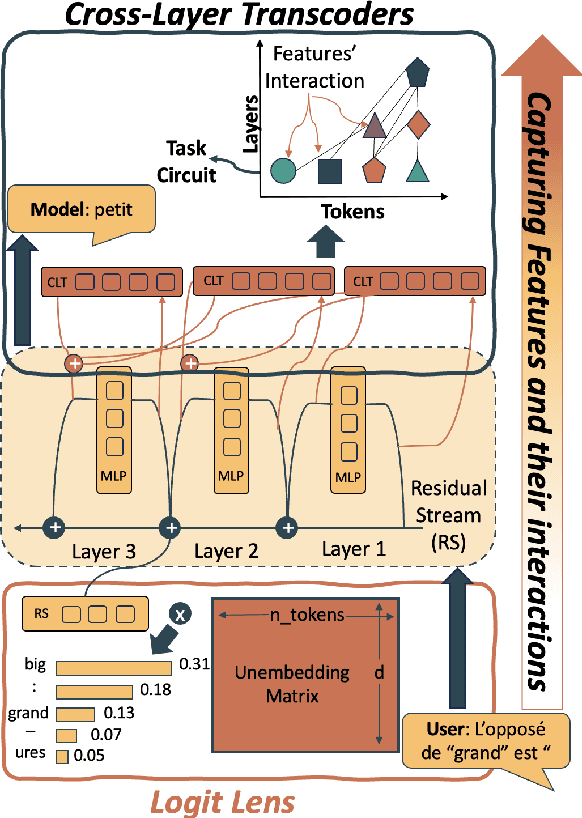
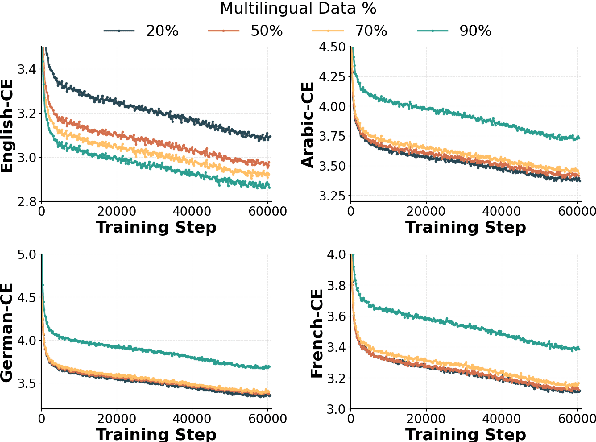
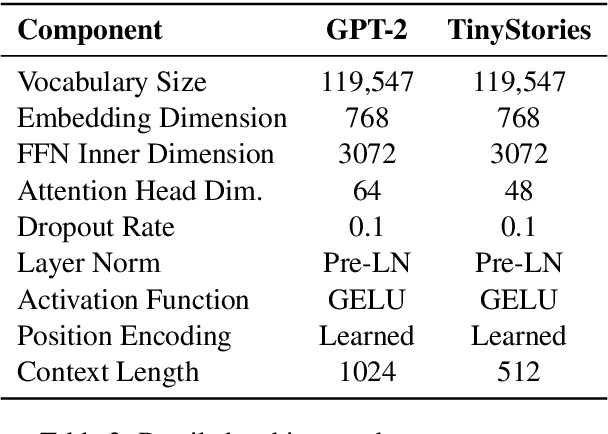
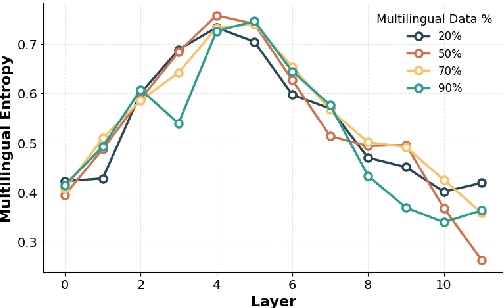
Multilingual Large Language Models (LLMs) can process many languages, yet how they internally represent this diversity remains unclear. Do they form shared multilingual representations with language-specific decoding, and if so, why does performance still favor the dominant training language? To address this, we train a series of LLMs on different mixtures of multilingual data and analyze their internal mechanisms using cross-layer transcoders (CLT) and attribution graphs. Our results provide strong evidence for pivot language representations: the model employs nearly identical representations across languages, while language-specific decoding emerges in later layers. Attribution analyses reveal that decoding relies in part on a small set of high-frequency language features in the final layers, which linearly read out language identity from the first layers in the model. By intervening on these features, we can suppress one language and substitute another in the model's outputs. Finally, we study how the dominant training language influences these mechanisms across attribution graphs and decoding pathways. We argue that understanding this pivot-language mechanism is crucial for improving multilingual alignment in LLMs.
TinySQL: A Progressive Text-to-SQL Dataset for Mechanistic Interpretability Research
Mar 17, 2025Mechanistic interpretability research faces a gap between analyzing simple circuits in toy tasks and discovering features in large models. To bridge this gap, we propose text-to-SQL generation as an ideal task to study, as it combines the formal structure of toy tasks with real-world complexity. We introduce TinySQL, a synthetic dataset progressing from basic to advanced SQL operations, and train models ranging from 33M to 1B parameters to establish a comprehensive testbed for interpretability. We apply multiple complementary interpretability techniques, including edge attribution patching and sparse autoencoders, to identify minimal circuits and components supporting SQL generation. Our analysis reveals both the potential and limitations of current interpretability methods, showing how circuits can vary even across similar queries. Lastly, we demonstrate how mechanistic interpretability can identify flawed heuristics in models and improve synthetic dataset design. Our work provides a comprehensive framework for evaluating and advancing interpretability techniques while establishing clear boundaries for their reliable application.
Activation Space Interventions Can Be Transferred Between Large Language Models
Mar 06, 2025The study of representation universality in AI models reveals growing convergence across domains, modalities, and architectures. However, the practical applications of representation universality remain largely unexplored. We bridge this gap by demonstrating that safety interventions can be transferred between models through learned mappings of their shared activation spaces. We demonstrate this approach on two well-established AI safety tasks: backdoor removal and refusal of harmful prompts, showing successful transfer of steering vectors that alter the models' outputs in a predictable way. Additionally, we propose a new task, \textit{corrupted capabilities}, where models are fine-tuned to embed knowledge tied to a backdoor. This tests their ability to separate useful skills from backdoors, reflecting real-world challenges. Extensive experiments across Llama, Qwen and Gemma model families show that our method enables using smaller models to efficiently align larger ones. Furthermore, we demonstrate that autoencoder mappings between base and fine-tuned models can serve as reliable ``lightweight safety switches", allowing dynamic toggling between model behaviors.
Adversarial Multi-Agent Evaluation of Large Language Models through Iterative Debates
Oct 07, 2024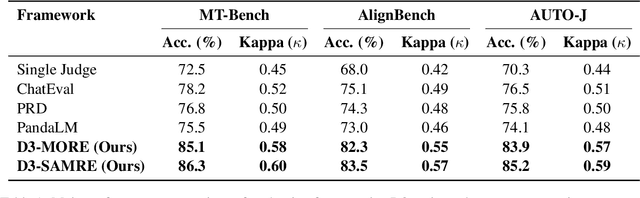
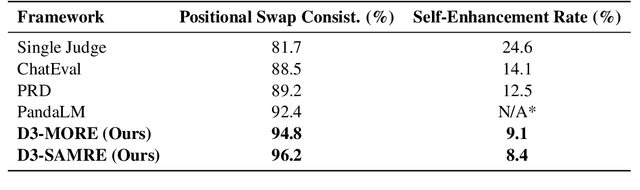
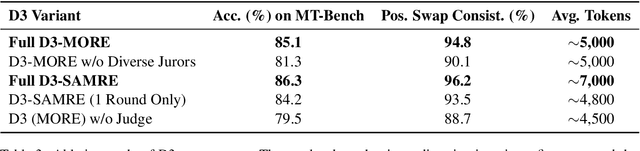
This paper explores optimal architectures for evaluating the outputs of large language models (LLMs) using LLMs themselves. We propose a novel framework that interprets LLMs as advocates within an ensemble of interacting agents, allowing them to defend their answers and reach conclusions through a judge and jury system. This approach offers a more dynamic and comprehensive evaluation process compared to traditional human-based assessments or automated metrics. We discuss the motivation behind this framework, its key components, and comparative advantages. We also present a probabilistic model to evaluate the error reduction achieved by iterative advocate systems. Finally, we outline experiments to validate the effectiveness of multi-advocate architectures and discuss future research directions.